Phone:
(701)814-6992
Physical address:
6296 Donnelly Plaza
Ratkeville, Bahamas.

Phone:
(701)814-6992
Physical address:
6296 Donnelly Plaza
Ratkeville, Bahamas.

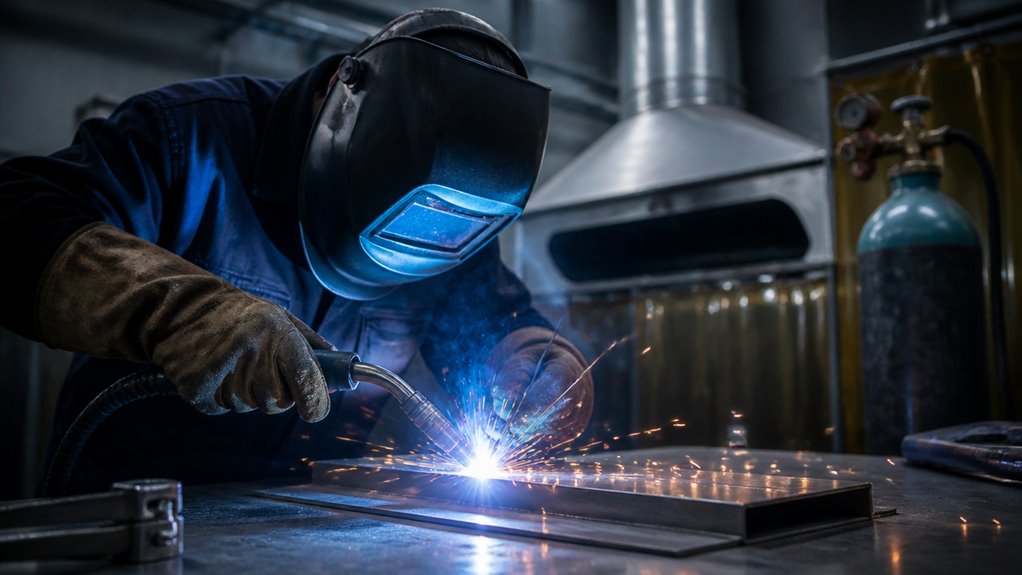
MIG welding, or gas metal arc welding, feeds a continuous wire electrode through a gun while shielding gas protects the weld pool.
You can produce welds quickly with less downtime, slag, and cleanup. Semi-automatic systems are relatively easy to operate.
However, you’ll need a power source, wire feeder, gas cylinder, and clean metal.
Wind can disrupt shielding, while poor settings risk burn-through or weak penetration.
The sections below explain when MIG’s productivity outweighs its limitations.
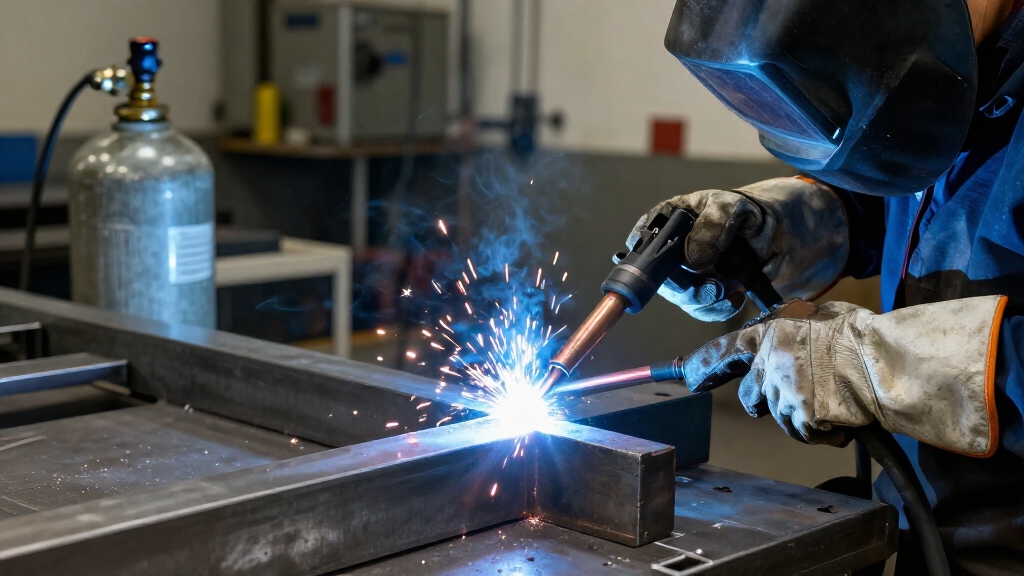
MIG welding, or metal inert gas welding, joins metal by feeding a continuous wire electrode through a welding gun into an electric arc.
MIG welding feeds a continuous wire electrode through a gun, where an electric arc melts it to join metal.
The wire acts as both electrode and filler metal, melting to form the joint. A shielding gas flows from the gun to protect the molten weld pool from atmospheric contamination.
You’ll often hear this process called gas metal arc welding, or GMAW, its technical name. In standard MIG welding, you select a wire and gas suited to the base metal and application.
The equipment typically includes a power source, wire feeder, welding gun, gas supply, and work clamp. You can use the process manually, semi-automatically, or with automated equipment.
Its defining features are continuous wire delivery and external gas shielding, which distinguish it from flux-cored welding. The shielding gas in MIG welding is typically an inert gas such as argon or helium.
MIG welding, or Metal Inert Gas welding, is pretty fascinating! You start by feeding a continuous wire electrode through the welding gun. This wire not only forms the arc but also supplies the filler metal needed for the weld.
Now, here’s where it gets interesting: as you’re welding, shielding gas flows through the gun. This gas plays a crucial role by protecting the molten weld pool from any atmospheric contamination. It’s like giving your weld a cozy blanket to keep it safe!
Because the wire feed and arc are controlled by the power source, MIG welding is a semi-automatic process.
As the arc melts the joint, a wire-feed mechanism continuously pushes filler wire from a spool through the welding gun and into the weld pool. You control feed speed to match current, wire diameter, and joint requirements.
A drive motor turns rollers, which grip and advance the wire. Tension must prevent slipping without deforming it. The contact tip transfers welding current to the moving wire, while the gun directs it toward the joint. Consistent wire feed speed helps maintain steady penetration and bead formation.
| Component | Function |
|---|---|
| Spool | Supplies continuous wire |
| Drive rollers | Advance wire at the set rate |
| Contact tip | Conducts current to the wire |
If feed speed is too low, the arc may burn back toward the tip. Excessive speed can cause stubbing. You’ll get stable transfer by coordinating feed rate, voltage, and travel speed.
To protect the molten weld pool from oxygen and nitrogen in the air, shielding gas flows through the gun nozzle and surrounds the arc. This barrier limits oxidation and contamination as the wire melts and the weld solidifies.
You’ll typically use argon, carbon dioxide, or a blend, selected to suit the metal, transfer mode, and desired bead characteristics. Gas composition affects arc stability, penetration, spatter, and weld appearance, so you must match it to the procedure.
Set the flow rate high enough to shield the pool, but avoid excessive flow, which can create turbulence and draw air into the arc. Because wind disperses the gas, outdoor welding can compromise protection.
You’ll also need a cylinder, regulator, hoses, and sound connections. Leaks or blocked nozzles can cause porosity and weaken the weld. For aluminum, pure argon is commonly used to provide inert shielding and a smooth arc.
Because MIG welding feeds wire continuously, you spend less time stopping to replace electrodes and more time making welds. This steady supply also helps you maintain a consistent arc and keep production moving.
Compared with processes that require frequent electrode changes, MIG welding can shorten cycle times and increase output.
Higher travel speed: You can complete suitable joints faster, reducing production time.
Greater deposition rate: You can place more filler metal into the joint per unit time, especially with appropriate settings and wire.
Automation potential: You can integrate MIG equipment with mechanized systems or robots for repeatable, sustained production.
These advantages make MIG welding productive in high-volume fabrication, where reduced downtime and predictable weld rates matter.
Actual output still depends on joint design, material thickness, setup, and operator control.
Excessive speed or unsuitable settings can compromise penetration and weld quality.
When you match parameters to the job, you can balance deposition, travel speed, and sound weld formation.
With Spray Arc Transfer, travel speeds can reach 90 cm/min on 10-mm plates.
MIG welding is relatively easy to learn because its continuous wire feed and straightforward arc ignition reduce the number of steps you need to manage.
You guide the gun along the joint while the machine feeds filler wire at a controlled rate. This setup removes the repeated electrode changes required in stick welding, so you can focus on travel speed, gun angle, and distance from the workpiece.
Semi-automatic operation also limits the coordination demands. You control the torch while the equipment maintains wire delivery.
Consistent arc starting helps you establish a stable bead with less practice. You’ll still need to select suitable voltage, wire-feed speed, and shielding-gas settings for the material and thickness.
With these variables matched, you can develop repeatable technique and produce sound welds more quickly. Testing your settings on scrap metal helps you fine-tune the wire-feed speed and voltage.
Since MIG welding uses no flux, it produces no slag, reducing the chipping and cleaning required after each weld. You’ll spend less time removing residue and more time moving work through your shop.
MIG welding produces no slag, reducing cleanup and helping you move work through the shop faster.
The process also produces minimal spatter when you set the machine correctly and maintain a stable arc. That means fewer particles to scrape or grind from the weld and nearby surfaces.
You can often skip slag chipping because no flux coating forms a solid byproduct. You’ll reduce grinding when low spatter leaves less material around the joint. You can shorten finishing time by cleaning the weld surface with less effort.
These savings don’t eliminate preparation; you still need to remove rust, paint, and dirt before welding. Clean surfaces support weld quality and help prevent rework, further reducing labor and cleanup costs. Regularly cleaning the contact tip and nozzle helps maintain consistent wire feeding and a stable arc.
Across a range of applications, you can use MIG welding to join mild steel, stainless steel, and aluminum, from light-gauge sheet to thick plate. Your results depend on selecting compatible filler wire, shielding gas, and settings for each material and thickness.
On thin sheet, control heat input to limit burn-through. On thick plate, use suitable joint preparation and parameters to achieve adequate penetration.
You can also weld in flat, horizontal, vertical, and overhead positions. However, control becomes more demanding as gravity affects the molten pool.
Adjust wire feed, voltage, travel speed, and technique to maintain a stable arc and sound bead.
Out-of-position work is possible, but joint access, material thickness, and operator skill influence quality. MIG’s material and position range makes it useful for fabrication, repair, and farm work. A continuous wire feed helps maintain consistent deposition throughout the weld.
The material range and production flexibility of MIG welding can lower costs when high weld rates and continuous wire feed reduce labor time and downtime.
You’ll gain the most when your work involves repeatable joints, steady production, or parts suited to mechanized welding.
Faster deposition places more filler metal in each joint per unit time, while fewer rod changes keep the arc running.
Robotic welding can achieve 60–80% arc-on time, improving productivity in high-volume production.
Consider these cost drivers:
Higher throughput: You can shorten cycle times and complete more parts per shift.
Lower labor demand: Semi-automatic or robotic setups reduce hands-on welding time.
Less finishing: Slag-free welds and low spatter can cut cleanup and grinding.
MIG’s consistent arc and accessible operation can also reduce training time and rework.
However, compare equipment, gas, and consumable costs with expected output.
Savings depend on suitable applications, settings, and production volume.
Wind and surface contamination can disrupt MIG shielding, allowing oxygen and moisture to reach the molten weld pool. When wind disperses shielding gas, you may see porosity, oxidation, or an unstable arc.
Wind can disperse MIG shielding gas, exposing the weld pool to oxygen and moisture and causing porosity, oxidation, or an unstable arc.
These defects weaken the joint and can require costly rework. Outdoor MIG welding is consequently limited unless you can protect the gas coverage from airflow.
Dirty metal creates a separate problem. Rust, paint, oil, and other residues can contaminate the arc and weld pool, causing porosity, inclusions, or inconsistent fusion.
You may also notice excess spatter and an irregular bead. Because MIG welding uses no flux to absorb contaminants, surface condition directly affects weld quality.
Inspect the joint before welding; contamination that remains can compromise the finished weld even when your arc appears stable. Keep consumables and base metals clean to reduce spatter and improve weld quality through proper surface preparation.
To prevent burn-through on thin metal and poor penetration on thick steel, match your MIG settings to the material’s thickness and joint design.
Control heat input by adjusting voltage, wire-feed speed, and travel speed; don’t rely on one setting alone.
Check the manufacturer’s chart, then test on scrap of comparable thickness before welding the workpiece.
On thin sheet, reduce voltage and wire-feed speed, move steadily, and use short welds to limit heat buildup.
On thick steel, increase heat and wire-feed speed as needed, prepare the joint with a suitable bevel, and confirm adequate root access.
Maintain a consistent contact-tip-to-work distance and torch angle.
Inconsistent technique can cause uneven fusion or excessive heat.
Inspect the weld bead and root where accessible.
If fusion remains inadequate, revise the joint preparation or settings rather than simply slowing down.
Although MIG welding can reduce labor time, its equipment adds upfront and operating costs. You’ll need a power source, wire feeder, gun, cables, and shielding-gas cylinder.
MIG welding can save labor time, but its equipment and operating costs require a substantial investment.
Suitable machines and accessories can require substantial initial investment.
Operating expenses include wire, gas, contact tips, liners, and electricity. Regular maintenance adds further cost.
That equipment also limits portability. A cylinder is heavy and bulky, and you must secure it and transport it separately.
The welder, feeder, cables, and gun add weight and setup time, making the system less convenient for remote repairs than compact processes.
You’ll also need to protect shielding gas from wind. Outdoor work may require screens or a sheltered location.
These costs and handling demands can outweigh labor savings for occasional jobs or mobile work.
Yes, MIG welding suits many home projects, especially repairs and fabrication involving mild steel, stainless steel, or aluminum.
You can learn its continuous-wire operation relatively quickly and produce clean welds with little finishing.
However, you’ll need shielding gas, suitable equipment, and a sheltered workspace because wind can disrupt gas coverage.
Clean rust, paint, and dirt first, and match settings to material thickness to prevent burn-through or inadequate penetration.
For MIG welding, you need a properly rated welding helmet with an appropriate shade, safety glasses underneath, and flame-resistant clothing that covers your skin.
Wear leather welding gloves and closed-toe, high-top leather boots to protect against heat, sparks, and spatter. Use hearing protection when noise levels warrant it.
Make sure there’s adequate ventilation; wear a suitable respirator if fumes remain hazardous after ventilation.
Keep a fire extinguisher nearby and remove flammable materials from your work area.
Yes, you can use MIG welding for automotive repairs. Think of it as a fast stitch that’s only as strong as the metal beneath it.
For example, a small patch on clean body steel can join quickly, but speed won’t compensate for poor fit-up.
Remove rust, paint, and contamination. Then match wire, shielding gas, and settings to the alloy and thickness.
On thin panels, control heat carefully to prevent burn-through and distortion.
Choose MIG wire by matching its material to your base metal: use mild-steel wire for steel, stainless wire for stainless steel, and aluminum wire for aluminum.
Then select diameter based on material thickness, welding current, and your machine’s feed capacity. Thinner wire suits light sheet, while thicker wire supports heavier sections.
Check the wire’s classification and shielding-gas requirements, too. For automotive repairs, prioritize thin-compatible wire and settings that minimize burn-through.
Treat maintenance like a routine pit stop: inspect your MIG welder before each use. Then clean and check it after every shift or job.
You’ll catch loose connections, damaged cables, clogged liners, and worn contact tips before they disrupt the arc. Follow the manufacturer’s schedule for deeper servicing, including drive-roll, wire-feed, and gas-system checks.
If you weld heavily, shorten intervals. Dust, heat, and frequent use accelerate wear and contamination.
MIG welding gives you fast, clean, consistent results when you match wire, gas, settings, and technique to the job.
Its ease of learning and production speed can reduce labor and cleanup, but wind, contamination, burn-through, and equipment costs can limit performance.
Before you commit, assess your material, workspace, workload, and mobility needs.
With sound setup and skilled control, you can use MIG welding’s strengths while managing its drawbacks and produce reliable welds efficiently across suitable applications.