Phone:
(701)814-6992
Physical address:
6296 Donnelly Plaza
Ratkeville, Bahamas.

Phone:
(701)814-6992
Physical address:
6296 Donnelly Plaza
Ratkeville, Bahamas.

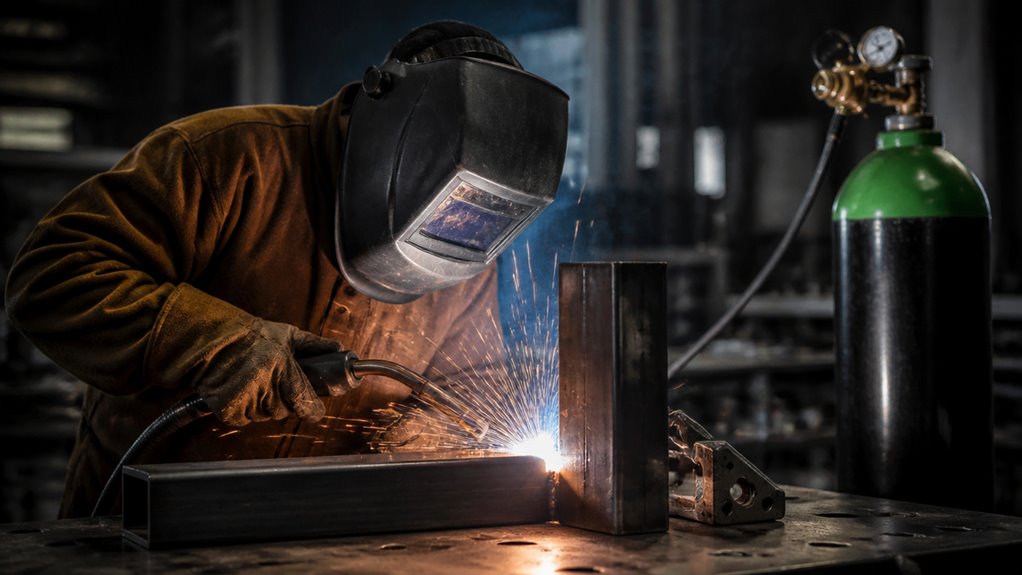
You use 90/10 welding gas, a blend of 90% argon and 10% carbon dioxide, mainly for MIG/MAG welding unalloyed and low-alloy carbon steel.
Its argon-rich mix supports a stable arc and generally reduces spatter compared with CO₂-rich blends.
It’s suited to fabrication, thin sheet, and appearance-critical welds, especially with spray or pulsed transfer when your equipment and joint position allow.
Match the gas to your wire and qualified procedure, and protect the weld area from drafts.
The details below cover setup and limitations.
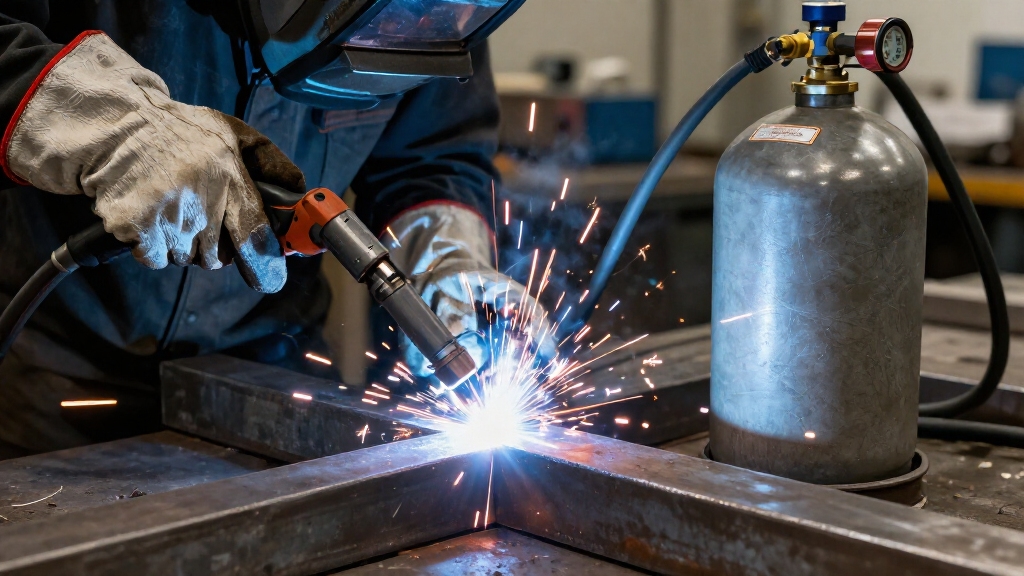
90/10 welding gas is a shielding-gas blend containing 90% argon and 10% carbon dioxide. You’ll also hear it called C10 because carbon dioxide makes up 10% of the mixture.
Argon provides most of the shielding, while carbon dioxide influences arc behavior and weld-pool characteristics.
Argon shields the weld, while carbon dioxide shapes the arc and molten pool.
In MIG/MAG welding, the gas flows through your torch nozzle and forms a protective envelope around the arc and molten metal.
This barrier limits exposure to atmospheric oxygen, nitrogen, and moisture, which can cause weld defects.
Compared with pure CO2, the argon-rich blend generally produces a smoother arc with less spatter. Spatter levels also depend on welding settings and gas flow.
The blend is supplied in a pressurized cylinder, so secure the cylinder upright and use a regulator rated for the gas service.
Check connections for leaks, maintain ventilation, and follow the cylinder label and equipment instructions.
Never use shielding gas to ventilate a confined space.
In practice, 90/10 gas is used mainly to shield MIG/MAG welds on carbon steel when you want a stable arc, low spatter, and a clean bead.
You’ll commonly use it for general fabrication, precision work, and applications where bead appearance matters.
Its argon-rich composition supports spray and pulsed-spray transfer, helping you achieve smooth metal transfer and consistent weld quality.
Compared with higher-CO₂ blends, it usually produces less spatter, though penetration may be less aggressive.
Choose it for thin-sheet work when controlled heat input and a tidy finish matter.
Use it for flat or horizontal joints where spray transfer suits the procedure.
Consider it for pulsed MIG or metal-core wire setups, following the wire and equipment specifications.
Set flow and voltage to the manufacturer’s guidance.
Keep adequate ventilation and prevent shielding gas from displacing breathable air.
Argon-rich blends generally produce shallower penetration than pure CO₂.
For most applications, 90/10 is suited to unalloyed and low-alloy carbon steel. This includes thin sheet and thicker joints welded with spray or pulsed transfer.
You can also use it on stainless steel in qualified applications. Confirm the gas and filler match your grade and procedure. Don’t assume it suits aluminum or other nonferrous metals.
| Metal | Suitability | Check before welding |
|---|---|---|
| Carbon steel | Primary use | Match wire to grade |
| Low-alloy steel | Generally suitable | Verify procedure |
| Stainless steel | Application-dependent | Confirm gas and filler |
| Aluminum | Not typical | Select a suitable gas |
| Other nonferrous metals | Not typical | Check process guidance |
For stainless, use an appropriate backing gas when root-side oxidation matters. Follow the filler manufacturer’s specifications and your qualified welding procedure. Shielding gas alone doesn’t guarantee sound welds. Use ventilation and required protective equipment. Gas selection can affect arc stability and weld bead characteristics.
Beyond choosing a compatible metal and filler, you need to match the transfer mode to the joint and equipment.
With 90/10, argon supports a stable arc and spray transfer, while carbon dioxide helps maintain penetration.
Conventional spray requires sufficient current to create a continuous stream of fine droplets.
Use it within your machine’s rated range and on suitable joint positions.
In pulsed MIG, the power source alternates peak and background current.
Peak pulses detach droplets; background current sustains the arc while limiting average heat input.
The blend’s lower CO2 content can help reduce spatter compared with 75/25.
Confirm the wire manufacturer’s gas recommendations before setup.
Set polarity, voltage, wire-feed speed, and pulse parameters to the procedure.
Check flow, ventilation, and cylinder security; follow equipment and gas-safety instructions.
Run a test bead, inspect transfer stability, and adjust settings systematically.
Don’t exceed duty-cycle limits or weld without required protective equipment.
Because its high argon content supports a stable arc with less spatter than richer CO₂ blends, 90/10 can help you produce cleaner beads on thin sheet metal and appearance-critical welds.
You’ll spend less time removing spatter and refining the surface, which helps preserve finished parts and reduce cleanup.
On thin material, control heat input carefully: excessive voltage, wire feed, or travel speed can still cause burn-through, distortion, or an oversized bead.
Set your machine for the wire diameter, material thickness, joint, and transfer mode, then test on matching scrap.
Adjust voltage and wire feed together, and maintain a consistent torch angle, travel speed, and contact-tip-to-work distance.
Regularly clean the contact tip and nozzle to support consistent wire feeding and stable arc performance.
Use proper ventilation, eye and skin protection, and fire precautions. Shielding gas doesn’t replace these safeguards, and drafts can disrupt coverage.
Check the finished weld for required size, fusion, and defects—not appearance alone.
Choosing between 90/10, 75/25, and pure CO₂ changes arc behavior, spatter, penetration, and operating cost. Match the blend to your wire, transfer mode, joint, and procedure.
Verify compatibility before welding.
90/10: Its higher argon content supports a smooth, stable arc and lower spatter. This blend allows for spray or pulsed transfer, resulting in a cleaner bead with less aggressive penetration than CO₂-rich blends.
75/25: This common short-circuiting blend generally costs less and offers useful penetration for general steel work. However, you’ll see more spatter and a rougher bead than with 90/10.
Pure CO₂: It’s typically the lowest-cost option and can provide strong penetration. However, its harsher arc produces more spatter and demands careful parameter control.
Shielding gas helps protect the weld pool from atmospheric contamination that can cause porosity and weaken the joint.
Use the gas specified by your qualified welding procedure.
Maintain ventilation and cylinder safety.
Although 90/10 produces a smooth, low-spatter arc, it isn’t ideal for every job: its lower CO₂ content may provide less penetration than CO₂-rich blends, and its higher cost may not suit routine work.
If you’re welding thick sections or need maximum fusion, you may find another gas more suitable, subject to your qualified procedure and joint design.
Don’t assume a clean bead proves adequate penetration; inspect the weld and verify it meets the required acceptance criteria.
This blend also isn’t universal across materials or processes: confirm compatibility with your wire, base metal, and applicable welding procedure, especially for stainless steel.
For outdoor work, shielding gas can disperse in wind, increasing contamination risk. Protect the weld area or use a process and consumables approved for those conditions.
Argon-CO₂ blends can reduce spatter while maintaining penetration on carbon steel.
Alright, let’s talk about setting up that 90/10 argon–CO₂ mixture for your welding job. First things first, you’ll want to pick a regulator that’s specifically rated for those argon–CO₂ mixtures. Don’t forget to check that it matches the pressure of your cylinder.
Once you’ve got your regulator sorted out, go ahead and set the flow rate according to your welding procedure. It’s super important to get this right! After that, take a moment to check every single connection for any leaks. You definitely don’t want any surprises while you’re working.
Finally, make sure that the gas is actually reaching the weld area. You want it to shield the pool effectively, so keep an eye out for any drafts that might mess with your coverage. Proper gas flow creates a protective barrier that helps keep atmospheric contaminants away from the weld pool. It’s all about creating that perfect environment for a solid weld!
To set up 90/10 shielding gas safely, use a regulator and flowmeter rated for argon–CO₂ mixtures. Connect it securely to the cylinder and check for leaks.
Confirm the regulator’s inlet matches the cylinder valve and its outlet fits your welding hose.
Keep the cylinder upright and secured. Close its valve before installing or removing equipment. Inspect fittings, seals, and hoses for damage.
Use the correct wrench without forcing connections.
Choose a dual-gauge regulator if you need to monitor cylinder pressure and delivery pressure. Select a flowmeter calibrated for the gas blend; readings can vary with gas composition.
Use compatible, clean fittings, and keep oil or grease away from oxygen-service components.
Open the cylinder valve slowly while standing to one side of the regulator. If you detect a leak, close the valve, ventilate the area, and repair the connection before welding.
Proper gas flow rates help maintain shielding and prevent contamination-related defects.
With the regulator connected and leak-checked, set the 90/10 flow rate to match your torch, nozzle, and welding conditions. Start with your torch or wire manufacturer’s recommendation; many MIG setups use roughly 20–30 cubic feet per hour (CFH). Use this table as a starting guide, then confirm against your equipment instructions.
| Setup | Starting flow | Adjustment cue |
|---|---|---|
| Small nozzle, indoor | 20 CFH | Reduce if turbulence occurs |
| Standard nozzle, indoor | 25 CFH | Adjust for stable shielding |
| Large nozzle or draft | 30 CFH | Shield from drafts first |
Open the cylinder valve slowly and read the flowmeter while gas flows through the torch. Static pressure can mislead. Increase flow only enough to protect the arc. Excessive flow wastes gas and can draw air into the shielding stream. Don’t exceed component ratings. Gas purity helps protect the weld from contamination and supports consistent results.
Before striking an arc, check every gas connection for leaks. Make sure the hose, regulator, and torch are secure and undamaged. Use an approved leak-detection solution on fittings; never check for leaks with a flame.
Confirm the cylinder is upright and secured. Then open its valve according to the regulator manufacturer’s instructions.
Inspect the hose for cuts, kinks, heat damage, or loose couplings. Verify the regulator and flowmeter suit argon/CO₂ service and show the set flow.
Check that the torch nozzle and gas passages are clean and unobstructed. Position the nozzle close enough to shield the weld pool without touching the work.
Keep the arc area clear of drafts, fans, and open doors, which can disperse 90/10 shielding gas. Test coverage on scrap and adjust flow or positioning if porosity appears.
Yes, you can use 90/10 welding gas indoors, but you must control welding fumes and maintain ventilation.
The argon–carbon dioxide blend can displace oxygen, creating an asphyxiation hazard, especially in confined or poorly ventilated spaces.
Don’t rely on the gas being nonflammable as proof of safety.
Use local exhaust ventilation, monitor oxygen where needed, follow your workplace safety procedures, and never weld in a confined space without proper authorization and precautions.
You don’t need a complicated setup: start at 20–25 cubic feet per hour (CFH) for 90/10 shielding gas in MIG welding.
Use about 15–20 CFH indoors with no drafts. Increase toward 25–30 CFH outdoors or in breezy conditions, using a windscreen.
Too much flow can create turbulence and draw air into the weld.
Check your machine and torch guidance, verify flow at the nozzle, and make sure adequate ventilation.
Yes, you can use 90/10 gas with gas-shielded flux-cored wire, but check the wire manufacturer’s specifications first. Some wires require a different gas or a specific blend.
Don’t use 90/10 with self-shielded flux-cored wire, which is designed to weld without external shielding gas. Using the wrong gas can cause porosity, unstable arcs, or poor weld properties.
Follow the wire’s recommended settings, make sure adequate ventilation, and protect yourself from welding fumes.
Store your 90/10 cylinder upright, secured with a chain or strap to prevent tipping. Keep its valve cap fitted when you’re not using it and close the valve before storage.
Choose a dry, well-ventilated area away from heat, flames, sparks, and corrosive chemicals. Protect the cylinder from impact and moisture; don’t store it in a vehicle or where temperatures exceed the supplier’s limits.
Follow the cylinder label and local regulations.
No, 90/10 welding gas doesn’t have a set expiration date. The blend remains usable as long as your cylinder stays sealed and uncontaminated.
However, a hidden problem can affect performance: leaks, moisture, or air entering through a damaged valve may compromise the gas.
Check the cylinder’s label, valve, and regulator, and confirm the supplier’s requirements. If you suspect contamination or notice unstable arc behavior, stop welding and have your supplier inspect or replace the cylinder.
With 90/10, you can produce a clean, controlled spray or pulsed-MIG arc on suitable steel.
However, the gas won’t compensate for the wrong process, settings, or preparation.
Confirm your wire, metal thickness, machine capability, and shielding-gas flow before striking an arc.
Keep the cylinder secured, ventilate the work area, and wear proper protection.
Then inspect the weld for defects. That final check matters; a bead that looks sound may still conceal the flaw you need to find.