Phone:
(701)814-6992
Physical address:
6296 Donnelly Plaza
Ratkeville, Bahamas.

Phone:
(701)814-6992
Physical address:
6296 Donnelly Plaza
Ratkeville, Bahamas.

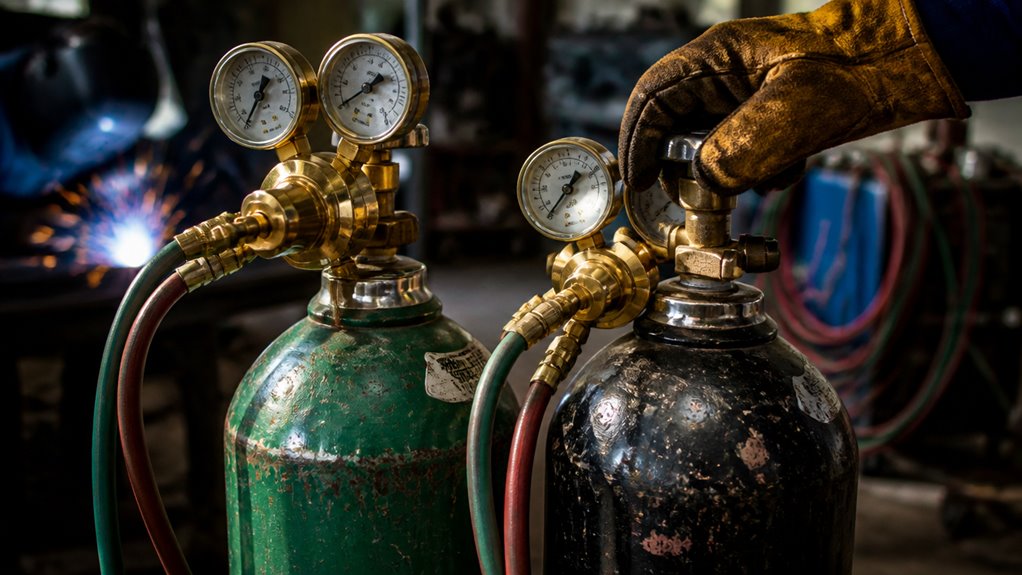
When choosing between 75/25 and 90/10 welding gases, consider your material thickness and weld quality needs.
Use 75/25 for thicker mild steel to gain deeper penetration and a forceful arc, though it produces more spatter.
Opt for 90/10 on thinner materials to reduce burn-through and spatter, achieving smoother, cleaner welds with lower voltage spray transfer.
Each blend balances cost, arc stability, and bead profile differently. Understanding these trade-offs helps you optimize your weld performance.
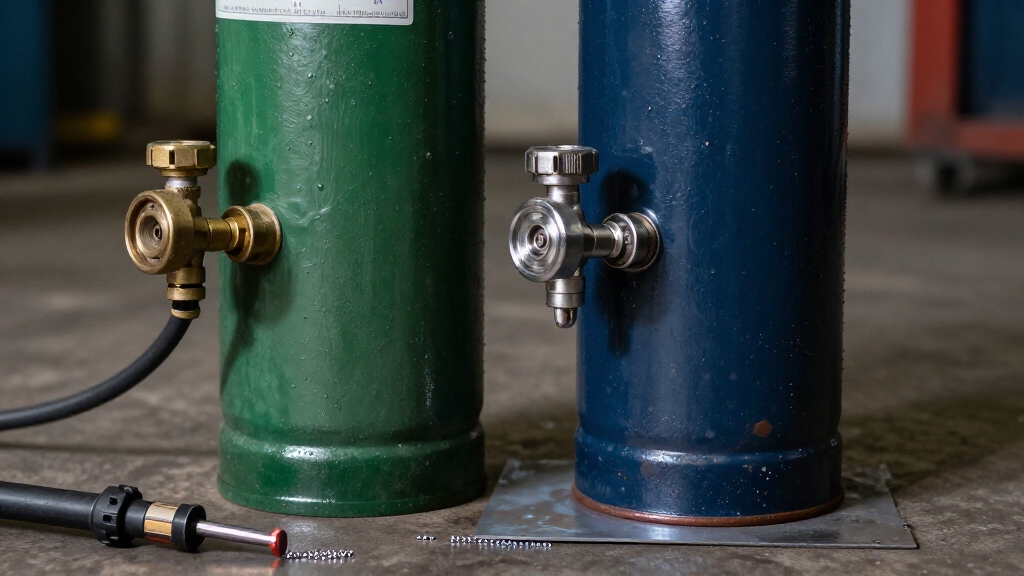
What exactly are the 75/25 and 90/10 welding gas blends, and why do they matter?
These blends consist of argon and carbon dioxide in specific ratios: 75% argon with 25% CO2 (known as C25) and 90% argon with 10% CO2 (referred to as C10).
Argon and carbon dioxide combine in precise ratios: 75/25 (C25) and 90/10 (C10) for welding gases.
Both serve as shielding gases primarily for MIG welding mild steel. The argon provides arc stability, while CO2 influences penetration and arc characteristics.
You’ll notice that the 75/25 blend delivers deeper penetration and a more active arc, making it suitable for general fabrication.
Meanwhile, 90/10 offers a smoother arc with less spatter and lower heat input, favoring thin materials and spray transfer.
Understanding their compositions and effects helps you select the appropriate gas for specific welding demands without ambiguity.
However, using these CO2-containing blends in TIG welding is detrimental due to CO2-induced oxidation, which destabilizes the arc and compromises weld quality.
Although both 75/25 and 90/10 welding gases serve as argon-CO2 shielding blends for MIG welding mild steel, they differ markedly in arc behavior, penetration, and spatter characteristics.
You’ll find 75/25 offers deeper penetration and a more active arc, making it suitable for thicker materials and general fabrication.
Conversely, 90/10 reduces penetration, which helps prevent burn-through on thin sheets. It also produces less spatter and yields a smoother, cleaner bead, ideal for cosmetic welds.
Cost-wise, 90/10 is slightly more expensive, but its lower spatter and refined finish justify the price in precision applications.
In contrast, 75/25 remains your versatile and forgiving choice, balancing cost, penetration, and weld profile.
Selecting between them depends on your material thickness, desired appearance, and transfer mode requirements.
Both blends require proper flow rate adjustments to optimize arc stability and minimize spatter during welding.
You’ll notice that 75/25 really shines when it comes to short-circuit transfer. It provides tight control, especially on thinner steel.
On the other hand, 90/10 is all about that smooth, stable arc. It works great for spray transfer, even at lower voltages.
Now, here’s the kicker: the higher argon content in 90/10 not only enhances the smoothness of the arc but also helps reduce spatter. This means you get a much better-looking weld.
Small additions of CO2 improve puddle wetting and bead profile, which is why 75/25 remains a popular choice for carbon steel.
Understanding the short-circuit transfer characteristics of 75/25 and 90/10 welding gas blends is essential for optimizing arc behavior in MIG welding.
When you work with 75/25 (C25), you get a more controlled short-circuit transfer, ideal for thin mild steel. In contrast, 90/10 (C10) offers a smoother arc but less stable short-circuit conditions.
Here’s what you should consider:
Choosing between these blends depends on your weld quality and material thickness requirements. Proper voltage and wire speed tuning are crucial to optimize arc stability and control spatter in both gas mixtures, enhancing overall weld quality and consistency with short-circuit transfer.
Spray transfer often performs better with a 90/10 argon-CO2 mix because it enables a smoother, more stable arc at higher amperages compared to 75/25.
The higher argon content promotes a consistent spray transfer mode at slightly lower voltages, reducing spatter and improving bead appearance.
You’ll notice that 90/10 supports a fine, continuous metal droplet transfer that enhances weld quality on thinner materials, minimizing burn-through risk.
In contrast, 75/25 tends to favor short-circuit transfer under similar conditions, requiring higher voltage to achieve spray transfer.
While 75/25 yields stronger penetration, 90/10’s spray transfer advantage is vital when controlled heat input and cleaner welds are priorities.
Using 90/10 allows you to optimize transfer efficiency and weld aesthetics in applications demanding precision and reduced thermal impact.
Additionally, the increased argon content in 90/10 leads to a softer arc which stabilizes molten metal transfer and minimizes spatter compared to higher CO2 mixes.
Arc stability plays a critical role in determining weld quality and efficiency when choosing between 75/25 and 90/10 argon-CO2 blends.
You’ll notice that 75/25 typically delivers a more forceful, controlled arc suitable for short-circuit transfer on thinner steels.
In contrast, 90/10 produces a smoother arc, favoring spray transfer modes at lower voltages.
Consider these key differences:
Choosing between these blends depends on your need for arc smoothness versus penetration and control in application. The use of small oxygen additions can stabilize the arc by counteracting oxide disruptions without compromising the inert process, improving overall weld quality through enhanced arc stability.
When you compare the 75/25 and 90/10 gas mixes, it’s pretty interesting to see how they perform differently. The 75/25 mix, with its higher CO2 content, tends to deliver deeper penetration. This can be a big advantage in certain situations, but it also means higher heat input. So, if you’re working with thinner materials, you might run the risk of burn-through.
On the flip side, the 90/10 mix has a different approach. It reduces both heat input and penetration, which is really helpful when you need to keep thermal distortion to a minimum. So, depending on your project’s needs, you can choose the mix that works best for you!
The presence of carbon dioxide in these blends also influences weld appearance and spatter, making the choice important for both mechanical and cosmetic outcomes.
Although both 75/25 and 90/10 argon/CO2 blends serve as effective shielding gases for MIG welding mild steel, they differ markedly in penetration and heat input characteristics.
You’ll find that 75/25 provides deeper penetration due to its higher CO2 content. This makes it suitable for thicker materials and applications demanding strong weld fusion.
Conversely, 90/10 delivers reduced penetration, which helps prevent burn-through on thin sheets.
Key differences include:
Choose your blend based on material thickness and penetration requirements. However, the increased CO2 in 75/25 also leads to higher spatter and rougher bead appearance compared to 90/10, which may affect weld quality.
Understanding how heat input varies between 75/25 and 90/10 welding gases helps you optimize weld quality and prevent defects.
The 75/25 mix delivers higher heat input due to its increased CO2 content, generating deeper penetration but raising the risk of burn-through on thin materials.
In contrast, 90/10 reduces heat input with lower CO2, producing a smoother arc and less aggressive penetration.
This makes 90/10 ideal when controlling heat input is critical, such as welding thin sheet metal or delicate components.
You’ll find 75/25 better suited for thicker sections where stronger fusion is required.
Balancing heat input directly influences arc stability and bead profile.
Selecting between these gases depends on your material thickness and weld objectives, ensuring ideal thermal management and minimizing defects like warping or inadequate fusion.
Choosing the appropriate gas mixture is as crucial as selecting the right power source for your welding equipment to maintain consistent performance and avoid operational issues.
Selecting the appropriate welding gas hinges markedly on the thickness of the material you’re working with. Thicker materials typically require a gas blend that delivers deeper penetration, making 75/25 (C25) ideal due to its higher CO2 content.
Conversely, thinner materials benefit from reduced heat input to avoid burn-through, where 90/10 (C10) excels.
Consider these factors when choosing your gas:
Match gas choice precisely to material thickness for best weld integrity. Also, selecting the correct polarity setting ensures optimal heat distribution and weld quality when using these gases.
You’ll often find that 90/10 welding gas produces noticeably less spatter compared to 75/25. This can materially improve bead appearance in many applications.
The reduced CO2 content in 90/10 creates a smoother, more stable arc, minimizing erratic metal ejection and resulting spatter. This leads to cleaner welds with a more uniform, aesthetically pleasing bead profile.
In contrast, 75/25’s higher CO2 concentration generates a more active arc with increased spatter. This can compromise bead smoothness and require additional cleanup.
While 75/25 offers a robust arc for general fabrication, 90/10’s spatter control makes it preferable when visual weld quality is critical.
Understanding these differences helps you optimize your welding process for both efficiency and finish quality based on your specific project requirements.
Although 90/10 offers advantages in spatter control and bead appearance, 75/25 welding gas remains the preferred choice when you need deeper penetration and robust arc stability on thicker mild steel.
You’ll want to select 75/25 when:
This blend’s 25% CO2 content increases heat input and arc energy.
This enables a deeper weld pool and better fusion on heavy material.
Choosing 75/25 guarantees you maintain weld integrity and productivity when dealing with demanding mild steel thicknesses.
When working with thin materials or aiming for a clean, polished weld appearance, 90/10 welding gas stands out as the best choice. Its 90% argon and 10% CO2 composition reduces heat input and penetration compared to 75/25.
This minimizes burn-through risk on thin sheets. You’ll notice 90/10 promotes a smoother, more stable arc with less spatter, essential for cosmetic welds where bead uniformity and finish matter.
This gas blend also facilitates spray transfer at lower voltages, enhancing control and weld bead consistency. While it sacrifices some penetration depth, the trade-off benefits delicate applications like automotive panels or thin-wall tubing.
While cost differences between 75/25 and 90/10 welding gases may seem minor per cubic foot, they can impact your overall project budget depending on usage volume.
75/25 typically comes at a lower price point and offers a versatile balance of penetration and arc control. This makes it cost-effective for general mild steel MIG welding.
When selecting the best gas, consider:
Ultimately, weigh your priorities between cost, weld aesthetics, and material compatibility. This will help you select the gas blend that maximizes efficiency and weld integrity.
You shouldn’t use 75/25 or 90/10 welding gas for aluminum.
Both mixtures contain carbon dioxide, which causes oxidation and poor weld quality with aluminum.
Instead, you need pure argon or argon-helium blends to achieve proper shielding and arc stability for aluminum MIG welding.
Using these argon-based gases prevents contamination, guarantees clean welds, and promotes better heat control and penetration specific to aluminum’s properties.
Humidity introduces moisture that can contaminate shielding gas, causing weld defects like porosity and spatter.
You’ll find both 75/25 and 90/10 gases sensitive to humidity. Moisture reacts with CO2, increasing oxidation and arc instability.
To maintain consistent arc behavior and bead quality, you should store gas cylinders in dry environments and use proper gas dryers or filters.
Controlling humidity is critical, especially with 90/10, which favors cleaner, smoother welds.
You won’t face unique safety concerns specific to either 75/25 or 90/10 gases since both contain argon and CO2, which share similar hazards.
You must handle them as asphyxiants and avoid confined spaces without proper ventilation.
Watch for CO2’s heavier-than-air nature, which can accumulate at low points, posing suffocation risks.
Always use proper regulators, check connections for leaks, and store cylinders securely to prevent accidents during MIG welding.
You know what they say: don’t mix apples and oranges.
You can blend 75/25 or 90/10 gases with others like oxygen or helium to tailor arc characteristics, but it requires precise control.
Mixing impacts arc stability, penetration, and spatter levels. Without proper ratios, weld quality suffers.
You should regularly inspect and clean your MIG gun, contact tips, and liner to prevent spatter buildup and guarantee consistent gas flow.
Check hoses and regulators for leaks, especially since CO2 levels can cause corrosion over time.
Calibrate flow meters to maintain proper shielding gas flow rates.
Also, clean or replace gas nozzles frequently to avoid contamination.
Consistent maintenance preserves arc stability and weld quality when using either gas mix.
Choosing between 75/25 and 90/10 welding gases boils down to your project’s demands.
If you want deep penetration and robust welds on thicker materials, 75/25 is your powerhouse.
For thin metals or cosmetic welds where spatter and bead appearance can’t be compromised, 90/10 shines.
Think of 75/25 as the heavyweight champion and 90/10 as the precision surgeon. Each excels in its arena.
Match your gas to your task for peak welding results every time.