Phone:
(701)814-6992
Physical address:
6296 Donnelly Plaza
Ratkeville, Bahamas.

Phone:
(701)814-6992
Physical address:
6296 Donnelly Plaza
Ratkeville, Bahamas.

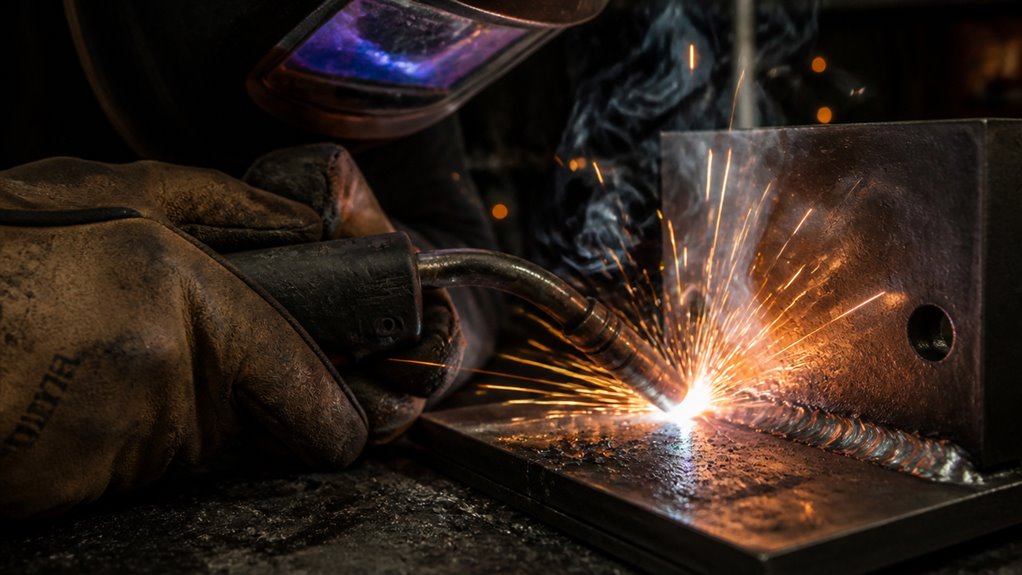
Flux-Cored Arc Welding (FCAW) uses a continuously fed, consumable tubular wire filled with flux to create strong, deep-penetration welds quickly.
You’ll find two types: self-shielded (FCAW-S), which produces its own gas shield, ideal for outdoor use, and gas-shielded (FCAW-G), which combines flux with external gas for cleaner welds in controlled settings.
FCAW handles thick steel well and boosts productivity on large projects.
Keep going to explore how to optimize your setup and avoid common challenges.
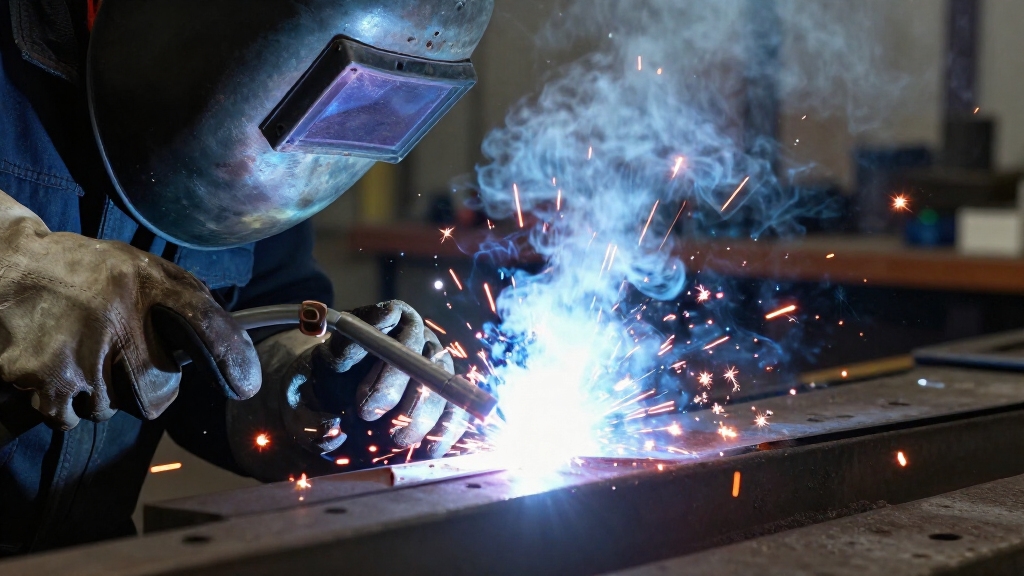
If you’ve ever worked with heavy steel fabrication or repair, you’ve likely come across Flux-Cored Arc Welding (FCAW).
FCAW is a semi-automatic or automatic arc welding process that uses a continuously fed, consumable tubular wire filled with flux.
Flux-Cored Arc Welding uses a continuously fed tubular wire filled with flux for semi-automatic or automatic welding.
When you strike an arc between the wire electrode and the workpiece, both metals melt, creating a strong weld.
The flux inside the wire decomposes under heat, producing shielding gases that protect the molten weld pool from contaminants.
This process is especially effective on ferrous metals and thick steel, offering high deposition rates and deep penetration.
The continuous wire feed allows you to weld longer runs without stopping, making FCAW a versatile and efficient choice for heavy fabrication and repair applications.
Its semi-automatic operation uses a constant-voltage power source and delivers high deposition rates, even on contaminated surfaces.
Although both self-shielded (FCAW-S) and gas-shielded (FCAW-G) flux-cored arc welding use tubular electrodes filled with flux, they differ primarily in their shielding methods.
FCAW-S relies solely on the flux inside the wire to generate a protective gas shield when heated by the arc. This eliminates the need for external shielding gas, making it ideal for outdoor or windy conditions since you won’t have gas disruption.
In contrast, FCAW-G combines flux-generated shielding with an external gas supply, typically CO₂ or a gas mix. This enhances arc stability and produces cleaner welds with less spatter.
However, FCAW-G requires a constant gas source and more controlled environments. Understanding these differences helps you select the appropriate FCAW type based on job site conditions and weld quality demands.
The choice of shielding gas, such as pure CO2 or argon-CO2 blends, significantly influences weld penetration and spatter levels in FCAW-G.
Understanding the differences between self-shielded (FCAW-S) and gas-shielded (FCAW-G) FCAW is important.
Recognizing the key distinctions between FCAW-S and FCAW-G is essential for effective welding.
Knowing how to manage common challenges during welding will improve your results markedly.
You’ll want to control parameters like voltage, wire feed speed, and travel speed carefully to avoid porosity and slag inclusions.
Excessive spatter and smoke can be minimized by maintaining proper shielding gas flow for FCAW-G or selecting the right flux-cored wire for FCAW-S.
Be mindful of wind or drafts that disrupt shielding gas coverage, particularly outdoors.
Additionally, clean the base metal thoroughly to reduce contamination effects.
Removing slag after each pass is essential to prevent defects.
Choosing the correct flux-cored wire type is crucial to optimize welding performance and minimize common FCAW defects.
Because FCAW offers deep penetration and high deposition rates, it excels in heavy steel fabrication where strong, durable welds are critical.
You can rely on FCAW to efficiently join thick steel sections with consistent fusion and minimal defects.
The continuous wire feed allows you to maintain long weld runs, reducing downtime and increasing productivity on large structural components.
For outdoor applications, self-shielded FCAW (FCAW-S) eliminates the need for external gas, making it resistant to wind interference that often compromises other welding methods.
This portability and robustness enable you to perform field repairs and construction work in challenging environments.
Additionally, FCAW tolerates surface contaminants better than many processes, so you don’t have to achieve perfect cleanliness before welding heavy, weathered steel.
FCAW also typically generates higher fumes and slag, which requires good ventilation and thorough post-weld cleanup to ensure safety and weld integrity.
When selecting your FCAW setup, consider the specific requirements of your project, including material thickness, environmental conditions, and desired weld quality.
For thick steel, opt for a gas-shielded FCAW-G wire to achieve cleaner welds with less spatter and better penetration.
If you’re working outdoors or in windy conditions, choose self-shielded FCAW-S to avoid issues from shielding gas disruption.
Match your electrode diameter and wire feed speed to the material thickness to guarantee proper heat input and avoid burn-through.
Use a constant-voltage power supply compatible with your wire type.
Also, select flux-cored wires formulated for the base metal to minimize defects like porosity or slag inclusions.
Properly balancing these factors guarantees efficient, high-quality welds tailored to your project’s demands.
Remember to verify machine polarity compatibility to ensure stable arc performance and optimal weld quality.
You generally can’t rely on FCAW for non-ferrous metals like aluminum or copper because its flux and wire composition are optimized for ferrous materials, especially steel.
The flux core and shielding are designed to handle oxidation and penetration characteristics typical of ferrous metals.
For non-ferrous metals, processes like TIG or MIG with appropriate filler metals and shielding gases offer better control and weld quality.
You need a welding helmet to protect your eyes and face. Gloves shield your hands, and a flame-resistant jacket guards your body.
You should wear ear protection against noise and respiratory gear to filter fumes and smoke. Safety boots protect your feet.
Always use proper ventilation and keep your gear in good condition. These essentials keep you safe from sparks, heat, and harmful emissions during FCAW welding.
You’ll find FCAW generally costs less upfront than MIG welding because it often doesn’t require external shielding gas, especially with self-shielded wires.
This reduces equipment and gas expenses.
However, FCAW wire can be pricier, and cleanup costs rise due to slag removal.
MIG welding’s consumables tend to be cheaper, but gas and equipment add to costs.
You need to regularly clean the welding gun nozzle and contact tip to prevent spatter buildup, ensuring consistent wire feeding.
Check and replace worn consumables like liners and drive rolls. Keep the wire spool dry to avoid rust.
Inspect cables and connectors for damage or wear. Also, guarantee the power source is calibrated and ventilate the workspace to manage fumes.
Proper maintenance keeps your FCAW equipment reliable and efficient.
Imagine welding stainless steel with sparks dancing precisely as you feed the wire.
Yes, you need specific FCAW wires designed for stainless steel, containing alloying elements like chromium and nickel to match its corrosion resistance.
These wires guarantee strong, clean welds that maintain stainless steel’s properties.
Using the right wire prevents contamination and cracking, giving you durable, high-quality joints tailored for stainless applications under demanding conditions.
Now that you understand Flux-Cored Arc Welding (FCAW), consider this: FCAW boosts productivity by up to 50% compared to traditional methods.
Whether you’re tackling heavy steel or working outdoors, its versatility and speed make it a go-to choice.
By selecting the right setup and materials and avoiding common pitfalls, you’ll optimize your welding quality and efficiency.
Embrace FCAW to enhance your projects with precision and reliability every time.