Phone:
(701)814-6992
Physical address:
6296 Donnelly Plaza
Ratkeville, Bahamas.

Phone:
(701)814-6992
Physical address:
6296 Donnelly Plaza
Ratkeville, Bahamas.

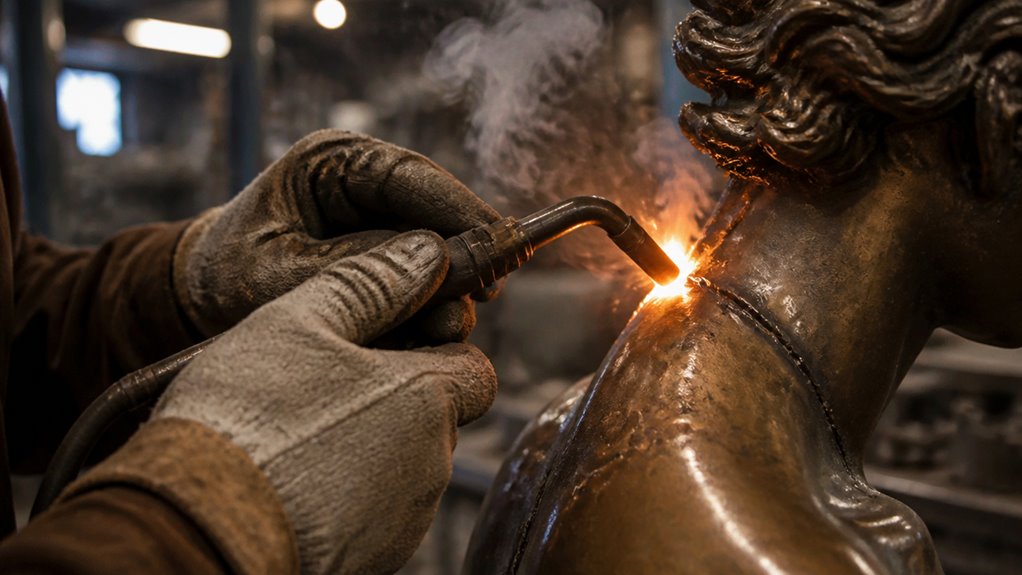
Yes, you can weld bronze alloys like aluminum bronzes effectively using TIG or MIG welding.
This is provided you choose compatible filler metals that match the base alloy’s composition.
Proper surface preparation and controlling heat input are vital to prevent common defects such as cracking and porosity.
Shielding gases like argon guarantee a stable arc and protect the weld.
For some bronzes, like leaded phosphor types, brazing is preferred to avoid fusion issues.
Understanding these details will help you master bronze joining techniques.
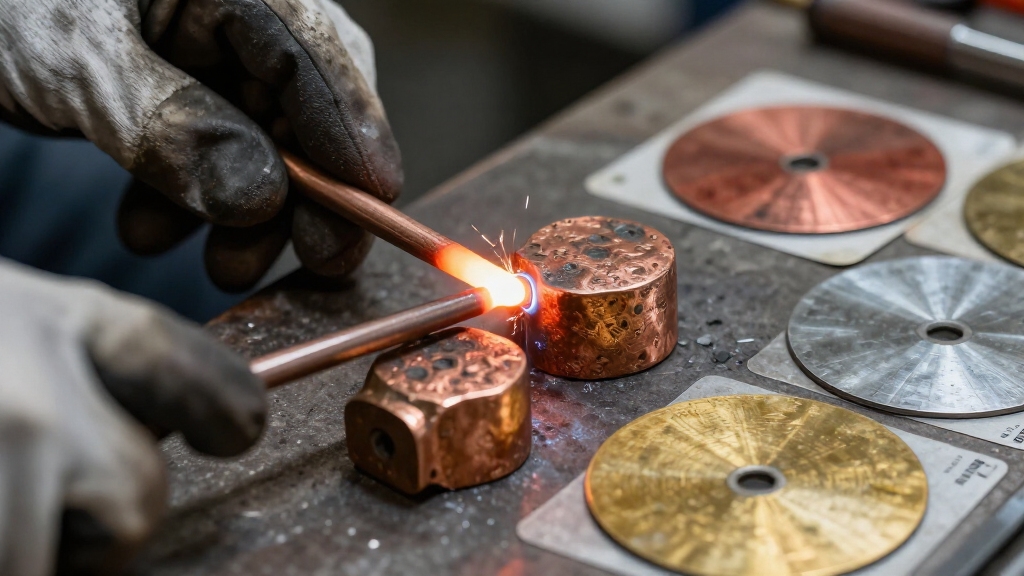
Understanding which bronze alloys you can weld successfully is essential because not all bronzes respond the same way to welding processes.
Aluminum bronzes offer good to excellent weldability with TIG, MIG, and SMAW methods, making them your best candidates for fusion welding.
Aluminum bronzes excel in weldability using TIG, MIG, and SMAW, ideal for fusion welding applications.
Conversely, leaded phosphor bronzes pose significant challenges due to porosity risks during fusion welding. You should consider low-temperature soldering or brazing instead.
Cast bronzes might contain contaminants or residues that impair weld quality, so thorough cleaning is essential.
The variability in bronze alloys means you can’t apply one standard welding setting universally. You need to tailor your approach based on the specific alloy’s characteristics, thermal conductivity, and response to heat input.
Selecting the right filler metal compatible with the base alloy is also critical for weld integrity.
Additionally, using inert shielding gases such as argon or helium can help prevent oxidation and porosity during the welding process.
To kick things off, it’s super important to clean the bronze surface really well. You want to get rid of any oils, oxides, and those pesky casting residues that can lead to porosity. Trust me, a clean surface makes a world of difference!
Next up, make sure to secure your workpieces with proper clamping. This step is crucial for maintaining a tight fit-up and preventing any warping as you heat things up. You don’t want any surprises when it comes time to weld!
Lastly, keep an eye on your heat input. Controlling that heat is key to managing thermal conductivity and reducing the risk of cracking throughout the welding process. A little attention here can save you a lot of headaches later on!
Additionally, cleaning immediately before welding is essential to prevent rapid re-oxidation that can compromise weld quality.
Safeguarding a thoroughly clean bronze surface is critical before welding to prevent defects such as porosity, cracking, and weak fusion.
You should start by removing any oils, grease, or dirt using a solvent like acetone or isopropyl alcohol. Next, eliminate any oxides or surface contamination with mechanical abrasion, such as fine-grit sanding or wire brushing, to expose fresh metal.
Finally, degrease and dry the surface completely to avoid moisture-related defects.
Key surface cleaning steps include:
Following these detailed cleaning techniques guarantees prime weld integrity and minimizes common bronze welding failures. Maintaining methodical maintenance of the surface before welding helps safeguard structural integrity and prevent corrosion-related issues.
When preparing bronze for welding, securing your workpieces firmly with proper clamping methods is essential to maintain precise fit-up and minimize distortion during heating.
Use rigid, heat-resistant clamps that hold parts without shifting under thermal expansion. Position clamps to evenly distribute pressure, preventing gaps or misalignment at the joint.
Avoid excessive clamping force, which can deform thin bronze sections. For complex shapes, employ custom fixtures or backing bars to stabilize the assembly.
Make certain clamps don’t interfere with the welding path or heat dissipation. Remember, bronze’s high thermal conductivity can cause uneven expansion, so adjust clamping to accommodate slight movement without loosening.
Proper clamping preserves joint integrity, reduces warping risk, and supports consistent weld bead formation, critical for defect-free bronze welds.
Choosing the appropriate welding method, such as stick welding for its tolerance to heat and environmental conditions, can further enhance joint stability during the welding process.
Because bronze’s high thermal conductivity rapidly dissipates heat, controlling temperature throughout the welding process is critical to prevent defects such as cracking and porosity.
You need to carefully manage heat input to maintain consistent weld pool temperatures and avoid thermal shock during cooling.
Preheating the bronze can reduce temperature gradients, while controlled interpass temperatures prevent excessive heat buildup.
Additionally, post-weld slow cooling helps minimize residual stress and cracking risk.
Key heat control strategies include:
Preheat the workpiece to 300°F–500°F (depending on alloy) to stabilize thermal gradients.
Use pulse welding or low heat input settings for precise temperature control.
Employ slow, controlled cooling methods like insulating blankets or sand beds to reduce thermal stress.
Applying these tactics guarantees a sound, defect-free bronze weld.
Moreover, selecting the appropriate inert gas shielding can significantly reduce oxidation and improve weld quality.
When it comes to welding bronze alloys, it’s super important to match the method to the specific type of alloy you’re working with. This helps you steer clear of defects such as porosity or cracking.
Now, let’s talk about filler metal. Selecting the right one is crucial for ensuring compatibility and maintaining the integrity of your weld. This is especially true for alloys like aluminum bronze or leaded phosphor bronze, where the wrong choice can lead to issues.
Understanding the thermal properties of each alloy is also key. This knowledge helps you control the heat input effectively.
Depending on your project, you might choose between TIG, MIG, oxy-acetylene, or even brazing techniques. Each method has its strengths, so it’s all about picking the right one for the job!
For precise and clean welds with minimal heat-affected zones, using aluminum bronze filler materials is often recommended for welding bronze alloys.
Although bronze encompasses a broad range of alloys, your choice of welding method must align closely with the specific alloy to guarantee joint integrity and minimize defects.
For example, aluminum bronzes respond well to TIG or MIG welding due to their excellent weldability. Leaded phosphor bronzes pose challenges like porosity, making braze welding a better option. Cast bronzes require thorough cleaning to remove casting residues before welding.
When selecting your technique, consider:
In all cases, it is critical to control heat input carefully to prevent porosity and cracking and to select appropriate filler materials for a strong, defect-free weld.
Selecting the right filler metal is critical when welding bronze, as it directly influences the joint’s strength, corrosion resistance, and overall integrity.
You need to match the filler to the specific bronze alloy. Aluminum bronzes require filler metals with similar aluminum content for compatibility. Phosphor bronzes demand lead-free fillers to minimize porosity.
For TIG welding, use ERCuAl or ERCuSn alloys depending on the base metal. MIG welding on thicker sections often uses solid wire fillers designed for copper-based alloys.
Avoid fillers that cause excessive dilution or cracking. In difficult-to-fuse bronzes, consider brazing rods with controlled melting points to maintain joint stability.
Ultimately, your filler choice must balance metallurgical compatibility with thermal expansion and mechanical properties for a sound, defect-free weld.
Controlling heat input during welding is essential to minimize residual stresses and prevent defects in the welded joint, especially when working with dissimilar metals like bronze alloys and steels, as explained in heat input control.
When welding bronze, choosing the correct filler material and shielding gas is critical to achieving a strong, defect-free joint. You must match the filler alloy closely to the base metal to prevent cracking and porosity. For example, aluminum bronzes respond well to aluminum-bronze fillers. Phosphor bronzes may require special formulations. Shielding gas selection also influences weld quality by protecting the molten pool from oxidation.
Consider these key factors:
Use argon or argon-helium mixes to guarantee stable arc and proper shielding.
Select filler rods or wires with compatible alloying elements to maintain mechanical properties.
Avoid fillers that introduce elements causing brittleness or excessive dilution.
Laser welding’s minimal heat input helps reduce thermal distortion and preserves the integrity of bronze welds.
Matching filler material and shielding gas to your bronze alloy sets the stage, but you still face inherent challenges unique to bronze welding. High thermal conductivity demands precise heat input control to prevent warping or cracking.
Porosity frequently arises from surface contamination or inadequate shielding; thorough cleaning and consistent gas flow are critical to minimize this. Cracking during cooling is another issue, often caused by thermal stress. Preheating and controlled cooling rates can alleviate this risk.
Additionally, incompatibility between filler and base metals can lead to weak joints, so ensure alloy compatibility. Secure clamping prevents joint movement under heat, maintaining fit-up integrity.
When joining dissimilar metals like bronze and steel, techniques such as brazing with silver-based fillers can offer stronger, more reliable connections by minimizing thermal stress and oxidation.
You’ll want to lean toward brazing instead of welding bronze when dealing with alloys that resist fusion welding or when minimizing thermal distortion is critical.
Brazing avoids melting the base metal, reducing risks like cracking and porosity common in fusion welding, especially with leaded phosphor bronzes.
It also helps maintain dimensional stability in thin or intricately shaped parts.
Consider brazing when:
Brazing uses a filler metal with a lower melting point than the base bronze.
This allows you to join components with less thermal stress and improved control over joint quality, making it ideal when welding challenges outweigh benefits.
It typically takes several weeks to a few months to learn bronze welding proficiently, depending on your prior welding experience.
You’ll need to master heat control, alloy-specific filler selection, and surface prep to avoid defects like porosity and cracking.
Starting with TIG welding is advisable for precision.
Hands-on practice and understanding the thermal challenges unique to bronze are vital.
Consistent training and experimentation will build the skill and confidence needed for quality bronze welds.
Start by securing safety gear suited specifically for bronze welding: strong gloves, sturdy sleeves, and a shielded helmet with proper filters.
Beware bronze’s bothersome byproducts; its fumes can feature harmful elements, so ventilate vigorously.
Vigilantly verify that surfaces are spotless to prevent sparks and spatter.
Manage metal’s high thermal conductivity carefully to avoid cracking.
Always clamp components to control fit-up during heating.
Never neglect protective eyewear to guard against intense light and flying debris.
You can weld bronze outdoors, but you’ll face challenges controlling shielding gas coverage, which is critical to prevent porosity and contamination.
Wind can disperse shielding gas, causing weld defects, so you’ll need windbreaks or enclosures.
Indoor environments offer more stable gas protection and temperature control, reducing cracking risks.
If you must weld outdoors, prepare carefully with windshields, secure clamping, and precise heat input to maintain weld integrity on bronze alloys.
Bronze welding typically alters the metal’s color and finish due to heat exposure.
You’ll notice oxidation and discoloration, often darkening or a dull grayish tint, around the weld zone.
This heat-affected zone can disrupt the original patina or shine.
To restore or maintain appearance, you’ll need post-weld cleaning, polishing, or chemical treatments.
Controlling heat input and using appropriate shielding gases help minimize color changes during welding.
You’ll want a TIG welder with adjustable amperage for precise heat control, essential when starting with bronze. Use a clean, stable power source and argon shielding gas to prevent contamination.
Equip yourself with bronze-compatible filler rods, a good-quality tungsten electrode, and a fine-tip torch for accuracy. Also, prepare proper safety gear: welding helmet, gloves, and ventilation.
A wire brush and acetone help clean surfaces, ensuring strong, defect-free welds.
Welding bronze isn’t rocket science, but it demands precision and care.
You must select the right alloy, prepare your workpiece meticulously, and choose appropriate filler materials and shielding gases to avoid cracks and porosity.
Keep in mind common challenges like overheating and contamination.
Sometimes, brazing offers a better solution.
Master these details, and you’ll achieve strong, flawless bronze welds every time, turning a tricky process into a reliable skill.