Phone:
(701)814-6992
Physical address:
6296 Donnelly Plaza
Ratkeville, Bahamas.

Phone:
(701)814-6992
Physical address:
6296 Donnelly Plaza
Ratkeville, Bahamas.

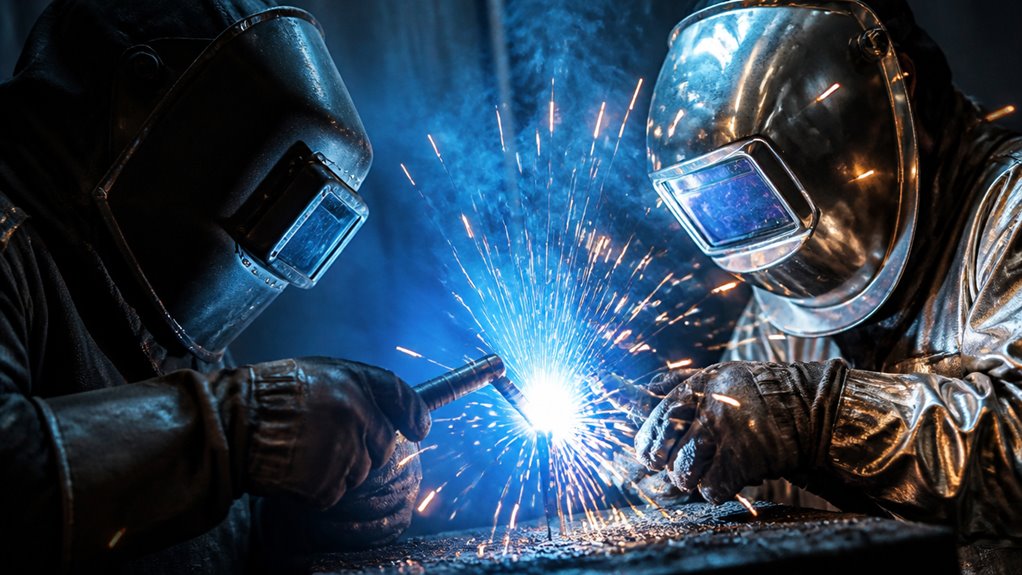
If you need a welder balancing power and durability, Vulcan offers higher amperage, longer duty cycles, and AC/DC TIG for aluminum. This makes it ideal for fixed, heavy-duty shop use.
Titanium favors portability with lighter weight, simpler connectors, and more basic TIG capabilities. It suits mobile or occasional tasks.
Vulcan’s robust accessories and build come at a premium, while Titanium cuts costs for ease of transport.
Choosing depends on your workload intensity and mobility needs. Exploring these factors reveals which fits your specific welding demands best.
| Feature | Vulcan Welder | Titanium Welder |
|---|---|---|
| Maximum Amperage | Up to 220A | Up to 200A |
| Duty Cycle | Longer; 25% at 200A on 240V | Shorter; 15% at 200A on 240V |
| Welding Processes | MIG, TIG, Stick | MIG, TIG, Stick |
| TIG Capability | Often AC/DC | Some models are DC-only |
| Aluminum TIG | Supported with AC mode | Limited without AC TIG |
| Weight | Around 49 lbs | Around 24 lbs |
| Portability | Lower | Excellent |
| Build | Heavier and more robust | Compact and lightweight |
| Connectors | Standard 50-series connectors | Smaller connector formats |
| Accessories | More comprehensive; often includes foot pedal | More basic accessory kit |
| Upgrade Potential | Better accessory compatibility | More limited |
| Price | Higher | Lower |
| Best Environment | Fixed workshop | Mobile or on-site work |
| Continuous Welding | Better suited | Better for intermittent tasks |
| Stability | Excellent due to heavier construction | Good, but prioritizes mobility |
| Warranty | 90-day limited warranty | 90-day limited warranty |
| Main Advantage | Higher output, longer duty cycle, and broader TIG capability | Lightweight, portable, and budget-friendly |
| Main Drawback | Heavier and more expensive | Lower duty cycle and more limited accessories |
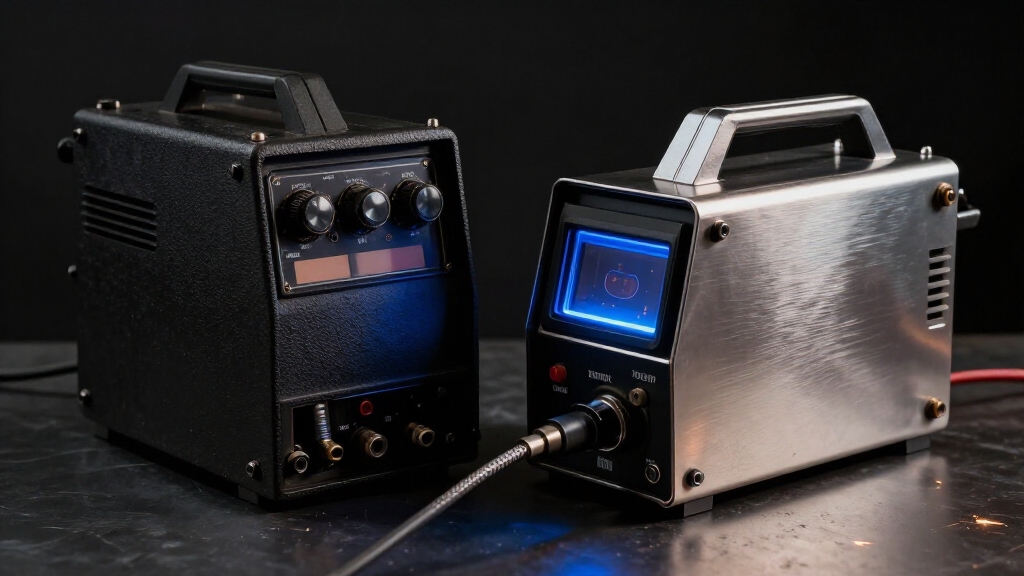
Choosing between Vulcan and Titanium welders depends largely on your specific welding needs and work environment.
Selecting Vulcan or Titanium welders hinges on your unique welding requirements and workspace conditions.
If you require a robust, heavier-duty machine for shop-style, continuous use, Vulcan’s OmniPro 220 with its higher amperage rating and solid build will likely suit you better.
Conversely, if portability, lower upfront cost, and a compact footprint are your priorities, the Titanium Unlimited 200 offers a lighter, more mobile solution with adequate multi-process capabilities.
Both lines support MIG, TIG, and stick welding, but Vulcan often provides AC/DC TIG options, while some Titanium models may be DC-only.
Your choice hinges on balancing the need for durability and power against ease of transport and budget constraints.
Align the machine’s design and feature set with your welding tasks.
Additionally, understanding the duty cycle limitations of each model is crucial to ensure it meets the demands of your welding projects.
When evaluating power output and duty cycles, you’ll find that Vulcan welders generally deliver higher amperage and longer continuous run times compared to Titanium models.
For instance, the Vulcan OmniPro 220 supports 220 amps with a 25% duty cycle at 200A on 240VAC. The Titanium Unlimited 200 maxes at 200 amps with only a 15% duty cycle at 200A on 240VAC.
This means you can weld longer without pauses on Vulcan machines, which suits heavier workloads and shop environments better.
Key differences include:
Choosing between them depends on the intensity and duration of your welding tasks. Additionally, machines with robust duty cycles and overload protection are essential for preventing overheating during extended use.
Explore the welding versatility offered by both Vulcan and Titanium welders. Each supports multiple processes tailored to different applications.
You’ll find both capable of MIG, TIG, and stick welding. However, Vulcan usually provides AC/DC TIG capability, expanding aluminum welding options.
Titanium often limits TIG to DC-only models. This impacts your material choices and project scope.
| Welding Process | Vulcan OmniPro 220 | Titanium Unlimited 200 |
|---|---|---|
| MIG | Yes | Yes |
| TIG | AC/DC (aluminum, steel, stainless) | DC-only (steel, stainless) |
| Stick | Yes | Yes |
| Aluminum TIG | Supported (AC mode) | Limited (no AC TIG) |
This delineation guides your process selection based on project requirements. Mastery of TIG welding demands precise heat input control and a methodical pace to ensure weld quality, which may affect your choice of welder and process capabilities.
When you take a look at the Vulcan welders, you’ll see they weigh about twice as much as the Titanium models. This difference really impacts how easy it’s to transport them.
If you need to move your welder around a lot, the Titanium’s compact design and lighter weight are big advantages. They make it much easier to handle, especially for on-site or overhead tasks.
On the other hand, Vulcan’s heft makes them more suitable for a fixed workshop environment. So, when you’re evaluating your options, think about your workflow and how much you need to move your welder.
Matching your welder choice to your specific needs can make a big difference in your overall experience. The Titanium 125’s inverter technology contributes significantly to its reduced weight and enhanced portability.
A key factor distinguishing Vulcan and Titanium welders is their weight, which directly impacts portability and user convenience.
You’ll find Vulcan welders markedly heavier, typically around 49 lbs. This reflects their robust construction and higher output capacity.
In contrast, Titanium welders weigh roughly 24 lbs, making them appreciably lighter for easier handling.
Consider these weight differences:
Vulcan welders: Heavier, suited for stationary or shop environments requiring durability.
Titanium welders: Lighter, designed for easier transport and quick setup.
Weight impact: Heavier units often correlate with improved duty cycles and thermal management.
Understanding these weight distinctions helps you align your choice with your operational needs. It balances convenience against performance demands.
Additionally, heavier welders typically offer higher amperage output, enabling them to handle thicker materials more effectively.
Weight plays a significant role in the portability of Vulcan and Titanium welders, but other design features also influence how easily you can move and set them up.
Vulcan units typically weigh around 49 lbs, making them more cumbersome. In contrast, Titanium welders average about 24 lbs, enhancing mobility.
Beyond weight, Titanium’s compact dimensions and simpler connector formats contribute to easier transport and quicker setups.
Vulcan welders offer sturdier builds and standard 50-series connectors, which add some bulk but improve durability and accessory integration.
Both lines support dual voltage inputs, but Titanium’s lighter frame and smaller footprint favor on-the-go use.
In contrast, Vulcan’s heavier, more robust design suits stable shop environments where portability is less critical but durability and performance prevail.
For comparison, welders like the Hobart 190 weigh approximately 79 pounds and feature a solid chassis construction that prioritizes durability over portability.
When considering how easily you can move and position your welder, the weight difference between Vulcan and Titanium models markedly affects user mobility.
Vulcan welders typically weigh around 49 lbs, making them more cumbersome but suited for stationary setups. In contrast, Titanium units weigh approximately 24 lbs, enhancing portability and ease of transport for on-site or hobbyist applications.
This difference directly influences how long and comfortably you can carry or reposition the unit during projects.
Key mobility factors include:
Choosing depends on whether you prioritize mobility or robustness. The Vulcan ProTIG 165, for instance, is noted for its lightweight portability, making it a preferred choice for hobbyists and onsite work where ease of movement is critical.
When you’re checking out Vulcan welders, you’ll notice they come with pretty comprehensive accessory packages. They often include foot pedals and 50-series connectors, which really support robust setups. It’s nice to have everything you need right out of the box!
On the flip side, Titanium welders tend to stick with more basic accessories. You’ll find smaller connectors, and sometimes you might need to buy upgrades if you want to tackle more advanced projects. Considering multi-process functionality in welder packages can add significant versatility for various tasks.
Several key accessories typically come standard with Vulcan and Titanium welders, but the scope and completeness of these packages vary markedly. When you choose a Vulcan welder, you often get a more thorough accessory set aimed at heavier-duty use.
Titanium welders, conversely, provide more basic kits, emphasizing portability and cost efficiency. This sometimes requires you to buy add-ons separately.
Key distinctions include:
Vulcan packages often include foot pedals, robust MIG torches, and 50-series style connectors for enhanced usability.
Titanium kits typically feature lighter, smaller torches and fewer included consumables.
Both brands supply essential cables and clamps, but Vulcan’s sets lean toward shop-ready completeness. Titanium’s focus is on minimalism.
This difference reflects Vulcan’s build for extended welding tasks versus Titanium’s compact, entry-level orientation.
Additionally, many Titanium models incorporate inverter technology for improved efficiency and precise current control in portable setups.
Accessory packages set the stage for differences in connector types between Vulcan and Titanium welders, influencing compatibility and ease of use.
Vulcan welders typically feature standard 50-series connectors, widely recognized for their robust design and compatibility with a broad range of industrial-grade torches and foot pedals. This standardization enhances interchangeability and supports heavier-duty applications.
In contrast, Titanium welders often employ smaller, less common connector formats, which may limit your accessory options and require specific torch models.
While Vulcan’s connector setup usually includes foot pedals or more extensive accessory kits, Titanium’s connectors reflect its focus on portability and cost savings, often resulting in more basic packages.
When selecting between them, consider whether you prioritize accessory compatibility and upgrade potential, favoring Vulcan, or compactness and initial price, favoring Titanium.
Additionally, selecting a welder with precise arc control capabilities can significantly impact welding quality and accessory performance.
Although both Vulcan and Titanium welders come with basic accessories to get you started, the scope and quality of included add-ons differ substantially.
Vulcan welders often include more all-encompassing accessory kits, supporting immediate multi-process welding setups. Titanium packages tend to be more minimal, requiring you to purchase certain add-ons separately to enable full functionality.
Consider these accessory differences:
Vulcan: Typically provides a foot pedal, 50-series connectors, and robust torch assemblies for MIG/TIG welding.
Titanium: Generally offers basic torches with smaller connectors and fewer included consumables.
Upgrade potential: Vulcan’s accessory ecosystem better supports incremental upgrades without compatibility issues.
When choosing, factor in your need for ready-to-weld completeness versus modular add-on acquisition.
When choosing between Vulcan and Titanium welders, you’ll notice that connector types and torch compatibility differ markedly. This impacts your setup and future accessory options.
Vulcan models typically use standard 50-series style connectors, which are widely accepted in the industry. This allows you to easily source compatible torches and accessories.
This standardization supports flexibility if you want to upgrade or replace components. In contrast, Titanium welders often employ smaller, proprietary connector formats. This limits torch interchangeability and accessory availability.
If you plan to use TIG welding extensively, Vulcan’s AC/DC models paired with their standardized connectors make integrating foot pedals and advanced torches more straightforward.
Titanium’s compact design trades off some connector universality, so you’ll want to verify accessory compatibility carefully before purchase. This will help you avoid costly mismatches.
Evaluating the price and value of Vulcan versus Titanium welders requires a clear understanding of their target users and feature sets.
You’ll find that Vulcan welders generally command a higher price due to their more robust build, higher output, and superior duty cycles.
Titanium welders, meanwhile, offer a lower upfront cost and lighter weight, prioritizing portability and budget-conscious buyers.
Consider these key aspects:
Your choice depends on balancing upfront investment against expected welding demands and portability needs.
You’ll find that Vulcan welders really shine in a stationary shop environment. Their higher duty cycles and robust output make them perfect for those longer, continuous welding tasks. If you’ve got a lot of welding to do in one spot, these are definitely a solid choice.
On the other hand, if portability is what you need, Titanium welders have got you covered. With their compact design, they’re ideal for on-site or mobile operations, especially when you need to move around frequently.
Although both Vulcan and Titanium welders can handle a range of welding tasks, Vulcan models clearly excel in stationary shop environments where durability and sustained output matter most.
You’ll benefit from Vulcan’s superior duty cycle of 25% at 200A on 240V. This allows for longer continuous welds without overheating. Its heavier, robust build supports stability and reduces vibration, enhancing welding precision in fixed setups.
Vulcan’s all-encompassing accessory packages and standard connectors also streamline workflow in a dedicated shop.
Key stationary shop advantages include:
These factors make Vulcan welders the best choice when consistent performance and durability are critical in your workshop.
Prioritizing portability means choosing a welder that balances performance with ease of transport and setup.
When you need mobility, the Titanium Unlimited 200’s compact size and 24-pound weight let you move and position it quickly. Its lower duty cycle limits continuous welding but suits intermittent tasks on-site.
You’ll appreciate the simpler accessory setup, minimizing gear bulk during transport. In contrast, the Vulcan OmniPro 220, while heavier at around 49 pounds, offers superior duty cycle and output that favor shop environments over frequent relocation.
If your work demands occasional moves with moderate welding loads, Titanium’s portability and affordability make it the practical choice.
For sustained, heavier welding in a fixed location, Vulcan’s robust design justifies its lack of portability. You’ll match tool to task by weighing these trade-offs.
When choosing between Vulcan and Titanium welders, understanding their warranty and support offerings plays an essential role in evaluating long-term value.
Both lines provide a 90-day limited warranty, reflecting Harbor Freight’s standard coverage for budget-conscious equipment. This limited term requires you to weigh potential out-of-warranty service costs.
Both product lines target hobbyist and light-to-mid duty applications rather than industrial-grade reliability. Support primarily includes access to online resources, manuals, and Harbor Freight’s customer service channels, with no significant differences reported between the two.
Key warranty and support considerations include:
Understanding warranty and support limitations helps clarify the practical lifespan and maintenance costs of Vulcan and Titanium welders.
To choose the right welder, assess your primary application: select Vulcan if you need higher output, longer duty cycles, and robust multi-process capability for stationary, heavier-duty work.
Opt for Titanium if portability, lower upfront cost, and lighter weight matter more, especially for intermittent or mobile tasks.
Consider process requirements; Vulcan often supports AC/DC TIG for aluminum, while Titanium models may be DC-only.
Evaluate accessory completeness; Vulcan packages typically include foot pedals and standard connectors, enhancing usability.
Factor in your workspace size and power availability, since both support 120V/240V but differ in weight and duty cycle performance.
Align these technical specifications with your workflow to optimize value and efficiency.
Yes, you can use third-party welding helmets with both Vulcan and Titanium welders since they don’t require proprietary helmet interfaces.
Just make sure the helmet’s auto-darkening feature supports the arc types (MIG, TIG, stick) and amperage ranges your welder produces.
Check for compatibility with the welding processes and verify the helmet’s reaction time and shade range meet your specific application needs.
Proper eye protection remains critical regardless of brand compatibility.
You want precision, you want control, you want flexibility. But neither Vulcan nor Titanium welders come with built-in options for upgrading to advanced digital controls.
Both lines feature basic digital interfaces suited for their budget-friendly design. While you can tweak settings manually, integrating sophisticated digital upgrades requires aftermarket modifications or external controllers.
If advanced digital control is critical, you’ll need to explore external solutions rather than expecting factory upgrade paths.
You’ll find that both Vulcan and Titanium welders include basic safety features like thermal overload protection to prevent overheating during extended use.
They typically have voltage protection circuits to guard against fluctuations.
However, neither line offers advanced digital safety controls.
You’ll need to rely on proper ventilation, grounding, and personal protective equipment.
Always follow manufacturer guidelines closely to guarantee safe operation, especially during high-output or prolonged welding sessions.
When it comes to welding wire or rods, you’re not reinventing the wheel with these machines. Both Vulcan and Titanium welders generally use standard wire types compatible with their process.
MIG requires spooled wire like ER70S-6, while stick welding needs common electrodes like E6011 or E7018. Just make sure the wire or rod matches the welder’s amperage and process specs to get consistent, quality welds without hassle.
You’ll find both Vulcan and Titanium welders produce moderate operational noise typical of multi-process inverter machines.
Vulcan models tend to emit slightly louder fan and arc sounds due to higher output and duty cycles.
Titanium welders run a bit quieter, benefiting from lighter-duty components and compact design.
Neither is excessively noisy, but if noise level is critical, Titanium might be preferable for quieter environments during light welding tasks.
When choosing between Vulcan and Titanium welders, consider your specific needs: power, portability, and process compatibility.
While Vulcan offers robust duty cycles ideal for heavy shop work, Titanium’s lighter design suits mobile tasks without sacrificing precision.
The theory that one welder fits all falls short; instead, align your choice with your workflow demands and budget.
Ultimately, understanding these nuanced differences guarantees you select a welder that maximizes efficiency and value in your projects.