Phone:
(701)814-6992
Physical address:
6296 Donnelly Plaza
Ratkeville, Bahamas.

Phone:
(701)814-6992
Physical address:
6296 Donnelly Plaza
Ratkeville, Bahamas.

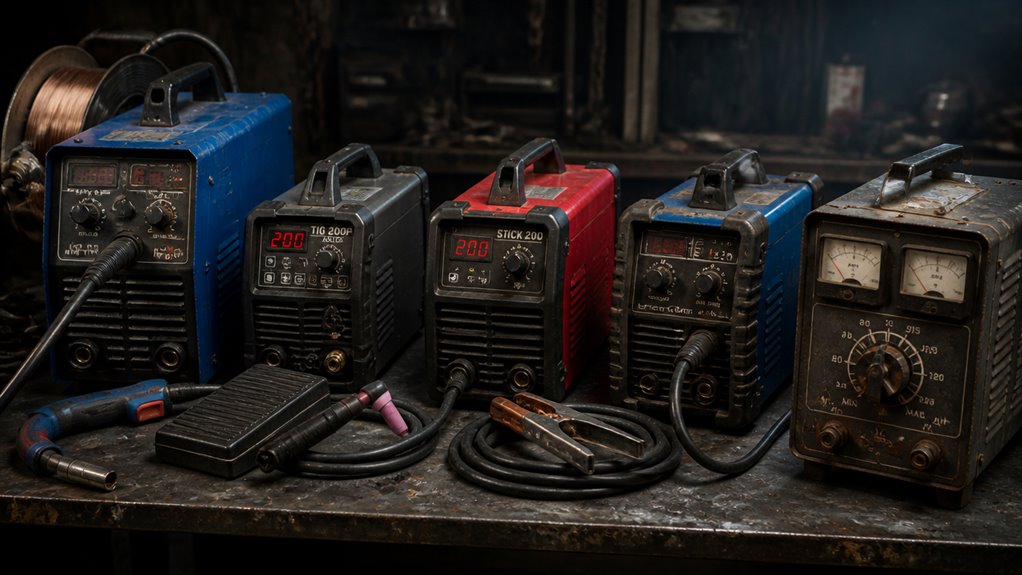
You’ll encounter several welding machines. MIG offers fast, continuous wire feed ideal for general fabrication and auto body work.
TIG provides precise, high-quality welds on thin metals but needs more skill.
Stick welders are tough, portable, and excel outdoors with flux-coated electrodes.
Flux-cored machines combine speed and strength without external gas. They are suited for thick steel in windy conditions.
Multi-process units handle various methods but require investment and skill.
Understanding these helps you match machine to material, environment, and project demands.
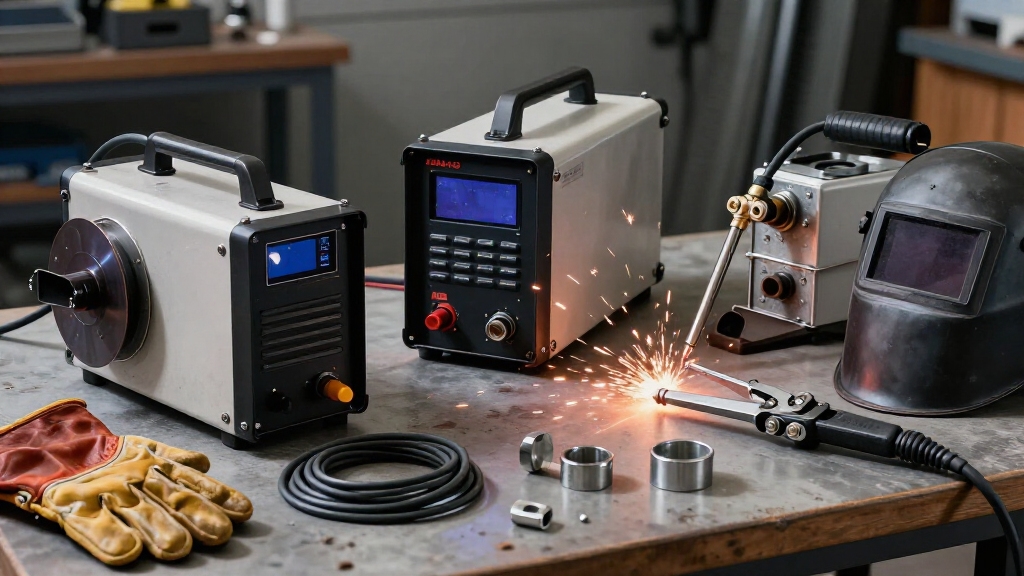
Selecting the right welding machine for your project begins with analyzing the materials you’ll work with and the environment in which you’ll operate.
You need to identify the metal types and thicknesses to determine compatibility with welding processes. For instance, steel and aluminum require different machine capabilities.
Next, consider the working conditions, whether indoors, outdoors, or in confined spaces. This influences protection needs and machine portability.
Evaluate the required weld quality and precision. Critical, thin materials demand more precise control.
Also, factor in your skill level, as some machines require advanced operation.
Finally, assess production speed and budget constraints. By systematically weighing these variables—material, environment, quality, skill, speed, and cost—you’ll select a welding machine optimized for your project’s technical and operational demands.
For example, choosing a machine that supports continuous wire feed can enhance welding speed and efficiency.
When you operate a MIG welding machine, it’s pretty straightforward. The machine feeds a continuous wire electrode right into the weld pool, and at the same time, shielding gas comes in to protect that molten metal from any contamination. Pretty neat, right?
This process really shines when you’re working with materials like steel, stainless steel, and aluminum, especially in controlled shop environments. You’ll find it’s just perfect for fast, general fabrication, auto body work, and even those home repairs where you want to get things done quickly and easily. So, if speed and simplicity are what you’re after, MIG welding is definitely the way to go! The continuous wire-feed and shielding gas automation simplify the welding process, making it ideal for beginners and professionals alike.
MIG welding machines frequently rely on a continuous wire electrode fed steadily through the welding gun to maintain a consistent arc and efficient metal deposition.
This continuous feed eliminates stops and starts inherent in stick welding, allowing you to achieve smoother, more uniform welds with higher deposition rates.
The wire’s diameter and feed speed directly influence penetration depth and bead profile, enabling precise control over weld characteristics.
You’ll find this method ideal for welding steel, stainless steel, and aluminum in controlled environments where efficiency matters.
By maintaining a steady arc length and wire feed, you reduce spatter and improve weld quality.
Understanding wire feed mechanisms helps you optimize performance, especially in fabrication or automotive repairs where speed and consistency are priorities.
The shielding gas selection also plays a crucial role in protecting the weld pool from contamination and optimizing weld quality.
In welding with a continuous wire electrode, shielding gas plays a critical role in protecting the weld pool from atmospheric contamination.
When you operate a MIG welding machine, the shielding gas flows around the arc and molten metal, preventing oxygen, nitrogen, and hydrogen from causing porosity, oxidation, or brittleness.
You need to select the right gas type, argon, CO2, or a blend, based on the metal and welding conditions to optimize arc stability and penetration.
Incorrect or insufficient shielding gas compromises weld quality, leading to defects and weaker joints.
By controlling the gas flow rate and composition, you maintain a clean weld environment, which guarantees consistent deposition and mechanical integrity.
Understanding this interaction is essential for achieving reliable, high-quality welds with MIG equipment.
Blends of argon and carbon dioxide are commonly used to balance arc stability, reduce spatter, and enhance weld appearance on carbon steels.
Controlling shielding gas flow and composition directly influences the quality of welds produced by MIG welding machines.
You’ll find MIG welding excels on steel, stainless steel, and aluminum, especially in controlled shop environments. Its continuous wire feed and gas protection enable fast, efficient welds with minimal spatter.
To optimize your welding, consider the following material and use cases:
| Material | Ideal Use Case |
|---|---|
| Steel | Structural fabrication |
| Stainless Steel | Automotive body repair |
| Aluminum | Lightweight assemblies |
| Mild Steel | General fabrication |
Maintaining the proper shielding gas flow between 20–25 CFH is essential to prevent oxidation and ensure consistent weld quality.
When it comes to welding, choosing TIG machines is often the best route if you need top-notch weld quality. They really shine when working with thin metals like stainless steel and aluminum.
You see, with their non-consumable tungsten electrode and inert gas shielding, you get those precise, clean welds that are hard to beat.
Plus, there’s minimal distortion, which is a huge plus. So, if your project demands both strength and a visually appealing finish, TIG welding is definitely the way to go. It’s all about getting that perfect balance, and TIG makes it happen!
Proper tungsten electrode grinding is essential to ensure arc stability and high-quality welds.
TIG welding machines consistently deliver superior weld quality by producing clean, precise joints with exceptional visual appeal. You’ll notice TIG’s non-consumable tungsten electrode and inert gas shielding minimize contamination.
This allows for tight control over heat input and weld bead formation. This precision reduces defects such as porosity and spatter, essential for structural integrity and aesthetics.
Maintaining a proper shielding gas flow throughout the weld and cooling process is critical to prevent oxidation and ensure corrosion resistance.
| Feature | TIG Welding | Comparison (MIG/Stick) |
|---|---|---|
| Weld Cleanliness | Minimal spatter, no slag | More spatter and slag present |
| Control Precision | High control over heat and filler | Less precise heat/filler control |
| Visual Quality | Smooth, uniform weld beads | Rougher weld appearance |
| Defect Rate | Low porosity and cracking risk | Higher defect susceptibility |
Choosing TIG means prioritizing quality and precision in your welds.
Although welding thin metals demands meticulous heat control to prevent warping or burn-through, TIG welding machines excel in this area due to their precise arc stability and adjustable current.
You can finely tune the amperage to match the metal’s thickness, minimizing heat input and avoiding distortion. The non-consumable tungsten electrode produces a focused arc, enabling you to create narrow, clean weld beads with superior penetration control.
TIG’s inert gas shielding also prevents oxidation, ensuring high-quality welds without contamination. While TIG welding requires more skill and slower operation than MIG, its precision makes it ideal for delicate materials like stainless steel and aluminum.
When your project demands accuracy and a visually flawless weld on thin metals, TIG welding machines offer unmatched control and reliability. The arc initiated by a high-frequency generator without electrode contact enables controlled heat input and bead formation.
When working in outdoor environments or on heavy-duty projects, stick welding machines excel due to their durability and adaptability.
Stick welding machines thrive in tough outdoor conditions thanks to their rugged durability and versatile performance.
You’ll find their flux-coated electrodes create a protective slag that shields the weld puddle from contamination. This makes them ideal for exposed or windy conditions where gas shielding would fail.
Their robustness allows you to weld on dirty, rusty, or painted metals without extensive surface preparation.
Additionally, stick welding delivers deep penetration suitable for thick steel and cast iron, essential in maintenance and structural repairs.
Portability also plays a vital role; you can easily transport these machines to remote locations without relying on external gas supplies.
When your tasks demand reliability in harsh environments and heavy material work, stick welding machines provide unmatched performance and flexibility.
Stick welding is also preferred for its minimal gear requirements, making it practical for on-site and remote jobs.
Boost productivity by choosing flux-cored arc welding machines, which combine wire-feed speed with the convenience of flux shielding.
These machines use a tubular wire filled with flux, eliminating the need for external shielding gas and enabling faster welding in outdoor or windy conditions.
You’ll achieve higher deposition rates compared to traditional MIG welding, making them ideal for thick plate structural work.
While they generate slag that requires post-weld removal, the flux core enhances penetration and weld strength, especially on heavy sections.
Their design supports continuous feeding, reducing downtime and increasing overall efficiency.
If your projects demand rapid, robust welds in less controlled environments, flux-cored arc welding machines deliver superior speed and mechanical integrity, optimizing both fabrication and repair workflows without sacrificing weld quality.
Additionally, the self-shielded flux core process offers consistent welds with minimal spatter, reducing cleanup time and improving overall productivity.
Since welding projects often vary in material type and complexity, multi-process welding machines provide essential versatility by integrating multiple welding methods like MIG, TIG, and Stick into one unit.
Multi-process welding machines offer vital versatility by combining MIG, TIG, and Stick welding in a single unit.
This integration allows you to switch seamlessly between welding processes based on material thickness, joint design, and environmental conditions without needing separate equipment.
You’ll appreciate how this flexibility optimizes workflow and reduces setup time, especially in small shops or mobile repair scenarios.
Although multi-process machines have a higher upfront cost, they eliminate the need to purchase and maintain multiple dedicated machines.
Although each welding machine type shares the core function of joining metals, their best applications vary markedly based on material compatibility and project requirements.
You’ll find MIG welders ideal for steel, stainless steel, and aluminum in fabrication or auto body repairs, thanks to fast deposition.
TIG welders excel with thin metals and critical welds on stainless steel and aluminum, offering precision but requiring skill.
Stick welders handle steel and cast iron in outdoor or maintenance settings where surface contamination exists.
Flux-cored arc welders suit thick plate and structural projects outdoors, emphasizing speed despite slag removal needs.
Multi-process machines offer adaptability across these materials and project types, ideal if you want one unit for varied tasks.
Choose based on metal type, environment, and weld quality demands.
In the world of industrial fabrication, you’re going to come across some pretty specialized welding machines. Take submerged arc welders, for example. They really shine in heavy industrial settings because they automate the process and provide high deposition rates, making them ideal for large-scale projects.
Then there are resistance welding techniques, like spot welding. These methods are fantastic for efficiently joining overlapping metal sheets, especially in mass production environments. It’s amazing how quickly and effectively they work!
For tasks that require precision, you can’t go wrong with plasma arc and laser welding machines. They offer controlled, high-quality welds that are crucial in advanced manufacturing. It’s fascinating how technology has evolved to meet the demands of modern fabrication!
Submerged arc welding (SAW) utilizes a continuously fed consumable electrode and a blanket of granular flux to create deep, high-quality welds in heavy industrial fabrication.
You’ll find SAW especially effective for thick steel sections, where its concentrated arc and flux coverage minimize spatter and contamination.
The granular flux acts as a protective barrier, stabilizing the arc and improving weld integrity by preventing oxidation.
SAW machines often integrate automated wire feeders and flux recovery systems, optimizing deposition rates and reducing material waste.
This process excels in producing uniform, defect-free welds with high penetration, making it ideal for large structural components, pressure vessels, and shipbuilding.
However, SAW demands precise parameter control and is limited to flat or horizontal positions, so you’ll need specialized equipment and setup to maximize efficiency and weld quality.
Joining metal sheets through resistance welding techniques offers a highly efficient and controlled method essential for industrial fabrication.
Resistance welding, especially spot welding, excels in joining overlapping sheets by applying pressure and electrical current. This process produces consistent, strong bonds without filler material.
It minimizes distortion and enables rapid cycle times, making it ideal for mass production like automotive assembly. When you use resistance welders, you control parameters precisely—current, pressure, and time—to guarantee peak joint integrity.
Experience unmatched speed in repetitive, high-volume welding tasks. Achieve uniform weld quality critical for structural safety.
Reduce post-weld cleanup with minimal spatter and no slag. Rely on robust equipment designed for heavy industrial environments.
Resistance welding machines stand out for their reliability and repeatability in demanding fabrication settings.
Precision plasma and laser welding machines frequently deliver exceptional control and accuracy for industrial fabrication tasks that demand exacting standards. You rely on plasma welding when you need a highly concentrated arc to precisely cut or join metals with minimal heat distortion.
It’s ideal for thin materials and complex geometries, offering deep penetration and fast welding speeds. Laser welding, on the other hand, uses a focused light beam to achieve even finer control, producing narrow, clean welds with minimal thermal impact.
You’ll find laser welding indispensable for high-volume production where repeatability and speed are critical. Both systems require advanced setup and skilled operators but excel in aerospace, automotive, and electronics fabrication where precision and quality can’t be compromised.
Their specialized nature justifies the investment for demanding industrial applications.
Frequently, when selecting a welding machine, you’ll need to balance cost against portability based on your project requirements.
Stick welders tend to be the most portable and affordable, making them ideal for fieldwork and rough conditions.
MIG and flux-cored machines offer moderate portability but at a higher price, suitable for shop and repair tasks.
TIG welders, while more expensive and less portable due to precision needs and shielding gas, provide superior weld quality.
Multi-process units combine versatility but increase upfront cost and weight.
Consider these emotional triggers when evaluating your choice:
When choosing a welding machine, you’ll want to evaluate factors such as the materials you’ll work with, the typical project environment, and your skill level.
For instance, MIG welders excel on steel and aluminum in controlled shop settings and suit beginners due to ease of use.
TIG welders provide precision for thin metals but require advanced skill and slower operation.
Stick welders offer portability and reliability outdoors or on rusty surfaces, ideal for maintenance.
Consider flux-cored machines if you need fast, heavy-duty welding in outdoor structural work despite increased slag.
Multi-process machines suit diverse tasks but demand higher investment.
Match machine type to material thickness, environment, and operator proficiency to optimize performance, cost, and project outcomes effectively.
You must wear a welding helmet with a proper shade lens to protect your eyes from intense UV and infrared radiation.
Use flame-resistant gloves and long-sleeve jackets to shield your skin from sparks and heat.
Respiratory protection is vital, especially with processes producing fumes, like flux-cored welding.
Guarantee sturdy, closed-toe boots and ear protection if noise levels are high.
Always work in a well-ventilated area to minimize inhalation hazards.
You’ll never escape maintenance demands when welding, but they vary widely by type.
MIG machines need regular wire feed cleaning and gas flow checks to prevent blockages.
TIG welders require electrode care and gas purity monitoring for precision.
Stick welders demand electrode holder inspection and slag removal.
Flux-cored units need wire feed upkeep and slag cleaning.
Multi-process machines require combined attention, while industrial systems call for detailed calibration and component servicing.
Yes, you can use welding machines for artistic or sculptural metalwork.
MIG and TIG machines are especially suited due to their control and precision.
TIG welding lets you create fine, clean lines on thin metals, ideal for detailed sculptures.
MIG machines offer faster deposition but less finesse.
Stick and flux-cored welders handle heavier materials but may produce rougher finishes, requiring more post-weld cleanup for artistic purposes.
You should start troubleshooting welding machine malfunctions by checking power supply connections and ensuring proper voltage.
Inspect cables, electrode holders, and grounding clamps for wear or damage.
Verify shielding gas flow and regulator settings if applicable.
Clean contact tips and check wire feed mechanisms.
Test the machine’s settings and controls for correct parameters.
If problems persist, consult the user manual or manufacturer support for diagnostic codes or advanced repairs.
Imagine voltage as the pressure pushing electricity through your welding circuit, while amperage is the volume of that flow.
You control the weld’s heat and penetration by adjusting these.
Higher voltage smooths the arc and widens the bead, but too much can cause spatter.
Increasing amperage boosts melting rate and penetration, but excessive amperage risks burn-through.
Balancing both precisely guarantees stable arc performance and peak weld quality.
Choosing the right welding machine isn’t just important; it’s absolutely mission-critical. Picking the wrong type can turn your project into a disaster zone, wasting time, money, and materials like there’s no tomorrow.
Whether you need precision with TIG or brute strength with Stick welding, understanding each machine’s nuances guarantees flawless results. Don’t underestimate how the right choice can turbocharge your work.
Select wisely or risk your entire project collapsing under avoidable errors.