Phone:
(701)814-6992
Physical address:
6296 Donnelly Plaza
Ratkeville, Bahamas.

Phone:
(701)814-6992
Physical address:
6296 Donnelly Plaza
Ratkeville, Bahamas.

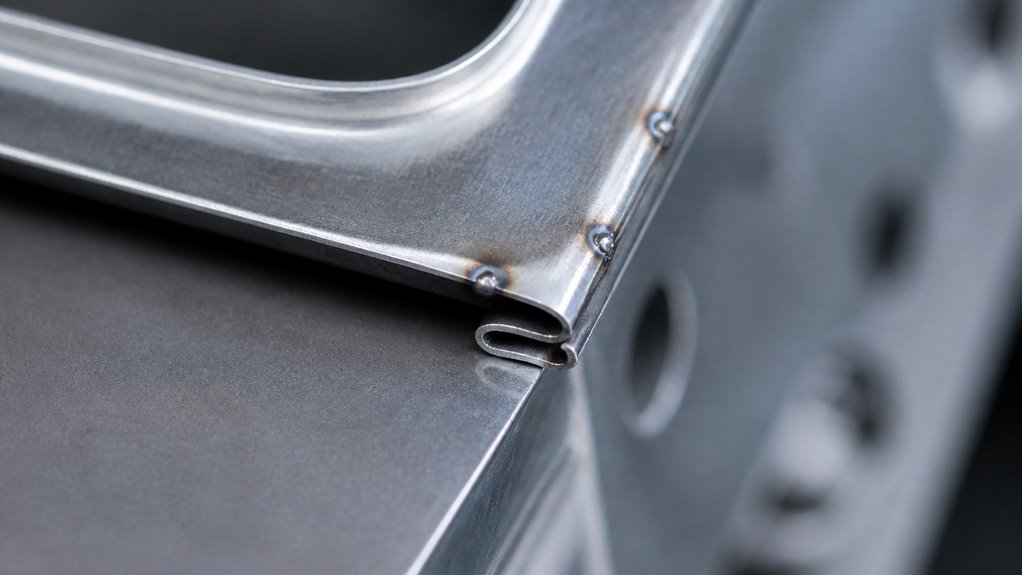
A pinch weld is a strong, precise welded seam where overlapping sheet metal panels join using resistance spot welding.
You rely on it to form rigid flanges that add structural strength, guarantee alignment, and provide a secure bonding surface for automotive glass.
These welds appear along lower body sections, door sills, and window perimeters, delivering essential support for safety and durability.
Understanding their formation, function, and impact on repairs reveals why pinch welds are critical to your vehicle’s integrity.
Pinch welds play a critical role in automotive design by providing strong, welded joints that enhance the structural integrity of unibody vehicles.
You’ll find these seams where two sheet metal panels overlap and are joined via resistance spot welding, creating a flange or lip integral to the body’s lower structure.
This welded seam isn’t just a connection; it forms a reinforced junction that supports the chassis and rocker panels.
The geometry of pinch welds is commonly L-shaped but sometimes flat or Z-shaped, varying depending on their location and functional requirements.
In window openings, the pinchweld forms the bonding surface for glass adhesives or gaskets, ensuring a secure fit.
When welding is not feasible, alternatives like mechanical fastening methods can provide reliable joint strength without heat.
When two sheet metal panels are joined by resistance spot welding, they form a flange that enhances the vehicle’s lower body structure. This flange, known as the pinch weld, creates a reinforced seam that improves rigidity, distributes stress, and maintains panel alignment.
You’ll find these welds essential for structural integrity, especially in the rocker and floor areas, where load-bearing strength is critical.
| Feature | Function | Benefit |
|---|---|---|
| Resistance Spot Weld | Joins overlapping panels | Strong, consistent seam |
| Flange Formation | Creates lip along seam | Enhanced structural rigidity |
| Load Distribution | Spreads impact forces | Reduces stress concentration |
| Alignment Maintenance | Keeps panels flush | Prevents deformation |
| Reinforced Support | Adds strength | Improves crash resistance |
Pinch welds serve as key structural components you rely on for safety and durability. Similar to how welded wire mesh uses tightly welded joints to prevent sagging and deformation, pinch welds ensure long-lasting strength and stability through precise seam formation and reinforcement of critical areas, providing structural integrity that withstands stress and environmental forces.
Although they mightn’t be immediately visible, the reinforced seams created by resistance spot welding are strategically placed along the lower chassis and rocker areas of your vehicle.
You’ll find pinch welds running beneath the doors, extending between the front and rear wheel wells, providing critical structural continuity.
Around window and windshield openings, the pinchweld forms the perimeter flange where glass bonds or gaskets fit precisely.
The floor of this seam acts as the adhesive surface, while the vertical wall often secures trim or moldings.
These locations aren’t arbitrary; each pinch weld is positioned to optimize load transfer and maintain body rigidity.
Understanding these common locations helps you identify safe lifting points and informs accurate repair or glass installation without compromising the vehicle’s structural integrity.
Proper welding preparation and positioning, such as precise machining or beveling, are essential to ensure reliable and strong pinch welds in automotive applications.
You’ll often come across L-shaped pinchwelds. They really shine when it comes to providing robust flange support along body panel joints. It’s like they were made for the job!
Then, you’ve got flat pinchwelds. You’ll typically find these in places like the A-pillar. They offer a nice, simple, and planar seam for bonding or attachment. It’s straightforward but effective!
And let’s not forget about Z-shaped pinchwelds. These are usually found in lower body sections. They’re designed to optimize strength while fitting specific structural requirements. It’s all about making sure everything fits just right!
Pinchwelds often require precise joining techniques, making welding a critical step in ensuring their structural integrity and durability.
Among the various pinch weld designs, the L-shaped pinchweld is the most prevalent due to its ideal balance of strength and ease of manufacturing.
You’ll find this design where two sheet metal panels overlap at roughly a 90-degree angle. This creates a flange that enhances rigidity and simplifies welding. Its geometry supports structural loads effectively, especially along rocker panels and lower chassis areas.
Here’s what makes the L-shaped pinchweld distinct:
Understanding this shape helps you recognize its critical role in vehicle body integrity. Proper welding techniques, including selecting the correct tip size for wire feeding, are essential to maintain the strength and quality of such welds.
Flat and Z-shaped pinchwelds serve specific structural and installation functions that differ from the more common L-shaped design.
You’ll find flat pinchwelds typically in areas like the A-pillar, where a smooth flange is necessary for glass bonding or gasket seating.
Z-shaped pinchwelds appear in lower body sections, providing enhanced rigidity and complexity for mounting or load distribution.
Understanding these forms helps you identify correct lifting points and secure glass installation surfaces.
Proper surface preparation and maintaining clean contact points are essential for ensuring consistent weld quality when working with these pinch weld types.
| Shape | Location | Function |
|---|---|---|
| Flat | A-pillar, window | Smooth surface for bonding glass |
| Z-shaped | Lower rocker panels | Provides structural rigidity |
| L-shaped | Door sills, chassis | Common, versatile joint |
| Notched | Lifting points | Reinforced for jack placement |
Manufacturers create pinch welds by joining two overlapping sheets of metal using resistance spot welding. This process applies pressure and an electrical current to fuse the materials at precise points.
Pinch welds are formed by fusing overlapping metal sheets with pressure and electric current at precise spots.
You’ll find this method guarantees a strong, consistent bond along the vehicle’s body seam. Here’s how the process unfolds:
This technique produces a reinforced flange or lip, vital for structural integrity and subsequent assembly steps. The precision of spot placement and pressure ensures uniform strength along the pinch weld seam. Proper control of weld time and current is critical to avoid defects and ensure a durable joint.
The resistance spot welding process that forms pinch welds creates a rigid and uniform flange. This flange serves as the primary surface for bonding automotive glass.
When you install windshield or window glass, you rely on this flange to provide a consistent, clean surface for adhesive application. The pinch weld’s precise geometry guarantees the adhesive forms a strong, continuous bond, critical for sealing and structural support.
If the pinch weld is uneven or damaged, the glass may not seat properly, risking leaks or detachment. Additionally, the flange’s rigidity helps distribute stresses around the glass perimeter, enhancing durability.
Understanding the pinch weld’s role helps you ensure proper glass alignment and adhesion. This knowledge can prevent issues related to fitment and long-term performance. For minor damage, temporary fixes using non-weld repair techniques can help maintain flange integrity until professional service is available.
Because pinch welds form a critical structural seam along the vehicle’s lower body, any damage to them can compromise both repair quality and occupant safety.
When you handle repairs or lifting, you rely on the pinch weld’s strength and integrity. Here’s why they matter:
If you neglect pinch weld condition, you risk weakening structural joints, misaligning panels, or increasing injury hazards.
Keeping these seams intact is essential for effective, safe repairs and vehicle longevity. Proper inspection and maintenance of pinch welds are vital to prevent structural integrity issues that could compromise safety.
When pinch welds sustain damage, you face significant challenges during vehicle repairs that can compromise both fitment and structural integrity.
Deformed or crushed pinch welds can distort adjacent panels, making proper alignment difficult and increasing the risk of gaps or uneven seams.
Because pinch welds contribute to the vehicle’s lower body strength, any bending or cracking reduces load-bearing capacity. This potentially affects crashworthiness and long-term durability.
Additionally, damaged pinch welds may hinder accurate placement of replacement parts, such as rocker panels or glass. These rely on the original geometry for secure bonding or attachment.
If you overlook pinch weld damage, repairs may not restore factory tolerances, leading to premature wear or failure.
Consequently, precise inspection and correction of pinch weld areas are critical for effective, safe vehicle restoration.
When repairing or joining metal components like pinch welds, it is essential to consider corrosion protection to prevent long-term damage and ensure durability.
Although pinch welds run continuously along the lower body, you can’t safely lift a vehicle just anywhere on this seam. The pinch weld serves as a reinforced joint, but only specific sections are engineered to bear lifting forces.
To identify safe jacking points, you should:
Following these guidelines guarantees structural integrity and safe lifting during maintenance or tire changes.
Yes, you can repair damaged pinch welds without replacing entire panels, but it requires precision.
You’ll need to straighten bent sections using specialized tools to restore proper geometry. Minor cracks or breaks can be welded carefully with spot welding or MIG techniques to regain strength.
After repair, verify alignment and structural integrity since improper fixes compromise safety and lifting capabilities. Always follow manufacturer guidelines and use protective measures to avoid further damage.
Yes, pinch weld damage can lower your vehicle’s resale value since it indicates potential structural issues or previous repairs.
Buyers and inspectors often scrutinize these seams because they contribute to body integrity and safe lifting points.
If the welds are bent, crushed, or poorly repaired, it raises concerns about accident history or weakened support.
Maintaining or professionally repairing pinch welds preserves your car’s structural reliability and resale appeal.
Of course, those essential pinch welds are totally immune to rust if you believe metal magically resists corrosion.
In reality, they’re prone to rusting because moisture and road salt often accumulate in these seams. Their overlapping design traps debris, making corrosion a frequent issue.
You should inspect and treat pinch welds regularly to prevent structural weakening and compromised lifting points. This ensures your vehicle’s body integrity remains intact over time.
Pinch welds markedly impact your vehicle’s crash safety ratings by reinforcing body panel joints, especially in rocker and lower chassis areas.
They create strong, continuous seams that absorb and distribute crash forces, maintaining structural integrity. If these welds are compromised or poorly designed, your vehicle’s ability to manage impact energy decreases, lowering safety ratings.
Properly engineered pinch welds guarantee your car’s frame holds up during collisions, protecting occupants effectively.
Can you trust every aftermarket part to maintain your pinch weld’s strength?
Aftermarket components can definitely alter the integrity of pinch welds if they don’t match factory specifications.
Improper fitment, different metal thicknesses, or welding methods may weaken these structural joints.
That compromises load distribution and safe lifting points.
Always confirm aftermarket parts are designed and installed precisely to preserve the pinch weld’s critical structural and service functions.
Understanding pinch welds is like uncovering the vehicle’s hidden backbone. They quietly fuse strength and safety where you least expect it.
When you respect their role in structural integrity, glass installation, and repair precision, you’re not just maintaining metal; you’re preserving engineered resilience.
Treat pinch welds with care, especially when jacking or repairing. Damaging these critical seams can unravel the very framework that holds your car’s safety and performance together.