Phone:
(701)814-6992
Physical address:
6296 Donnelly Plaza
Ratkeville, Bahamas.

Phone:
(701)814-6992
Physical address:
6296 Donnelly Plaza
Ratkeville, Bahamas.

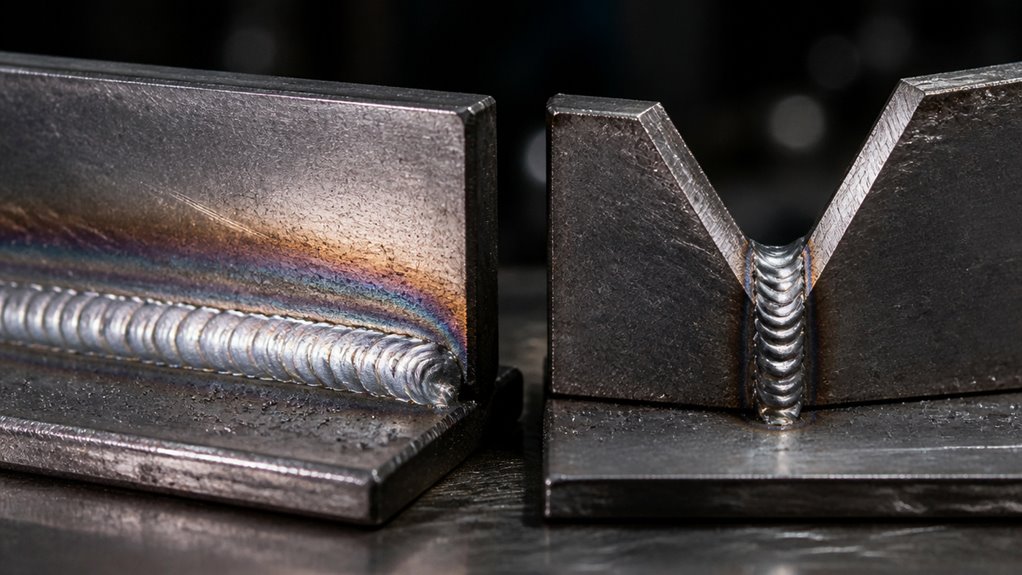
When deciding between fillet and groove welds, consider your joint type and strength needs.
Fillet welds suit angled joints like T-joints and lap joints. They require minimal prep and are faster and cheaper, but offer limited penetration and strength.
Groove welds join edges with beveled preparations. They provide deeper fusion and deliver full penetration for load-bearing or critical applications.
You’ll want groove welds for thicker materials or high-strength demands, while fillet welds work for general fabrication where speed matters.
Explore how joint geometry and inspection impact these choices further.
| Feature | Fillet Weld | Groove Weld |
|---|---|---|
| Joint Type | T-joints, lap joints, and corner joints | Butt joints and edge-to-edge joints |
| Joint Preparation | Minimal or none required | Requires beveling and groove preparation |
| Welding Speed | Faster | Slower |
| Fabrication Cost | Lower | Higher |
| Skill Requirement | Moderate | Higher |
| Weld Penetration | Limited penetration | Deep or full penetration |
| Joint Strength | Moderate | High |
| Load-Bearing Capacity | Suitable for general loads | Ideal for heavy and critical loads |
| Material Thickness | Thin to medium materials | Medium to thick materials |
| Weld Appearance | Triangular cross-section | Flush or reinforced groove profile |
| Distortion Control | Good | May require more control measures |
| Inspection Requirements | Primarily visual inspection | Often requires NDT testing |
| Labor Requirements | Lower | Higher |
| Structural Applications | General fabrication and support structures | Structural steel, pressure vessels, pipelines |
| Production Efficiency | High | Moderate |
| Common Defects | Undercut, lack of fusion, porosity | Incomplete penetration, slag inclusions, cracking |
| Main Advantage | Fast, economical, and easy to apply | Maximum strength and penetration |
| Main Drawback | Lower strength and penetration | Higher cost and preparation time |
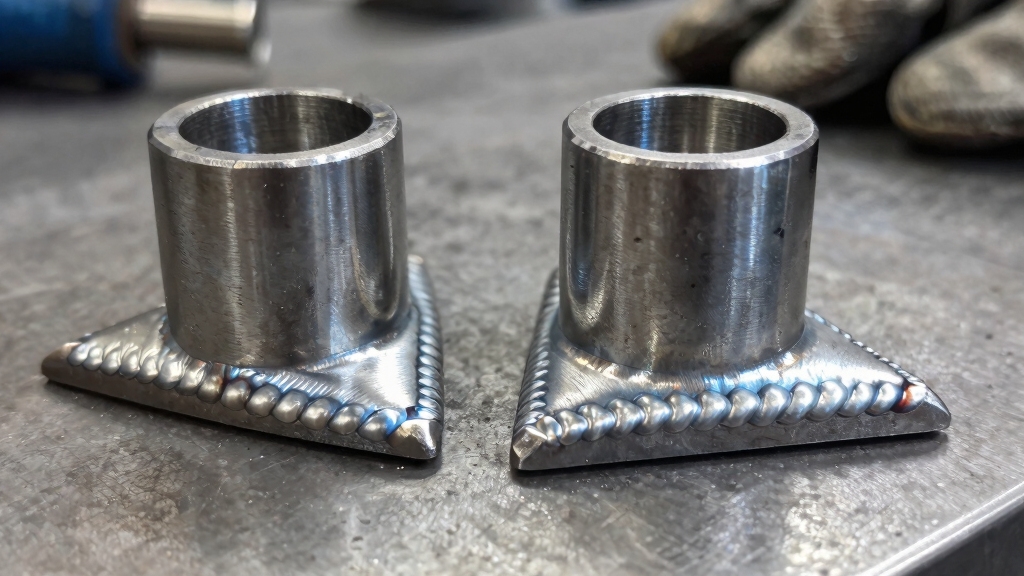
While both fillet and groove welds serve to join metal components, they differ fundamentally in joint design and application.
Fillet welds connect surfaces at an angle, typically in T-joints, lap joints, or corner joints, with geometry defined by leg size and throat.
Groove welds, however, join members edge-to-edge with a prepared bevel or groove, commonly in butt joints, where bevel angle, root face, and root opening dictate geometry.
Groove welds allow deeper penetration due to joint preparation, enhancing strength and access.
Fillet welds require minimal preparation and are simpler, while groove welds need precise beveling and skilled labor.
Selecting between them depends on joint type, strength requirements, and fabrication complexity.
Groove welds are favored for critical, high-strength applications, while fillet welds are used for general, angled joins.
Butt welds, a common type of groove weld, provide full penetration and base-metal-equivalent strength for load-bearing and pressure applications.
Sure! Here’s a more conversational version of your text:
—
You know, joint geometry really plays a crucial role in determining weld strength. It basically controls how deep the weld penetrates and how the load gets distributed. For instance, when you look at fillet welds, they depend heavily on their leg and throat dimensions, especially at angled joints. This can actually limit how deep the penetration goes.
On the other hand, groove welds are a bit different. They use bevel angles and root openings to achieve a deeper fusion. This design really shines in butt joints, leading to higher strength overall. It’s fascinating how these details can make such a big difference, isn’t it?
In fact, using double groove welds can further enhance strength and reduce distortion by welding from both sides of the joint.
—
Because joint geometry directly affects weld strength, understanding its impact is essential when selecting between fillet and groove welds.
You’ll see that fillet welds rely on leg size and throat dimensions, influencing load distribution on angled joints. Groove welds, meanwhile, depend on bevel angle, root face, and opening, allowing you to optimize penetration and joint strength in butt joints.
| Joint Type | Key Geometric Factors | Impact on Weld Strength |
|---|---|---|
| Fillet Weld | Leg size, throat | Controls shear capacity on angled joints |
| Groove Weld | Bevel angle, root face | Enables deeper penetration, higher tensile strength |
| Groove Weld | Root opening | Affects weld access and fusion quality |
You should choose geometry that aligns with load demands and welding access for efficient, strong joints. Proper measurement and verification of fillet weld leg size and throat ensure compliance with AWS D1.1 minimums and reliable joint performance.
Although joint geometry varies greatly between fillet and groove welds, it fundamentally governs weld strength by controlling penetration and load distribution.
In fillet welds, the leg size and throat define the weld’s ability to transfer loads across angled surfaces. However, the lack of groove preparation limits penetration depth, resulting in lower strength compared to groove welds.
Groove welds rely on precise bevel angles, root faces, and root openings to create a joint that facilitates deep fusion between base metals. This maximizes penetration and joint capacity.
By adjusting groove dimensions, you can optimize weld strength for demanding applications. Consequently, understanding the geometric parameters is vital.
Groove welds typically achieve superior load-bearing performance through enhanced penetration, while fillet welds offer simpler geometry but reduced penetration and strength.
Controlling heat input during welding is essential to manage weld pool formation and optimize penetration depth for both fillet and groove welds.
Groove welds really stand out when it comes to penetration. Why? Well, it’s all about that beveled joint design. This shape allows the weld metal to fuse deeply with the base metals, creating a strong bond.
And here’s the cool part: this enhanced penetration means higher joint strength. This is especially true for full-penetration welds, where load capacity is super important.
Achieving full penetration in thick plates often requires multi-pass welding to ensure strength and minimize defects.
Groove welds achieve superior penetration by utilizing a prepared bevel or groove that exposes more of the joint’s base metal. This allows the weld to fuse deeply into the materials.
This joint geometry guarantees the welding arc reaches the root, enabling full or partial joint penetration and minimizing unwelded areas. You gain consistent metallurgical bonding through the entire thickness, which fillet welds can’t accomplish due to their lap or T-joint configurations.
With groove welds, you control bevel angle, root opening, and depth to optimize penetration based on material thickness and welding parameters. Consequently, groove welds provide a more uniform fusion profile, reducing defects like lack of fusion or incomplete penetration.
This precise control over weld access and heat distribution directly enhances penetration quality. This is critical for load-bearing applications requiring dependable weld integrity. Achieving complete joint penetration requires precise groove design and skilled welding techniques to ensure full fusion through the joint thickness.
When you require maximum strength and reliable load-bearing capacity, groove welds deliver superior performance due to their full or partial penetration capabilities. This depth of fusion guarantees the weld metal integrates thoroughly with the base metals, eliminating gaps and discontinuities found in fillet welds.
You benefit from a joint that better resists tensile, shear, and bending stresses. Groove weld strength is directly influenced by bevel angle, root face, and weld fill, allowing precise control over joint integrity. In contrast, fillet welds, limited by their throat size and geometry, inherently possess lower strength because they don’t fully penetrate the joint.
For critical applications, groove welds provide predictable, higher load capacity and fatigue resistance. This makes them the preferred choice when structural demands exceed what fillet welds can reliably handle. Proper control of fusion and penetration is essential to achieve these strength benefits and avoid weak points that compromise joint integrity.
Frequently chosen for their efficiency, fillet welds offer significant advantages in speed and cost savings during fabrication.
Fillet welds are favored for their efficiency, providing faster fabrication and notable cost savings.
You’ll want to choose fillet welds when joint preparation needs to be minimal since these welds require little to no edge preparation. This reduces fabrication time and labor costs.
Fillet welds suit T-joints, lap joints, and corner joints where members intersect at angles rather than end-to-end. Because they don’t demand groove beveling or precise root openings, fillet welds allow faster setup and welding cycles.
Additionally, you can rely on less skilled labor for fillet welding, further lowering expenses.
However, you should select fillet welds primarily when the load requirements don’t necessitate full penetration or maximum joint strength. This allows you to capitalize on simplicity and rapid execution without compromising reasonable structural integrity.
Proper workpiece preparation and positioning help ensure consistent weld quality even with fillet welds.
While fillet welds excel in speed and cost efficiency, understanding their most suitable applications alongside groove welds helps you select the best method for your construction needs.
You’ll find fillet welds ideal for T-joints, lap joints, and corner joints in general structural work and high-volume fabrication where full penetration isn’t critical. They suit angled member connections and non-butt joint configurations, offering simplicity and lower fabrication effort.
Conversely, groove welds are essential for butt joints requiring full or partial penetration, especially in thick plates and high-strength assemblies. Use groove welds when maximum joint strength and limited deformation are priorities, despite higher preparation and labor costs.
Your weld choice depends on joint type, thickness, load demands, and inspection requirements, balancing efficiency with structural integrity. Proper welding preparation and positioning is crucial to avoid misalignment and ensure reliable, leak-proof joints in both fillet and groove weld applications.
Since weld integrity directly impacts structural performance, you must apply rigorous inspection and quality control measures tailored to fillet and groove welds.
For fillet welds, focus on visual inspection of leg size, throat dimensions, and fusion at the root and toe to guarantee adequate strength. This helps avoid undercuts or lack of fusion.
Groove welds demand more all-encompassing testing, including dimensional verification of bevel angle, root opening, and fill quality.
Non-destructive testing methods such as ultrasonic or radiographic testing are often necessary to detect internal defects and confirm full joint penetration.
Accurate groove preparation and consistent weld penetration are critical to prevent flaws that compromise strength.
Adhering to these inspection criteria guarantees each weld type meets its structural requirements efficiently and safely.
Employing non-destructive inspection techniques ensures welds meet design specifications and safety standards.
For fillet welds, you’ll typically use MIG or stick welding equipment because they’re efficient and require minimal joint preparation.
They also provide good control over bead size.
For groove welds, especially full-penetration types, TIG or flux-cored arc welding (FCAW) often works best.
These methods offer precise control and deeper penetration.
You’ll need equipment capable of handling groove preparation and skilled operation to guarantee consistent weld quality and strength.
Environmental conditions can throw a wrench in your weld quality. Wind and moisture can cause porosity and weaken both fillet and groove welds.
Groove welds suffer more because they rely on deep penetration. Cold temperatures slow cooling, risking cracks in groove welds, while fillet welds may experience less distortion.
Dust or contaminants reduce fusion quality, demanding cleaner conditions. You must control the environment tightly to maintain consistent, reliable weld integrity.
Yes, you can combine fillet and groove welds in a single joint when design demands both penetration and speed.
You’d typically apply a groove weld along the joint root for strength and full penetration.
Then add fillet welds on the joint’s edges to increase load capacity or stiffen the assembly.
This hybrid approach balances fabrication time and cost while meeting structural requirements, especially in complex or heavily loaded connections.
Imagine a weld as a bridge. If cracks or voids appear, that bridge weakens.
In fillet welds, you’ll often face porosity, undercut, and lack of fusion at the toe or root.
Groove welds commonly suffer from incomplete penetration, slag inclusions, and cracks within the groove.
Both require meticulous control of heat, angle, and cleanliness.
Spot these defects early, or your weld’s strength and integrity will falter under stress.
You’ll find welding position markedly affects fillet and groove weld performance.
Fillet welds handle various positions better due to their simpler geometry and quicker execution. This makes vertical or overhead welds easier.
Groove welds require precise joint prep and deeper penetration. Positional challenges can increase defect risk and reduce strength, especially in vertical or overhead orientations.
You must adjust technique and parameters carefully to maintain groove weld integrity across positions.
When deciding between fillet and groove welds, remember groove welds offer up to 30% greater strength due to deeper penetration. This makes them ideal for critical joints.
Fillet welds, however, save time and cost in less demanding scenarios. By understanding joint geometry and application needs, you can optimize weld performance and efficiency.
Accurate inspection guarantees quality, preventing failures. Choosing wisely based on these factors enhances both safety and project success.