Phone:
(701)814-6992
Physical address:
6296 Donnelly Plaza
Ratkeville, Bahamas.

Phone:
(701)814-6992
Physical address:
6296 Donnelly Plaza
Ratkeville, Bahamas.

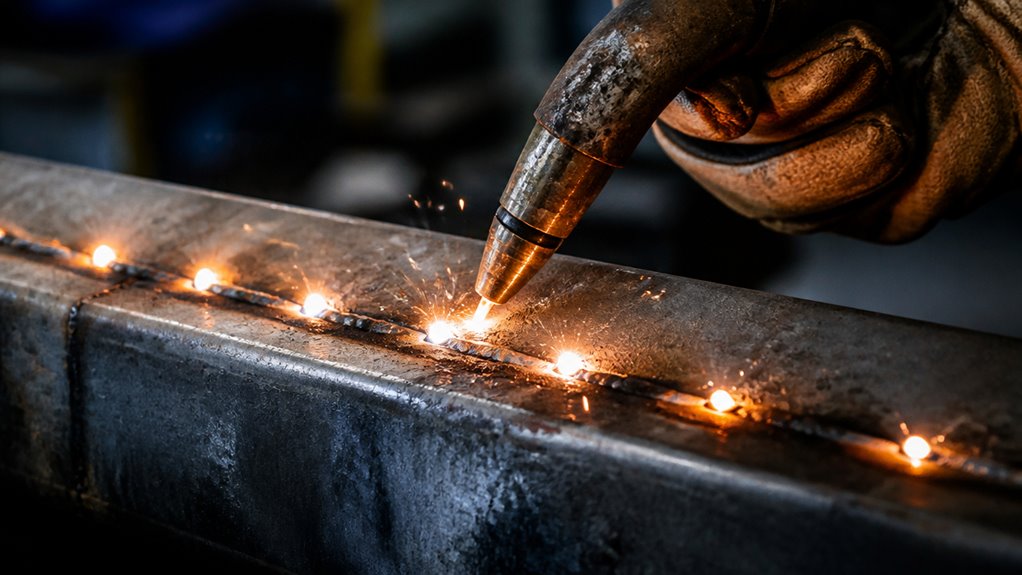
Stitch welding applies a series of short, intermittent weld beads along a joint with gaps between them. This controls heat input to minimize distortion and preserve material properties.
You’ll typically use this method for thin or heat-sensitive metals, like galvanized steel or aluminum, where managing thermal effects is critical.
By balancing weld length and pitch, you reduce heat-affected zones and maintain corrosion resistance while ensuring joint strength.
Understanding these principles can help you optimize your welding process for quality and performance.
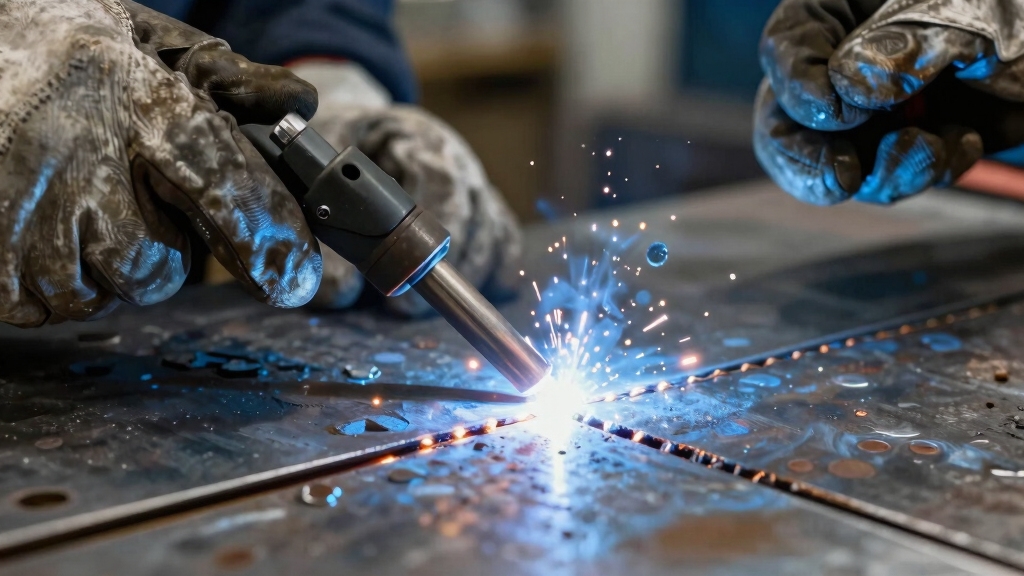
Stitch welding creates a series of short weld beads spaced along a joint, rather than a continuous seam.
Stitch welding forms multiple short weld beads along a joint instead of one continuous seam.
You apply a weld bead of specific length, pause, then leave a gap before placing the next bead. This defines the pattern by weld length and pitch, which is the distance between weld centers.
This intermittent pattern reduces total heat input compared to a continuous weld, helping you control metal expansion and contraction.
You can use stitch welding on both corner and flat joints. It’s often applied as a final welding method rather than just tacking.
Some systems even incorporate stitch welding as a weaving pattern within a weld node.
This technique helps manage the heat-affected zone size to minimize distortion and preserve material properties.
When you look at stitch welding and seam welding, the main difference really comes down to the weld pattern. Stitch welding uses these intermittent welds that leave gaps, while seam welding provides a continuous bead along the joint.
Now, this difference in pattern has a significant impact on heat input. With stitch welding, you get less thermal distortion because it limits the amount of heat applied. On the flip side, seam welding delivers consistent heat, which helps create a stronger joint integrity. Proper heat input control is essential to balance weld strength and minimize distortion in both methods.
Understanding the fundamental differences between stitch welding and seam welding helps you select the most appropriate weld pattern for your application.
Stitch welding uses intermittent welds with gaps, reducing heat input and distortion.
Seam welding creates a continuous weld for maximum joint strength and sealing.
Your choice depends on factors like required strength, heat sensitivity, and fabrication speed.
Both methods can benefit from semiautomatic welding processes to enhance productivity and precision.
| Aspect | Stitch Welding |
|---|---|
| Weld Pattern | Intermittent welds with gaps |
| Heat Input | Lower, reduces distortion |
| Joint Strength | Moderate, not fully continuous |
| Aspect | Seam Welding |
| Weld Pattern | Continuous weld |
| Heat Input | Higher, more heat and distortion |
| Joint Strength | Maximum, fully bonded joint |
Heat management plays a crucial role in determining the performance and durability of welded joints.
With stitch welding, you introduce intermittent heat input, reducing overall thermal stress and limiting distortion in the metal.
In contrast, seam welding applies continuous heat, creating a larger heat-affected zone (HAZ) but delivering stronger, fully bonded joints.
When comparing heat and strength, consider these key differences:
Stitch welding reduces expansion and contraction by allowing cooling intervals.
Seam welding produces higher joint strength due to continuous fusion.
Stitch welding minimizes filler metal use and fabrication time.
Seam welding guarantees a sealed, continuous bond, critical for pressure or corrosion resistance.
Choosing between the two depends on your application’s thermal sensitivity and strength requirements.
For thicker materials, multi-pass welding with controlled heat input is essential to ensure full penetration and minimize distortion.
Stitch welding offers you significant advantages in controlling distortion and minimizing thermal impact on thin or heat-sensitive materials.
By applying intermittent welds with gaps, you reduce overall heat input, which limits expansion and contraction in the base metal.
This approach decreases the heat-affected zone (HAZ), preserving the mechanical properties around the weld.
Additionally, you use less filler metal compared to continuous welding, resulting in material savings and faster fabrication times.
The weld pattern also helps prevent fatigue cracks from propagating along a long seam, enhancing structural durability in cyclic loading environments.
Its effectiveness is heightened when paired with techniques like downhill welding that control heat input on thinner metals.
While stitch welding offers many advantages, you should be aware that its intermittent nature can result in slightly lower joint strength compared to continuous seam welding.
Stitch welding’s intermittent pattern may lead to slightly reduced joint strength versus continuous seam welding.
The gaps between welds interrupt the bond, which may not suit applications demanding maximum structural integrity or airtight sealing.
Additionally, these gaps can become sites for crevice corrosion in aggressive environments.
You’ll find stitch welding less appropriate when a fully bonded, sealed joint is essential.
Your choice depends heavily on the part’s functional requirements and environmental exposure.
Consider these limitations when selecting stitch welding:
Proper surface preparation and cleaning are essential to minimize defects and ensure the best possible weld quality in stitch welding applications, especially given its inherent discontinuities and susceptibility to surface discontinuities.
Because the welds are applied intermittently with intentional gaps, you can markedly reduce the overall thermal input during the process.
This reduction limits the heat-affected zone (HAZ) size and minimizes thermal expansion and contraction cycles in the base metal. As a result, you control distortion more effectively than with continuous welding, especially on thin or heat-sensitive materials.
The gaps act as thermal sinks, allowing heat to dissipate between weld segments, preventing excessive local overheating. By carefully selecting stitch length and pitch, you optimize heat distribution, balancing weld strength and distortion control.
This approach reduces residual stresses, which lowers the risk of warping or dimensional changes.
Ultimately, stitch welding offers precise thermal management, enabling you to maintain tight tolerances and structural integrity in fabricated assemblies.
Using techniques such as pulsed TIG welding during stitch welding further minimizes heat input and helps prevent burn-through on thin metals.
Applications requiring careful thermal management and minimal distortion often rely on intermittent welding patterns. Stitch welding excels here by limiting heat input and reducing expansion and contraction effects.
Intermittent welding patterns like stitch welding effectively manage heat and minimize distortion in sensitive applications.
You’ll find it widely used in automotive chassis and body reinforcements, where controlling flex and distortion is critical. It’s also common in metal fabrication involving thin materials or galvanized steel, where thermal sensitivity and corrosion resistance matter.
Typical materials and applications include:
When performing stitch welding, it is important to control heat input to prevent weak joints and ensure strong fusion.
Selecting the appropriate weld length and pitch in stitch welding directly influences joint strength, heat input, and distortion control.
You’ll want to balance weld length to ensure sufficient fusion without excessive heat buildup. Longer welds increase strength but raise heat input, risking distortion.
Shorter welds reduce heat but may compromise joint integrity. Pitch, the center-to-center distance between welds, affects load distribution and thermal cycling.
A smaller pitch improves strength by reducing unbonded gaps but increases overall heat. Conversely, a larger pitch lowers heat input but may weaken the joint and elevate stress concentration at weld edges.
Consider material thickness, thermal conductivity, and mechanical load when selecting these parameters. Referencing fabrication requirements or standards will help you optimize weld length and pitch for your specific application, ensuring durable, distortion-minimized stitch welds.
Precise control of heat input is essential to prevent defects and maintain weld quality during the stitch welding process.
While choosing weld length and pitch helps balance strength and heat input, it’s equally important to address corrosion risks inherent in welded joints.
Welded areas often experience microstructural changes, making them more vulnerable to corrosion, especially crevice corrosion in the gaps of stitch welds.
To mitigate these risks, you should focus on proper joint design, material selection, and post-weld treatments.
Consider the following:
Additionally, applying a weld-through primer before welding can help protect the joint from corrosion by providing a sacrificial barrier that remains effective through the welding process.
To optimize stitch welding efficiency and quality, you need to carefully control weld length and pitch to balance heat input and joint strength.
Select weld lengths that provide sufficient fusion without excessive heat buildup, typically ranging from 5 to 15 mm. Set pitch to maintain structural integrity while minimizing distortion.
Choose weld lengths between 5 to 15 mm and adjust pitch to ensure fusion and reduce distortion.
Use consistent welding parameters, current, voltage, and travel speed, to assure uniform bead appearance and penetration.
Monitor interpass temperatures closely to avoid overheating and reduce residual stresses.
Position welds to distribute stress evenly and prevent crack initiation.
Employ proper joint fit-up and clean surfaces to promote sound welds.
Finally, inspect welds using non-destructive testing methods to detect defects early, enabling adjustments that maintain high-quality and efficient stitch welding outcomes.
Stitch welding is super effective for thin materials. Why? Because it helps control heat input, which reduces distortion and keeps the heat-affected zone to a minimum. That’s a big plus, especially when you want to maintain the integrity of your work!
You’ll also find that it works really well with corner and flat joint configurations. This gives you plenty of flexibility when it comes to assembly design. So whether you’re working on a project that needs those specific joint types or just looking for versatility, stitch welding has got you covered.
And if you’re dealing with galvanized metals, stitch welding shines here too. It limits damage to the coating during the welding process, which is crucial for maintaining the material’s protective properties. Overall, it’s a fantastic choice for various applications!
Stitch welding excels when working with thin materials that are prone to distortion from excessive heat input. By applying intermittent welds, you limit heat concentration, reducing warping and preserving base metal properties.
This method suits materials like low-carbon steel, stainless steel, and aluminum alloys under 3 mm thickness, where maintaining structural integrity matters. You’ll find stitch welding ideal for joints requiring moderate strength without full seam continuity.
Consider these points when selecting thin materials for stitch welding:
This approach guarantees you control distortion while optimizing weld quality on delicate thin sections.
When working with corner and flat joints, selecting the appropriate welding method greatly influences joint performance and distortion control.
Stitch welding suits these joint types well, especially when working with thin metals or assemblies sensitive to heat input. Its intermittent welds limit thermal expansion and contraction, reducing warping and residual stress in corner joints and maintaining flatness in lap or butt configurations.
| Joint Type | Ideal Material Thickness | Key Advantage |
|---|---|---|
| Corner Joint | 0.5 – 3 mm | Controls distortion in corners |
| Flat Joint | 0.8 – 4 mm | Maintains flatness, reduces HAZ |
| Lap Joint | 1 – 5 mm | Efficient heat management |
You’ll find stitch welding effective for these joints when minimizing distortion and heat-affected zone size is critical.
Handling galvanized metals requires careful welding techniques to prevent coating damage and maintain corrosion resistance. Stitch welding suits galvanized steel well because its intermittent heat input minimizes zinc coating burn-off and reduces distortion.
You’ll find this method ideal for thin sheets and assemblies where preserving the galvanized layer is critical. It also works effectively on lap and butt joints, common in automotive and structural fabrication.
When working with galvanized metals, consider these factors:
This approach helps maintain galvanized metal’s longevity and performance.
You’ll want to adjust current and voltage lower than continuous welds to control heat input, especially on thin metals like aluminum or galvanized steel.
Use shorter weld lengths (3-10 mm) and longer pitches (15-30 mm) to reduce distortion. For carbon steel, moderate amperage with controlled wire feed speed works best.
Always tailor parameters to metal thickness and type.
Testing is key to avoid undercut or weak joints while maintaining intermittent weld consistency.
Stitch welding reduces overall heat input. When you perform post-weld heat treatment (PWHT), you’ll see less distortion and residual stress compared to continuous welds.
However, because stitch welds create intermittent bonds, PWHT might need adjustment in cycle duration or temperature to guarantee uniform metallurgical changes.
You should carefully monitor the heat-affected zone, as its smaller size affects how heat treatment relieves stresses and modifies microstructure in the welded area.
Yes, you can automate stitch welding in robotic welding systems.
Robots precisely control weld length and pitch, ensuring consistent intermittent welds. Automation reduces variability, improves speed, and optimizes heat input, which helps limit distortion.
You’ll need to program specific parameters for the stitch pattern and gaps. Additionally, select appropriate sensors for quality monitoring.
This approach suits high-volume production, especially for thin materials where thermal control and repeatability are critical.
Safety specifics stem from stitch welding’s stop-start sequence.
You’ll need sharp shielding to stop sparks during weld gaps and sturdy gloves to guard against sporadic heat surges.
Since intermittent arcs cause fluctuating fumes, guarantee focused ventilation to filter fumes effectively.
Watch for metal warping from uneven heating.
Also, confirm robotic systems pause precisely to avoid misfires.
These tailored tactics minimize risks unique to stitch welding’s segmented style.
Welding codes and standards require you to follow specific parameters for stitch welding, such as weld length, pitch, and acceptable gaps, ensuring structural integrity.
They often mandate inspection criteria addressing potential defects like incomplete fusion or crevice corrosion.
You’ll need to verify heat input limits to control distortion and heat-affected zones.
Standards like AWS D1.1 or ISO 15614 provide detailed guidance on qualification, testing, and documentation tailored to intermittent welds.
When you master stitch welding, you’re not just joining metals. You’re weaving strength with precision, stitch by stitch.
Like a skilled artisan controlling heat and distortion, you create durable, resilient bonds that withstand corrosion and stress.
By choosing the right weld length and pitch, you optimize efficiency without sacrificing quality.
Embrace stitch welding’s balance of power and finesse. You’ll craft joints that stand the test of time, turning metalwork into a meticulous craft.