Phone:
(701)814-6992
Physical address:
6296 Donnelly Plaza
Ratkeville, Bahamas.

Phone:
(701)814-6992
Physical address:
6296 Donnelly Plaza
Ratkeville, Bahamas.

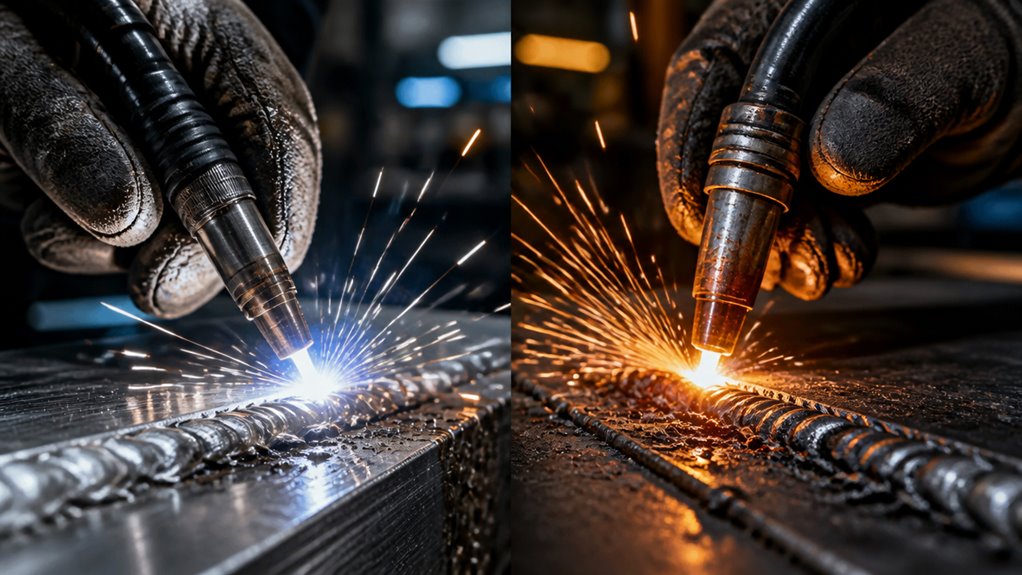
When welding aluminum, you must manage its low melting point, high thermal conductivity, and rapid oxide formation. This requires AC TIG or tightly controlled MIG with thorough cleaning to avoid porosity and cracking.
Steel’s higher melting point and slower heat dissipation make welding more forgiving with DC TIG or standard MIG. It needs less oxide removal but careful rust and scale prep.
Controlling heat input and joint fit is vital for both to minimize distortion and cracking. Understanding these differences helps optimize your welding approach.
| Feature | Aluminum Welding | Steel Welding |
|---|---|---|
| Melting Point | Lower (requires careful heat control) | Higher and more forgiving |
| Thermal Conductivity | Very high; dissipates heat quickly | Lower; retains heat longer |
| Thermal Expansion | About 3× higher than steel | Lower expansion rate |
| Welding Difficulty | More challenging | Easier for most applications |
| Preferred Processes | AC TIG, MIG with spool gun | DC TIG, MIG, Stick |
| Surface Preparation | Requires thorough oxide removal | Requires rust, scale, and contaminant removal |
| Oxide Layer | Forms quickly and can cause porosity | Less critical oxide management |
| Heat Control | Requires precise control to prevent burn-through | Wider operating range |
| Distortion Risk | Higher due to thermal expansion | Lower |
| Cracking Risk | Higher if heat and filler selection are incorrect | Lower with proper technique |
| Welding Speed | Faster travel speed often required | More flexible welding speeds |
| Common Filler Metals | ER4043, ER5356 | ER70S-6 and alloy-specific fillers |
| Strength Applications | Lightweight structures and corrosion-resistant parts | Structural and heavy-duty applications |
| Corrosion Resistance | Excellent due to self-healing oxide layer | Requires coatings or treatments |
| Repair Difficulty | More sensitive to heat and contamination | Easier to repair and modify |
| Best For | Aerospace, automotive, marine, lightweight fabrication | Construction, machinery, structural fabrication |
| Main Advantage | Lightweight, corrosion-resistant welds | Strong, affordable, and easier fabrication |
| Main Drawback | Requires more preparation and precise control | Heavier and more prone to corrosion |
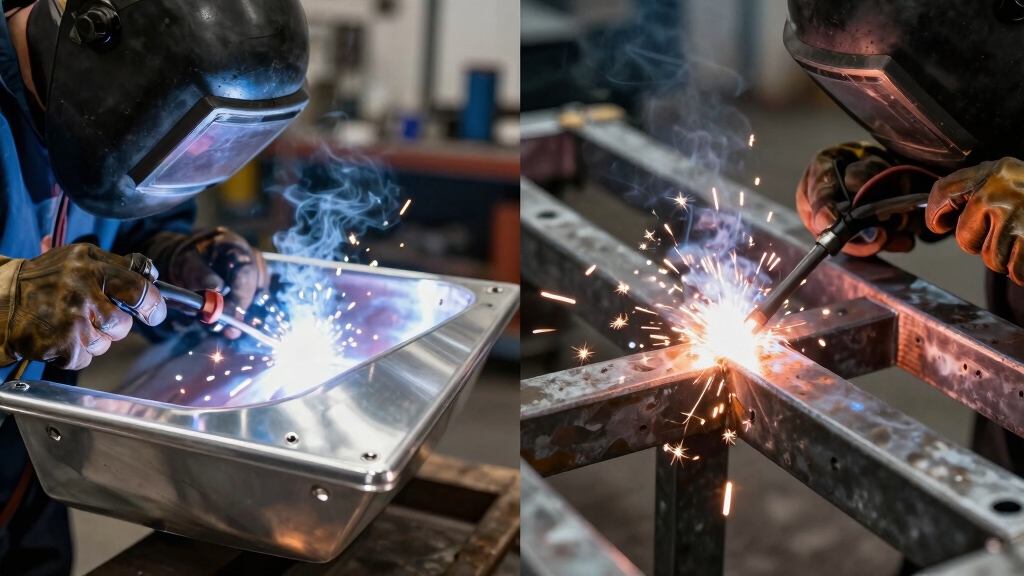
Although both aluminum and steel require welding, their distinct material properties and thermal behaviors demand different approaches.
Welding aluminum and steel calls for tailored techniques due to their unique material and thermal characteristics.
Aluminum’s lower melting point and higher thermal conductivity cause heat to dissipate rapidly. This requires precise heat input control to avoid burn-through and distortion.
In contrast, steel’s higher melting point and slower heat conduction provide a wider thermal window, making it more forgiving during welding.
You’ll also notice aluminum’s rapid oxide formation necessitates rigorous surface cleaning. Steel has less demanding oxide management.
When choosing between them, consider application requirements. Aluminum excels where weight reduction and corrosion resistance matter. Steel offers superior strength and cost efficiency for structural uses.
Understanding these differences helps you select the proper welding technique and material for the best results. For aluminum, using an AC/DC TIG welder is essential to break the oxide layer and ensure strong, clean welds.
When you weld aluminum, its low melting point and high thermal conductivity demand rapid and precise heat control to prevent burn-through and distortion.
Aluminum’s thermal conductivity causes heat to disperse quickly, requiring faster process adjustments compared to steel. Its melting point, about half that of steel, narrows your welding temperature window, increasing the risk of defects like porosity and cracking.
Additionally, aluminum’s thermal expansion coefficient is roughly three times higher than steel’s, so you must anticipate greater distortion and stress during cooling.
Steel’s slower heat conduction and higher melting point provide a wider working range, making temperature control less critical.
You’ll find steel’s lower expansion reduces cracking risk and distortion, allowing more forgiving welding parameters in standard fabrication environments.
Understanding these material differences is essential to managing weld quality effectively.
To ensure the integrity of aluminum welds, thorough cleaning to remove the native aluminum oxide layer before welding is crucial to prevent weld defects and porosity.
Because aluminum forms a tenacious oxide layer within seconds of exposure to air, you must remove this barrier thoroughly before welding to guarantee proper fusion and minimize porosity.
Start by mechanically cleaning aluminum using a dedicated stainless steel brush to avoid contamination.
Next, degrease the surface with a suitable solvent to eliminate oils and residues.
Finally, make certain the metal is dry to prevent hydrogen-induced porosity.
Steel requires less intensive oxide removal but still benefits from wire brushing or grinding to expose clean metal and remove rust or mill scale.
For both metals, inspect surfaces closely for contaminants or imperfections before welding.
Key preparation steps include:
It is also important to avoid harsh chemicals or aggressive abrasion that can damage the protective oxide layer and compromise structural integrity.
Selecting the best welding process and equipment hinges on understanding the distinct thermal and metallurgical behaviors of aluminum and steel.
For aluminum, you’ll want AC TIG welding to break the oxide layer and precise heat control to counter rapid thermal conductivity. MIG welding with spool guns suits faster work but demands tight parameter control.
Steel welding generally tolerates standard wire feeding and DC TIG or MIG, benefiting from slower heat dissipation.
| Material | Preferred Process | Equipment Features | Challenges | Filler Metals |
|---|---|---|---|---|
| Aluminum | AC TIG, MIG | Spool gun, AC power | Oxide removal, burn-through | ER4043, ER5356 |
| Steel | DC TIG, MIG | Standard feeders | Heat control less critical | ER70S-6, alloy-specific |
Choose equipment based on these differences to optimize weld quality and efficiency. Proper oxide layer removal and cleaning are essential steps for aluminum to ensure strong, porosity-free welds.
Understanding the welding process and equipment lays the groundwork for addressing the challenges of cracking and distortion in aluminum and steel welds. You must account for aluminum’s higher thermal expansion and rapid heat dissipation, which increase cracking and distortion risks compared to steel.
To mitigate these issues, focus on:
Additionally, maintaining proper travel speed and welding angles is critical to controlling heat input and minimizing distortion in both aluminum and steel welds.
When welding aluminum, you must prioritize removing oxide layers and preventing moisture contamination to avoid porosity. Use dry storage and a stainless steel brush for cleaning.
Aluminum’s high thermal conductivity demands tighter heat control to prevent burn-through, so stay alert to rapid temperature changes.
For steel, focus more on managing fumes and preheating thicker sections to reduce cracking.
Both require proper ventilation and PPE, but aluminum’s sensitivity to moisture and oxides demands extra surface prep vigilance.
Like a shield that adapts to wear, aluminum welding enhances corrosion resistance by preserving its oxide layer, which acts as a protective barrier.
You’ll find aluminum’s natural oxide is stable and self-healing, making welded joints more resistant to rust.
In contrast, steel welding exposes bare metal prone to oxidation, requiring coatings or treatments to prevent corrosion over time.
You can’t directly weld aluminum and steel together in a single joint because of their vastly different melting points, thermal conductivities, and metallurgical incompatibilities.
Instead, you’ll need specialized techniques like explosion welding, friction stir welding, or using bimetallic intermediary inserts.
These methods create a metallurgical bond without melting both metals simultaneously, preventing brittle intermetallic compounds and ensuring structural integrity in the joint.
Balancing between brightness and burden, welding aluminum demands more energy due to its high thermal conductivity and lower melting point. This leads you to use precise, power-intensive processes like AC TIG.
This increased energy use can raise your carbon footprint. Conversely, steel’s higher melting temperature means longer heat retention but often more efficient energy use.
Plus, aluminum’s oxide layer requires aggressive cleaning, producing more waste and potential environmental contaminants than steel welding.
When maintaining aluminum welds, you’ll need to monitor for cracking and distortion due to its high thermal expansion.
Repairs require meticulous cleaning to remove oxides and careful heat control to avoid further defects.
Steel welds tolerate more aggressive grinding and reheating without significant damage, making repairs simpler.
You’ll find steel easier to maintain and repair, as it’s less sensitive to thermal stress and surface contamination compared to aluminum welds.
Welding aluminum vs steel is like traversing two different terrains; each demands specific techniques and preparation.
You’ll need to adjust your approach based on their unique thermal conductivity and melting points.
By carefully selecting the right equipment and surface prep, you can prevent cracking and distortion.
This ensures strong, reliable welds. Mastering these distinctions sharpens your skills and guarantees precision, no matter which metal you’re joining.