Phone:
(701)814-6992
Physical address:
6296 Donnelly Plaza
Ratkeville, Bahamas.

Phone:
(701)814-6992
Physical address:
6296 Donnelly Plaza
Ratkeville, Bahamas.

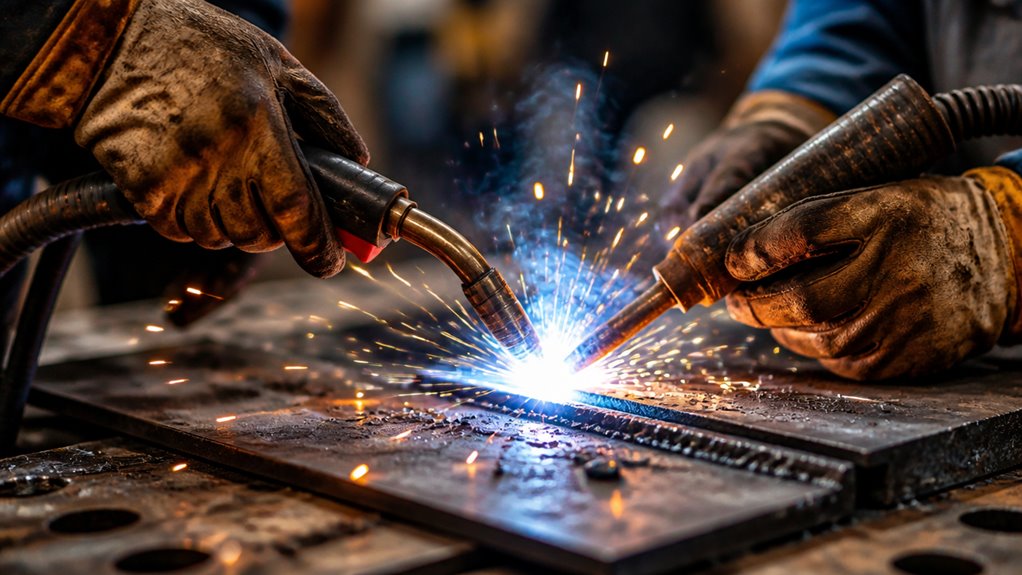
You use GMAW and FCAW as semiautomatic welding processes that combine continuous wire feeding with manual torch control to achieve efficient, consistent welds.
GMAW employs external shielding gas for cleaner welds and smoother bead profiles, ideal for indoor and thinner metals.
FCAW uses flux-cored wire creating its own shielding gas, making it suitable for outdoor and thick metal welding despite slag cleanup.
Understanding their operational differences helps you select the best process for your specific project needs.
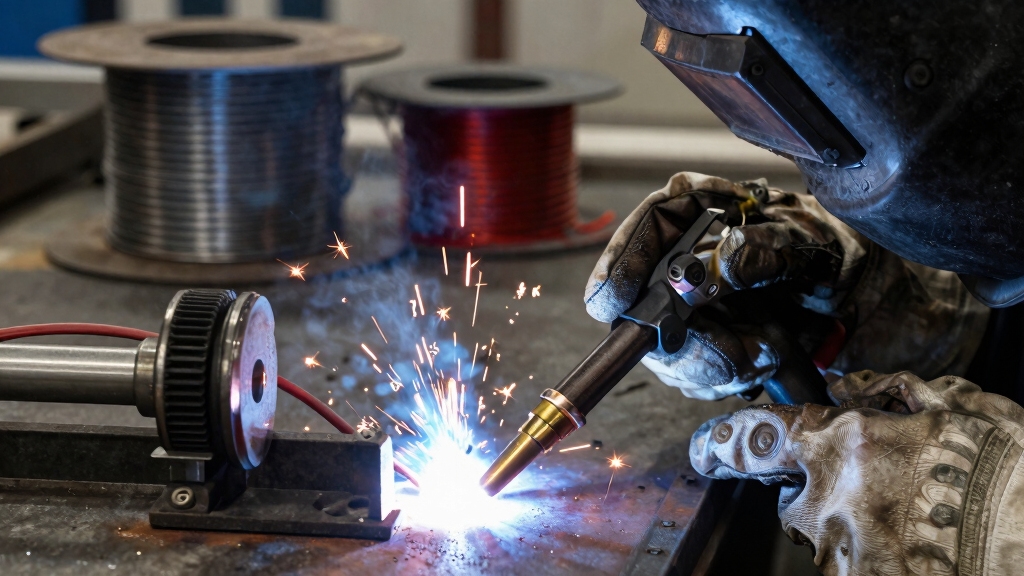
In semiautomatic GMAW and FCAW welding, the wire feeding mechanism continuously supplies the consumable electrode wire to the arc, controlled by the welding machine.
You rely on this automated feed to maintain a consistent arc length and steady deposition rate, essential for producing uniform welds.
While the machine controls wire speed and arc voltage, you must manually manipulate the torch along the joint, adjusting travel speed, angle, and position for optimal penetration and bead shape.
This division of control enhances precision and productivity by automating electrode delivery but retaining operator oversight for joint navigation.
The continuous feed also reduces interruptions common in manual welding, enabling smoother operation.
Understanding this interplay between machine and operator is critical to mastering semiautomatic GMAW and FCAW welding techniques.
The use of shielding gas protects the weld pool from atmospheric contamination, ensuring strong, clean welds with minimal spatter.
Mastering the wire feeding process sets the foundation for consistent welds.
Achieving peak weld quality in GMAW also depends heavily on the choice and control of shielding gas.
You must select an appropriate shielding gas, commonly argon, helium, or argon-carbon dioxide mixtures, to protect the molten weld pool from atmospheric contamination.
This contamination can cause porosity and weaken the joint.
The gas composition influences arc stability, penetration, and spatter levels, directly affecting weld appearance and mechanical properties.
Maintaining proper gas flow rate and ensuring nozzle integrity are essential to prevent gas turbulence or insufficient coverage.
By precisely controlling these parameters, you optimize arc characteristics and minimize defects, yielding cleaner, stronger welds.
In GMAW, shielding gas management is critical. Neglecting it compromises weld integrity and reduces overall process efficiency.
Using the correct gas mixture, such as 75% Argon/25% CO2 for mild steel, helps balance penetration and spatter control.
Frequently chosen for challenging environments, FCAW excels in outdoor and thick metal welding due to its unique flux-cored wire design.
Ideal for tough conditions, FCAW shines in outdoor and thick metal welding applications.
The tubular wire contains flux, which generates its own shielding gas, allowing you to weld effectively in windy or dusty conditions without relying solely on external shielding gas.
This self-shielding capability reduces contamination risk and stabilizes the arc outdoors.
Additionally, FCAW delivers higher deposition rates, enabling you to weld thicker materials more efficiently.
The slag produced by the flux protects the molten weld pool from oxidation and facilitates better weld bead formation on heavy sections.
You’ll also benefit from FCAW’s robust arc characteristics, which tolerate joint gaps and surface irregularities common in thick plate work.
These advantages make FCAW your preferred method for structural and heavy fabrication tasks in outdoor settings.
Moreover, the process combines features of MIG and stick welding with a constant-voltage power source and wire feeder for high deposition rates and consistent weld quality.
While FCAW offers advantages in demanding environments and thick metal applications, evaluating productivity and cleanup requirements reveals distinct operational considerations between it and GMAW.
FCAW typically achieves higher deposition rates, which can enhance productivity in structural and heavy fabrication tasks. However, the flux core generates slag that requires removal after welding, increasing post-process labor.
In contrast, GMAW produces cleaner welds with minimal slag and spatter, reducing cleanup time and improving overall efficiency on projects where appearance and surface preparation matter.
GMAW’s external shielding gas contributes to more consistent arc stability, facilitating smoother weld beads.
Consequently, when balancing productivity and cleanup, you must consider FCAW’s robust deposition versus GMAW’s cleaner welds to align with your operational priorities and project specifications.
Additionally, the wire feed mechanism in both processes ensures a consistent feed rate essential for stable arc conditions and uniform weld deposition.
Selecting the appropriate welding process requires careful assessment of your project’s specific needs, including material type, environmental conditions, and desired weld quality.
If you prioritize cleaner welds and work primarily indoors on thin to medium metals, GMAW is advantageous due to its external shielding gas and smoother arc control.
Conversely, if you face outdoor conditions or thicker materials, FCAW’s flux-cored wire provides superior tolerance to wind and higher deposition rates, enhancing productivity.
Consider post-weld cleanup: GMAW produces minimal slag, reducing finishing time, while FCAW necessitates slag removal.
Your choice should also reflect operational factors, such as available equipment and operator skill level.
Ultimately, matching these variables guarantees peak weld integrity, efficiency, and cost-effectiveness for your project.
It is also important to consider that FCAW produces more fumes and requires effective ventilation to maintain a safe working environment.
You can weld a wide range of metals effectively with GMAW and FCAW.
GMAW excels on thin to thick metals, including carbon steel, stainless steel, aluminum, and other nonferrous alloys, offering cleaner welds.
FCAW suits thicker materials, especially carbon steel and structural steel, performing well outdoors and in heavy fabrication.
Both handle various steel grades well, but FCAW’s flux core provides better tolerance for harsher conditions and higher deposition rates.
Think of the flux core in FCAW wire as a tiny, protective fortress.
When you weld, the heat melts this flux, releasing gases that shield the molten metal from harmful atmospheric contamination like oxygen and nitrogen.
This gas envelope prevents oxidation and porosity, ensuring a strong, clean weld.
Simultaneously, the flux forms a slag layer on top, which further protects the cooling weld and must be removed afterward for a smooth finish.
When welding with FCAW, you need extra caution due to slag formation. Wear protective gear to prevent burns from hot slag and ensure proper ventilation, as flux fumes can be more hazardous.
GMAW requires careful handling of shielding gases, so avoid gas leaks and provide adequate airflow to prevent asphyxiation.
Both processes demand eye protection against intense UV light and respiratory protection, but FCAW’s flux fumes require heightened respiratory safeguards.
You can automate GMAW and FCAW beyond semiautomatic use by integrating robotic arms or mechanized welding systems.
Both processes adapt well to full automation, allowing precise control over wire feed, torch movement, and arc parameters.
This enhances consistency and efficiency in high-volume production.
While semiautomatic setups require manual torch manipulation, automated systems eliminate this, increasing precision and reducing operator fatigue.
This is especially beneficial in complex or repetitive welding tasks.
You’ll encounter porosity and undercut more often with GMAW due to sensitivity to shielding gas coverage and arc instability.
FCAW welds commonly show slag inclusions and incomplete fusion because of flux residue and rapid deposition rates.
Additionally, FCAW can suffer from excessive spatter and slag entrapment, requiring thorough post-weld cleaning.
Recognizing these unique defects helps you adjust parameters and techniques to guarantee sound, high-quality welds.
When you choose between GMAW and FCAW, you’re steering a ship through the currents of welding demands. Each process offers unique strengths that shape your project’s success.
GMAW delivers precise, clean welds with shielding gas, while FCAW shines in rugged, outdoor conditions with its flux-cored wire.
By understanding these semiautomatic methods, you’ll navigate productivity and quality with confidence. This ensures your welds hold firm like a well-forged anchor in any environment.