Phone:
(701)814-6992
Physical address:
6296 Donnelly Plaza
Ratkeville, Bahamas.

Phone:
(701)814-6992
Physical address:
6296 Donnelly Plaza
Ratkeville, Bahamas.

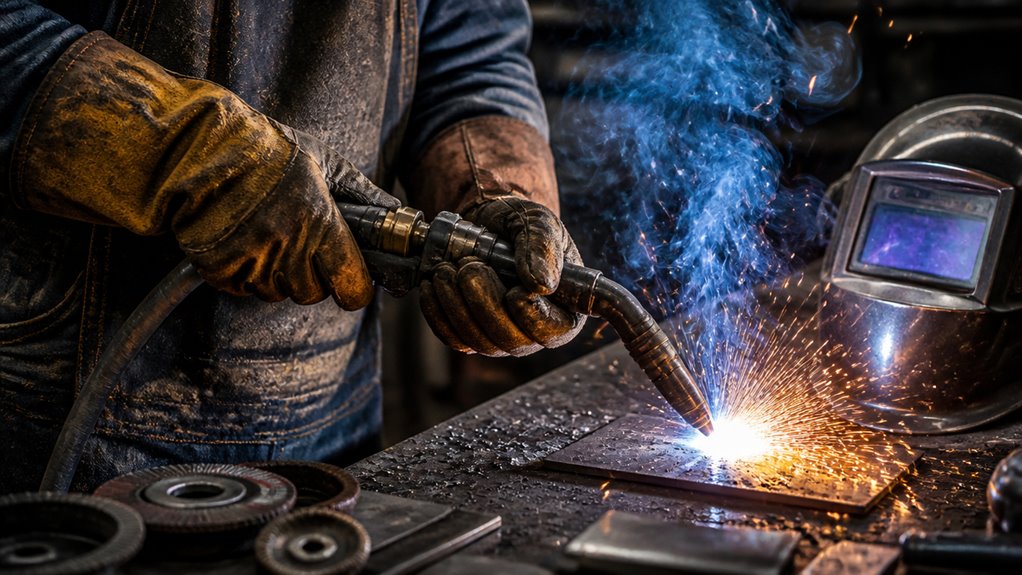
To be a welder, you need at least a high school diploma or equivalent and basic math skills.
You’ll gain hands-on training through certificate programs, apprenticeships, or trade schools lasting months to years.
Master welding techniques like MIG and TIG while learning blueprint reading and safety protocols.
Earning certifications, such as the AWS Certified Welder, boosts your credentials and job prospects.
If you want a clear path and practical guidance, there’s plenty more to explore about welding careers.
Starting your welding journey begins with meeting basic education requirements, which typically include having a high school diploma or GED.
Beginning your welding career starts with fulfilling basic education requirements like a high school diploma or GED.
You’ll find that courses in math, science, and technical education give you a vital advantage, as welding relies heavily on measurements, chemical properties, and practical skills.
Focus particularly on classes like blueprint reading, shop mathematics, and mechanical drawing to build your ability to interpret welding plans accurately.
If you’re still in high school, some programs even allow juniors to apply, giving you early exposure.
In the UK, equivalent qualifications such as GCSEs in English and math are commonly expected.
Meeting these foundational education standards not only prepares you for welding coursework but also strengthens your problem-solving and technical understanding, essential for succeeding in this skilled trade.
Additionally, many apprenticeship programs require basic math skills to ensure accurate measurements and safety compliance.
Sure thing! Here’s a more conversational version of that text:
You’ve got a bunch of options when it comes to welding training programs. Whether you’re looking at trade schools, community colleges, or career centers, there’s something out there for everyone. Each place offers its own specializations, like MIG, TIG, and SMAW.
Now, if you’re thinking about a certificate program, those usually run about three months to a year. On the other hand, if you’re leaning toward an associate degree, you’re looking at roughly two years of study.
Ultimately, picking the right program really boils down to your career goals and how in-depth you want your training to be. So, what’s your plan? Maintaining welding certification continuity is essential to stay qualified in the aerospace welding field.
Although employers value hands-on experience, completing a formal welding training program markedly enhances your skills and job prospects.
You can choose from trade schools, community colleges, or career training centers offering programs that cover essential techniques like MIG, TIG, SMAW, FCAW, blueprint reading, and safety protocols.
Certificate programs typically span three months to a year, while associate degrees take around two years.
Apprenticeships combine classroom instruction and on-the-job training, often lasting two to four years, giving you valuable real-world experience.
High school welding classes can also provide early exposure.
Regardless of the route, formal training guarantees you develop technical precision, safety awareness, and blueprint interpretation skills that employers prioritize.
This training makes you more competitive and competent in various welding fields.
Continuous practice is essential to refine your hand-eye coordination and welding dexterity.
When choosing a welding training program, understanding the duration is essential for aligning your education with career goals and time commitments.
Certificate programs typically span three months to one year, focusing on core skills like MIG, TIG, and SMAW welding, along with safety and blueprint reading.
If you want a more all-inclusive education, associate degrees usually take about two years, combining theory with extensive hands-on practice.
Apprenticeships often last two to four years, blending classroom instruction with on-the-job training, providing valuable real-world experience.
Your choice depends on how quickly you want to enter the workforce and the depth of skills you aim to acquire.
Balancing program length with your availability guarantees you gain relevant qualifications efficiently and meet employer expectations.
Shipyard welders typically require specialized training in marine welding techniques to handle the unique challenges of ship construction and repair.
Since welding requires both technical knowledge and practical skills, apprenticeships offer an ideal route to gain hands-on experience while learning industry standards.
You’ll combine classroom instruction with on-the-job training, accelerating your skill development.
Apprenticeships usually last 2 to 4 years, providing exposure to real-world welding in fabrication, pipe fitting, or construction.
Here’s what to expect:
Additionally, apprenticeships often prepare welders to achieve essential certifications that validate their skills in multiple welding positions.
If you want to stand out in the welding industry, obtaining certifications is essential. They validate your skills and demonstrate your commitment to quality and safety.
The AWS Certified Welder certification is highly regarded and performance-based. It requires you to pass a practical welding test at an approved facility.
You don’t need prior credentials to attempt it, making it accessible if you have the skill. Many employers and states prefer or require such certifications to guarantee weld quality.
Remember, some certifications require periodic renewal to confirm you maintain your welding proficiency. Holding recognized certifications boosts your credibility and broadens your job opportunities.
This proves you meet industry standards and can handle specific welding processes reliably and safely. AWS certification also ensures adherence to rigorous industry standards that enhance safety and quality.
To excel as a welder, having sharp hand-eye coordination is key. It allows you to control your tools with precision, which is essential for quality work. Plus, you’ll want to brush up on your blueprint reading skills. Being able to accurately interpret project specifications can make a big difference in the final outcome.
And, of course, let’s not forget about safety. Maintaining a strong awareness of safety protocols is critical. It not only protects you but also ensures that the work environment remains hazard-free for everyone involved. So, always keep safety as a top priority! Proper use of helmet with auto-darkening feature is vital to protect your eyes from harmful light and sparks.
Hand-eye coordination frequently proves essential for welders, as it directly impacts the accuracy and quality of each weld.
When you weld, your hands must move precisely, guided by your eyes to maintain steady control over the torch and filler material.
Without sharp coordination, welds can be uneven or weak, jeopardizing structural integrity and safety.
To develop and maintain excellent hand-eye coordination, focus on:
Mastering these elements guarantees your welds meet technical and safety standards.
Additionally, using a quality MIG welder can aid beginners in developing smoother and more consistent hand movements during practice.
Blueprint reading forms the foundation for accurate welding projects, guiding you through complex designs and specifications.
To excel, you need to interpret symbols, dimensions, and notes precisely. This ensures every weld aligns with the engineer’s intent.
You’ll encounter multiple views: plan, elevation, and section. These reveal critical details like weld locations, sizes, and joint types.
Mastering scale and measurement conversions is essential, as inaccuracies can lead to costly rework.
Additionally, understanding material callouts and fabrication instructions allows you to prepare correctly before welding.
Developing these skills sharpens your problem-solving and helps you anticipate challenges on the job.
A key part of blueprint reading is recognizing the reference line and arrow, which anchor welding details and indicate weld placement.
Although welding demands technical skill and precision, maintaining safety awareness is equally critical to protect yourself and others on the job.
You’ll face hazards like intense heat, sparks, harmful fumes, and electrical risks. Staying vigilant is non-negotiable.
Here are four essential safety practices you must follow:
Regular training and supervision significantly reduce the risk of welding-related injuries by promoting safe practices and hazard recognition.
When you pursue a welding career, you’ll often find that age and experience requirements vary depending on the employer, state regulations, and training programs.
Typically, you must be at least 17 years old to enroll in many welding programs. Some employers will hire younger apprentices under supervision.
Experience ranges from none for entry-level roles to several years for specialized positions. Formal training and certifications often compensate for limited experience.
| Requirement Type | Typical Criteria |
|---|---|
| Minimum Age | 17 years (varies by state) |
| Entry-Level Experience | None to 1 year |
| Apprenticeships | 2 to 4 years of combined training |
| Certifications | Often preferred or required |
| Employer Flexibility | On-the-job training possible |
This table clarifies your pathway options and employer expectations.
You need essential personal protective equipment to stay safe while welding.
Always wear a welding helmet with a proper shade lens to protect your eyes and face from sparks and UV radiation.
Use flame-resistant gloves and a long-sleeved jacket to shield your skin from burns.
Don’t forget safety glasses under your helmet, ear protection, and sturdy boots.
Respirators may be necessary to guard against harmful fumes and gases in certain environments.
Welding affects your long-term health like a slow-burning fuse. If you’re not careful, it can ignite serious issues.
Prolonged exposure to fumes and ultraviolet light can cause respiratory problems, skin burns, and eye damage. Chronic inhalation may lead to lung diseases or metal fume fever.
Using proper ventilation, wearing protective gear, and following safety protocols are essential to protect your lungs, skin, and eyesight over time.
You’ll find the highest job demand in specialties like pipeline welding, underwater welding, and aerospace welding.
Pipeline welding stays vital for oil and gas infrastructure.
Underwater welding combines diving skills with welding expertise, making it highly sought after.
Aerospace welding demands precision for aircraft manufacturing and repair.
Additionally, structural welding for construction and automotive welding consistently offer steady work.
Focusing on these areas boosts your job security and earning potential.
Think you can weld remotely or from home?
Unfortunately, welding demands hands-on work with specialized equipment and safety gear, making remote welding impractical.
While you can study theory, blueprint reading, and safety protocols online, the actual welding requires a controlled environment and direct supervision.
However, some design or programming roles related to robotic welding might offer remote opportunities, but the core physical welding tasks can’t be done safely or effectively from home.
You can expect an entry-level welder’s salary to range from about $30,000 to $45,000 annually, depending on location, employer, and industry.
In some regions or specialized sectors, starting pay might be slightly higher, especially with certifications or apprenticeships.
Keep in mind that overtime, bonuses, and union membership can also boost your earnings.
As you gain experience and skills, your salary will typically increase accordingly.
Think of welding like forging a strong chain. Each link represents your education, training, experience, and certifications.
Just as one weak link compromises the chain, skipping any step can hinder your career. For example, 82% of welders report that apprenticeships gave them the hands-on skills they couldn’t learn in class alone.
By investing in every essential element, you’ll build a solid foundation. This ensures your welding career holds strong under any pressure.