Phone:
(701)814-6992
Physical address:
6296 Donnelly Plaza
Ratkeville, Bahamas.

Phone:
(701)814-6992
Physical address:
6296 Donnelly Plaza
Ratkeville, Bahamas.

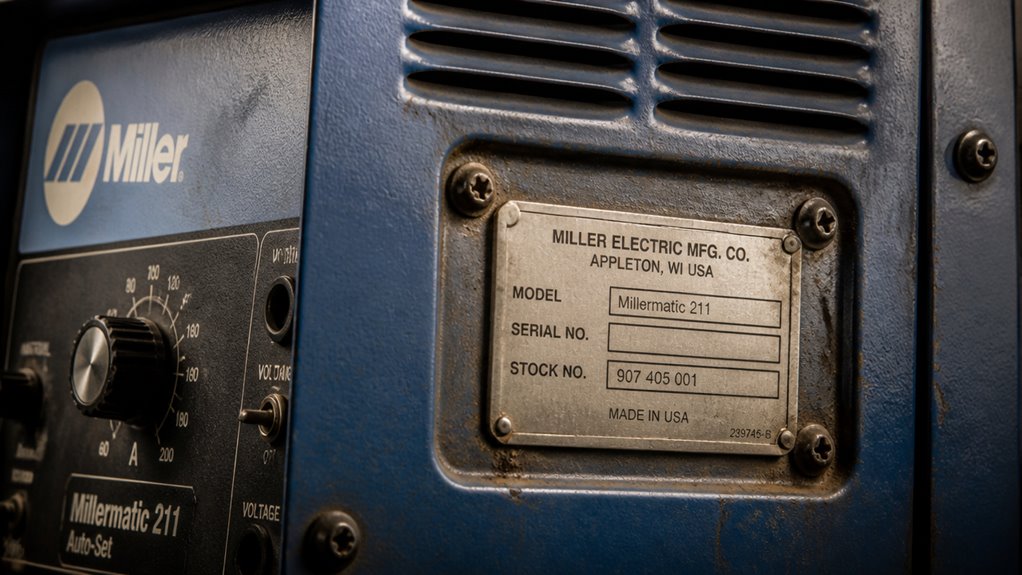
You’ll find your Miller welder’s serial number on metal nameplates located on the front or side panels, inside the wire compartment door, on the transformer housing, or near the control panel.
Check bottom and rear panels too, especially behind removable covers or near ventilation slots.
Use a flashlight and mirror to spot hidden tags, and clean grime for better visibility.
Knowing serial formats helps identify production years and aids parts lookup. Explore further details to optimize service and maintenance.
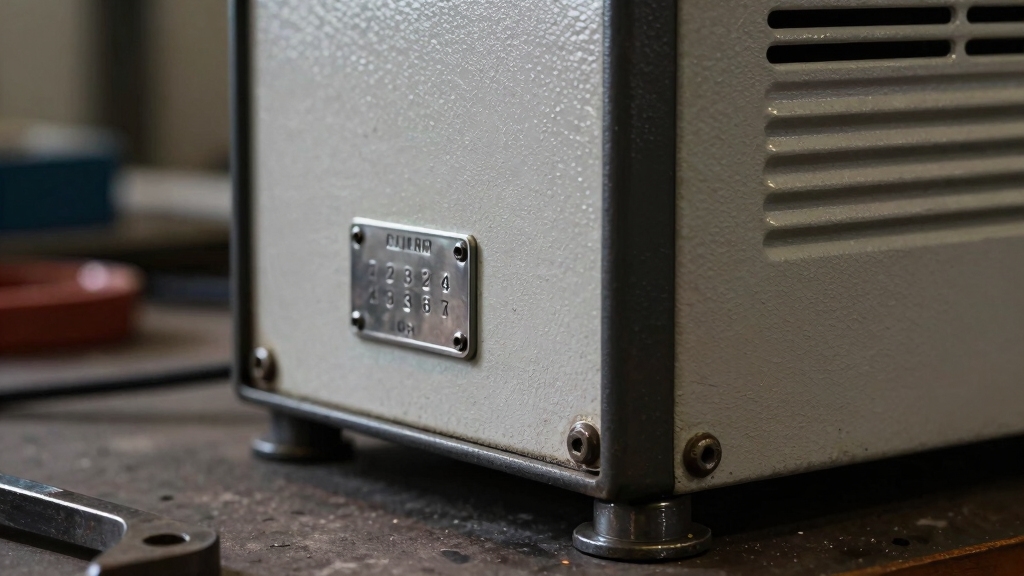
When you need to locate your Miller welder’s serial number, start by examining the front or side panels of the machine’s housing. The serial number is typically on a metal nameplate securely attached to these areas.
If you don’t find it there, check inside the wire compartment door, if your model has one, since it’s a common alternate location. Also, inspect the bottom or rear panels, as some units place the serial tag in these less visible spots.
On certain models, the transformer housing or the control panel region may carry identification labels with the serial number. By systematically checking these key areas, you can efficiently identify the serial number without unnecessary disassembly or guesswork.
For proper machine operation and maintenance, always ensure that cables and connections are inspected and secured when accessing these areas.
Locating the serial number varies depending on the Miller welder model you have. Commonly, the serial number appears on a metal nameplate affixed to the frame or housing.
You’ll often find it on the front panel, but some models position it elsewhere for easier access or protection.
Check these typical locations based on your model:
Front or side panels: Most mid-range and older models display the serial tag here for quick identification.
Wire compartment door: Certain units place the serial number inside this door to prevent wear.
Transformer housing or control panel area: Some heavy-duty or specialized models have labels here to guarantee durability.
Knowing these spots helps you pinpoint the serial number without unnecessary disassembly or guesswork. Always ensure machine maintenance is performed regularly to keep all labels and components legible and intact.
You know, when it comes to Miller welders, their serial numbers are usually between 8 to 10 characters long.
They mix letters and numbers, which is pretty handy for identification.
Now, if you look closely at the letter prefixes, you’ll often see they indicate the manufacturing year, especially with the older models.
Isn’t that neat?
Understanding these alphanumeric variations can really help you keep track of production details and the history of the models.
Although Miller welder serial numbers vary by model and era, they typically range from 8 to 10 characters in length.
You’ll notice these serial numbers often combine letters and numbers, maintaining a consistent format for easy recognition.
Understanding this length helps you quickly identify valid serial numbers and avoid confusing them with model or part numbers.
Key points to recognize typical serial number length include:
For professional welding equipment, it is essential to ensure compliance with industry standards to maintain quality and safety.
Miller welders often use letter prefixes in their serial numbers to indicate the manufacturing year. This makes it easier for you to identify the production date at a glance.
These prefixes precede the numeric sequence, allowing quick recognition of the welder’s age without decoding the entire serial number. Familiarizing yourself with these codes streamlines maintenance and parts ordering.
| Letter Prefix | Year | Example Serial Number |
|---|---|---|
| W | 1970 | W-117683 |
| JC | 1982 | JC122376 |
| LG | 2006 | LG124622 W |
| H | 1990 | H-903456 |
| K | 1995 | K-951234 |
Use this table as a reference to accurately identify your Miller welder’s manufacturing year from its serial number prefix. Understanding the serial number can also help you determine if your machine supports multiple welding processes to maximize its versatility.
Understanding the letter prefixes helps pinpoint the manufacturing year, but serial numbers also vary markedly in their alphanumeric structures. Miller welders’ serial numbers combine letters and numbers in formats that differ by era and model. Recognizing these variations aids accurate identification and support.
Here’s what to look for:
Early models often feature 8 to 10 characters with a single letter prefix followed by numeric sequences indicating production details.
Mid-era welders may use two-letter prefixes with extended numeric strings for batch tracking.
Newer models employ longer alphanumeric codes incorporating letters and numbers to enhance traceability and differentiate units precisely.
Start by locating the serial number on your welder. Then use Miller’s serial number charts to decode the manufacturing year.
Begin by finding your welder’s serial number and consult Miller’s charts to determine its manufacturing year.
Typically, older Miller welders have serial numbers with a letter prefix or the first one or two digits representing the production year.
For instance, a serial number like W-117683 indicates a 1970 manufacture, while JC122376 corresponds to 1982.
More recent models may use extended codes, where specific letter and number combinations pinpoint the year, such as LG124622 W for 2006.
Match your serial number’s initial characters against Miller’s chart to identify the exact year.
This method guarantees accurate year identification, which is vital for sourcing correct manuals, parts, and service information.
Always refer to official Miller resources for the most reliable decoding.
Although they might seem similar at first, serial, model, and part numbers serve distinct purposes on your welder.
Understanding these differences helps you accurately identify and maintain your Miller welder.
Serial Number: Unique to your specific unit, it tracks manufacturing details and production date.
This number enables precise service or warranty support.
Model Number: Defines the overall product family or configuration, indicating features and power capacity.
It doesn’t provide individual unit specifics.
Part Number: Identifies individual components or replaceable parts within your welder.
This number is used for ordering and inventory management.
Proper equipment inspection before use ensures safety and effective operation of your Miller welder.
Locate your Miller welder’s serial number to quickly access accurate parts and service information. Use this unique identifier when searching owner’s manuals or parts catalogs to guarantee compatibility and avoid ordering errors.
Most Miller parts lookup systems require the serial number to match components precisely to your machine’s production batch and configuration.
When contacting Miller support, providing the serial number expedites troubleshooting and service requests by confirming the exact model and manufacturing details.
The serial number also helps verify warranty status and locate technical bulletins relevant to your welder.
Keep this number accessible, as it’s the primary key for all official documentation, parts ordering, and professional servicing. This guarantees efficient maintenance and repair throughout your welder’s operational life.
Additionally, maintaining detailed records and continuity of documentation ensures compliance with industry standards and facilitates smooth service processes.
If you’re having trouble locating the serial number on the front or side panels, don’t worry—there are other places to check. One common spot is inside the wire compartment door; that’s often where it’s tucked away.
Also, take a peek at the transformer housing. You might find identification labels there, too.
And don’t forget to look at the bottom and back of the welder. Sometimes, tags are hidden in those less visible spots, so it’s worth a thorough inspection!
For mobile welders, the serial number may also be found near the welding machine or on the control panel where power settings are adjusted.
Open the wire compartment door on your Miller welder to reveal a common yet easily overlooked spot for the serial number tag. This area often houses the metal nameplate, especially on models designed with accessible wiring sections.
To locate the serial number here, follow these steps:
Look on the inner surface of the door for a stamped or riveted metal plate. Check the compartment frame edges for adhesive or metal tags.
Use a flashlight to illuminate dark corners inside the compartment.
The serial number in this location typically combines letters and numbers, matching Miller’s format of 8 to 10 characters. Inspect carefully, as dirt or paint may obscure the tag.
Identifying this tag inside the wire compartment door guarantees accurate tracking of your welder’s manufacturing details. Always verify the nameplate rated input current on this tag before sizing breakers or performing electrical work on the welder.
When examining your Miller welder for its serial number, don’t overlook the transformer housing, a frequent location for identification tags on certain models.
The serial number plate is often riveted or affixed with durable adhesive to the metal housing surrounding the transformer.
This spot can be overlooked due to its recessed placement or because it’s partially obscured by cables or protective covers.
Use a flashlight to illuminate tight spaces and carefully move any obstructing wires without disconnecting them.
Be sure to check all sides of the transformer housing since tags may be on the front, top, or side surfaces.
Finding the serial number here guarantees accurate identification for parts ordering and service inquiries, especially when other common locations don’t display the tag.
Keep in mind that the transformer housing contains the magnetic core and windings, which are essential components for the welding transformer’s operation.
Checking the bottom and back of your Miller welder often reveals serial number tags hidden in less obvious spots. These areas tend to collect dust and grime, so a thorough inspection is crucial.
Use a flashlight and, if needed, a mirror to access tight spaces. Focus on flat metal surfaces where the metal nameplate might be riveted or glued.
Look for serial numbers in these key locations:
These spots are common on models where front and side plates lack identification tags. Finding the serial number here guarantees accurate model info for service, parts, and warranty verification.
Don’t overlook these hidden areas when tracking your welder’s identification. Proper surface preparation around the serial number area can help prevent corrosion and ensure the tag remains legible over time.
You can’t legally change the serial number on your Miller welder. It’s a unique identifier tied to the machine’s manufacturing history and warranty.
Altering it voids warranties and may violate laws, leading to serious consequences.
If you need support or parts, always use the original serial number.
If the tag is damaged or missing, contact Miller directly for proper verification and assistance instead of attempting any unauthorized modifications.
Yes, your Miller welder’s serial number directly affects its warranty. It verifies the unit’s authenticity, purchase date, and eligibility for coverage.
You’ll need this number when registering your product or requesting warranty service. Without a valid serial number, Miller may deny warranty claims.
Always keep your serial number handy to guarantee smooth support, accurate parts matching, and to confirm your welder’s warranty status throughout its service life.
You’d think verifying a Miller welder serial number is rocket science, but it’s simpler than you expect.
Cross-check your serial number with official Miller databases or charts to confirm format and year codes.
Make sure the tag matches Miller’s typical 8-10 character alphanumeric style.
If unsure, contact Miller support with your serial number for authentication.
Authentic serials align with Miller’s manufacturing details, preventing counterfeit issues and ensuring genuine parts and service.
Yes, you can use your Miller welder’s serial number to track its repair history.
The serial number uniquely identifies your unit, allowing service centers and Miller support to access detailed maintenance and repair records.
When you contact Miller or authorized service providers, provide the serial number to retrieve accurate repair data.
This ensures proper service history tracking and parts compatibility.
It streamlines troubleshooting and helps maintain your welder’s performance and warranty compliance.
The serial number is essential for Miller welder software updates because it guarantees you get the right version tailored to your machine.
As they say, “measure twice, cut once.” Using your serial number helps avoid compatibility issues and ensures proper functionality.
It also assists Miller’s support team in verifying your welder’s configuration, making the update process smooth and accurate.
Don’t skip providing it when updating software.
Think of your Miller welder’s serial number as its unique fingerprint, hidden yet essential.
Just like a key opens a treasure chest, this number reveals crucial information about your machine’s history, parts, and service needs.
By knowing where to find it and how to read it, you hold the map to maintaining your welder’s peak performance. Don’t let this small code stay a secret; it’s your direct line to precision and reliability.