Phone:
(701)814-6992
Physical address:
6296 Donnelly Plaza
Ratkeville, Bahamas.

Phone:
(701)814-6992
Physical address:
6296 Donnelly Plaza
Ratkeville, Bahamas.

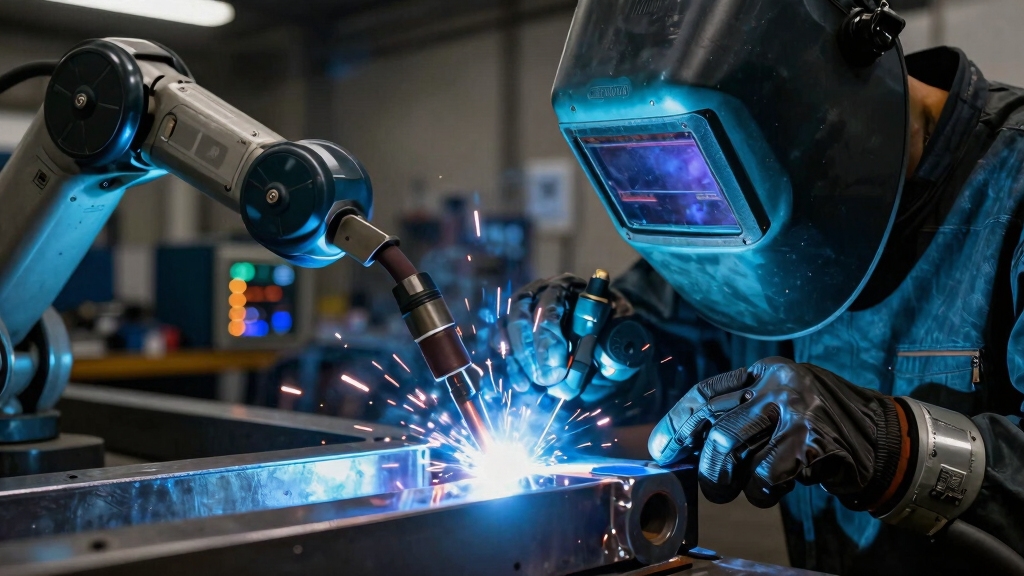
Digital welding lets you precisely control voltage, current, and pulse rate in real time. This optimizes weld quality across various materials and thicknesses.
It combines advanced inverter technology, adaptive controls, and digital interfaces to stabilize arcs. This allows for rapid parameter adjustments.
Pulse welding further enhances heat management and weld consistency, reducing defects and distortion.
This integration supports both manual skill and automation, boosting productivity while cutting costs.
Exploring this technology reveals how it standardizes quality and drives smart manufacturing forward.
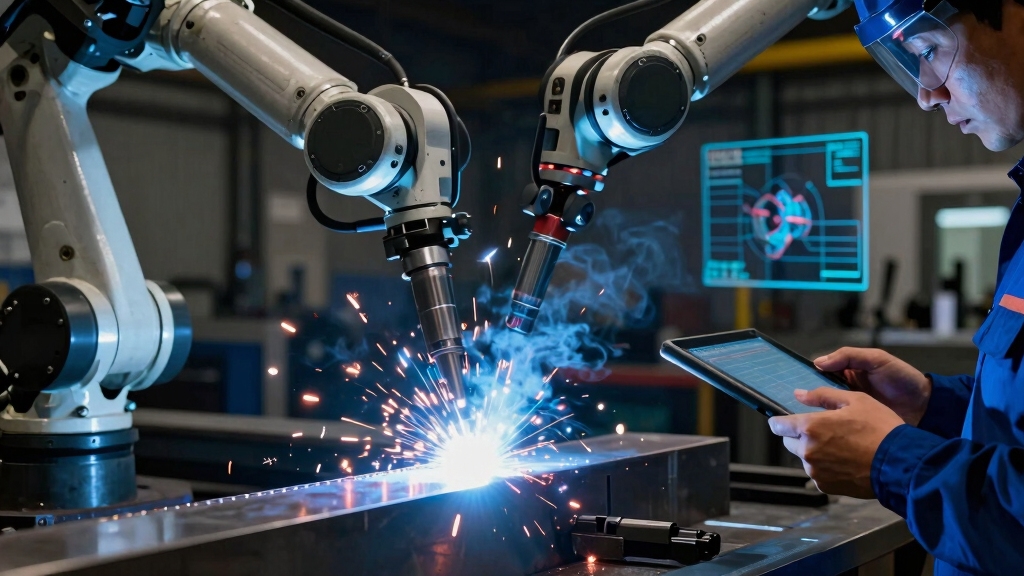
By integrating digital welding into your fabrication processes, you gain precise, real-time control over critical parameters like voltage, current, and pulse rate. This guarantees consistent weld quality regardless of operator skill.
You can monitor voltage and electric currents directly on LCD displays, allowing immediate adjustments. The advanced control systems enable you to select optimal settings for different materials and thicknesses with simple button presses, reducing variability.
Pulse welding functions let you alternate current frequency, minimizing heat input to prevent distortion and warping. This digital approach standardizes welding conditions, enhances process stability, and improves productivity by streamlining parameter management.
Additionally, inverter technology used in digital welders improves energy efficiency and provides precise current control to optimize welding performance.
Digital welding seamlessly connects manual expertise with automated precision, allowing you to harness the strengths of both methods in structural steel fabrication.
By integrating computerized control with skilled operator input, it guarantees consistent weld quality regardless of individual experience, bridging the gap between manual and robotic processes.
You gain precise management over welding parameters, including voltage, current, and pulse rate, while retaining the adaptability of manual adjustments.
Key benefits include:
This hybrid approach enhances productivity and quality, making structural steel welding more reliable and efficient without fully removing human oversight. Advanced control circuits enable real-time monitoring and adjustment of welding parameters to maintain arc stability and minimize defects.
Although welding technologies have advanced rapidly, the core of today’s digital welding systems lies in integrating precise real-time monitoring with adaptive control mechanisms.
You rely on digital interfaces displaying voltage and current data on LCD screens, allowing instant adjustments. Advanced control systems let you select parameters based on material type and thickness, ensuring quality consistency.
These technologies bridge manual skill gaps and automate complex welds efficiently.
| Technology Component | Function |
|---|---|
| 3D Steel Engineering | Retrieves robotic welding data |
| Voltage & Current Displays | Enables real-time process control |
| Adaptive Control Systems | Adjusts settings for materials |
| Program Storage | Allows quick job switching |
This combination stabilizes the welding process, enhances quality, and boosts productivity. The use of shielding gas is also integrated into digital systems to maintain weld integrity by preventing contamination during the process.
When you control welding current through pulse welding, you alternate between high and low current levels. This materially improves heat management during the process.
This precise modulation reduces heat input, preventing warping and distortion in the weld area. Pulse welding stabilizes the arc and allows better control over the molten pool, enhancing weld penetration and bead appearance.
It also lowers thermal stress on thin metals, preserving their structural integrity.
Key benefits include:
Pulse welding produces one molten droplet per pulse, preventing electrode contact and reducing welding defects through controlled droplet transfer.
Digital welding is really making waves in industries like shipbuilding, aerospace, automotive, and structural steel. It’s all about that precise control and consistent quality that these sectors need.
For instance, in shipbuilding, the ability to weld thin metals with improved integrity is a game-changer. In aerospace, enhanced process stability is crucial, especially when dealing with complex assemblies.
Understanding how these applications work can really help you boost production efficiency and ensure product reliability across various manufacturing environments. So, whether you’re in automotive or structural steel, there’s a lot to gain from embracing digital welding! The use of inert shielding gases like argon and helium in digital welding further improves arc stability and weld quality, enhancing overall performance.
Digital welding technologies deliver critical advantages across diverse sectors by ensuring precision and consistency in complex fabrication tasks.
You’ll find these technologies essential where accuracy and repeatability matter most, especially in high-stakes manufacturing environments.
Key industry applications include:
Advanced real-time sensor feedback enables dynamic adjustments during welding, improving consistency and reducing defects across these industries.
Although various industries rely on welding, those requiring stringent quality control and complex fabrication benefit most from digital welding’s precision and consistency.
You’ll find aerospace, automotive, shipbuilding, and electronics sectors leverage digital welding to guarantee weld integrity, reduce defects, and standardize quality regardless of operator skill.
This technology’s real-time control over parameters like voltage and pulse rate optimizes production and minimizes rework.
Additionally, integrating digital welding into the fabrication workflow ensures precision and strength from initial processing through final assembly.
| Industry | Key Benefit | Application Example |
|---|---|---|
| Aerospace | High weld integrity | Aircraft structural components |
| Automotive | Consistent quality | Car door and chassis assembly |
| Shipbuilding | Complex fabrication | Large-scale hull welding |
| Electronics | Precise heat control | Thin metal enclosures |
Digital welding’s adaptability delivers measurable improvements across these sectors.
You’ll see how digital welding streamlines operations by cutting down on manual effort. It’s pretty amazing how even unskilled workers can produce expert-level results consistently.
This stabilization of the process really makes a difference. In fact, it boosts productivity by about 20 percent!
But that’s not all—costs also take a hit in a good way. Thanks to precise heat control and standardized workflows, expenses drop significantly.
Auto-Set technology allows for automatic voltage and wire feed adjustments, ensuring optimal welding parameters with minimal manual input.
Boost productivity by cutting manual effort and streamlining decision-making in welding projects through advanced automation. Digital welding systems enable you to execute complex welds with minimal intervention, standardizing quality regardless of operator skill.
This automation reduces errors and accelerates throughput by precisely controlling welding parameters like pulse frequency and current.
Key productivity gains include:
Empowering unskilled operators to produce expert-level welds through preset digital programs.
Stabilizing the welding process to prevent distortion and material warping.
Enhancing process repeatability and quality consistency across production runs.
Eliminating variability tied to individual welder experience, ensuring uniform output.
Moreover, integrating digital welding with constant current (CC) power supplies can further enhance arc stability and precision, especially in manual welding applications.
Beyond enhancing productivity, digital welding substantially drives down costs by streamlining operations and minimizing resource waste.
You’ll reduce material consumption through precise control of voltage, current, and pulse frequency, preventing overheating and distortion.
Digital programming lets you store presets for different weld types and materials, cutting setup times and eliminating trial-and-error adjustments.
By standardizing quality regardless of operator skill, you avoid costly rework and scrap.
Real-time monitoring via digital interfaces helps you detect faults early, reducing downtime and repair expenses.
The integration of automated data retrieval and control systems allows efficient process optimization, lowering labor costs while maintaining integrity.
Ultimately, digital welding enables you to deliver consistent, high-quality welds faster and with fewer resources, maximizing profitability across manufacturing and repair workflows.
Additionally, selecting the proper welding consumables compatible with digital welding processes further enhances weld quality and reduces defects.
Digital welding consistently guarantees uniform quality by automating critical parameters like voltage, current, and pulse rate. This removes variability caused by individual skill differences.
You can rely on preset programs that precisely control welding conditions, ensuring each weld meets strict standards regardless of who operates the equipment.
This standardization reduces human error and enhances repeatability across production batches.
Key aspects include:
As intelligent manufacturing evolves, welding processes must integrate seamlessly with digital systems to meet Industry 4.0 standards.
Digital welding achieves this by employing computerized interfaces that precisely control voltage, current, and pulse rates. This enables real-time monitoring and adjustments through LCD displays.
You can utilize 3D steel engineering data adapted for robotic welding, ensuring accurate compensation for weld type, material, and conditions.
This integration standardizes quality and boosts process stability, reducing reliance on manual intervention.
By embedding digital solutions from planning through quality control, you enhance transparency, efficiency, and resilience across production lines.
As a result, digital welding supports intelligent manufacturing by improving productivity, enabling automation, and facilitating data-driven decision-making essential for Industry 4.0’s connected, adaptive factories.
When you integrate advanced digital technologies into welding, you release new levels of innovation and efficiency that redefine industry standards.
Digital welding transforms manual tasks into automated, precise processes, standardizing quality regardless of operator skill.
Digital welding automates manual tasks, ensuring consistent precision and quality across all skill levels.
You gain enhanced control over voltage, current, and pulse rates, optimizing weld integrity and reducing defects.
This evolution supports intelligent manufacturing and Industry 4.0 integration, making welding more adaptable and productive.
Consider these key future benefits:
Digital welding reduces energy consumption by optimizing voltage and current precisely, cutting unnecessary heat input.
You’ll minimize material waste through consistent, high-quality welds that prevent defects and rework.
By enabling pulse welding, you limit thermal distortion, extending the lifespan of components.
These efficiencies lower emissions and resource use, making your production cleaner and more sustainable.
Operating digital welding systems requires you to undergo specialized training focused on computerized controls and robotic interfaces.
You’ll learn to interpret real-time data like voltage and current displayed on LCDs, adjust parameters for materials and thicknesses, and manage pulse welding settings.
This methodical instruction guarantees you handle complex programming confidently, bridging manual skills with automation precision.
You can maintain consistent quality and process stability every time you weld.
Yes, digital welding machines are compatible with most existing equipment, especially in structural steel and shipbuilding industries.
You’ll find they integrate smoothly with traditional welding setups through adaptable interfaces and control systems.
The digital controls allow you to retrofit older machinery, enabling precise voltage, current, and pulse adjustments.
This compatibility guarantees you can upgrade your processes without replacing entire systems, preserving investments while enhancing welding accuracy and productivity.
When it comes to data security in digital welding, you can rest easy knowing it’s locked down tight.
These systems use encrypted communication protocols and controlled access to safeguard welding parameters and process data.
They employ rigorous authentication and secure storage to prevent unauthorized tampering.
Like keeping your cards close to your chest, the data integrity guarantees your welding quality records remain confidential and reliable throughout production and analysis.
You’ll need to perform regular calibration of sensors and control units to maintain accuracy.
Keep software updated to guarantee peak performance and security.
Inspect and clean electrical contacts and connectors to prevent signal loss or corrosion.
Monitor cooling systems to avoid overheating during pulse welding.
Finally, document maintenance activities meticulously to support quality assurance and traceability.
This guarantees consistent welding results and minimizes unexpected downtime in your digital welding setup.
As you embrace digital welding, you’re stepping into a sphere where precision meets innovation, much like a skilled conductor orchestrating a symphony of sparks and circuits.
This technology doesn’t just weld metals; it fuses efficiency with accuracy, bridging manual craft and automation seamlessly.
By integrating real-time data and intelligent controls, you’ll transform fabrication into a streamlined, cost-effective process. This ensures every joint is a masterpiece in the evolving narrative of Industry 4.0.