Phone:
(701)814-6992
Physical address:
6296 Donnelly Plaza
Ratkeville, Bahamas.

Phone:
(701)814-6992
Physical address:
6296 Donnelly Plaza
Ratkeville, Bahamas.

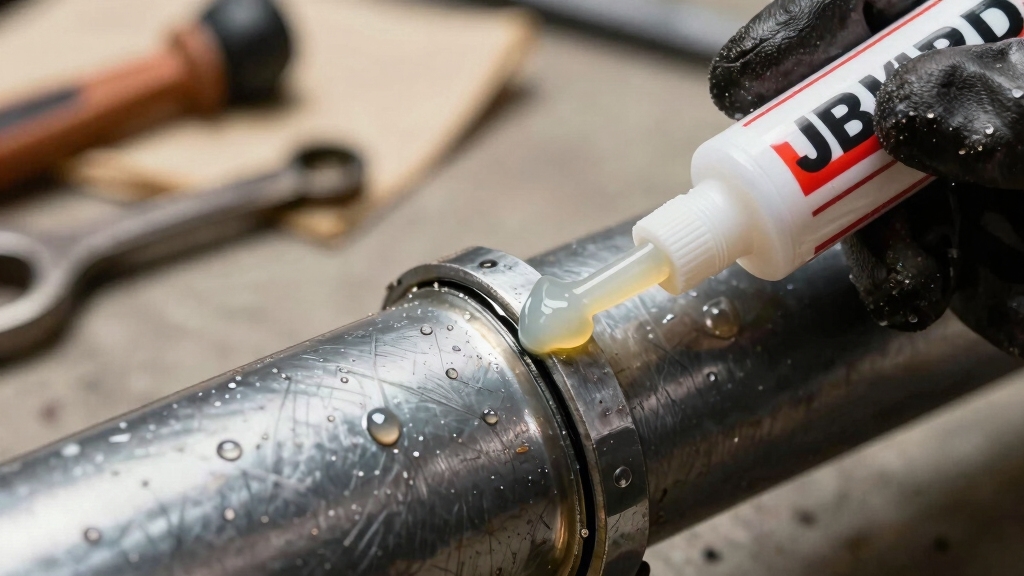
You need J-B Weld because it delivers durable, oil-resistant epoxy designed to repel petroleum products and maintain strong adhesion on oil-exposed surfaces like pans and tanks.
Its dense, cross-linked polymer matrix blocks oil penetration, preventing bond failure and chemical degradation. Proper surface preparation and curing within 70°F–85°F guarantees maximum durability.
Withstands high temperatures up to 550°F intermittent and delivers up to 5020 PSI strength. Exploring further reveals how environmental factors and variants affect performance.
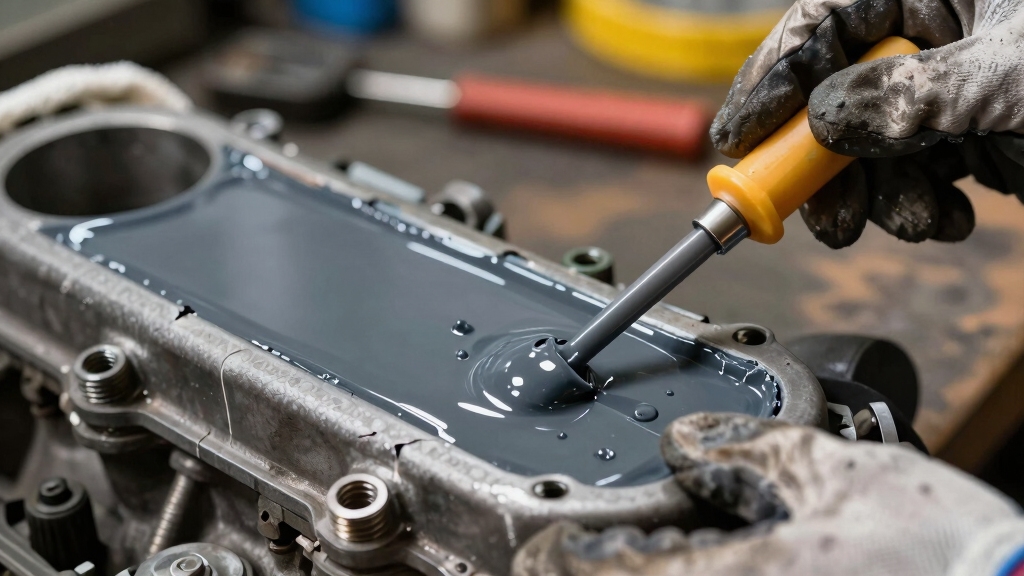
Durability plays an essential role when selecting an epoxy for repairs exposed to oil and petroleum products. You need an epoxy that can resist chemical degradation and maintain adhesion despite prolonged oil contact.
Durability is key when choosing an epoxy to withstand chemical degradation and maintain adhesion in oil-exposed repairs.
Oil-resistant epoxies prevent bond failure caused by oil penetration, which otherwise leads to softening, swelling, or cracking. By choosing a product engineered for oil resistance, you guarantee the structural integrity of your repair under harsh petroleum exposure.
This resistance is critical for applications involving gas tanks, oil pans, and industrial machinery, where compromised bonds risk leaks and mechanical failure. Additionally, oil-resistant epoxies provide a consistent barrier against petroleum products, preserving mechanical properties and extending repair lifespan.
Selecting an epoxy without these characteristics increases maintenance frequency and operational downtime, making oil resistance a fundamental criterion for reliable repair solutions. Proper surface preparation, including cleaning and roughening, further enhances the epoxy’s adhesion and durability in oily environments, ensuring a long-lasting bond. This step is often overlooked but crucial for a durable repair.
You know, J-B Weld’s oil resistance is pretty impressive. It comes from a special epoxy formulation that’s designed to repel all those petroleum products.
Once it cures, the epoxy creates a strong barrier that stops oil from getting in and breaking down the bond.
What’s really cool is that this chemical makeup ensures that the adhesion strength stays stable, even when it’s exposed to oil. So, whether you’re working on a car repair or another project, you can trust that J-B Weld will hold up in those oil-prone environments.
Additionally, proper surface prep and curing time are critical to achieving maximum adhesion strength in oil-exposed conditions.
J-B Weld epoxy resists oil by forming a dense, cross-linked polymer matrix that blocks petroleum molecules from penetrating the bond line.
This molecular network creates a physically impermeable barrier, preventing diffusion of hydrocarbons into the adhesive interface.
The epoxy’s resin and hardener chemistries are engineered to optimize cross-link density, enhancing chemical resistance without sacrificing mechanical strength.
When fully cured, the formulation achieves a balance of rigidity and chemical inertness, maintaining adhesion under exposure to gasoline, oil, and petroleum derivatives.
You’ll find this formulation effective across standard and specialized variants like TankWeld, each optimized for different temperature ranges and stress conditions.
This precise polymer architecture guarantees that oil resistance is integral to the epoxy’s performance, making it reliable for automotive and industrial applications where petroleum contact is routine.
Proper surface preparation and full curing are essential to ensure the maximum durability of the oil-resistant bond.
When exposed to petroleum products, the epoxy forms a dense, cross-linked polymer barrier that actively blocks oil molecules from penetrating the bond line. This molecular network resists chemical degradation and maintains structural integrity under oil exposure.
You’ll find this barrier critical in applications like automotive oil pans or fuel tanks where petroleum contact is constant. The epoxy’s chemical makeup prevents swelling, cracking, or weakening even during thermal cycling.
Consider these key factors about the barrier against oil:
Understanding these mechanisms helps you trust J-B Weld’s oil resistance in demanding conditions. For optimal effectiveness, ensure thorough surface preparation before application to achieve maximum adhesion and durability.
Although oil exposure presents a challenging environment for adhesives, this epoxy maintains structural integrity across a broad temperature range.
Standard J-B Weld withstands intermittent temperatures up to 550°F and maintains continuous exposure resistance at 500°F when fully cured.
This temperature performance guarantees the bond endures thermal cycling typical in oil-rich automotive engine compartments.
The TankWeld variant offers reliable oil resistance at temperatures up to 300°F, suitable for specialized petroleum applications.
These heat thresholds prevent bond degradation, guaranteeing consistent adhesion and mechanical strength under thermal stress.
When using J-B Weld in oil environments, consider these temperature limits to optimize repair longevity and durability, especially in static or low-vibration conditions where thermal stress can challenge the epoxy’s performance.
Proper surface preparation including cleaning and roughening is essential to maximize adhesion and durability in oil-exposed applications.
Since effective oil resistance depends on the specific formulation, you should select the variant designed for your application’s temperature and mechanical demands.
Effective oil resistance requires choosing a J-B Weld variant suited to your temperature and mechanical needs.
J-B Weld’s standard epoxy and TankWeld are engineered to offer robust oil resistance, with differences in thermal tolerance and tensile strength tailored to distinct uses.
Consider these key variants:
Choose based on your repair’s thermal exposure and mechanical stress for best possible oil resistance. Proper surface preparation and curing within the optimal temperature range (70°F–85°F) ensure maximum bond strength and durability when exposed to oil.
You know, when it comes to automotive repairs, J-B Weld‘s oil resistance is a real game-changer. It’s perfect for sealing up oil pans and fuel tanks that come into contact with petroleum. That peace of mind is crucial, right?
Plus, it boasts impressive tensile strength, making it ideal for load-bearing fixes in both cars and industrial machinery. It’s not just a quick fix; it’s something you can rely on for those high-stress situations. Proper surface preparation and curing time are critical to ensure maximum strength and chemical resistance in these applications.
J-B Weld excels in oil-exposed automotive repairs by providing a durable, oil-resistant bond essential for components like oil pans, radiators, and gas or oil tanks.
Its epoxy formulation withstands petroleum exposure and thermal cycling up to 500°F, ensuring bond integrity in harsh engine environments.
When you apply J-B Weld, you create a chemical and heat-resistant seal that resists oil penetration and mechanical stress common in automotive systems.
Key applications where you’ll find its oil resistance critical include:
This precision-engineered epoxy delivers reliable, load-bearing repairs in oil-rich conditions. Proper surface preparation and curing are essential for maximizing the bond strength and longevity of repairs exposed to oil and heat.
Beyond automotive repairs, industries rely heavily on oil-resistant adhesives for maintaining machinery exposed to petroleum products.
You’ll find J-B Weld widely used in industrial settings to repair oil tanks, pumps, and other petroleum-containing equipment.
Its epoxy formulation creates a durable barrier against oil penetration, preventing degradation under continuous exposure.
With tensile strengths up to 5020 PSI, J-B Weld supports mechanical system repairs where oil resistance and structural integrity are critical.
The TankWeld variant, rated for 4000 PSI and 300°F, suits specialized oil tank maintenance.
You must make certain surface preparation is meticulous, as residual oils can hinder bonding.
By applying J-B Weld, you’ll extend service life and reduce downtime in machinery subjected to oil and thermal cycling.
This proves its value in industrial maintenance and repair operations.
Proper surface preparation is essential to ensure the epoxy bonds effectively and withstands oil exposure over time.
Repairs on load-bearing automotive and industrial equipment demand adhesives that combine high tensile strength with reliable oil resistance.
J-B Weld’s standard formula, boasting 5020 PSI tensile strength, secures components exposed to petroleum without bond degradation.
Its cured epoxy barrier resists oil penetration, ensuring durability under thermal cycling up to 500°F continuous exposure.
You’ll find J-B Weld ideal for:
This combination of strength and chemical resistance makes J-B Weld indispensable for load-bearing fixes where oil exposure threatens conventional adhesives. Its performance depends on proper surface preparation and curing to maximize adhesion and chemical resistance.
When bonding to oily surfaces, the strength of the epoxy relies heavily on proper surface preparation to guarantee adhesion.
J-B Weld’s epoxy formulations resist oil penetration and maintain structural integrity, achieving tensile strengths up to 5020 PSI on cleaned, oil-exposed substrates.
The cured epoxy forms a barrier that prevents oil-induced degradation, ensuring long-term bond stability under petroleum exposure.
However, residual oil can markedly reduce adhesion strength, so degreasing and surface abrasion are critical steps.
J-B Weld withstands intermittent temperatures up to 550°F and continuous exposure at 500°F, preserving bond strength in oil-rich environments like engine compartments.
While effective for static or low-vibration repairs, high mechanical stress combined with oil exposure may diminish performance over time.
Proper application maximizes its oil-resistant bonding capability.
Achieving peak oil resistance with J-B Weld depends largely on following the recommended curing procedures. Proper curing guarantees the epoxy fully develops its barrier properties against oil penetration and degradation.
To maximize oil resistance, you should:
Following these steps guarantees the cured J-B Weld maintains its oil resistance and tensile strength. This is essential for durability in petroleum-exposed environments.
Under exposure to petroleum products, J-B Weld’s oil resistance depends heavily on both the chemical composition of the oil and environmental conditions such as temperature and vibration.
J-B Weld’s oil resistance varies with oil type, temperature, and vibration conditions.
You’ll find that petroleum types like gasoline and diesel have varying effects on the epoxy’s integrity.
However, J-B Weld’s cured barrier effectively resists penetration and degradation.
Temperature plays a critical role; standard J-B Weld tolerates intermittent heat up to 550°F and continuous exposure up to 500°F, maintaining bond strength in oil-rich environments.
However, high vibration combined with heat can stress the adhesive over time, potentially compromising durability.
To guarantee peak performance, you must prepare surfaces thoroughly and consider the operating environment.
J-B Weld performs best in static or low-vibration applications, where oil resistance remains stable throughout its lifespan.
You shouldn’t use J-B Weld on polyethylene plastic surfaces exposed to oil, as it lacks proper adhesion there.
For other plastics, performance varies and requires thorough surface preparation to remove oil residues. Without that, the bond weakens.
If your plastic isn’t polyethylene and you clean it well, J-B Weld might work.
However, expect reduced durability under constant oil exposure and thermal cycling compared to metal or rigid substrates.
Vibration affects J-B Weld’s oil-resistant bond like constant waves eroding a shoreline. It gradually stresses and weakens adhesion.
While it maintains strength under static or low-vibration conditions, high-vibration environments combined with heat can compromise the bond over time.
You need to ensure proper surface prep and consider mechanical stresses. Prolonged dynamic stress and thermal cycling reduce the epoxy’s durability in oil-exposed applications.
Yes, you can rely on J-B Weld to resist gasoline as well as oil. Its two-part epoxy system is specifically engineered to withstand exposure to petroleum products, including gasoline.
The cured epoxy forms a durable barrier preventing gasoline penetration and degradation. It maintains adhesion and tensile strength even under thermal cycling.
This makes J-B Weld suitable for repairs on gas tanks and oil-containing equipment where gasoline resistance is critical.
Yes, you can paint cured J-B Weld without losing its oil resistance.
Once fully cured within 15-24 hours, the epoxy forms a stable, oil-resistant barrier that remains intact despite surface treatments like painting.
Painting after curing doesn’t compromise the petroleum resistance properties, so you maintain chemical durability while achieving the desired finish.
Just make sure to do proper surface prep before painting for best adhesion and longevity.
Think of bonding oily materials like planting seeds in a well-tilled garden. You must clear away debris first.
You’ll need to thoroughly clean the surface, removing all oil, grease, and contaminants with a suitable solvent or degreaser.
After drying, lightly abrade the area to increase surface roughness for better adhesion. Without this essential prep, the epoxy can’t form a strong bond, risking failure under stress and oil exposure.
When you choose J-B Weld for your oil-exposed repairs, you’re not just picking an adhesive. You’re ensuring durability where others fail.
It’s no coincidence that its chemical makeup resists oil degradation and high temperatures. This makes it ideal for demanding automotive and industrial tasks.
By understanding the right variant and curing method, you maximize strength on oily surfaces. So, when reliability matters most, J-B Weld stands as the precise, oil-resistant solution you need.