Phone:
(701)814-6992
Physical address:
6296 Donnelly Plaza
Ratkeville, Bahamas.

Phone:
(701)814-6992
Physical address:
6296 Donnelly Plaza
Ratkeville, Bahamas.

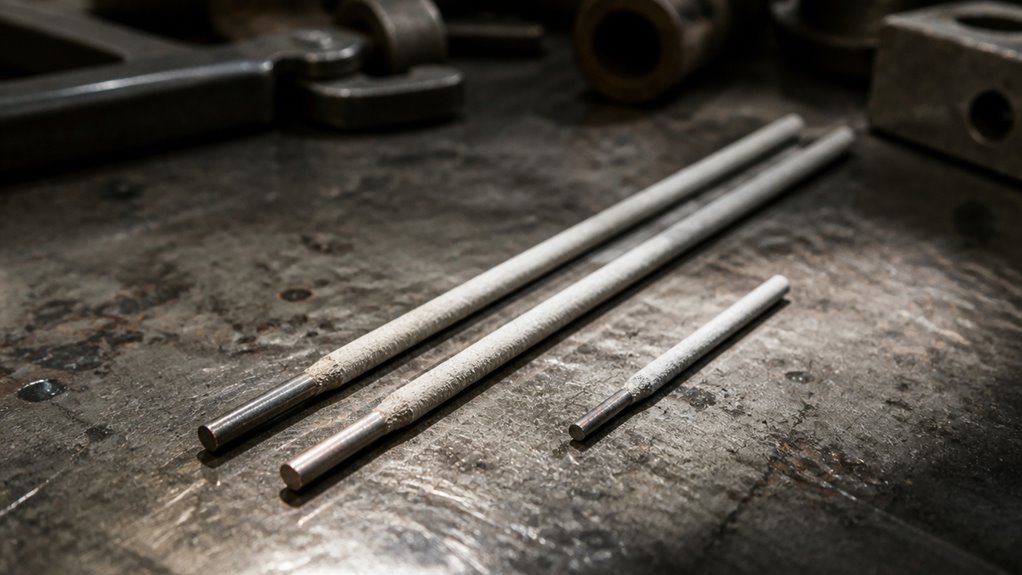
When choosing between 3/32 and 1/8 welding rods, consider your metal thickness and welding position.
Use 3/32 rods for thinner metals under 1/4 inch and vertical or overhead positions.
Precise control and lower amperage (40–150A) reduce burn-through.
Opt for 1/8 rods for thicker metals over 1/4 inch and flat or horizontal welding.
They support higher amperage (90–250A) and offer faster deposition.
Understanding these factors guarantees stronger, efficient welds and sets the stage for deeper insight into ideal rod selection.


| Feature | 3/32 Welding Rod | 1/8 Welding Rod |
|---|---|---|
| Rod Diameter | 0.09375 inches | 0.125 inches |
| Best For | Thin metals and precision welding | Thick metals and heavy fabrication |
| Recommended Metal Thickness | Under 1/4 inch | Over 1/4 inch |
| Amperage Range | 40–150A | 90–250A |
| Weld Control | Better precision and control | Faster weld deposition |
| Burn-Through Risk | Lower risk on thin metal | Higher risk on thin metal |
| Welding Positions | Vertical, overhead, all-position welding | Flat and horizontal welding |
| Deposition Rate | Slower deposition | Higher deposition rate |
| Weld Bead Size | Smaller and cleaner beads | Larger and stronger weld beads |
| Travel Speed | Slower, more controlled | Faster welding speed |
| Rod Changes | More frequent changes | Fewer rod replacements needed |
| Heat Input | Lower heat input | Higher heat penetration |
| Best Applications | Sheet metal, root passes, repair work | Structural steel, fabrication, thick plates |
| Ease of Use | Easier for detailed work | Better for productivity |
| Slag Control | Easier slag removal | Thicker slag formation |
| Power Requirement | Lower power demand | Requires stronger welding machine |
| Main Advantage | Precision and reduced distortion | Speed and strong weld buildup |
| Main Drawback | Slower for large projects | Harder to control on thin metals |
| Ideal User | Beginners and precision welders | Experienced welders and fabrication work |
| Overall Best Use | Thin metal and controlled welding | Heavy-duty welding and thick materials |
When selecting a welding rod, you need to take into account diameter carefully because it directly impacts weld quality and efficiency.
Choosing the right welding rod diameter is essential for achieving optimal weld quality and efficiency.
The 3/32-inch rod, measuring 0.09375 inches, suits thinner base metals, typically under 1/4 inch thick.
It allows better control, reduces burn-through risk, and operates at lower amperage ranges (40-150A), making it ideal for precision and vertical welding.
Conversely, the 1/8-inch rod at 0.125 inches accommodates thicker metals, supporting higher amperages (90-250A) and higher deposition rates.
This size minimizes rod changes on heavy fabrication projects by depositing more weld metal per pass.
Selecting the correct diameter guarantees appropriate penetration, bead size, and amperage settings.
These factors are critical to meeting structural integrity and efficiency requirements in your welding tasks.
Additionally, proper storage and handling are essential to maintain low-hydrogen coating effectiveness and weld quality.
When choosing a welding rod size, it’s important to match it to the thickness of your base material. If you’re working with thinner metals—those under 1/4 inch—3/32-inch rods are your best bet. They really shine in those situations!
Now, if you’re dealing with thicker sections, like those over 1/4 inch, you’ll want to go for 1/8-inch rods. They’re designed to handle the extra material and give you a solid weld.
Also, don’t forget to think about your welding position. If you’re welding vertically or overhead, 3/32 rods can give you better control and help prevent sagging. So, keep these factors in mind; they’ll really influence the quality, penetration, and overall efficiency of your project!
Additionally, selecting the correct amperage range helps ensure proper penetration and arc stability for each rod size.
Although selecting the correct welding rod size depends on multiple factors, material thickness remains the primary criterion for choosing between 3/32 and 1/8 inch rods.
You should use 3/32 rods for thinner materials, typically up to 1/4 inch thick. Their smaller diameter (0.09375 inches) offers better control and reduces burn-through risk.
Conversely, 1/8 rods (0.125 inches) suit thicker metals above 1/4 inch, providing higher deposition rates and faster weld buildup.
Remember, the rod diameter shouldn’t exceed the base metal thickness to guarantee proper penetration and avoid defects.
For example, 3/32 rods efficiently weld 1/8 to 1/2 inch plates at moderate amperage.
Meanwhile, 1/8 rods handle heavy fabrication with thicker sections, maximizing productivity and weld strength.
Match rod size precisely to thickness for optimal outcomes.
Choosing the appropriate rod size also influences welding positions and technique, since all-position welding often requires rods that support versatile handling and penetration.
Material thickness guides rod diameter selection, but welding position shapes which rod will offer better control and weld quality.
When welding vertical or overhead, you’ll typically prefer the 3/32 rod due to its smaller diameter. This enhances maneuverability and reduces slag sagging, allowing for precise bead placement and consistent penetration on thinner materials.
Conversely, the 1/8 rod suits flat or horizontal positions where higher deposition rates improve efficiency on thicker metals. Its larger diameter supports faster buildup and fewer rod changes, ideal for heavy fabrication.
Consider amperage limits, too: 3/32 runs lower amps (40-150A) offering finer control, while 1/8 requires higher amps (90-250A) but deposits more weld metal.
Matching rod size to position optimizes weld integrity and operator control for your specific project demands. Proper amperage is critical for penetration to ensure strong, defect-free welds and avoid weak joints.
Choosing the 3/32 7018 welding rod enhances control and precision, especially in vertical and all-position welding scenarios.
The 3/32 7018 rod offers superior control and precision in vertical and all-position welding.
You’ll benefit from its lower amperage range (40-150A), which reduces burn-through risks on thin to medium metals up to 1/2 inch thick.
The smaller diameter provides better maneuverability, allowing you to maintain a finer, more consistent bead with less sagging.
This rod is ideal for root passes and thin sheet metal, where precise deposition is critical.
Its faster travel speed and controlled penetration optimize heat input, minimizing distortion.
Additionally, the 3/32 7018’s cost-effectiveness on smaller jobs reduces downtime due to fewer rod changes.
When welding structural steel in challenging positions, this rod gives you the accuracy and reliability that heavier rods can’t match.
Its flux coating also generates a protective gas and slag layer, providing atmospheric contamination shielding without the need for external gas.
The 1/8 7018 welding rod really shines when it comes to efficiency. It has a higher deposition rate, which makes it a great choice for thicker metal applications.
If you’re working on heavy fabrication, this rod is perfect because it allows for larger weld sizes and quicker progress. That means less downtime for you!
Plus, using the 7018 rod helps boost productivity, especially when you’re tackling substantial steel structures. You can get the job done faster without sacrificing weld integrity.
However, it is important to store these rods properly to prevent moisture absorption, which can compromise weld quality and cause defects.
Maximize your welding efficiency by opting for the 1/8-inch 7018 rod when working on thicker metals or large-scale projects.
This rod delivers a higher deposition rate compared to the 3/32-inch alternative, allowing you to deposit more weld metal per pass.
The increased diameter supports amperage ranges of 90-250A, enabling faster welding speeds and reducing the number of rod changes.
Consequently, you minimize downtime and improve overall productivity.
The larger weld bead size created by the 1/8-inch rod suits applications requiring substantial weld throat thickness, typically around 3/16 inch or more.
By choosing the 1/8 7018, you guarantee efficient metal deposition critical for maintaining structural integrity without sacrificing weld quality.
This makes it ideal for jobs demanding sustained, heavy weld build-up over extended runs.
Unlike 6013 rods, 7018 rods require special storage to preserve their low-hydrogen coating and weld quality.
Tackle heavy fabrication projects efficiently by using 1/8-inch 7018 welding rods, which excel in delivering the high deposition rates necessary for thick materials and extended weld runs.
You’ll benefit from their ability to build substantial weld sizes while minimizing rod changes, critical for maintaining productivity on large-scale jobs.
These rods are engineered to handle the demands of structural steel and heavy equipment welding, especially in flat and horizontal positions.
Supports weld throat sizes of at least 3/16 inch, aligning with heavy fabrication standards.
Optimizes amperage ranges (90-250A) for consistent penetration and bead profile.
Reduces downtime by maximizing deposition per pass on thick metals.
Using 1/8-inch 7018 rods guarantees robust, low-hydrogen welds that meet stringent strength requirements in demanding fabrication environments.
For vertical welding, it is important to select amperage near the lower half of the electrode’s range to control puddle fluidity and prevent defects.
When working with thick metal, 1/8-inch 7018 welding rods offer superior efficiency due to their higher deposition rates and amperage capacity.
You’ll benefit from fewer rod changes since 1/8-inch electrodes deposit more weld metal per pass, which is critical for heavy fabrication and structural steel.
Their ability to handle amperages up to 250A allows you to create larger welds, such as 3/16-inch throat sizes, meeting strength requirements without sacrificing productivity.
This rod size excels in flat and horizontal positions where you can maintain consistent, high-volume welds.
While 3/32 rods provide better control on thin materials, 1/8 rods reduce downtime on thick metals.
Selecting 1/8-inch 7018 rods guarantees efficient, robust welds on thick base metals, optimizing both time and weld integrity.
Additionally, matching amperage to material thickness is essential to ensure proper penetration and fusion without causing burn-through or porosity.
Because welding positions affect control and bead quality, choosing between 3/32 and 1/8 rods hinges on how well each size performs in specific orientations.
Welding rod choice depends on position, balancing control and bead quality for optimal results.
You’ll find the 3/32 rod excels in vertical and overhead positions due to its superior maneuverability and lower amperage needs. This reduces sagging and burn-through.
Conversely, the 1/8 rod suits flat and horizontal welds where faster deposition rates and larger bead sizes improve efficiency.
Consider these position-based impacts:
Vertical uphill welding favors 3/32 for precise bead control and minimized slag inclusions.
Flat and horizontal positions benefit from 1/8’s higher deposition rate and weld size capacity.
Overhead welding demands the thinner rod’s control to prevent excessive weld metal dripping.
Selecting rod size by position optimizes weld integrity and operator control.
Understanding the role of weld pool control in different positions further guides the choice between rod sizes to maintain consistent quality.
Welding position dictates rod control, but matching rod size to metal thickness and desired weld size guarantees structural integrity and weld efficiency.
You should select a 3/32-inch rod for base metals up to 1/4 inch thick, as its smaller diameter offers precise penetration without burn-through.
For metals thicker than 1/4 inch, a 1/8-inch rod is preferable; it delivers higher deposition rates and builds larger weld throats efficiently.
Remember, the rod diameter should never exceed the base metal thickness to avoid weld defects.
Also, aim for a weld size at least 3/4 of the metal thickness to assure adequate strength.
Understanding the amperage range and deposition rates of 3/32 and 1/8 7018 rods is crucial for optimizing weld quality and efficiency.
The 3/32 rod operates between 40 to 150 amps, offering precise control on thinner metals. In contrast, the 1/8 rod requires 90 to 250 amps, delivering higher deposition rates suited for thicker sections.
This amperage difference directly affects your weld bead size and penetration depth.
Key points to contemplate:
3/32 rod: Lower amperage, slower deposition, better for thin metals and vertical welding.
1/8 rod: Higher amperage, faster deposition, ideal for heavy fabrication and flat/horizontal welds.
Deposition rate impact: Larger rods reduce rod changes but demand more power and generate larger welds.
Selecting the right amperage and rod size balances efficiency with weld integrity.
To get the best weld quality with 3/32 and 1/8 rods, you’ll need to fine-tune your amperage settings and technique based on the rod size and material thickness.
Use 3/32 rods for thin materials with lower amperage (40-150A). This ensures controlled, precise welds, especially in vertical positions. For thicker metals, 1/8 rods operate at higher amperage (90-250A), maximizing deposition and efficiency.
Always test settings on scrap to avoid defects.
| Rod Size | Amperage Range (A) | Application Focus |
|---|---|---|
| 3/32 | 40 – 150 | Thin metals, vertical |
| 1/8 | 90 – 250 | Thick metals, flat |
| Both | Match rod to metal | Optimize weld quality |
Adjust travel speed and maintain consistent arc length for stable penetration.
Yes, you can use 3/32 and 1/8 rods interchangeably in emergencies, but understand the trade-offs.
The 3/32 rod offers better control on thinner materials and vertical positions. The 1/8 rod deposits more weld metal, suiting thicker plates.
Using a larger rod on thin metal risks burn-through. A smaller rod on thick metal slows the job.
Always adjust amperage accordingly and test on scrap to guarantee weld integrity.
You need to store both 3/32 and 1/8 rods in a dry, temperature-controlled environment to maintain their shelf life.
Moisture and humidity cause hydrogen pickup, leading to weld defects.
Keep rods in sealed containers or rod ovens at around 250°F to prevent deterioration.
While size doesn’t change storage needs, improper conditions reduce effectiveness and increase scrap rates.
Always monitor and re-bake rods if exposed to moisture before use.
You’ll need to treat 1/8 rods like miniature suns, managing higher amperage that demands better heat-resistant gear and ventilation to avoid excessive fumes.
With 3/32 rods, lower amperage means less intense heat and fumes.
Precise control is critical to prevent burn-through, so you’ll focus more on steady hand positioning and eye protection from spatter.
Both require full PPE, but 1/8 rods push your safety gear and ventilation systems harder.
Yes, you’ll notice differences in slag removal between the two.
The 3/32 rod produces a thinner, more manageable slag that’s easier to chip off, especially on vertical or thin materials.
The 1/8 rod, with its larger weld bead, creates thicker slag requiring more effort and care to remove fully.
You’ll need a heavier chipping hammer or wire brush for 1/8 slag to guarantee clean weld surfaces, particularly on thicker metals.
Rod diameter directly impacts electrode stub waste and cost efficiency.
Smaller rods like 3/32 inch create less stub waste because you can use shorter lengths before discarding unusable stubs. They also operate at lower amperage, reducing overheating and wasted material.
Larger 1/8 inch rods deposit more weld metal per pass, cutting downtime and rod changes on thick work. This improves cost efficiency despite higher stub waste per rod length.
Choose based on job scale.
When choosing between 3/32 and 1/8 welding rods, consider your metal thickness, weld position, and amperage needs carefully.
Like a knight selecting the perfect sword, your choice impacts weld quality and strength.
The 3/32 rod excels in precision and thinner metals, while the 1/8 rod handles heavier work with higher deposition rates.
Mastering these factors guarantees efficient, reliable welds, no matter your project’s demands or the era you’re welding in.
Last update on 2026-10-17 / Affiliate links / Images from Amazon Product Advertising API
