Phone:
(701)814-6992
Physical address:
6296 Donnelly Plaza
Ratkeville, Bahamas.

Phone:
(701)814-6992
Physical address:
6296 Donnelly Plaza
Ratkeville, Bahamas.

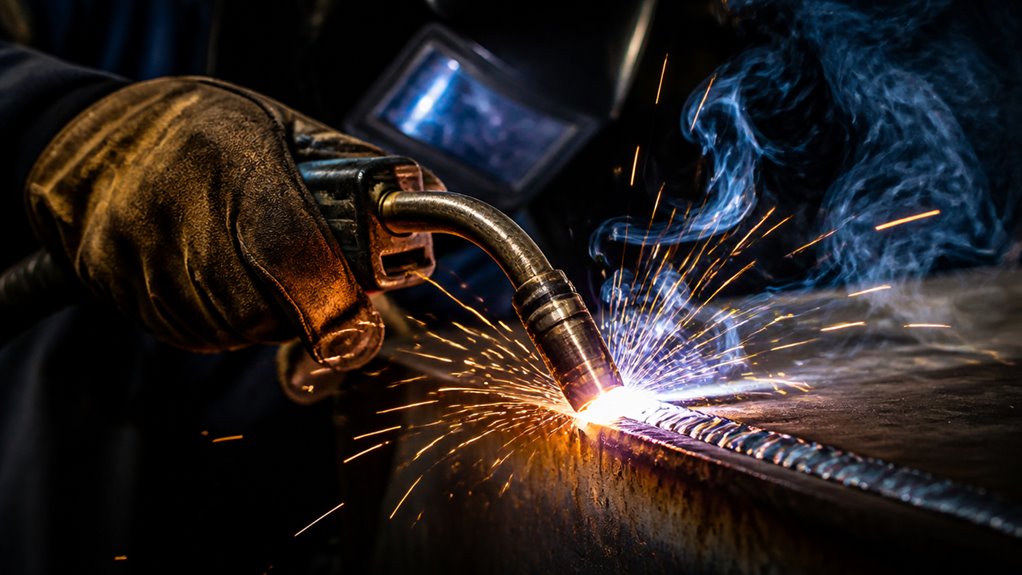
In MIG welding, the arc’s temperature typically ranges between 6,000°F and 14,000°F. This is far hotter than the weld pool, which melts metal around 2,500°F to 3,500°F.
This extreme heat arises because the arc creates ionized plasma, concentrating energy in a narrow channel.
You’ll control heat input through current, voltage, and wire feed, balancing fusion and distortion risks. Understanding this heat interplay helps optimize weld quality and safety as you explore further details.
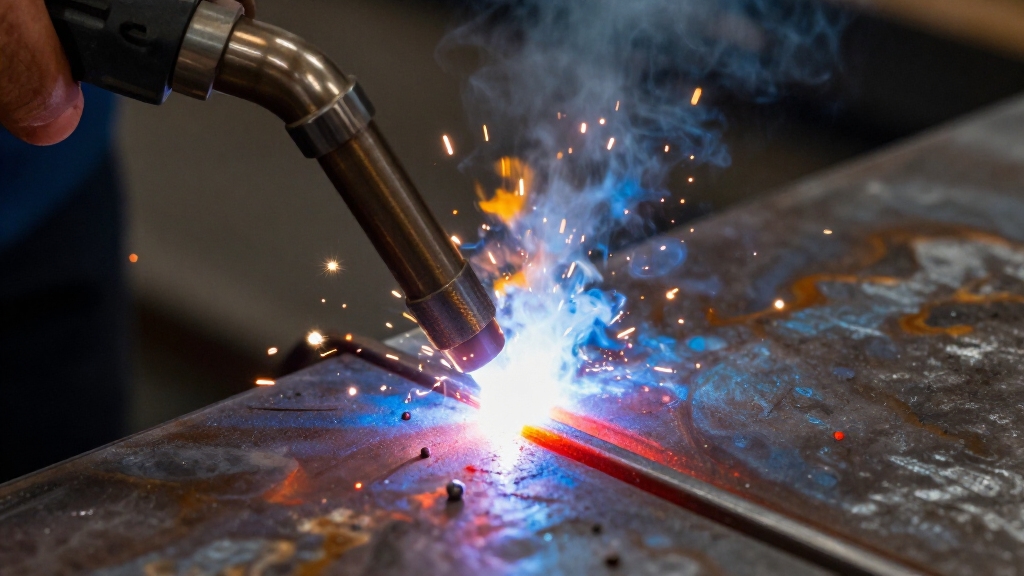
When you strike a MIG welding arc, temperatures quickly ramp up, typically ranging between 6,000°F and 10,000°F (about 3,300°C to 5,500°C).
Striking a MIG welding arc rapidly generates extreme temperatures from 6,000°F to 10,000°F, enabling efficient metal melting.
This intense thermal energy is concentrated within a narrow plasma channel, sustaining the arc and enabling effective metal melting.
In contrast, the weld pool temperature remains markedly lower, generally between 2,500°F and 3,500°F (1,371°C to 1,930°C).
This is sufficient to melt the base and filler metals for proper fusion and penetration.
You’ll notice that the arc temperature is substantially hotter than the molten pool, reflecting the energy transfer dynamics.
Factors such as current, voltage, wire feed rate, and shielding gas influence these temperatures.
Understanding these ranges helps you optimize heat input, balancing penetration and material integrity in MIG welding applications.
The use of inert shielding gas in MIG welding protects the weld pool from contamination, ensuring high-quality welds.
You know, when it comes to MIG welding, the temperatures can really blow your mind. The welding arc can reach anywhere from about 6,000°F to a whopping 14,000°F! That’s pretty intense compared to the weld pool, which hovers around 2,500°F to 3,500°F.
This big difference in temperature is fascinating. The arc’s incredible heat is what melts the base metal so effectively, while the weld pool stays just hot enough to ensure proper fusion and solidification without going overboard.
Understanding these temperature variations is super important. It helps you control things like penetration, weld quality, and even thermal distortion. So, keeping an eye on those numbers can really make a difference in your welding projects!
Additionally, selecting the right shielding gases can significantly influence arc stability and heat input, further affecting weld temperature and quality.
MIG welding arcs typically reach temperatures between 6,000°F and 10,000°F (about 3,300°C to 5,500°C). This extreme difference allows efficient melting and fusion without excessive bulk heating.
The arc’s plasma can reach even higher temperatures, up to 24,000°C in some cases, emphasizing the intense localized heat source. Meanwhile, the weld pool temperature usually ranges from 2,500°F to 3,500°F (1,370°C to 1,930°C), sufficient to maintain metal fusion.
Using DCEN polarity during welding optimizes arc stability and penetration, which is crucial for effective heat control.
| Parameter | Temperature (°F) | Temperature (°C) |
|---|---|---|
| MIG Arc | 6,000–10,000 | 3,300–5,500 |
| Weld Pool | 2,500–3,500 | 1,370–1,930 |
| Plasma (max) | ~43,000* | ~24,000* |
*Plasma temperatures vary by conditions.
Understanding the temperature difference between the weld pool and the welding arc is essential for controlling heat input and achieving proper fusion.
The MIG welding arc reaches temperatures between roughly 6,000°F and 14,400°F (3,300°C to 8,000°C), far exceeding the weld pool’s typical range of 2,500°F to 3,500°F (1,370°C to 1,930°C).
This disparity arises because the arc generates intense plasma energy, delivering heat rapidly and locally.
Meanwhile, the weld pool’s temperature remains just above the melting point of the base metal, ensuring proper fluidity for fusion without excessive bulk heating.
You must manage the arc’s high heat concentration carefully to avoid overheating or distortion.
The weld pool temperature directly influences penetration, bead shape, and metallurgical quality.
Selecting the appropriate transfer mode helps control heat input and manage weld pool characteristics effectively.
Although the welding arc reaches temperatures up to several thousand degrees higher than the weld pool, it’s the concentrated and controlled heat input that determines weld quality.
The MIG arc typically operates between 6,000°F and 14,000°F, vastly exceeding the weld pool’s 2,500°F to 3,500°F range.
This extreme temperature difference lets the arc rapidly melt base and filler metals without overheating surrounding material.
You rely on precise control of voltage, current, and wire feed rate to manage heat transfer efficiently, shaping the pool’s size and penetration depth.
Too much heat risks burn-through and distortion, while too little compromises fusion.
Understanding this temperature disparity helps you optimize settings to balance penetration, quality, and thermal impact.
This ensures consistent, defect-free welds with minimal thermal distortion.
Proper adjustment of wire feed speed is essential to maintain this balance and avoid common welding defects.
Because the welding arc relies on ionized plasma to conduct electricity, it achieves temperatures far exceeding the melting point of the metal being joined. This extreme heat results from the arc’s unique physical properties and energy concentration.
You’ll notice the arc temperature can soar between 6,000°F and 10,000°F, while the molten weld pool stays around 2,500°F to 3,500°F. The reasons include:
Plasma’s ionization allows efficient electrical conduction, generating intense localized energy.
The arc concentrates heat in a narrow zone, minimizing bulk heating and maximizing temperature.
Continuous wire feed and current sustain high energy input, raising arc temperature beyond the melting point.
Understanding this difference helps you control weld quality and prevents overheating or burn-through during MIG welding.
The ionized gas in the arc is a conductive fourth state of matter that enables the high temperatures and energy concentration critical for effective welding.
When you switch metals in MIG welding, you’ll need to adjust heat settings to match their distinct thermal properties and melting points.
For example, mild steel melts around 2,500°F. Typical weld pool temperatures range between 2,800°F and 3,200°F to guarantee proper fusion and penetration.
Aluminum, with a melting point near 1,220°F but higher thermal conductivity, demands higher heat input to compensate for rapid heat dissipation.
Stainless steel, having variable melting points based on alloy composition, often requires moderate heat settings to balance penetration and avoid warping.
You must consider each metal’s thermal conductivity, melting temperature, and specific heat capacity. These factors influence how quickly heat transfers and dissipates.
Adjusting power and travel speed accordingly guarantees a stable weld pool without overheating or insufficient fusion.
In addition, wire feed speed and voltage control are critical to managing heat input and achieving consistent weld quality across different materials.
Adjusting MIG welding settings directly influences the arc temperature and weld pool heat, determining weld quality and penetration. You control the energy input by tweaking voltage, current, and wire feed speed, which affects how hot the arc burns, often between 6,000°C and 8,000°C.
The weld pool temperature typically hovers around 1,500°C to 2,000°C. Precise control guarantees proper fusion without overheating or warping.
Key factors include:
Balancing voltage and amperage is essential to maintain a stable arc and achieve the desired weld bead profile.
Controlling MIG welding settings directly impacts the heat generated by the arc and weld pool. This poses significant safety risks if not properly managed.
Properly managing MIG welding settings is crucial to control heat and ensure safety during welding.
You need to wear appropriate personal protective equipment, including flame-resistant clothing, welding gloves, and a helmet with a suitable filter lens. These items shield your skin and eyes from intense radiant heat and spatter.
Make sure your workspace is free from combustible materials, as spatter and radiant heat can ignite them.
Maintain proper ventilation to avoid inhaling hazardous fumes produced by high-temperature arcs.
Monitor your current and voltage settings carefully to avoid excessive heat input that increases burn-through risk.
Always inspect welding equipment regularly for damage and proper grounding to prevent electrical hazards during operation.
Managing heat input during MIG welding directly influences weld penetration depth and the degree of distortion in the workpiece.
If you increase heat, you enhance penetration but risk excessive distortion or burn-through. Conversely, lowering heat reduces distortion but may compromise fusion quality.
You must balance parameters like current, voltage, and travel speed to optimize results.
Consider these key effects:
Higher amperage and slower travel speed increase heat input, deepening penetration but raising distortion.
Lower heat input preserves base metal integrity, minimizing warping but risking incomplete fusion.
Adjusting wire feed rate and shielding gas can fine-tune thermal transfer, affecting both weld pool stability and heat distribution.
Proper heat control guarantees structural integrity and dimensional accuracy, vital for reliable, high-quality welds.
Selecting the correct amperage for thickness ensures optimal penetration without causing burn-through or excessive spatter.
You’ll find that using argon mixed with a small percentage of CO2 (commonly 75-95% argon, 5-25% CO2) offers precise temperature control during MIG welding.
This blend improves arc stability and heat input, allowing you to manage weld pool temperature effectively.
Pure CO2 can increase heat and penetration but may cause more spatter.
On the other hand, pure argon reduces heat and penetration.
Adjusting gas ratios helps you tailor heat transfer to your specific application.
Increasing your wire feed speed raises the weld current, resulting in a wider, flatter bead with better penetration. If you feed too fast, the bead may become irregular and spatter increases due to excessive heat input.
Conversely, a slower feed speed produces a narrower, higher bead with less penetration and potential lack of fusion. You need to balance feed speed precisely to optimize bead shape, minimize defects, and maintain consistent arc stability.
You generally can’t perform MIG welding outdoors without shielding gas because the gas protects the weld pool from atmospheric contamination.
Wind disperses the shielding gas, leading to porosity and weak welds.
To weld outside without shielding gas, you’d need flux-cored wire, which generates its own protective slag.
If you insist on MIG welding outdoors, use windbreaks or specialized gas mixes.
However, expect compromised weld quality without proper shielding gas coverage.
Think of your MIG gun as a race car engine. You’ve got to keep it cool to perform.
To prevent overheating, regularly clean the contact tip and nozzle to guarantee smooth electrical flow and proper gas coverage.
Check for worn or damaged cables and replace them promptly to avoid resistance buildup.
Maintain proper wire feed tension and inspect cooling fans or water-cooling systems if equipped.
These steps manage heat effectively, keeping your gun running efficiently and reliably.
Ambient temperature directly influences your MIG welding performance by affecting cooling rates and arc stability.
In colder environments, the weld pool cools faster, risking inadequate fusion or increased brittleness.
Warmer ambient temperatures can reduce heat dissipation, potentially causing overheating or excessive weld distortion.
You need to adjust your settings, such as amperage, voltage, and travel speed, to compensate.
This ensures consistent weld quality and prevents defects linked to thermal fluctuations in your work environment.
When you plunge into MIG welding, you’re harnessing a concentrated sunburst.
Arc temperatures soar around 6,500°F, far hotter than the molten weld pool beneath.
Understanding this fiery dance lets you control heat input precisely, balancing penetration and distortion.
By mastering settings and metal types, you don’t just weld; you sculpt with fire, protecting yourself while shaping metal with surgical accuracy.
Your grasp of MIG heat transforms sparks into strength, precision, and safety.