Phone:
(701)814-6992
Physical address:
6296 Donnelly Plaza
Ratkeville, Bahamas.

Phone:
(701)814-6992
Physical address:
6296 Donnelly Plaza
Ratkeville, Bahamas.

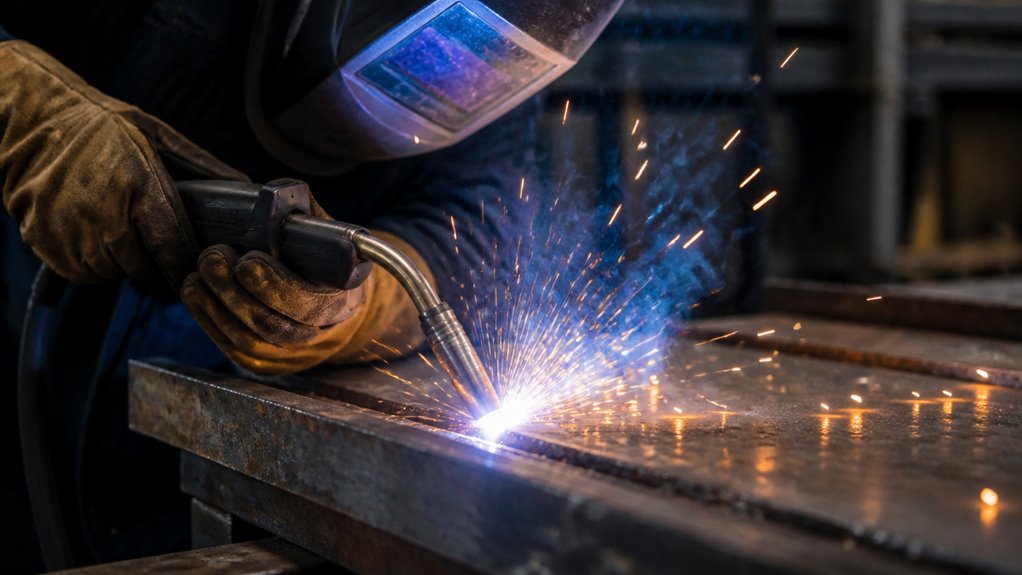
You’ll find MIG welding is the most common type due to its high-speed, semi-automatic wire feed and consistent shielding gas protection.
This ensures clean, strong welds on steel and aluminum. It offers a low learning curve, making workforce training efficient while delivering minimal spatter and excellent productivity.
Its versatility suits many industries, from automotive to aerospace. If you want to understand how MIG compares to stick and TIG welding or when each method fits best, this overview will guide you.
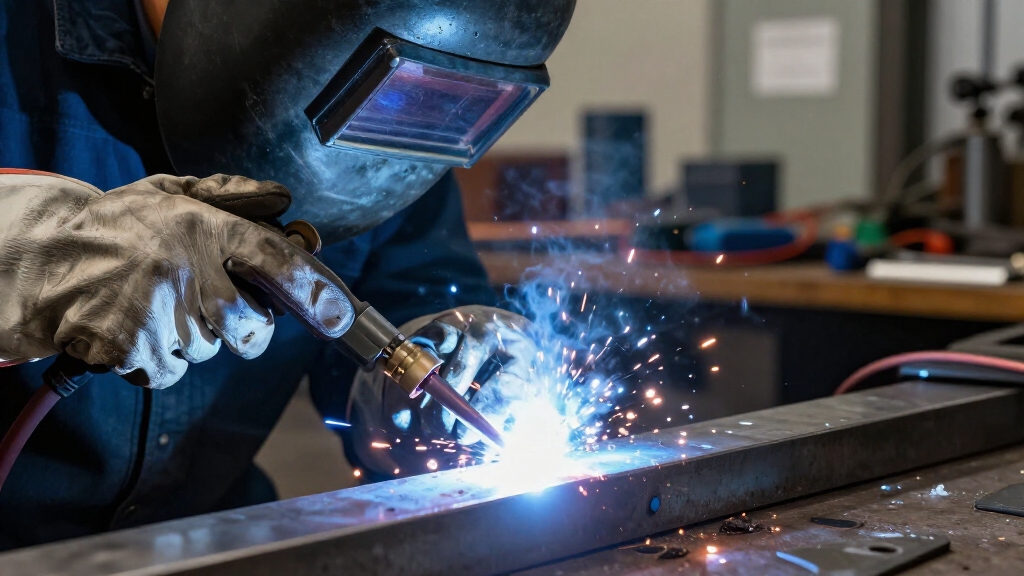
Frequently, MIG welding stands out as the most common welding method due to its efficiency and versatility in industrial applications.
You’ll find it favored because its continuous wire feed minimizes downtime, boosting production speed substantially.
The use of shielding gas like argon or carbon dioxide protects the weld pool from contamination, ensuring consistent quality.
Its broad compatibility with various metals—steel, aluminum, and more—makes it adaptable across sectors such as automotive and construction.
You’ll also appreciate its relatively low learning curve, which facilitates quicker workforce training and broader adoption in manufacturing environments.
This combination of productivity, weld integrity, and accessibility explains why MIG welding dominates over alternatives like stick or TIG welding in many industrial contexts.
Additionally, ensuring proper surface preparation before welding improves strength and durability, which is critical for achieving high-quality welds.
MIG welding operates by feeding a continuous wire electrode through a welding gun while simultaneously releasing a shielding gas to protect the molten weld pool from atmospheric contamination.
This continuous wire feed minimizes downtime, enabling faster, more efficient welding compared to intermittent manual electrode replacement.
You’ll find that the shielding gas, commonly argon or a CO₂ mix, prevents oxidation and contamination, ensuring a cleaner, stronger weld.
The process is versatile, accommodating various metals like steel and aluminum, and offers high deposition rates for productivity.
Its relatively low skill barrier helps you achieve consistent weld quality quickly, making it ideal for repetitive industrial applications.
Ultimately, MIG welding combines speed, strength, and cleanliness, which explains its widespread adoption across numerous manufacturing environments.
Its semi-automatic operation provides consistent welds with minimal spatter, reducing cleanup time and enhancing efficiency.
Manufacturing sectors relying on high-speed, reliable joining frequently turn to gas metal arc welding due to its efficiency and adaptability.
If you work in industries requiring consistent and strong welds, MIG welding is likely your go-to method. Its continuous wire feed and shielding gas system optimize productivity and weld integrity across various materials.
You’ll find MIG welding chiefly used in:
Understanding these industry applications helps you appreciate why MIG welding remains a dominant process. It balances speed and reliability within demanding production environments. Additionally, the use of solid wire with shielding gas ensures cleaner welds essential for these high-quality applications.
Several distinct advantages position gas metal arc welding as the preferred method in many industrial settings. You benefit from continuous wire feed, reducing downtime compared to manual electrode changes.
The shielding gas protects weld integrity by preventing contamination, while the process’s fast deposition rate maximizes productivity. Additionally, MIG welding supports a wide range of materials and offers a lower learning curve, making it accessible to operators at various skill levels.
| Advantage | Impact |
|---|---|
| Continuous wire feed | Minimizes welding interruptions |
| Shielding gas | Guarantees clean, contaminant-free welds |
| High deposition rate | Increases production speed |
| Broad material compatibility | Expands application scope |
These factors collectively make MIG welding the top industrial choice.
You’ll notice that MIG, Stick, and TIG welding really stand out in terms of how they work, and this definitely impacts both speed and weld quality.
For instance, each method has its own strengths when it comes to different materials. TIG is fantastic for non-ferrous metals, while Stick welding is often the go-to choice for field repairs.
Now, let’s talk about skill levels. TIG welding usually requires a bit more precision and finesse, which can be a challenge for some. On the flip side, MIG welding is often easier for beginners to pick up, making it a popular choice for those just starting out.
Although MIG, stick, and TIG welding all join metals through electric arcs, each process differs substantially in technique, equipment, and application.
You’ll notice MIG welding uses a continuously fed wire electrode with shielding gas, enabling high-speed, semi-automatic operation.
Stick welding employs a consumable electrode coated in flux, requiring manual replacement and producing slag that must be chipped away.
TIG welding demands a non-consumable tungsten electrode and separate filler material, offering precise control but slower speed.
Key differences include:
Understanding the differences in technique and equipment among MIG, stick, and TIG welding naturally leads to examining how each process handles various materials.
MIG welding excels with mild steel, stainless steel, and aluminum due to its continuous wire feed and shielding gas. This offers versatility in thickness and alloy types.
Stick welding adapts well to thicker, rusty, or dirty metals, making it effective in field repairs and heavy steel structures. However, it’s less suited for non-ferrous metals.
TIG welding provides superior control, ideal for thin or exotic metals like stainless steel, titanium, and aluminum. It delivers precision with clean, high-quality welds.
Each process’s material compatibility hinges on electrode type, shielding method, and heat control. These factors influence your choice depending on metal type, thickness, and application environment.
MIG welding uses an inert shielding gas such as argon or helium to protect the weld pool from contamination, making it especially suitable for welding non-ferrous metals.
When comparing MIG, stick, and TIG welding, the skill level required varies markedly due to differences in equipment complexity, control demands, and technique sensitivity.
MIG welding generally demands less skill because it uses a continuous wire feed and shielding gas, simplifying operation.
Stick welding requires moderate skill, balancing manual electrode handling with arc control.
TIG welding demands the highest proficiency, requiring precise coordination of torch, filler rod, and foot pedal for gas flow.
MIG welding suits beginners with straightforward controls and fast learning curves.
Stick welding needs decent technique to manage slag and maintain arc stability.
TIG welding tests your dexterity and focus, ideal for critical welds on thin metals.
Skill impacts weld quality, speed, and consistency across these methods.
Since stick welding offers simplicity and versatility, you should choose it for outdoor or fieldwork where shielding gas protection is impractical.
Unlike MIG welding, stick welding uses flux-coated electrodes that generate their own shielding gas, making it effective in windy or contaminated environments.
Its equipment is compact, rugged, and requires minimal setup, which suits repairs or remote locations lacking power or gas supply.
Additionally, stick welding excels on thicker materials and dirty or rusty surfaces, where gas shielding might fail.
While it demands more skill for consistent weld quality, its adaptability to diverse conditions and low operational cost justify its selection.
The flux-coated electrodes create a protective gas and slag shield, preventing atmospheric contamination even in damp or breezy conditions.
Evaluate your project’s specific requirements, such as material type, thickness, environmental conditions, and desired weld quality, before selecting a welding method. This evaluation guides you to the most suitable process, optimizing efficiency and weld integrity.
Assess your material, environment, and quality needs first to choose the ideal welding method for optimal results.
Consider these critical factors:
Additionally, understanding the metal transfer modes in GMAW can help optimize weld performance for your specific application.
You need to wear a welding helmet with a proper shade lens to protect your eyes from UV and infrared rays.
Use flame-resistant gloves and clothing to prevent burns.
Guarantee adequate ventilation to avoid inhaling hazardous fumes and gases.
Keep a fire extinguisher nearby and maintain a clean workspace free of flammable materials.
Always check equipment for damage before use and never weld in damp or wet conditions to prevent electrical shocks.
Wondering how much MIG welding equipment typically costs?
Entry-level MIG welders usually range from $300 to $800, perfect for hobbyists or light-duty work.
For professional-grade machines with advanced features, expect to pay between $1,000 and $3,000.
Remember, you’ll also need accessories like a welding helmet, gas regulators, and shielding gas, which can add several hundred dollars.
Investing wisely guarantees you get reliable performance and safety.
You can do MIG welding outdoors in windy conditions, but it’s challenging.
Wind disperses the shielding gas, exposing the weld pool to contamination and causing porosity or weak welds.
To minimize this, use windshields or welding tents to block airflow.
Alternatively, consider flux-cored arc welding (FCAW), which offers better weld quality outdoors without shielding gas.
You should always monitor wind speed and adjust your setup to maintain weld integrity.
Joining metals with MIG welding is like fitting puzzle pieces that don’t quite match.
Certain metals resist bonding effectively.
You’ll struggle with cast iron and magnesium because their thermal properties cause cracking and poor fusion.
Also, titanium requires a highly controlled environment beyond typical MIG setups.
If you try welding zinc-coated steel without proper precautions, you risk contamination.
Understanding these limits helps you choose the right welding method for each metal type.
You can become proficient in MIG welding within a few weeks of consistent practice, typically 20 to 40 hours.
This timeframe allows you to master basic techniques like wire feed control, maintaining proper arc length, and shielding gas flow.
Achieving advanced proficiency, including welding various metals and positions, may take several months.
Your progress depends on prior experience, training quality, and frequency of hands-on welding sessions.
You’ve seen why MIG welding stands out as the most common type. Its efficiency, ease, and versatility make it ideal for many industries.
While Stick and TIG have their places, MIG’s balance of speed and precision often wins the day, much like using a rotary phone in a smartphone world.
When choosing your welding method, consider project needs, material, and environment to guarantee peak results every time.