Phone:
(701)814-6992
Physical address:
6296 Donnelly Plaza
Ratkeville, Bahamas.

Phone:
(701)814-6992
Physical address:
6296 Donnelly Plaza
Ratkeville, Bahamas.

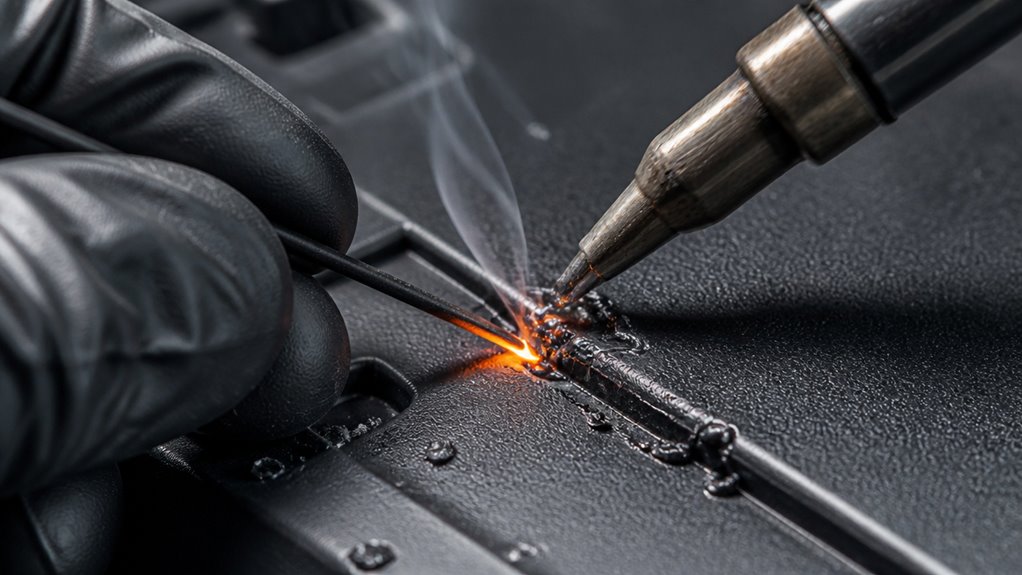
To weld plastic, you heat the thermoplastic surfaces until they soften, then press them together firmly to fuse as they cool under pressure, creating a strong molecular bond.
Use a plastic welding gun with adjustable temperature, matching the heat to the plastic type. Clean, align, and roughen the surfaces for best adhesion.
Apply steady heat and pressure while feeding a compatible filler rod if needed. Following proper steps guarantees durable joints. You can explore detailed methods and safety next.
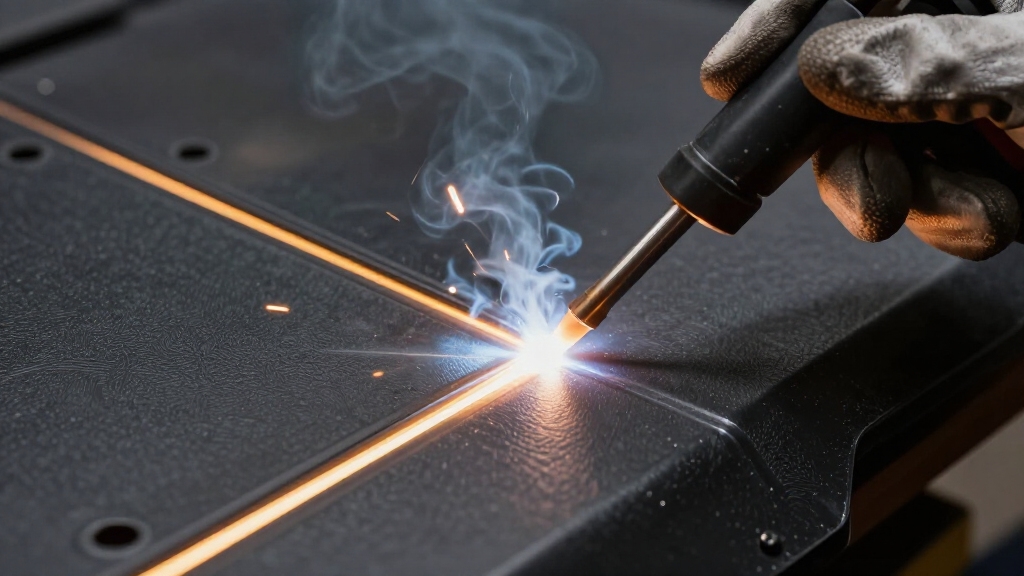
Although plastic welding might seem complex at first, it’s a straightforward process that joins thermoplastic parts by heating their surfaces until they soften and then pressing them together to fuse as they cool.
You’ll start by preparing the surfaces, ensuring they’re clean and aligned without gaps.
Next, you apply heat to soften the plastic at the joint interface. This can be through hot air, a heated tool, or other energy sources.
While the material is molten, you press the parts firmly to enable molecular bonding. This creates a strong, continuous joint rather than a simple surface adhesion.
Finally, allow the weld to cool under pressure to solidify the fusion.
This method produces durable, homogeneous connections ideal for many thermoplastic applications.
Ultrasonic welding, for example, uses high-frequency vibrations to generate localized heat without melting the bulk material, enabling fast and precise plastic joining.
Understanding the types of plastics suitable for welding helps guarantee strong, reliable joints. You should focus on thermoplastics, which soften when heated and solidify upon cooling, enabling molecular fusion.
Focusing on thermoplastics ensures strong, reliable joints through heat-softened molecular fusion.
Common thermoplastics ideal for welding include polyethylene (PE), polypropylene (PP), polyvinyl chloride (PVC), acrylonitrile butadiene styrene (ABS), nylon, polycarbonate (PC), and polystyrene (PS). These materials respond well to heat and pressure, creating durable bonds.
Avoid thermosetting plastics, as they don’t melt and therefore can’t be welded by conventional methods. Always confirm the plastic type via markings or testing to match the correct welding rod and temperature settings.
Selecting compatible plastics guarantees effective fusion, reducing failure risks and improving joint integrity. It is also essential to match the welding rod material precisely to the base plastic to ensure adhesion strength and prevent weak joints.
When it comes to plastic welding, having the right tools is key. You’ll want a reliable plastic welding gun that can provide consistent heat at the perfect temperature for your specific material. It’s really important to pay attention to this because different plastics require different heat levels.
Now, let’s talk about filler rods. Choosing one that matches the parent plastic is crucial. This ensures a strong molecular bond, which is what you’re after for a successful weld. So, remember, proper tool selection and material compatibility really lay the groundwork for a great welding job! Using precise thermal control during welding is essential to maintain mechanical integrity and avoid weak joints.
Select a plastic welding gun designed specifically for hot-gas welding to guarantee effective heat delivery and control.
Make certain the gun offers adjustable temperature settings between 390°F and 570°F, matching the thermoplastic you’re working with.
Choose a model with interchangeable nozzles to direct hot air precisely along the joint.
The gun should have ergonomic grips and a stable trigger mechanism for consistent airflow.
Verify the heating element’s reliability, as uniform heat is vital to prevent material degradation or weak bonds.
Use a welding gun with a built-in temperature sensor or digital display for accurate monitoring.
Before welding, preheat the gun to stabilize output.
Proper maintenance, including cleaning the nozzle and inspecting wiring, ensures consistent performance and safety during operation.
Ensure all components are inspected and free of damage or contamination before use to maintain precision and control during welding.
Once your welding gun is properly set up and preheated, the next step is choosing the right filler rod.
Select a rod made from the same thermoplastic material as your workpieces. Common options include PE, PP, PVC, or ABS.
Matching the rod guarantees molecular compatibility and a strong, uniform bond. If you’re uncertain about the base material, use a plastic identification kit or look for resin codes on parts.
Trim the rod tip to feed smoothly into the nozzle without obstruction. During welding, feed the rod consistently into the heated air stream, allowing it to soften and fuse with the parent plastic.
Avoid rods with additives or fillers different from the base polymer, as they can weaken the joint or cause defects. Proper rod selection is critical for weld integrity and durability.
Controlling parameters such as precise current control during welding ensures optimal heat distribution and joint strength.
Before welding plastic surfaces, you need to make sure they’re properly prepared to achieve a strong molecular bond.
First, identify the plastic type using markings or tests to select the correct filler rod.
Clean the surfaces thoroughly to remove dirt, oil, and oxidation.
Use isopropyl alcohol for final cleaning after mechanical abrasion if needed.
Make certain both joint faces are smooth and free of contaminants, as any debris weakens the weld.
Align the parts precisely to eliminate gaps, which can prevent proper fusion.
Secure the components with clamps or tape to maintain contact during heating.
Proper surface prep guarantees uniform heat transfer and molecular interdiffusion when you apply heat and pressure.
This ultimately produces a durable, high-quality weld.
For optimal adhesion, it is also important to roughen the surface to create micro-abrasions that increase mechanical interlocking before welding.
You’ll come across a variety of plastic welding methods, and each one is tailored for particular applications and materials. For instance, hot gas welding is great for repairs and smaller parts. It’s a go-to option when you need to fix something quickly without fuss.
On the other hand, if you’re working with larger assemblies, hot plate and vibration welding are your best friends. These methods create stronger joints, making them perfect for more demanding applications. When it comes down to choosing the right technique, you’ll want to consider factors like part size, the type of material you’re using, and how strong you need that joint to be. It’s all about finding the perfect fit for your project! Precise control of temperature, pressure, and timing is essential to ensure durable, leak-free welds across different plastic welding methods.
Plastic welding techniques vary widely, each suited to specific materials, part sizes, and joint requirements. You’ll choose hot gas welding for repairs or detailed seams using heated air and filler rods.
Hot plate welding works best for thick parts requiring strong, uniform joints. Ultrasonic welding suits small precision components through high-frequency frictional heat.
| Technique | Ideal Application | Key Benefit |
|---|---|---|
| Hot Gas Welding | Repairs, ducts, tanks | Manual control, versatility |
| Hot Plate Welding | Large, thick parts | Uniform, strong joints |
| Ultrasonic Welding | Small precision parts | Fast, clean, no filler rod |
Proper surface preparation, including cleaning and roughening, is critical to ensure strong bonds during plastic welding and related adhesive repairs, as detailed in the surface preparation process.
Selecting the right welding method depends on factors like material type, part geometry, and joint requirements.
For small precision parts made from ABS or PC, ultrasonic welding offers clean, rapid fusion.
If you’re working with large thermoplastic assemblies, vibration welding provides consistent heat through mechanical motion.
Hot gas welding suits repairs and detail work on materials like PP and PVC, where manual control is needed.
Hot plate welding excels for thick sections requiring strong, uniform joints, especially with PE or PP.
Laser and spin welding fit specialized applications with compatible plastics and precise geometries.
Always match the method to your plastic’s thermal properties and joint complexity to ensure peak fusion strength and efficiency.
Using the appropriate technique reduces defects and improves weld quality.
Additionally, surface preparation such as cleaning and sanding is critical to achieve a durable bonding surface and successful weld.
Before starting the weld, preheat the hot-air welding gun to the appropriate temperature for your material, typically between 390°F and 570°F.
Trim the welding rod to guarantee smooth feeding into the nozzle.
Hold the gun at about a 45-degree angle, directing hot air evenly onto the joint and rod.
Move steadily along the seam, applying consistent heat and pressure so the rod and base plastic soften and fuse.
Maintain close contact between surfaces, avoiding gaps.
Use steady, controlled movements to prevent overheating or underheating.
Once the entire seam is welded, stop heating and allow the joint to cool fully without disturbance.
Proper cooling solidifies the molecular bond, guaranteeing a strong, durable weld ready for use.
Using controlled heat application ensures optimal fusion without damaging the plastic materials.
After completing your weld and allowing it to cool undisturbed, inspect the joint carefully to identify any issues that could compromise strength.
Look for voids, cracks, or incomplete fusion, which often result from underheating or improper pressure.
Watch for voids, cracks, or incomplete fusion caused by insufficient heat or incorrect pressure during welding.
If you detect weak spots, reheating and reapplying pressure may be necessary, but avoid overheating to prevent degradation.
Make certain surfaces were clean and compatible filler rods were used, as poor material matching weakens bonds.
Check alignment and contact; gaps cause weak seams.
Maintain a steady hand and consistent speed during welding to avoid uneven melting.
Regularly test your welds under stress when possible to validate strength.
Although plastic welding offers strong and reliable joints, you must prioritize safety to prevent injuries and exposure to harmful fumes.
Always work in a well-ventilated area or use localized exhaust ventilation to avoid inhaling toxic gases emitted during heating.
Wear heat-resistant gloves, long sleeves, and eye protection to guard against burns from hot tools and molten plastic.
Secure the workpiece firmly to prevent movement that could cause improper fusion or accidents.
Before starting, inspect your equipment for damage and make certain the welding gun is functioning correctly.
Avoid overheating the plastic to prevent release of hazardous fumes and material degradation.
Follow manufacturer guidelines for temperature settings and maintain steady technique to guarantee both safety and weld quality throughout the process.
You generally can’t perform plastic welding underwater or in wet conditions because moisture interferes with proper fusion.
Water cools the surfaces too quickly and prevents the thermoplastic from softening and bonding properly.
If you must weld in damp environments, thoroughly dry the parts first and ensure no residual moisture remains.
Specialized underwater welding techniques exist for metals, but plastic welding requires dry, clean surfaces for a strong, reliable joint.
Oh, your plastic weld will magically last decades outdoors if only plastic were immortal!
Realistically, expect around 5 to 15 years depending on UV exposure, temperature swings, and the plastic type.
You’ll want to select UV-resistant materials and apply protective coatings.
Proper cleaning, matching rods, and steady technique can extend life.
But know that weathering breaks molecular bonds eventually, so plan inspections and maintenance for lasting strength.
Yes, you can find eco-friendly welding rods made from biodegradable or recycled thermoplastics like PLA or certain bio-based PE.
When selecting these rods, confirm compatibility with your parent plastic to maintain weld integrity.
These rods help reduce environmental impact during fabrication. However, their mechanical strength and heat resistance may differ from conventional rods, so test welds are pivotal.
Always verify material properties and certifications for eco-friendly claims before use.
Imagine stitching a cracked beam back to full strength with molecular threads. Yes, you can repair structural damage in load-bearing plastic parts through welding, but it demands precision.
Use compatible thermoplastics, guarantee clean, tight joints, and apply proper heat and pressure.
For critical loads, choose robust methods like hot plate welding over hot-gas techniques.
Always test weld strength before relying on the repair in demanding structural applications.
Plastic welding generally costs more upfront due to specialized equipment like welding guns and matching rods.
However, it provides stronger, more durable joints, reducing long-term repair expenses.
Adhesive bonding usually requires less initial investment in tools and materials, making it cheaper initially.
However, adhesives may need frequent reapplication or fail under stress, potentially increasing maintenance costs.
You should weigh your project’s durability requirements against budget constraints to choose the most cost-effective method.
Now that you know how to prepare, choose the right tools, and apply hot-gas welding techniques, you’re set to create strong, reliable plastic welds.
Mastering surface prep and temperature control simultaneously guarantees your welds won’t just hold; they’ll last.
Remember, precision and safety go hand in hand, so follow each step carefully.
With practice, you’ll weld plastics confidently, turning potential frustrations into professional-quality results every time.