Phone:
(701)814-6992
Physical address:
6296 Donnelly Plaza
Ratkeville, Bahamas.

Phone:
(701)814-6992
Physical address:
6296 Donnelly Plaza
Ratkeville, Bahamas.

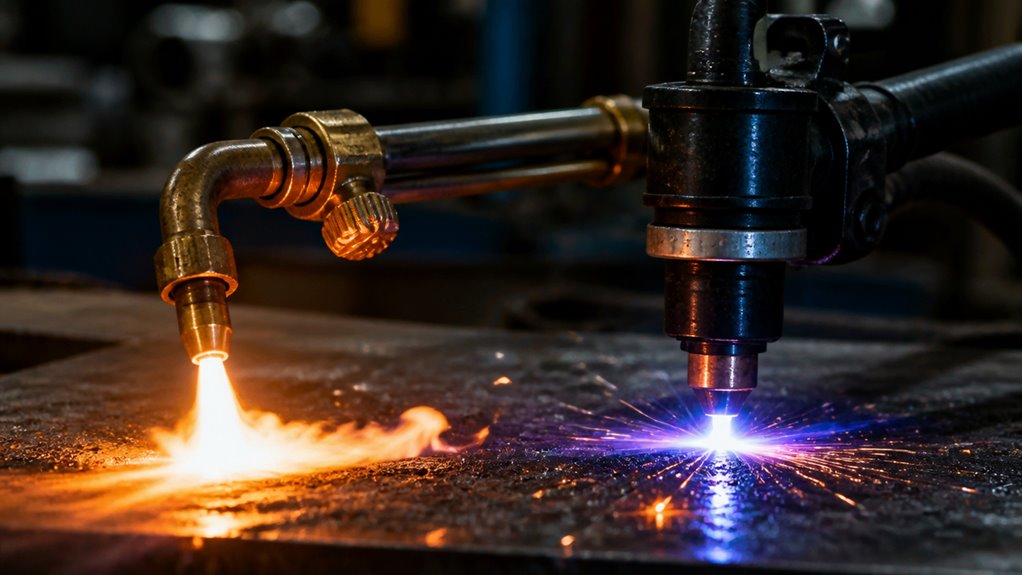
You’ll want a plasma cutter for electrically conductive metals like steel and aluminum up to about 2 inches thick. It delivers cleaner, faster cuts with tight tolerances and minimal cleanup.
An acetylene torch suits thicker ferrous metals over 2 inches. It offers heavy-duty cutting without electricity, but with rougher edges and slower speed.
Your choice depends on metal type, thickness, precision needs, and site conditions. Exploring further reveals how each tool maximizes performance in specific scenarios.
| Feature | Acetylene Torch | Plasma Cutter |
|---|---|---|
| Best Material | Thick ferrous metals like steel and iron | Electrically conductive metals like steel, aluminum, stainless steel |
| Ideal Thickness Range | 2–12 inches | Thin to medium metals up to about 2 inches |
| Cutting Method | Combustion and oxidation | High-temperature plasma arc |
| Cutting Temperature | Lower concentrated heat compared to plasma arc | Around 20,000°C–25,000°C |
| Cutting Speed | Slower on thin metals | 2–5× faster on metals under 1 inch |
| Cut Quality | Rougher edges with wider heat-affected zones | Cleaner edges with smaller kerf |
| Precision | Lower accuracy | Higher precision and tighter tolerances |
| Kerf Width | Wider | Narrower |
| Finishing Required | More grinding and cleanup needed | Minimal cleanup required |
| Heat-Affected Zone | Larger | Smaller |
| Electricity Requirement | No electricity needed | Requires electrical power |
| Air Requirement | No compressed air required | Requires compressed air supply |
| Portability | Excellent for remote locations | Limited by power and air availability |
| Initial Cost | Lower | Higher |
| Operating Cost | Higher due to gas refills | Lower long-term operating costs |
| Maintenance | Tip cleaning and gas leak checks | Consumable replacement, air system, and cooling maintenance |
| Best Applications | Heavy steel cutting, field repairs, brazing | Precision fabrication, CNC cutting, detailed metal work |
| Main Advantage | Powerful, portable, and works without electricity | Fast, clean, and precise cutting with less finishing |
| Main Drawback | Slower cuts with rougher edges and more heat distortion | Needs electricity, air supply, and higher initial investment |
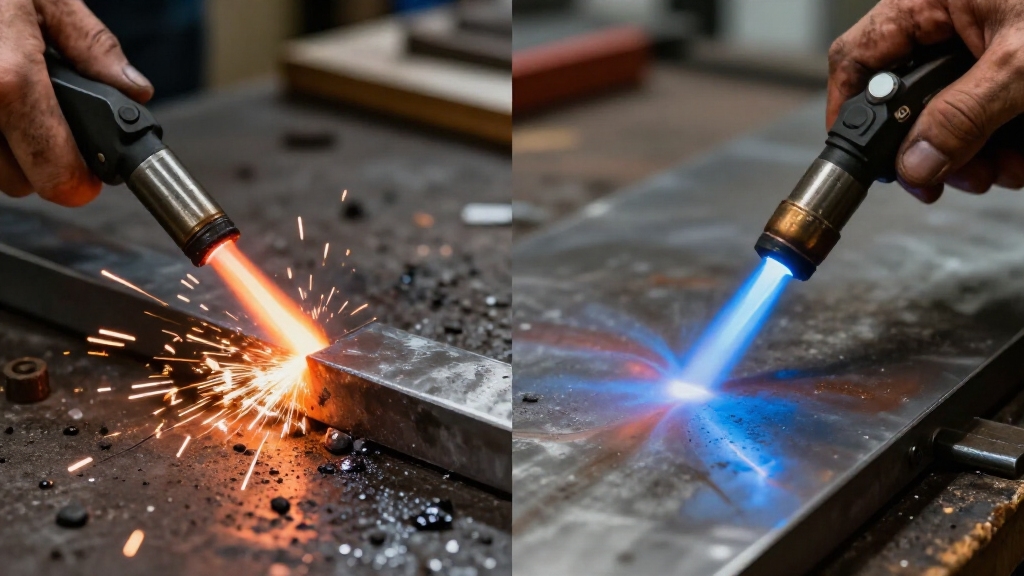
When deciding between a plasma cutter and an acetylene torch, consider the material type, thickness, and the precision required for your project.
Choosing between a plasma cutter and acetylene torch depends on material, thickness, and precision needs.
Plasma cutters excel with electrically conductive metals, offering faster, cleaner cuts with minimal finishing, especially on thinner materials.
Acetylene torches, relying on oxidation, suit ferrous metals like steel and iron, performing well on thicker sections where raw heat output is critical.
You’ll find plasma cutting delivers tighter tolerances and smaller kerfs, ideal for detailed work.
However, acetylene torches provide unmatched portability and operate without electricity, making them advantageous for remote or field tasks.
Assess your project’s demands: if precision, speed, and cleaner edges matter, plasma cutting is likely preferable.
For heavy, thick steel or off-grid work, acetylene remains practical.
Plasma cutters generate extremely high temperatures, typically between 20,000°C and 25,000°C, enabling near-instant melting of metals through a focused plasma arc.
Although both plasma cutters and acetylene torches serve metal cutting needs, the choice depends heavily on the metal type and thickness you’re working with.
Plasma cutters excel on electrically conductive metals such as steel, stainless steel, aluminum, brass, and copper. They offer efficient cuts on thin to medium thicknesses, typically up to 2 inches, with some models reaching 6 inches.
Conversely, acetylene torches rely on oxidation, making them ideal for ferrous metals like carbon steel and iron. They’re especially effective in thicker sections ranging from 2 to 12 inches.
You’ll find plasma cutting faster and cleaner on thin metals under 1 inch. Acetylene torches remain competitive for heavy-duty, thick steel where high heat output is critical.
Avoid acetylene for non-ferrous metals, as the oxidation process is ineffective there.
Plasma cutting uses a high-energy plasma jet that achieves precise and efficient cutting with minimal distortion.
Choosing between plasma cutters and acetylene torches impacts the final quality and accuracy of your metal cuts.
Plasma cutting yields a smaller kerf, cleaner edges, and markedly less slag. This makes it ideal for precision parts. In contrast, oxy-acetylene cuts often demand more finishing due to rougher edges and wider heat-affected zones.
Consider these factors:
Additionally, plasma cutting’s narrow kerf tolerances enable intricate profiles with minimal thermal distortion, enhancing part accuracy.
Your choice hinges on the precision and finishing demands of your project.
Maximizing cutting speed and productivity hinges on understanding the fundamental operational differences between plasma cutters and acetylene torches.
Plasma cutters use an electrically generated plasma arc, enabling rapid cuts on thin to medium metals.
They often cut 2 to 5 times faster than oxy-acetylene torches on materials under one inch thick.
They eliminate preheating, streamlining workflow and minimizing downtime.
Conversely, acetylene torches rely on combustion and oxidation, delivering slower cut speeds.
This is particularly evident on thin metals where heat dispersion reduces efficiency.
However, torches maintain productivity advantages on thick steel beyond two inches, where raw heat output matters more than speed.
For high-volume, precision cutting of thinner metals, plasma cutters offer superior throughput.
They also reduce post-cut cleanup, markedly enhancing overall productivity compared to acetylene torches.
Additionally, plasma cutting produces a narrow kerf that minimizes the heat-affected zone, preserving material integrity and reducing distortion.
Several factors influence the overall costs and portability considerations when selecting between plasma cutters and acetylene torches.
You’ll find plasma cutters demand a higher upfront investment due to electrical and compressed air requirements but often yield lower long-term operating costs.
Acetylene torches offer lower initial expenses and unmatched portability, functioning independently of electrical power.
Consider these key points:
Additionally, understanding how to achieve and maintain a neutral flame is essential for optimal torch performance and weld quality.
Your choice depends on balancing these cost and operational logistics against job-specific demands.
You’ll find acetylene torches need frequent tip cleaning and careful gas leak checks due to fuel combustion risks.
Torch tips wear unevenly and require replacement or reshaping.
Plasma cutters demand regular inspection and replacement of consumables like electrodes and nozzles, which wear from electrical arcs.
You’ll also maintain the air compressor and keep cooling systems functional to prevent overheating.
Both require safety checks, but plasma systems involve more electrical component upkeep.
You must handle acetylene torches with extreme care due to open flames and gas pressure. Ensure proper ventilation, check for leaks, and keep flammables away.
With plasma cutters, focus on electrical safety. Wear insulated gloves, avoid wet conditions, and shield yourself from intense UV radiation and flying molten metal.
Both require eye protection, but plasma demands specialized goggles to filter bright plasma arcs.
Following these method-specific precautions prevents burns, shocks, and respiratory hazards.
You can use plasma cutting underwater with specialized underwater plasma systems designed to handle water pressure and conductivity. However, standard plasma cutters aren’t suitable for submerged use.
In extreme weather, plasma cutters require protection from moisture, wind, and temperature extremes since these can disrupt the plasma arc and damage electronics.
You’ll need weatherproof enclosures and stable power sources to maintain cutting quality and equipment longevity in harsh outdoor environments.
You’ll find plasma cutting generates noise levels around 90 to 110 decibels, markedly louder than acetylene cutting, which typically ranges between 70 and 90 decibels.
This difference stems from plasma’s high-velocity plasma jet and compressed air, producing a higher-pitched, more intense sound.
In contrast, acetylene cutting’s combustion process yields a lower, roaring noise.
Yes, both cutting methods have environmental impacts you should consider.
Plasma cutting consumes electricity and compressed gases, leading to energy use and emissions depending on your power source.
Acetylene torches emit combustion byproducts like CO and NOx, contributing to air pollution.
Additionally, oxy-fuel setups require handling and refilling gas cylinders, which involve resource consumption and transportation emissions.
You’ll reduce impact by optimizing efficiency and choosing cleaner energy sources.
When choosing between an acetylene torch and a plasma cutter, you’ll find that each tool’s strengths perfectly coincide with specific tasks.
If you need precision and speed on thinner metals, plasma cutting is your best bet.
Conversely, acetylene torches excel with thicker materials and versatile applications.
Understanding these overlaps helps you match tool capabilities to your project demands, ensuring efficiency and quality without compromise.
The right tool isn’t just about cutting metal; it’s about cutting through complexity.