Phone:
(701)814-6992
Physical address:
6296 Donnelly Plaza
Ratkeville, Bahamas.

Phone:
(701)814-6992
Physical address:
6296 Donnelly Plaza
Ratkeville, Bahamas.

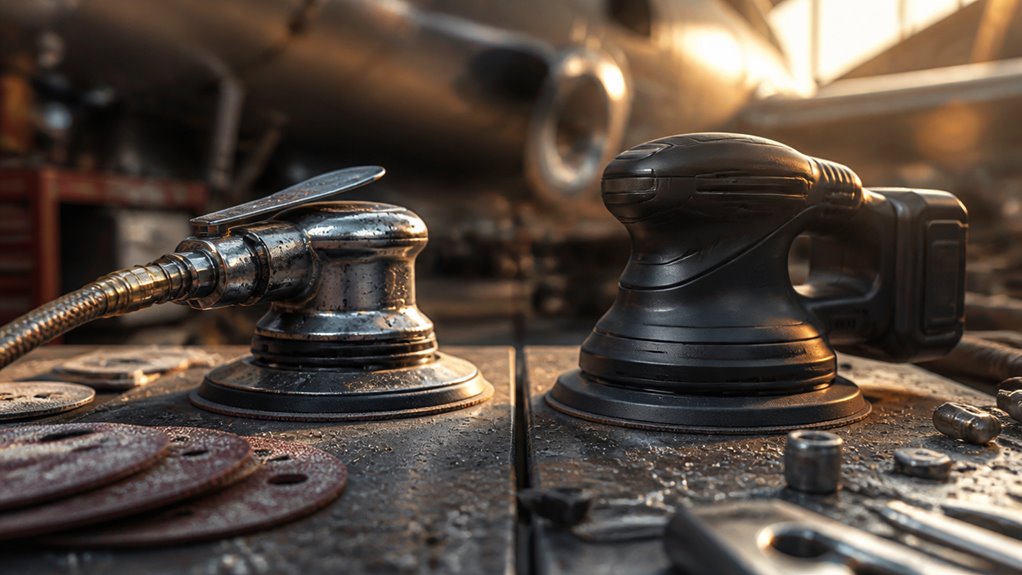
You’ll find air sanders excel in high-speed, heavy-duty tasks by using compressed air from a separate compressor. They can reach up to 12,000 RPM, but torque varies with air pressure.
Electric sanders deliver steadier torque and consistent speed near 10,000 RPM. They are powered by internal motors, allowing for portability and easy setup.
Air sanders are ideal for industrial, continuous work, while electric models are better suited for precision woodworking and remote jobs. If you want to understand their operational trade-offs and ideal applications, keep exploring.
| Feature | Air Sander | Electric Sander |
|---|---|---|
| Power Source | External air compressor | Built-in electric motor |
| Maximum Speed | Up to 12,000 RPM | Around 10,000 RPM |
| Torque | Varies with air pressure | Consistent and stable |
| Speed Consistency | Can fluctuate with compressor output | Maintains steady RPM |
| Weight | Lighter | Heavier |
| Handling | Easier for extended use | Slightly bulkier |
| Operator Fatigue | Lower | Higher during long sessions |
| Best For | Industrial, automotive, heavy-duty sanding | Woodworking, DIY, furniture refinishing |
| Wet Environment Use | Safe | Not recommended |
| Heat Dissipation | Excellent | Moderate |
| Initial Tool Cost | Lower (excluding compressor) | Higher |
| Operating Cost | Higher due to compressor | Lower daily running cost |
| Maintenance | Simple tool maintenance but compressor upkeep required | Motor and electrical maintenance |
| Portability | Limited by air compressor | Excellent |
| Main Advantage | Lightweight, fast, and ideal for continuous heavy-duty work | Portable with consistent power and precise control |
| Main Drawback | Requires an air compressor | Heavier and less suitable for wet environments |
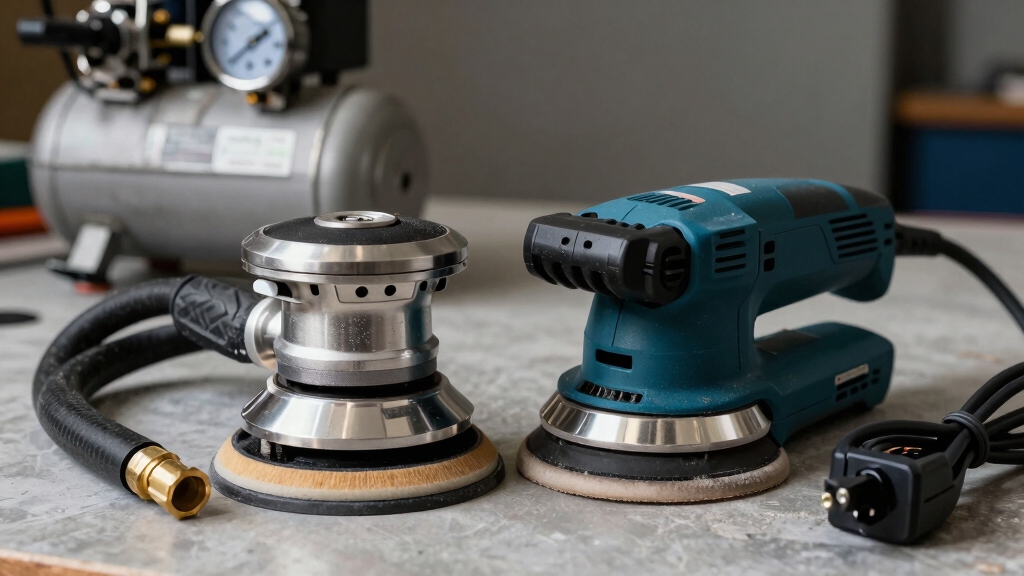
Understanding how air and electric sanders get their power is essential for selecting the right tool for your project.
Air sanders operate using compressed air supplied by an external air compressor. This setup requires you to invest in compressor infrastructure but keeps the tool lightweight and mechanically simple.
Air sanders use compressed air from an external compressor, making them lightweight and mechanically straightforward.
In contrast, electric sanders rely on an internal electric motor powered directly by plugging into an electrical outlet. This allows immediate use without additional equipment but results in a heavier tool due to motor components.
You should also note that air pressure fluctuations can cause variable speeds in pneumatic sanders. Electric models maintain consistent power output. Choosing between them depends on your workspace setup and whether you prefer the portability of electric units or the simplicity and cooling advantages of air-powered tools.
For operations in remote locations, selecting a power source with an onboard generator can ensure consistent and stable electricity for electric sanders.
When you’re looking at sanders, speed and torque are key factors to consider. Air sanders can really rev up, reaching impressive RPMs of up to 12,000. That’s pretty fast! On the other hand, electric sanders tend to keep a steady pace, usually around 10,000 RPM, but they pack a punch when it comes to torque.
One thing you’ll notice is that electric models deliver a consistent RPM. They don’t fluctuate with airflow changes, which can be a game-changer for your projects. In contrast, air sanders might vary in speed depending on the pressure changes in the air supply. Regular maintenance and cleaning of your tools ensure they perform at their best and avoid costly defects, similar to how consistent cleaning maintains proper performance in welding equipment.
Although air sanders can reach higher top speeds up to 12,000 RPM, you’ll find electric sanders provide stronger torque and more stable speed control.
Typically, they maintain consistent speeds up to 10,000 RPM without fluctuations.
Air sanders rely on compressed air, so their RPM can vary with air pressure changes, causing speed inconsistency during use.
Electric sanders, powered by internal motors, deliver steady RPMs less affected by external factors, ensuring uniform sanding performance.
While air sanders excel in high-speed tasks, their speed variability may affect precision.
Conversely, electric sanders offer controlled speed modulation, which is beneficial for delicate surfaces.
Understanding these RPM characteristics helps you match the sander to your project’s demands.
This balance of speed and stability ensures optimum results.
For projects requiring versatility and precision, considering tools with IGBT inverter technology can enhance control and efficiency.
Consider torque as the pivotal factor when deciding between air and electric sanders for your project.
Air sanders reach higher top RPMs, up to 12,000, suitable for aggressive material removal. However, their torque tends to drop under heavy load due to reliance on compressed air flow.
In contrast, electric sanders deliver stronger, more stable torque, maintaining consistent power output even during demanding tasks.
This stability helps avoid speed reductions and guarantees smoother sanding under resistance.
While air sanders excel at high-speed surface prep, electric models give you greater control and efficiency when torque is critical.
Understanding these torque performance differences allows you to select the tool that best matches your workload.
This balance ensures you maintain consistent material removal without stalling.
Additionally, just as welding plays a crucial role within fabrication by providing permanent metal bonds, choosing the right sander ensures optimal performance and finish quality for your project.
Since maintaining consistent speed is crucial for achieving smooth, even sanding results, understanding the factors that influence speed stability in air and electric sanders is essential.
Air sanders rely on compressed air, so fluctuations in air pressure can cause variations in speed. This may affect finish quality during heavy or prolonged use.
In contrast, electric sanders use internal motors powered by electricity, providing stable speed control up to around 10,000 RPM without variability caused by external factors.
While air sanders reach higher maximum speeds (up to 12,000 RPM), their speed consistency depends heavily on compressor performance.
Electric models deliver stronger torque and maintain consistent power output, ensuring uniform sanding speed under varying load conditions.
As a result, if you prioritize steady speed and torque, electric sanders generally offer better speed consistency than air sanders.
Proper pressure and flow control, such as maintaining oxygen and acetylene pressures within recommended limits, are crucial for stable operation in pneumatic tools and equipment like air sanders, impacting their overall performance and reliability. pressure and flow control
When you handle air sanders, you’ll notice their lighter weight results from the absence of an internal motor and electrical components. This makes them easier to maneuver during prolonged tasks.
This reduced mass minimizes operator fatigue and enhances precision in detailed work. Electric sanders, while slightly heavier due to integrated motors, provide better torque stability but may cause quicker hand fatigue over extended use.
The compact design and lower vibration of air sanders also improve control. Similar to how lift TIG welding requires precise control and handling to achieve clean starts, air sanders benefit from careful operation to maximize performance and reduce wear on components like the torch trigger.
| Feature | Air Sanders | Electric Sanders |
|---|---|---|
| Weight | Lighter, no internal motor | Heavier, includes motor |
| Handling | Easier maneuverability, less vibration | Slightly bulkier, more vibration |
| Operator Fatigue | Reduced during long tasks | Increased during prolonged use |
Managing costs and maintenance for air and electric sanders involves weighing initial investments against long-term expenses.
Air sanders typically have lower upfront tool costs due to simpler mechanics and fewer moving parts. However, you’ll also need to invest in and maintain an air compressor, which adds to operational costs and energy consumption.
Air sanders cost less initially but require an air compressor, increasing operational expenses and energy use.
On the other hand, electric sanders come with a higher initial purchase price but generally incur lower daily running costs, often under $0.35 per 8-hour use.
Maintenance for air sanders is often simpler, with fewer components prone to failure, resulting in reduced downtime. Electric sanders require periodic motor and electrical inspections but benefit from consistent power delivery without variability caused by compressor pressure fluctuations.
Your choice depends on balancing upfront costs, energy use, and maintenance preferences.
Beyond cost and maintenance considerations, safety in demanding work environments plays a significant role in choosing between air and electric sanders.
You’ll find air sanders more reliable in harsh conditions because they resist heat, dust, and moisture better.
Since they operate on compressed air, air sanders can function safely even if you’re working near water or damp surfaces, eliminating electrical shock risks.
On the other hand, electric sanders rely on internal motors and power outlets, making them vulnerable to water exposure and overheating in hot environments.
If your work involves wet or hazardous settings, using electric sanders increases the chance of premature failure and safety hazards.
Consequently, for tough conditions, air sanders provide a safer, more durable option due to their non-electrical operation and better environmental resistance.
Regular maintenance and environmental controls are essential to ensure longer equipment lifespan and reliable performance in challenging conditions.
Why do air sanders often outperform electric models in certain demanding applications? You’ll find air sanders excel in high-volume continuous use, especially in automotive and industrial settings.
Their higher top RPMs, up to 12,000, allow aggressive material removal. Superior heat dissipation supports extended operation without overheating.
You’ll also appreciate their lighter weight and reduced vibration, which improve maneuverability and operator comfort during long sessions. Plus, pneumatic tools operate safely in wet or hazardous environments where electric sanders risk failure or electric shock.
Although they depend on an air compressor, the robustness and reliability of air sanders under harsh conditions make them indispensable for heavy-duty metalwork like paint stripping and rust removal. In these scenarios, air sanders clearly outperform electric alternatives.
For optimal results, consistent tensioning process and precise tool handling are essential to maintain efficiency and tool longevity.
While air sanders hold advantages in heavy-duty industrial tasks, electric sanders offer distinct benefits tailored for woodworking.
Electric sanders provide specialized advantages that make them ideal for woodworking projects and detailed surface work.
You’ll find electric sanders excel at furniture refinishing, wood surface smoothing, and floor sanding due to their consistent speed and strong torque.
They maintain a steady RPM up to 10,000 without fluctuations from airflow, ensuring uniform material removal and finish quality.
Their internal electric motors provide reliable power output, making them suitable for detailed work and prolonged use on wood.
Although slightly heavier, electric sanders remain portable for on-site woodworking projects.
You can rely on them for stripping old finishes and preparing surfaces before staining or painting.
Their plug-in operation simplifies setup, enabling you to work efficiently without compressor dependency, which is ideal for woodworking environments.
For optimal results when finishing wood surfaces before painting, maintaining ideal temperature ranges between 50°F and 90°F is essential to ensure proper adhesion and drying.
When you’re picking the right sander for your project, it’s really important to think about the environment where you’ll be working. Are there power outlets nearby? What about safety conditions? These factors can really influence your choice.
For instance, if you’re tackling a big job and have access to compressed air, air sanders are fantastic for continuous, high-volume tasks. They really shine in those scenarios. On the other hand, if you’re working in different locations or need something more portable, electric sanders are a solid choice. They provide consistent torque, which is super handy for various on-site jobs.
Now, when you’re comparing different sanders, pay attention to their performance. Things like RPM consistency, how well they dissipate heat, and their weight can make a big difference in how well they fit your needs. So take the time to match the sander to your specific application requirements—it’ll save you a lot of hassle in the long run! Always prioritize workspace safety to ensure an efficient and hazard-free sanding process.
In selecting the right sander for your project, evaluating the work environment plays a crucial role in determining tool suitability and safety.
Air sanders excel in damp, hazardous, or high-volume factory settings due to their resistance to heat, dust, and water.
Electric sanders suit dry environments and portable jobs better, offering consistent power without compressor dependency.
Consider access to power sources and environmental hazards carefully.
| Environment Type | Air Sander Suitability | Electric Sander Suitability |
|---|---|---|
| Wet/Damp Conditions | Ideal; safe with water exposure | Not recommended; electrical risk |
| Industrial Settings | Preferred; continuous use | Less optimal; heat sensitive |
| Portable/Home Use | Less convenient; needs compressor | Recommended; plug-and-play use |
Match your tool choice to these conditions for peak performance and safety.
Understanding the performance attributes of air and electric sanders will help you select the best tool for your specific project demands.
Air sanders operate at higher top speeds, reaching up to 12,000 RPM. This makes them ideal for aggressive tasks like paint stripping or rust removal. Their lighter weight and superior heat dissipation support extended use without overheating.
Conversely, electric sanders provide stronger torque and maintain consistent speed, up to 10,000 RPM, even under heavy loads. This offers better control for woodwork and floor smoothing.
While electric models are heavier and may cause fatigue over time, they deliver stable power without relying on air pressure.
Your choice depends on workload intensity, material type, and operational environment. Balancing speed, torque, consistency, and portability will help optimize performance.
No, you can’t use air sanders without an air compressor. They rely entirely on compressed air to operate, so without an external compressor unit providing consistent air pressure, the tool won’t function.
The air compressor is essential for generating the airflow that powers the sander’s motor. Without it, the air sander won’t spin or deliver any sanding performance, making the compressor an indispensable part of the setup.
You’ll notice air sanders generally produce more noise due to the compressed air motor’s high RPM and airflow turbulence, often exceeding 85 decibels.
Electric sanders tend to run quieter, usually around 70-80 decibels, because their electric motors operate more smoothly with less vibration.
If noise level is critical for your workspace, electric models offer a quieter operation, reducing hearing fatigue and minimizing disturbances during extended sanding tasks.
You’ll find durable air sanders from brands like Ingersoll Rand, known for robust pneumatic tools with high RPM capabilities and excellent heat dissipation.
Chicago Pneumatic also produces reliable air sanders favored in industrial settings for their lightweight design and vibration reduction.
Additionally, Dynabrade offers specialized models with strong torque and consistent performance.
These brands emphasize low maintenance, resistance to harsh environments, and long-lasting components, ensuring you get dependable, high-quality air sanders.
You’ll find air sanders perform well on plastic surfaces if you control pressure and speed carefully.
Their high RPM capability allows efficient material removal, but too much torque or speed risks melting or gouging plastic.
Since air sanders dissipate heat effectively, you can sand longer without overheating.
Use fine-grit abrasives and moderate air pressure to avoid damaging plastics, ensuring smooth finishes without surface distortion or excessive wear.
Yes, electric sanders can be battery-operated for cordless use. These portable units rely on rechargeable lithium-ion batteries, giving you freedom from power outlets and improving maneuverability on job sites.
While battery life limits continuous operation time, advancements have increased runtimes and power output to rival corded models. You’ll find cordless electric sanders suitable for light to medium sanding tasks.
However, heavy-duty jobs may require frequent battery swaps or recharging.
When choosing between air and electric sanders, remember: “The right tool makes the job easier.”
Air sanders excel in speed, torque, and durability for heavy-duty tasks.
Electric sanders offer portability and user-friendly handling ideal for woodworking and lighter projects.
Consider power source, maintenance, and safety for your specific conditions.
By matching the sander’s strengths to your project’s demands, you’ll achieve efficient, precise results every time.