Phone:
(701)814-6992
Physical address:
6296 Donnelly Plaza
Ratkeville, Bahamas.

Phone:
(701)814-6992
Physical address:
6296 Donnelly Plaza
Ratkeville, Bahamas.

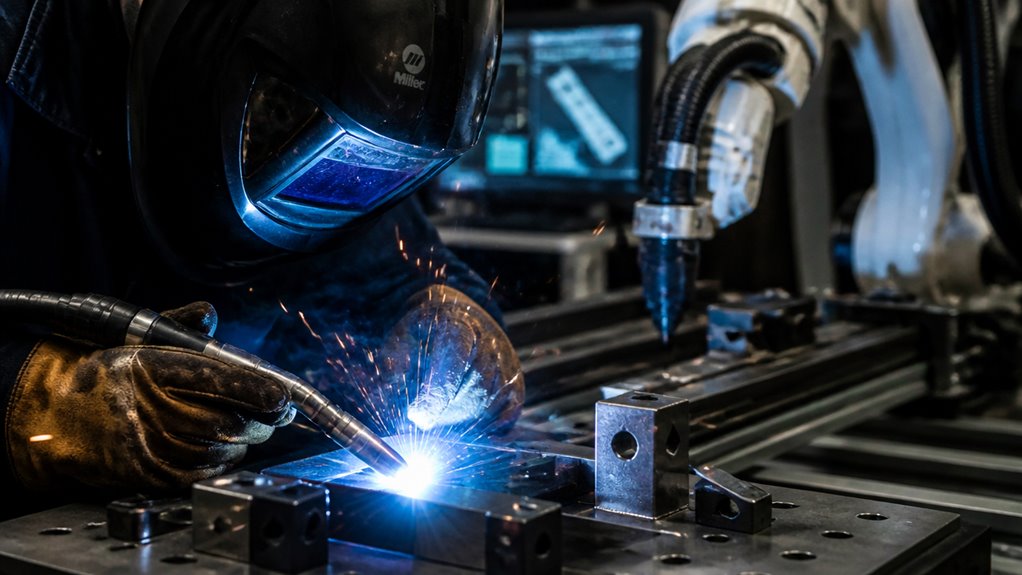
You use cad welding to create permanent, low-resistance electrical connections by igniting a thermite reaction inside a graphite mold.
This reaction produces intense heat exceeding 4,000°F, melting metal powders that fuse conductors at the molecular level without external power.
The resulting joint is mechanically robust, corrosion-resistant, and electrically continuous, essential for grounding and bonding systems.
Proper material selection and mold design guarantee consistent weld quality.
Explore further to understand its applications and advantages over mechanical connectors.
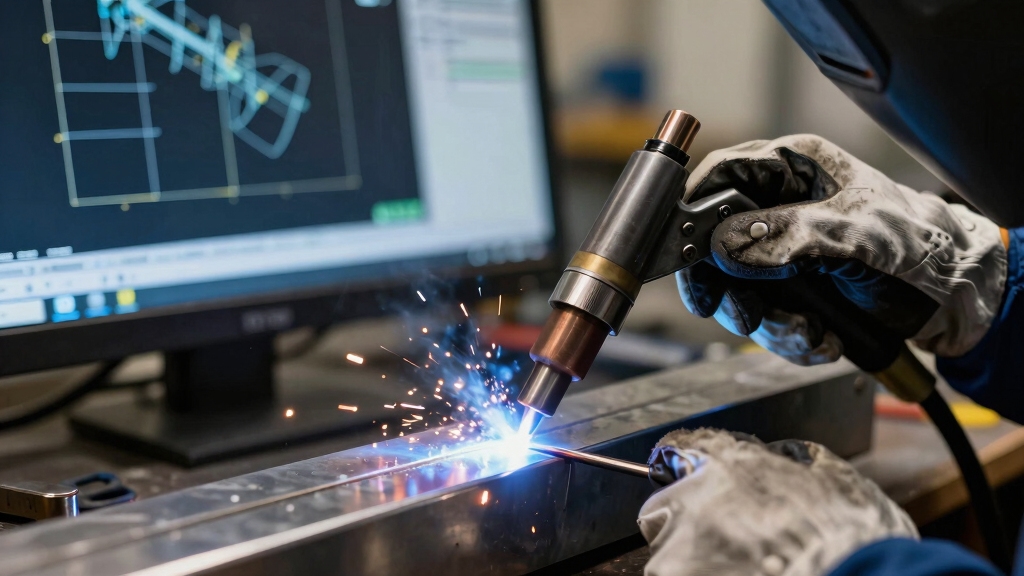
Cad welding, commonly known as exothermic welding, relies on a chemical reaction to forge permanent electrical connections without needing external heat or power.
You prepare the conductors and position them inside a precisely designed graphite mold.
Once you ignite the thermite-based mixture, it generates intense heat, often exceeding 4,000°F.
This heat melts metal powders into molten metal, which then flows around the joint area.
The molten metal fuses the conductors together, creating a molecular-level bond.
As it solidifies, the connection becomes mechanically robust and electrically conductive.
This process eliminates the need for external energy sources and mechanical fastening, providing a reliable, low-resistance joint ideal for critical grounding and bonding applications where durability and conductivity are paramount.
Proper electrode materials and precise control of heat and pressure are similarly critical in ensuring a strong, consistent weld in spot welding processes, highlighting the importance of electrode material selection in electrical connections.
Select metals carefully to guarantee strong, reliable welds that meet electrical and mechanical requirements.
Cad welding primarily uses copper due to its excellent conductivity and compatibility with exothermic reactions.
You’ll often join copper to copper, but the process also supports copper-to-steel connections, enhancing versatility.
Additionally, materials like cast iron, brass, bronze, stainless steel, and Monel are compatible, enabling dissimilar metal bonding without compromising joint integrity.
The graphite mold design corresponds to conductor dimensions, securing peak heat distribution and reaction efficiency.
You must use metals with suitable melting points and chemical compatibility to avoid defects such as incomplete fusion or brittle intermetallics.
By selecting appropriate metals and alloys, you safeguard welds that deliver low impedance, corrosion resistance, and mechanical durability.
These properties are critical for grounding, earthing, and electrical bonding applications.
Preheating and precise surface preparation are essential steps to ensure crack-free joints when welding copper to steel, overcoming challenges posed by copper’s thermal conductivity.
You’ll often come across common cad welding connections, like copper-to-copper and copper-to-steel joints, out in the field. It’s really important to know how to handle those dissimilar metal pairings. Getting this right is key for ensuring a solid bond and good conductivity.
Now, when it comes to selecting the right graphite mold, keep in mind that it should match the conductor size and joint type. This choice can significantly impact the integrity of the weld. So, take your time to choose wisely!
Proper surface preparation and cleaning are essential to prevent defects and ensure weld strength and durability.
When joining electrical conductors, understanding the common connection types is essential for guaranteeing reliable, long-lasting bonds.
Cad welding typically involves copper-to-copper connections, widely used for grounding and bonding applications.
You’ll also encounter copper-to-steel joints, especially when connecting conductors to ground rods or steel structures.
Copper-to-cast iron, brass, bronze, stainless steel, and Monel are less common but viable with proper mold selection.
Each connection type requires a specifically designed graphite mold to accommodate conductor size and shape, guaranteeing optimal molten metal flow and fusion.
This precision guarantees low-resistance electrical paths and mechanical stability.
Proper material preparation is critical to prevent contamination and ensure strong, clean welds.
Understanding dissimilar metal pairings in cad welding is crucial for ensuring strong, reliable joints in complex electrical systems. You’ll often join copper to steel, brass, bronze, or stainless steel. Each requires specific attention to metallurgical compatibility and thermal expansion differences. Cad welding excels here, producing molecular bonds that maintain conductivity and mechanical integrity without external heat sources.
| Metal 1 | Metal 2 | Typical Application |
|---|---|---|
| Copper | Steel | Ground rods, structural |
| Copper | Brass | Electrical connectors |
| Copper | Bronze | Corrosion-resistant joints |
| Copper | Stainless Steel | Industrial grounding |
| Copper | Cast Iron | Specialized grounding grids |
You must select the right mold and materials to accommodate these pairings for peak weld quality and durability. Proper heat control during welding ensures the integrity and longevity of these dissimilar metal joints.
Although selecting the right mold might seem straightforward, it plays a critical role in achieving consistent, high-quality cad welds.
You need to match the mold precisely to the conductor size and type to guarantee proper containment of molten metal and ideal joint formation.
Graphite molds come in various configurations tailored for specific connections, such as copper-to-copper or copper-to-steel.
Using an incorrect mold risks incomplete fusion, voids, or weak bonds.
Additionally, molds must withstand extreme temperatures and maintain dimensional stability during the thermite reaction.
Consider joint geometry and accessibility when choosing molds, as improper fit can cause spillage or inconsistent weld quality.
Proper mold design is essential to control the molten metal temperature, ensuring a self-sustaining and defect-free weld.
Cad welding frequently involves handling extremely high temperatures and reactive materials, so you must follow strict safety protocols to prevent injuries and equipment damage.
Cad welding requires strict safety measures due to extremely high temperatures and reactive materials.
Always wear appropriate personal protective equipment, including heat-resistant gloves, face shields, and flame-retardant clothing.
Make certain the work area is well-ventilated to avoid inhaling fumes generated during the thermite reaction.
Use only manufacturer-approved graphite molds and materials to maintain consistent reaction control and avoid hazardous failures.
Keep bystanders at a safe distance during ignition, as molten metal can spatter.
Confirm that all surfaces are clean and dry to promote proper fusion and reduce the risk of incomplete welds or sparks.
Finally, review and adhere to all instructions and safety data sheets before initiating the weld to ensure a controlled, hazard-free process.
Additionally, always inspect and maintain your welding equipment regularly to prevent electrical hazards and ensure safe operation of welding tools and components.
You start the thermite reaction by igniting a special chemical mixture. This creates an intense heat that melts metal powders inside the mold. Pretty cool, right?
Once the metal is molten, it flows right into the joint area, fusing the conductors at a molecular level. The outcome? A strong, permanent bond that ensures low electrical resistance and long-lasting durability. It’s quite impressive how it all works together!
To ensure optimal bonding in aluminum joints, precise control of weld time and current is essential to prevent defects and achieve consistent results.
Through a controlled thermite reaction, exothermic welding generates the extreme heat necessary to fuse metals at a molecular level.
When you ignite the thermite mixture, typically aluminum powder and metal oxides, it rapidly oxidizes, releasing temperatures exceeding 4,000°F.
This intense heat melts the metal powders inside the graphite mold, producing molten metal that flows around the prepared conductors.
You’ll notice the molten metal fills gaps and displaces impurities, ensuring a clean, void-free joint.
The reaction is self-sustaining, requiring no external power, and occurs within seconds.
By managing the reaction carefully, you control the weld’s quality and consistency, achieving a permanent, low-resistance electrical connection.
This thermite reaction process forms the foundation of cad welding’s reliability and strength in electrical and grounding applications.
Similar to poly welding’s reliance on precise molecular bonding, cad welding achieves strong, permanent joints through controlled thermal processes.
Once the thermite reaction generates molten metal, this material flows seamlessly around the prepared conductors within the graphite mold.
As the molten metal envelops the joint area, it penetrates microscopic surface irregularities on each conductor, eliminating air gaps and contaminants.
This intimate contact at the atomic interface enables diffusion and metallurgical bonding, effectively merging the metals at a molecular level.
As the molten mass cools and solidifies, it forms a continuous crystalline structure across the interface, producing a joint with mechanical integrity equivalent to or exceeding that of the base metals.
You achieve a permanent, low-resistance electrical connection without relying on external heat or pressure.
This molecular fusion guarantees exceptional durability, corrosion resistance, and electrical conductivity, making cad welding a superior method for critical grounding and bonding applications.
To ensure weld quality and prevent defects such as oxidation and embrittlement, it is essential to maintain sealed openings during the welding process.
Enhancing grounding and electrical systems with cad welding delivers superior electrical conductivity and long-term reliability.
You achieve a molecular-level bond that minimizes electrical resistance, ensuring efficient current flow and effective fault dissipation.
Unlike mechanical connectors, cad welding forms a permanent joint that resists loosening and corrosion, critical for buried or concrete-embedded connections exposed to environmental stressors.
The process creates a low-impedance path essential for grounding safety and system performance.
You also benefit from its compatibility with dissimilar metals, allowing versatile connections without compromising conductivity or integrity.
Since cad welding doesn’t rely on external power, it offers consistent results in diverse field conditions.
This permanence and stability translate to reduced maintenance costs and enhanced system safety over decades, making cad welding a technically sound choice for grounding and electrical installations.
Cad welding finds widespread use across various industrial sectors due to its ability to create durable, low-resistance electrical connections.
You’ll find it essential where permanent, corrosion-resistant joints are critical. The process is particularly valuable for joining dissimilar metals, enhancing system reliability.
These applications benefit from the molecular bonding that cad welding achieves, which mechanical connectors can’t match in long-term performance.
When selecting a graphite mold for exothermic welding, you need to match the mold precisely to the conductor size and joint type to guarantee peak metal flow and bond integrity.
Using an ill-fitting mold risks incomplete fusion or weak joints. Consider conductor diameter, shape, and connection style (e.g., cable-to-cable or cable-to-rod) when choosing molds.
Make certain the mold’s cavity design facilitates correct metal distribution and solidification.
| Conductor Size (AWG/mm²) | Joint Type | Mold Shape |
|---|---|---|
| 6-2 AWG (13-35 mm²) | Cable-to-Cable | Rectangular |
| 1/0-350 kcmil (53-177 mm²) | Cable-to-Rod | Circular |
| Above 350 kcmil (177+ mm²) | Multiple Conductor | Custom/Segmented |
Select molds from reputable sources to maintain dimensional accuracy and durability.
Frequently, professionals prefer exothermic welding over mechanical connectors because it delivers superior electrical continuity and long-term reliability.
When you use cad welding, you create a molecular-level bond that eliminates the contact resistance common in mechanical joints. This guarantees consistent performance over time without loosening or corrosion risks.
Consider these advantages:
A cad weld joint typically lasts several decades underground, often exceeding 40 to 50 years under proper conditions.
You’ll benefit from its molecular-level bond, which resists corrosion and mechanical loosening better than clamps or compression fittings.
Since the joint is chemically fused and sealed, it maintains low impedance electrical continuity even in harsh environments.
This makes it ideal for long-term grounding applications buried in soil or concrete.
Yes, you can perform cad welding in wet or damp conditions, but you must take precautions.
The exothermic reaction generates heat exceeding 4,000°F, which is sufficient to displace moisture at the joint site.
However, moisture can interfere with the mold integrity and reaction if not controlled.
You should make certain the mold and conductors are as dry as possible, use proper protective gear, and follow strict safety protocols to maintain weld quality and prevent hazards.
You should know cad welding materials pose minimal environmental impact since the process uses metal powders and graphite molds, which are stable and non-toxic.
However, the thermite reaction releases intense heat and fumes, requiring proper ventilation to avoid air contamination.
Waste disposal of used molds and residual metals must follow environmental guidelines to prevent soil or water pollution.
Yes, special schooling sharpens skills for safe, successful cad welding. You’ll need certified training to understand thermite reactions, mold handling, and safety protocols.
This technical training teaches you precise preparation, ignition, and post-weld inspection to guarantee strong, stable connections. Without it, you risk improper bonding or injury.
Certification validates your competence, assuring you follow industry standards and regulations essential for reliable, resilient exothermic welds in electrical and grounding systems.
Weather conditions markedly impact your cad welding process. Moisture, such as rain or snow, can compromise mold integrity and the chemical reaction. This may cause weak bonds.
Extreme cold may slow cooling, affecting joint strength. High winds risk dispersing molten metal, posing safety hazards.
You must guarantee dry, controlled conditions and use protective covers or windshields to maintain reaction consistency. This is crucial during ignition and solidification phases for safety.
When you plunge into cad welding, you’re forging more than metal. You’re crafting unbreakable bonds that stand the test of time and current.
Like a conductor orchestrating flawless harmony, cad welding fuses materials with precision and strength, eliminating weak links.
By mastering this technique, you guarantee your electrical systems perform reliably, grounded in science and durability.
Embrace cad welding, and you’ll wield a tool that merges innovation with steadfast resilience.