Phone:
(701)814-6992
Physical address:
6296 Donnelly Plaza
Ratkeville, Bahamas.

Phone:
(701)814-6992
Physical address:
6296 Donnelly Plaza
Ratkeville, Bahamas.

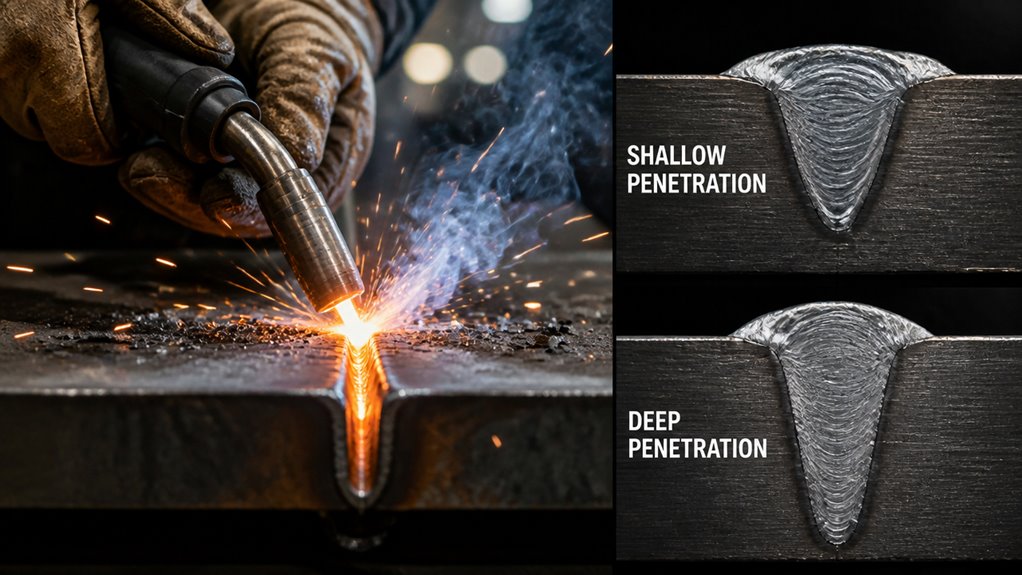
To improve FCAW weld penetration, use pure CO2 shielding gas since it produces a forceful arc that maximizes heat concentration and weld fusion depth. This results in deeper penetration, ideal for thick materials and structural joints.
However, it increases spatter and requires careful process control. Argon-CO2 blends soften the arc, reducing penetration but enhancing weld quality and control.
Understanding how gas composition, polarity, and flow rates affect penetration will help you optimize your FCAW process effectively.
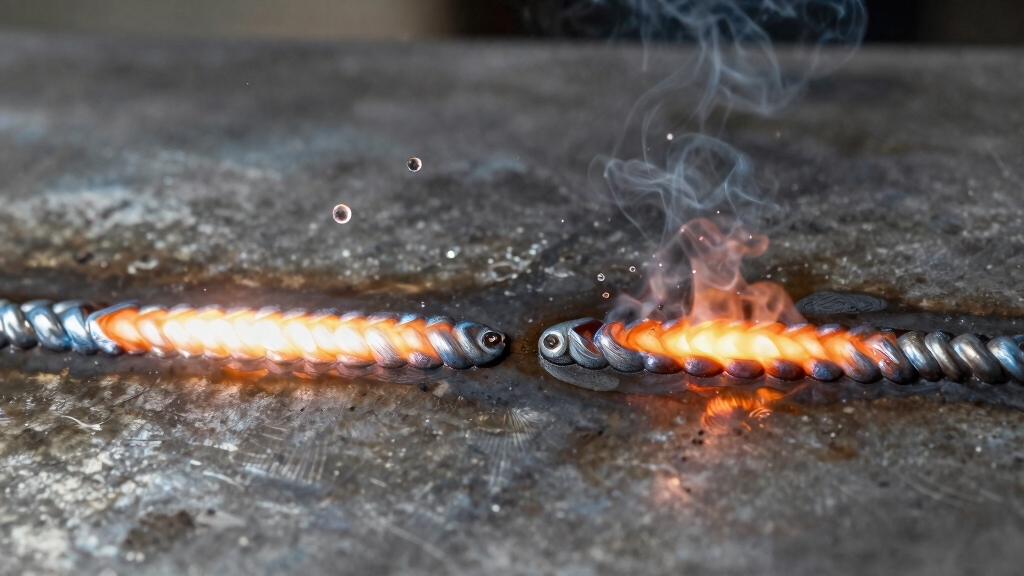
Although both FCAW-G and FCAW-S employ flux-cored wires, they differ fundamentally in shielding approach and resulting penetration characteristics.
FCAW-G uses an external shielding gas combined with flux, allowing you to control the gas composition precisely. This influences arc stability and penetration depth. This approach typically delivers deeper, more consistent penetration, making it ideal for thicker materials and critical welds.
FCAW-G’s external gas and flux combo ensures precise control for stable arcs and deep, consistent penetration.
FCAW-S relies solely on flux-generated shielding, which simplifies setup and enhances portability. However, it often produces shallower penetration due to limited shielding control.
You’ll find FCAW-G preferred in controlled environments where penetration consistency matters. In contrast, FCAW-S suits outdoor or windy conditions where external gas shielding is impractical.
Understanding these distinctions helps you select the appropriate method based on your weld thickness, position, and quality requirements.
Additionally, selecting the right shielding gases like pure CO2 or argon-CO2 blends is critical to optimizing penetration and minimizing weld defects.
When selecting shielding gas for FCAW, you directly affect penetration depth by controlling arc characteristics and heat transfer into the weld joint.
Higher CO2 content in the gas increases penetration by producing a more forceful, globular transfer arc that drives heat deeper.
Pure CO2 maximizes penetration, making it ideal for thick materials requiring strong fusion.
Conversely, argon-CO2 blends soften the arc, reducing heat intensity and thereby penetration depth, but improving arc stability and bead appearance.
You’ll find that increasing argon percentage leads to shallower penetration but smoother welds with less spatter.
Ultimately, your choice balances penetration needs with bead quality, material thickness, and welding position.
Precise control over shielding gas composition enables you to optimize weld integrity and performance in FCAW applications.
Adding small amounts of oxygen to argon-CO2 mixtures can also improve arc stability and droplet transfer, enhancing weld quality in carbon steels through improved arc stability.
Understanding how polarity influences penetration in gas-shielded FCAW builds on your grasp of shielding gas effects.
In FCAW-G, Direct Current Electrode Positive (DCEP) is typically used, directing more heat to the electrode tip. This intensifies wire melting and enhances weld penetration.
DCEP also supports spray transfer, which stabilizes the arc and allows for deeper fusion. Conversely, straight polarity (DCEN) decreases heat at the electrode, reducing penetration and deposition rates. This makes it less common in gas-shielded FCAW.
Key points to weigh:
Proper preparation and surface preparation improve weld strength and penetration by removing contaminants before welding.
When you use pure CO2 as shielding gas in FCAW, you really maximize penetration. This is crucial, especially when you’re working with thick materials that need deep fusion. The strong arc characteristics it creates lead to globular transfer, which is great for achieving that depth.
However, there’s a bit of a trade-off. You might notice that there’s more spatter compared to using argon blends. It’s all about finding that balance. By understanding these pros and cons, you can optimize your weld quality and performance, especially for heavy-duty applications.
Using the correct polarity with CO2 shielding gas is essential to maintain arc stability and reduce weld defects.
Maximizing weld penetration with pure carbon dioxide (CO2) in flux-cored arc welding (FCAW) offers distinct advantages, especially for thicker materials and structural applications.
When you use pure CO2, you generate a more forceful arc that increases heat concentration, driving deeper weld fusion into the base metal.
This capability guarantees robust joint strength and superior load-bearing performance.
However, you should balance penetration benefits with increased spatter and rougher bead appearance typical of pure CO2 shielding.
Consider these deep penetration benefits when choosing shielding gas:
Selecting pure CO2 is strategic for applications demanding maximum weld strength.
Pure CO2 also tends to increase spatter and potential porosity, which requires careful process control to maintain weld quality.
Although pure carbon dioxide (CO2) increases weld penetration in FCAW by generating a more forceful arc, it also alters arc characteristics such as stability, heat distribution, and metal transfer mode.
Pure CO2 promotes globular transfer, which delivers deeper penetration but reduces arc smoothness. The arc becomes more aggressive, concentrating heat in the joint while increasing spatter and reducing bead aesthetics.
Understanding these trade-offs helps optimize weld quality and penetration for specific applications.
| Arc Property | Pure CO2 Effect | Practical Impact |
|---|---|---|
| Arc Stability | Reduced | More spatter, irregular arc |
| Heat Distribution | Concentrated | Deeper penetration |
| Metal Transfer Mode | Globular | Higher penetration, more spatter |
| Bead Appearance | Rougher | Less visually appealing |
| Penetration Depth | Maximum | Ideal for thick materials |
Proper control of heat input and welding parameters is essential to prevent defects such as undercut and porosity that can compromise the structural integrity of the weld.
Because pure carbon dioxide (CO2) generates the deepest weld penetration in flux-cored arc welding (FCAW), it’s the preferred shielding gas for thick material applications.
When working with heavy sections, you need maximum heat input and penetration to guarantee fusion through the entire joint thickness.
Pure CO2 produces a more forceful arc with globular transfer, driving the weld pool deeper. However, it also increases spatter compared to argon blends, so you must balance penetration needs with cleanup time.
Key considerations for thick material FCAW with pure CO2 include:
Pure CO2 remains the best choice when weld depth is your top priority. Additionally, managing the increased spatter associated with CO2 shielding requires thorough post-weld cleanup to maintain weld quality and appearance.
You’ll notice that argon-CO2 blends offer some great benefits over pure CO2. For starters, they really enhance arc stability, which leads to smoother welding conditions. That’s something every welder appreciates, right?
Another perk is the significant reduction in weld spatter. This not only improves the overall quality of the bead but also cuts down on cleanup time. Who doesn’t want to spend less time cleaning up after a job?
Now, it’s worth mentioning that the penetration depth may be a tad lower compared to straight CO2. But honestly, many find that the improvements in weld appearance and process control make that trade-off well worth it. It’s all about finding the right balance for your welding needs!
These blends effectively reduce CO2 spatter while maintaining good penetration on carbon steel.
Argon-CO2 blends frequently enhance arc stability in flux-cored arc welding by moderating the aggressive characteristics of pure CO2. When you use a 75% argon and 25% CO2 mix, the arc becomes smoother and less forceful, giving you better control over the weld. This stability reduces arc fluctuations, helping maintain consistent heat input and weld bead formation.
You’ll notice less erratic metal transfer, leading to improved weld quality despite slightly shallower penetration than pure CO2.
Key benefits you gain include:
This improved arc stability makes Argon-CO2 blends ideal when you prioritize weld quality and control. Small additions of CO2 improve arc stability and penetration, optimizing the bead profile for steel welds.
Welders often prefer argon-CO2 blends for FCAW because they markedly reduce weld spatter compared to pure CO2 shielding. This reduction stems from the softer arc characteristics argon introduces, which stabilizes the molten metal transfer and minimizes erratic droplet ejection.
While pure CO2 generates a more forceful arc that promotes deep penetration, it also increases spatter due to the globular transfer mode. By blending 75% argon with 25% CO2, you achieve a balance: sufficient penetration with a smoother arc and less spatter.
This not only improves bead appearance but also reduces post-weld cleanup time and material waste. Ultimately, selecting an argon-CO2 mix enhances weld quality by controlling spatter without sacrificing necessary penetration for most structural applications. The 75/25 mixture’s effectiveness in FCAW contrasts with TIG welding, where the presence of CO2 causes oxidation that degrades weld quality and arc stability.
When selecting shielding gases for FCAW, understanding the penetration differences between pure CO2 and argon-CO2 blends is essential.
Pure CO2 generates a more forceful arc and deeper penetration, making it ideal for thicker materials and structural welds.
In contrast, argon-CO2 blends soften the arc, reducing penetration but improving bead appearance and arc stability.
You’ll want to weigh penetration needs against weld aesthetics and spatter control when choosing your gas.
Key points for consideration:
This comparison guides you in optimizing weld quality based on specific project demands.
Although selecting the right shielding gas depends on multiple factors, you must consider the base material thickness and welding position first.
For thick materials requiring deep penetration, pure CO2 is ideal, especially in flat or horizontal positions, due to its forceful arc and enhanced heat input.
When welding thinner materials or out-of-position joints, argon-CO2 blends offer improved arc stability and reduced spatter, facilitating better bead control.
FCAW-G wires paired with dual shielding gases perform well in controlled environments, but you’ll need to adjust gas composition based on wire classification and joint accessibility.
In vertical or overhead positions, softer arcs from argon blends minimize weld defects.
Matching gas to wire and position guarantees consistent penetration depth, weld quality, and operator control, optimizing overall performance for your specific application.
Since shielding gas flow directly influences arc stability and weld quality, maintaining the ideal flow rate is critical for achieving consistent FCAW penetration.
You want to set the flow rate typically between 30 and 45 cubic feet per hour (CFH) to guarantee proper shielding without excessive turbulence.
Too low a flow rate risks atmospheric contamination, causing porosity and weak welds.
Too high a flow creates gas turbulence that destabilizes the arc and reduces penetration consistency.
Balancing flow rate also optimizes heat transfer and weld pool fluidity, which directly impacts penetration depth.
Consider these factors when adjusting gas flow:
Temperature affects shielding gas performance in FCAW by influencing gas density and flow behavior.
As temperature rises, gas density decreases, potentially reducing shielding effectiveness and increasing porosity risk.
You’ll need to adjust flow rates to maintain proper coverage, especially in hotter environments.
Higher temperatures can also alter arc stability and penetration depth, so you must monitor these factors closely to guarantee consistent weld quality and adapt your shielding gas parameters accordingly.
You can customize shielding gas mixtures to match specific FCAW needs because adjusting CO2 and argon ratios directly influences arc stability, penetration, and spatter levels.
For instance, increasing CO2 boosts penetration but raises spatter, while argon softens the arc and improves bead appearance.
By tailoring blends, you optimize heat input and weld quality for your material thickness and position.
This ensures precise control over weld characteristics and consistent performance in diverse applications.
When using CO2 shielding gas, you must guarantee proper ventilation to avoid oxygen displacement, which can cause asphyxiation.
Always check for leaks in gas lines and connections to prevent accidental exposure.
Use appropriate personal protective equipment, including gloves and eye protection, since CO2 can cause frostbite if released rapidly.
Monitor gas cylinders carefully, secure them upright, and follow handling protocols to prevent cylinder damage or rupture hazards during FCAW operations.
When it comes to weld spatter cleanup time, the choice of shielding gas can make or break your workflow.
Using pure CO2 tends to increase spatter, so you’ll spend more time grinding and cleaning.
On the flip side, argon-CO2 blends produce less spatter, meaning less post-weld cleanup and smoother finishes.
Choosing the right gas directly affects your efficiency and weld appearance. So, weigh your priorities carefully before deciding.
Yes, you need to take into account environmental factors when selecting FCAW shielding gases.
Pure CO2, while effective, contributes more to greenhouse gas emissions compared to argon blends.
Argon is inert and less reactive, reducing environmental impact but may require more energy due to shallower penetration.
Also, gas production, transportation, and consumption affect your carbon footprint.
Balancing weld quality with sustainability goals helps you choose the best shielding gas responsibly.
If you want your FCAW weld to penetrate like a heat-seeking missile, pure CO2 is your no-nonsense agent. It cuts deep with surgical precision.
Argon-CO2 blends, however, play it like a cautious diplomat, offering smoother arcs but shallower penetration.
So, don your welding helmet, choose your gas like a tactician choosing ammo, and remember: in the battlefield of metal fusion, the right shielding gas doesn’t just shield; it drives the weld deep where it counts.