Phone:
(701)814-6992
Physical address:
6296 Donnelly Plaza
Ratkeville, Bahamas.

Phone:
(701)814-6992
Physical address:
6296 Donnelly Plaza
Ratkeville, Bahamas.

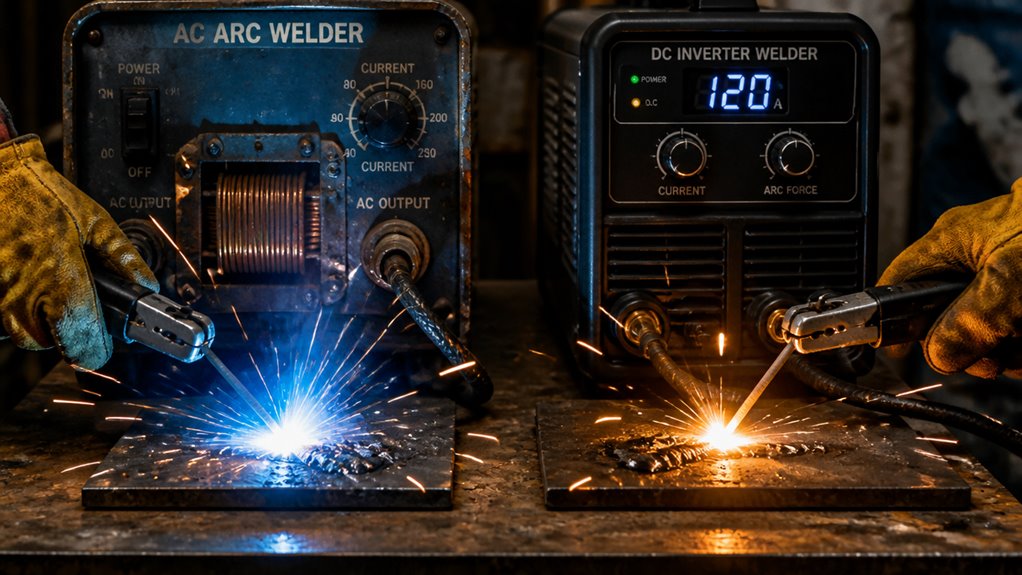
If you’re welding aluminum or magnesium, an AC welder excels by flipping polarity rapidly to clean oxides and maintain moderate penetration.
However, for steel and stainless, an AC/DC welder gives you superior arc stability, deeper penetration, and versatility across positions, including vertical and overhead, thanks to its stable DC mode.
AC welders are simpler and budget-friendly, but AC/DC machines offer precision and adaptability for complex jobs.
Understanding these differences will help you select the best tool for your welding challenges.
| Feature / Aspect | AC Welder | AC/DC Welder |
|---|---|---|
| Current Type | Uses alternating current only | Can switch between alternating current and direct current |
| Best For | Aluminum, magnesium, and basic welding tasks | Steel, stainless steel, aluminum, and multi-metal applications |
| Arc Stability | Less stable due to polarity changes | More stable in DC mode with smoother arc control |
| Penetration | Moderate penetration | Deeper and more consistent penetration in DC mode |
| Oxide Cleaning Ability | Excellent oxide removal on aluminum | Excellent in AC mode plus stable DC performance |
| Spatter Levels | Higher spatter production | Lower spatter, especially in DC mode |
| Weld Quality | Good for simple jobs | Cleaner, smoother, and more precise welds |
| Welding Positions | Best for flat position welding | Suitable for flat, vertical, overhead, and complex positions |
| Ease of Use | Simpler machine design | More advanced controls and settings |
| Versatility | Limited to AC applications | Highly versatile across materials and projects |
| Cost | More budget-friendly | Higher upfront investment |
| Maintenance | Easier maintenance due to simpler components | More maintenance because of advanced electronics |
| Arc Blow Resistance | Better resistance to arc blow | DC mode can experience arc blow near magnetic fields |
| Ideal Users | Beginners and budget-conscious welders | Professionals and advanced hobbyists |
| Precision Work | Less suitable for precision welding | Excellent for precision and controlled welding |
| Long-Term Value | Lower initial cost but limited capability | Better long-term value due to flexibility and reduced rework |
| Performance on Thin Metals | Less precise control | Better control and cleaner results |
| Equipment Complexity | Basic and straightforward | More sophisticated and feature-rich |
| Recommended Applications | Repair jobs, aluminum welding, simple fabrication | Automotive, fabrication, stainless work, structural welding |
| Overall Advantage | Affordable and effective for specific tasks | Combines cleaning power of AC with control and penetration of DC |
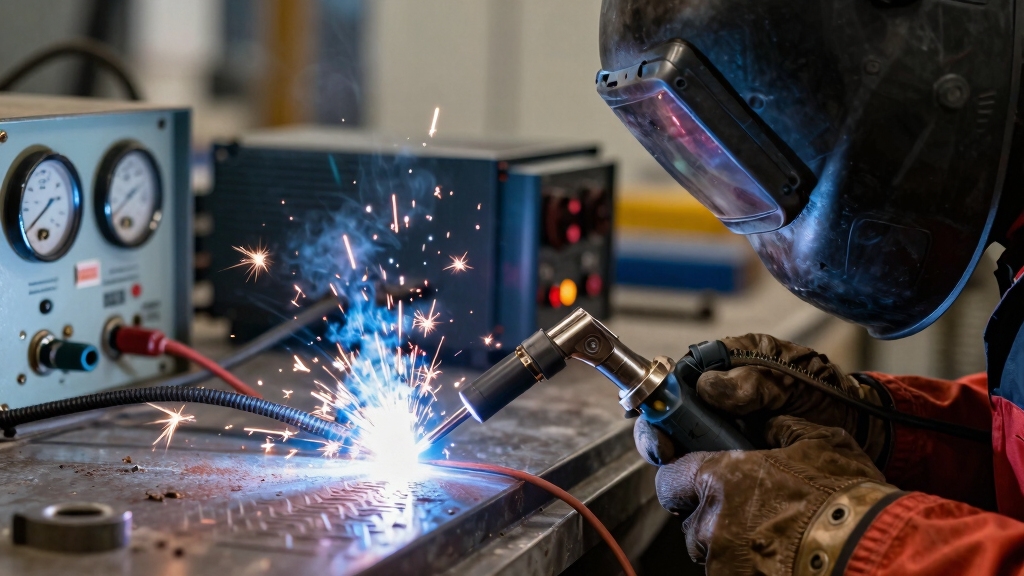
Although AC welders operate with alternating current that reverses polarity multiple times per second, they maintain a continuous arc by rapidly switching the electrode’s charge.
AC welders sustain a steady arc by quickly alternating the electrode’s polarity multiple times each second.
This reversal can occur up to 120 times per second, ensuring the arc remains stable despite the polarity shifts.
You’ll notice that the electrode alternates between positive and negative polarity, which affects electron flow and heat distribution in the weld pool.
The rapid switching prevents the arc from extinguishing during zero-crossing points, typical in AC cycles.
As you control an AC welder, you rely on this mechanism to manage oxide layers on materials like aluminum.
The continuous polarity change facilitates cleaning action, allowing you to remove surface oxides effectively while maintaining sufficient heat to melt the base metal and electrode consistently.
This process is essential for welding metals like aluminum, as it helps achieve clean, precise welds without contamination.
AC welders are all about that alternating current, which means the polarity flips back and forth quickly. This can impact things like arc stability and how well oxides are removed during the welding process.
On the other hand, AC/DC welders offer a bit more flexibility. They can switch between alternating and direct current, allowing you to have greater control over aspects like penetration, spatter, and overall weld quality.
For optimal welding safety and precision, using an auto darkening welding helmet is essential when working with both AC and AC/DC welders.
When selecting a welder, understanding the differences between AC and AC/DC current types is essential for optimizing your welding process.
AC welding uses alternating current, where polarity reverses continuously, causing arc instability and more spatter.
In contrast, DC welding provides steady, unidirectional current, delivering a smoother arc with less spatter and cleaner bead appearance.
AC is advantageous for welding aluminum and magnesium, as its polarity shifts help remove oxide layers.
DC excels with steel and stainless steel, offering deeper penetration and better control, especially in vertical or overhead positions.
AC/DC welders combine both currents, giving you flexibility across materials and applications.
Your choice hinges on the metals you work with, desired arc stability, and position, balancing cost and performance for precision and efficiency.
Additionally, DCEN polarity concentrates heat on the workpiece, making it more energy-efficient for most TIG welding applications.
Because welding projects often involve a range of materials and positions, choosing between AC and AC/DC welders greatly impacts your operational flexibility.
AC welders excel in applications like aluminum and magnesium, where alternating current effectively removes oxide layers. However, their arc instability and spatter can challenge precision work.
AC/DC welders offer greater versatility by providing both current types, enabling you to switch to DC for smoother arcs, deeper penetration, and better control on steels or thin metals.
This adaptability benefits overhead or vertical welds requiring stability and reduced spatter.
While AC-only machines are cost-effective for specific tasks, AC/DC units allow you to tackle diverse materials and welding positions with improved arc stability and cleaner welds.
This makes them ideal if your projects demand broad capability.
Additionally, polarity selectable DC welding allows optimization of weld characteristics by choosing electrode polarity to suit different metals and applications.
Although both AC and DC welding methods create arcs necessary for melting metal, their arc stability and the amount of spatter produced differ markedly.
When you weld with DC, the current flows steadily in one direction, resulting in a more consistent and stable arc. This stability reduces arc fluctuations, which in turn minimizes spatter and leads to cleaner weld beads.
Conversely, AC welding involves rapid polarity changes, causing the arc to fluctuate frequently and generate more spatter, making control more challenging.
DC welding’s steady arc lowers spatter, reducing cleanup time and improving bead quality.
AC welding’s polarity reversal causes arc instability, increasing spatter and affecting weld appearance.
Beginners often find DC welding easier to manage due to its smoother arc behavior.
Additionally, DC welding typically operates in constant current mode, which helps maintain arc stability despite minor variations in arc length.
Understanding how penetration varies between AC and DC welding is essential for selecting the right current type for your metal thickness and application.
DC welding typically provides deeper and more consistent penetration due to its steady current flow and stable arc. Using direct current with electrode positive (DCEP) further increases penetration by approximately 10%, making it effective for thicker materials requiring strong fusion.
DC welding offers deeper, more consistent penetration, especially with DCEP, ideal for thicker materials needing strong fusion.
Conversely, AC welding, with its alternating polarity, delivers moderate penetration but can be advantageous for certain heavy sections where oxide removal is critical. However, the fluctuating arc in AC can limit penetration control compared to DC.
When working with thinner metals, DC’s precision and deeper penetration often yield superior weld quality. AC may be less effective due to its variable arc characteristics and penetration depth fluctuations.
Proper polarity selection, such as choosing DCEP for MIG welding with solid wires, is critical to optimize heat distribution and penetration depth.
While DC welding provides consistent penetration and control for many metals, it falls short when tackling materials like aluminum and magnesium.
The key lies in AC’s alternating polarity, which reverses up to 120 times per second. This rapid polarity shift effectively breaks up and removes the tough oxide layers that naturally form on aluminum and magnesium surfaces, allowing for cleaner welds.
You’ll find AC welding advantageous because it:
For optimal results, it is critical to use 100% inert argon as shielding gas to maintain arc stability and prevent oxidation during welding.
Choosing DC mode for welding steel and stainless steel guarantees a stable arc and deeper penetration. These factors are critical for achieving strong, precise welds.
You’ll benefit from a consistent current flow that eliminates the zero-crossing fluctuations typical of AC. This reduces spatter and improves bead quality.
DC welding, especially with DCEP polarity, enhances penetration, allowing for secure fusion of thicker or high-strength steel components.
This mode also provides better control over the weld pool, which is essential for stainless steel where oxidation control and weld integrity matter.
While DC can be prone to arc blow near magnetic fields, its advantages in penetration and arc stability make it the preferred choice for most steel fabrication tasks.
Use DC mode whenever you require clean, deep, and controlled welds on steel and stainless steel.
Ensure proper gas management during welding to maintain consistent shielding gas coverage and avoid contamination for optimal weld quality.
Steel and stainless steel welding benefits from DC mode’s stable arc and deep penetration. Welding positions also play a significant role in performance.
DC mode’s stable arc and deep penetration enhance steel and stainless steel welding performance across various positions.
When you weld overhead or vertically, DC’s consistent arc control helps you maintain better bead shape and reduces spatter. Conversely, AC welding often suits flat positions where arc stability is less critical.
Position impacts heat input, weld pool fluidity, and control, influencing your choice between AC and DC modes. Overhead and vertical welding favor DC for smoother control and reduced slag issues.
Flat position welding can tolerate AC’s arc fluctuations, benefiting from its oxide cleaning on aluminum. Magnetic interference in certain positions may require AC to minimize arc blow when DC causes instability.
Understanding these factors optimizes your weld quality and efficiency across varied positions. Inverter welding machines provide rapid microsecond output regulation for precise arc control, enhancing performance in different welding positions.
Because equipment cost and functionality directly impact your welding capabilities, understanding the financial and technical differences between AC and DC welders is essential.
AC welding machines generally come at a lower upfront cost, making them appealing if budget constraints dominate your choice.
However, DC welders, though more expensive, offer superior arc stability and versatility, which can reduce rework and improve weld quality over time.
If your projects demand precision, smoother welds, or varied material compatibility, investing in DC or combined AC/DC equipment might prove more cost-effective in the long run.
Additionally, consider maintenance complexity; DC units often require more sophisticated components, influencing service costs.
Balancing your immediate budget against long-term performance needs will help you select equipment that aligns with your welding applications efficiently.
Multi process welders using inverter technology can further enhance energy efficiency and arc control, providing a flexible solution for diverse welding needs.
When deciding between AC and AC/DC welders for your projects, you need to carefully assess the specific demands of your materials, welding positions, and desired arc stability.
AC welders excel with aluminum and magnesium due to their oxide-cleaning capability. AC/DC welders offer flexibility for steel and various metals, providing both stable arcs and deeper penetration.
Consider the welding environment and precision requirements to optimize your choice.
Choose AC for cost-effective solutions and applications involving magnetized materials or flat welding positions.
Opt for AC/DC welders if you require versatility across multiple metals, superior arc control, and smoother welds, especially in vertical or overhead positions.
Evaluate material thickness and job complexity to determine whether you need the enhanced penetration and arc stability of DC capabilities.
Yes, AC/DC welders can operate on generator power sources, but you need to make sure the generator provides stable, clean power with sufficient amperage and proper voltage.
Fluctuations or low quality power can cause arc instability or damage sensitive electronics in the welder.
You should use a generator rated for welding with a high surge capacity and minimal harmonic distortion to maintain consistent arc performance and protect your equipment during operation.
You’ll find welding safety varies with AC and DC due to current behavior. AC’s rapidly reversing polarity can cause more arc instability, increasing spatter and flash risk. This demands extra caution with protective gear.
DC provides a steadier arc, reducing unexpected sparks. However, it can cause arc blow near magnetic fields, requiring careful positioning.
Always ensure proper insulation, grounding, and maintain safe distances regardless of current type to minimize electrical shock and burns.
You check connections, clean components, and inspect cables regularly.
For AC machines, you focus on maintaining simple circuitry and guaranteeing proper cooling.
With AC/DC welders, you also monitor switching mechanisms and control boards due to their complexity.
You calibrate settings frequently and replace worn parts promptly.
Both require electrode holder and ground clamp inspections.
Proper maintenance guarantees reliability, prevents downtime, and extends machine lifespan.
However, AC/DC units demand more detailed attention.
You’ll want electrodes compatible with both AC and DC currents when using AC/DC welders.
For AC, cellulose or rutile-based electrodes perform well, especially for aluminum or magnesium.
DC modes favor low-hydrogen or basic electrodes, which offer deeper penetration and cleaner beads on steel.
Some electrodes are dual-purpose, labeled for AC/DC use, ensuring stable arcs across currents.
Selecting the right electrode depends on your material, weld position, and desired penetration.
You’ll find welding certifications differ based on your specialization. If you’re certified for AC welding, your qualification typically focuses on handling oxide-prone materials like aluminum.
When you pursue AC/DC certification, you demonstrate versatility across multiple currents and metals, including steel and magnetized materials. This dual certification demands you master distinct arc control techniques and equipment settings.
These reflect your broader technical expertise and adaptability in diverse welding scenarios and industrial standards.
Choosing between an AC and AC/DC welder depends on your project’s material and precision needs.
You might worry that AC welders lack versatility, but combining AC/DC options actually gives you superior control over arc stability and penetration across metals like aluminum and steel.
Investing in an AC/DC welder guarantees you handle varied welding positions and materials efficiently, maximizing both performance and cost-effectiveness for professional or advanced hobbyist work.