Phone:
(701)814-6992
Physical address:
6296 Donnelly Plaza
Ratkeville, Bahamas.

Phone:
(701)814-6992
Physical address:
6296 Donnelly Plaza
Ratkeville, Bahamas.

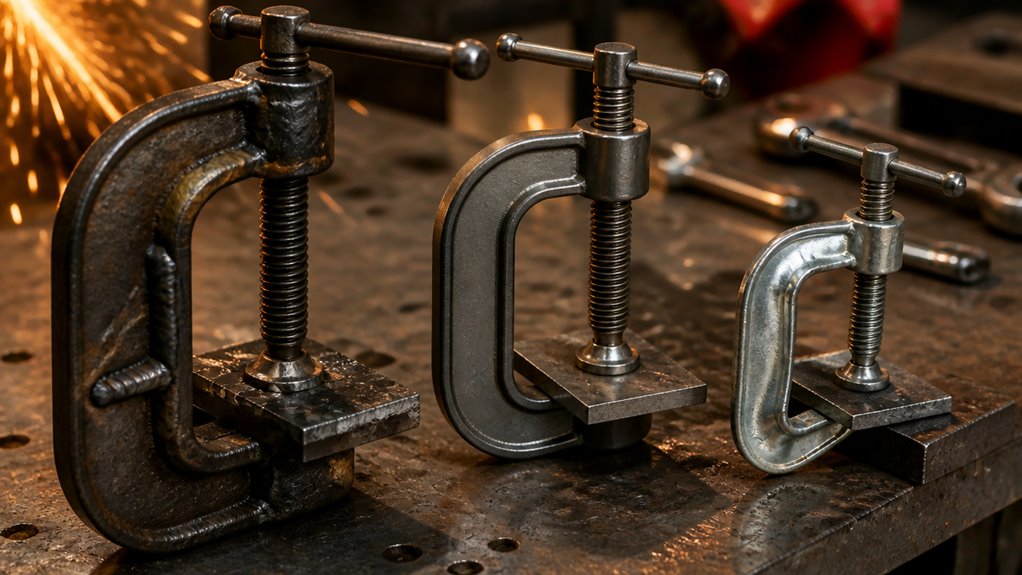
You want welding C clamps made from heat-treated, forged high-carbon steel because they resist deformation under extreme heat and pressure.
Precision-machined jaws tailored to your workpiece guarantee consistent grip and even pressure distribution. This prevents slippage or distortion.
Clamps with at least 90 psi load capacity and a proper throat depth suit various project sizes safely.
Chrome plating adds corrosion resistance in harsh environments.
Understanding these factors helps you select a reliable clamp built for demanding welding tasks.
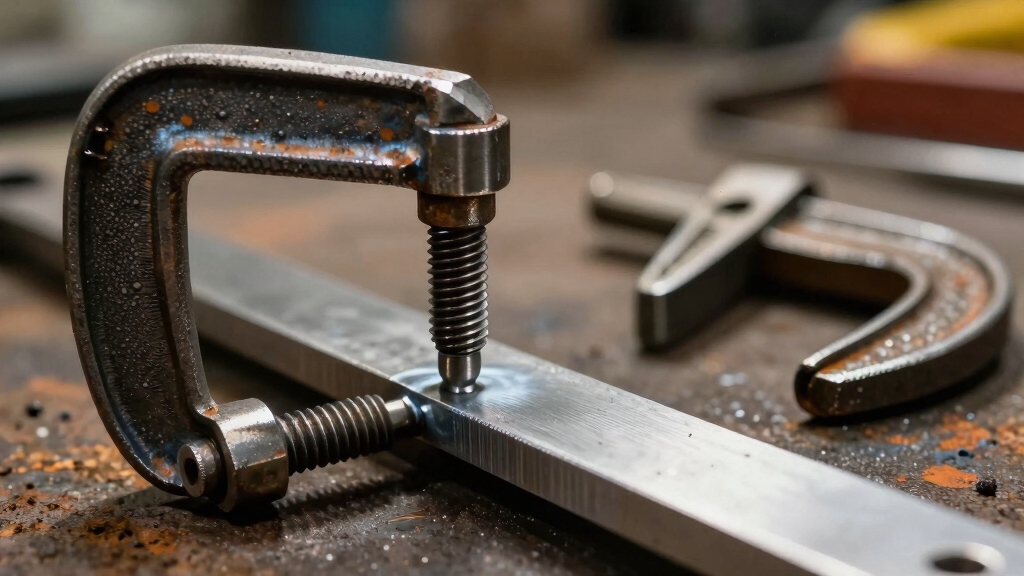
Because welding subjects clamps to intense heat and pressure, the material quality of C clamps directly impacts their performance and durability.
Welding’s intense heat and pressure make C clamp material quality crucial for lasting performance and durability.
You’ll want clamps made from high-carbon steel since they resist deformation under these conditions.
Heat-treated jaws are essential to prevent warping during elevated temperatures, ensuring consistent clamping force.
Forged clamp bodies outperform cast ones by offering superior toughness and longevity, which means fewer failures during demanding welds.
Chrome plating isn’t just cosmetic; it reduces rust formation in humid or spatter-rich environments, extending clamp life.
Avoid ductile iron variants; they tend to crack under extreme torque, risking joint integrity.
When selecting a C clamp, prioritize these material characteristics because they determine how reliably the clamp maintains grip and withstands the harsh welding environment without compromising your work’s quality.
Additionally, maintaining proper ventilation and monitoring ambient temperature can help prevent heat-related damage to both clamps and welding equipment.
High-carbon steel forms a solid foundation for welding clamps, but heat treatment and forging take their strength and durability to the next level.
Heat treatment refines the steel’s microstructure, increasing hardness and resistance to deformation under welding temperatures. It stabilizes the jaws, preventing warping when exposed to intense heat.
Forging aligns the steel’s grain structure, eliminating internal voids and enhancing overall toughness. Compared to cast clamps, forged bodies withstand extreme torque and pressure without cracking, ensuring longevity in demanding welding tasks.
Together, heat treatment and forging produce clamps that maintain clamping force and structural integrity under stress, critical for reliable weld joints.
This combination outperforms ductile iron alternatives, which tend to crack, and cast steel, which lacks the toughness required for repetitive heavy-duty use.
Additionally, incorporating overload protection features in welding equipment complements clamp durability by preventing damage during high-stress welding operations.
When you select a C clamp, the jaw design directly influences how securely it grips your workpiece and how evenly pressure is distributed across the clamping surface.
Smooth, flat jaws provide uniform pressure, minimizing deformation and preventing concentrated stress points that could damage delicate metals. Conversely, V-grooved jaws excel at gripping round stock, reducing slippage during welding.
Swivel pads are vital when dealing with irregular surfaces, as they self-adjust to maintain consistent contact without marring. Precision machining of the jaws reduces play, enhancing stability under high clamping forces.
Additionally, a deep throat depth in jaw design enables access to recessed weld joints, ensuring effective clamping where it matters most. Selecting a clamp with optimized jaw geometry directly impacts the quality and safety of your welding setup.
Proper clamping is essential to maintain alignment and prevent movement during welding, which directly affects weld strength and consistency.
Although clamping capacity might seem like a straightforward specification, it critically determines the range and size of materials you can securely hold during welding.
When selecting a C clamp, you must consider the maximum throat opening, measured in inches, because it dictates the largest workpiece thickness the clamp can accommodate.
For example, an EF clamp’s 4.6-inch capacity allows you to handle larger assemblies, while brands like Crescent or Proto with 4.2 inches suit smaller projects.
Choosing a clamp with sufficient capacity guarantees stable positioning and prevents slippage, which is vital for precision welds.
Insufficient clamping capacity forces you to improvise or reposition clamps, potentially compromising joint integrity and workflow efficiency.
Consequently, understanding clamping capacity directly impacts your ability to maintain consistent, secure weld setups.
In addition, taking regular microbreaks during welding tasks helps maintain focus and reduces muscle fatigue, ensuring better clamp handling and weld precision.
When picking C clamps, it’s crucial to choose ones with load capacity ratings that go beyond your welding force needs. This ensures safety and durability. You don’t want to take any chances here!
Also, keep in mind that the materials play a big role. Clamps made from high-carbon steel and those with heat-treated jaws are often stronger and can handle more pressure. So, look for those when you’re shopping around.
Lastly, understanding safety margins is key. It helps you dodge any potential failures by opting for clamps that have been tested to handle forces higher than what you usually work with. Better safe than sorry, right?
Additionally, always ensure you are wearing flame-resistant fabrics and proper protective gear when handling welding clamps to maintain safety.
Since load capacity directly impacts the safety and effectiveness of your clamping, understanding the benchmarks for C-clamps is critical.
Top-tier clamps maintain clamping forces exceeding 90 psi without structural failure, guaranteeing secure holds during welding. Brands like Wilton, Yost, and EF consistently surpass these thresholds.
Lower-end clamps, such as Pittsburgh, fall short below 90 psi and risk deformation or breakage. When selecting a C-clamp, prioritize those validated by rigorous tension and damage tests.
These clamps resist “finger-buster” stress and maintain jaw stability under load. Benchmarks around 90 psi serve as reliable indicators of durability and safety.
Exceeding these guarantees your clamp withstands the intense pressure and heat typical in welding, preventing slippage and potential joint failure.
A properly secured workpiece with firm clamping ensures consistent bead quality and a solid foundation for final welds.
When selecting C-clamps for welding, understanding load capacity ratings is essential to guarantee material strength and safety.
You want clamps that withstand at least 90 psi clamping force. Premium models maintain structural integrity under these stresses.
Materials like high-carbon steel and forged bodies excel here, resisting deformation and warping even under intense heat and pressure.
Avoid clamps made from ductile iron or cheaper imports that often crack or fail below this threshold.
Chrome plating also aids durability by preventing corrosion in harsh welding environments.
By focusing on clamps tested for consistent performance above 90 psi, you secure reliable, strong clamping that supports precise welds.
This is critical for both safety and weld quality.
Additionally, ensuring the clamp materials have adequate heat resistance helps maintain strength and prevents failure during prolonged welding.
Understanding load capacity ratings goes beyond just meeting minimum thresholds; it means guaranteeing a safety margin that accounts for unexpected stresses during welding.
When selecting C clamps, you want models tested to withstand at least 90 psi clamping force without failure. This threshold guarantees the clamp maintains integrity under heat expansion and vibration.
Brands like Wilton and Yost consistently deliver these margins, while lower-tier clamps, such as Pittsburgh, fall short, risking deformation or slippage.
The safety margin factors in material resilience, jaw design, and clamping capacity, providing a buffer against overload.
Ensuring proper clamping force is also critical for precise positioning and fit-up, which prevents defects that compromise weld strength and durability.
Offering a protective barrier against oxidation, chrome plating markedly reduces rust formation on C clamps used in welding environments.
When you work in high-humidity or heat-intensive settings, the steel surfaces face accelerated corrosion risks.
Chrome plating creates a dense, impermeable layer that blocks moisture and oxygen from contacting the underlying metal.
This barrier prevents electrochemical reactions that cause rust, preserving the clamp’s structural integrity and clamping accuracy over time.
Additionally, chrome’s smooth finish resists weld spatter adhesion, reducing surface degradation.
By minimizing rust, chrome plating helps maintain the clamp’s load capacity and prevents jaw warping caused by corrosive damage.
Choosing chrome-plated C clamps guarantees your tools endure harsh welding conditions without sacrificing performance or safety.
This enhances longevity and reliability in demanding applications.
Proper surface preparation, including thorough cleaning and removal of contaminants, is essential to maximize the protective benefits of chrome plating and prevent coating failure through surface contamination control.
Which welding C clamp brand delivers the highest durability and clamping force under rigorous conditions?
You want a clamp that endures extreme heat and torque without warping or cracking.
Wilton and Yost stand out, offering over 90 psi clamping force with forged, heat-treated steel bodies.
EF clamps lead in maximum opening capacity (4.6 inches), ideal for larger assemblies.
Meanwhile, Crescent and Wright Tool provide reliable mid-range durability at 4.2-inch capacity.
Pittsburgh models often fall short below 90 psi, risking failure.
Here’s a comparison for clarity:
| Brand | Max Clamping Force (psi) | Max Opening (inches) |
|---|---|---|
| Wilton | 92 | 4.25 |
| EF Clamp | 95 | 4.6 |
| Crescent | 89 | 4.2 |
| Pittsburgh | 85 | 4.2 |
Choose brands proven to resist deformation and maintain steady pressure for welding precision. Proper surface prep and alignment are essential to ensure the clamp’s effectiveness during welding operations.
Testing metrics provide essential insights into the reliability of welding C clamps by quantifying how well they withstand real-world stresses.
When you evaluate a clamp, hardness tests assess the material’s resilience before use. This ensures it won’t deform under heat or pressure.
Jaw slop evaluation gauges the play and stability, critical for maintaining a secure grip during welding.
Finally, clamping force measurements in psi reveal whether the clamp can sustain the necessary pressure without failure.
Consider these key metrics:
Understanding the testing metrics helps you pinpoint the specific qualities your welding project demands from a C clamp.
Start by evaluating material quality: opt for high-carbon steel with heat-treated jaws to resist deformation and warping under heat.
Next, consider jaw design; choose smooth, flat jaws for even pressure or V-grooved jaws for cylindrical workpieces.
Evaluate clamping capacity relative to your work size; larger openings (up to 4.6 inches) suit bigger projects.
Load capacity is critical; select clamps that withstand over 90 psi without failure to guarantee durability under stress.
Finally, factor brand performance. Premium brands like Wilton and Yost consistently deliver reliability.
Yes, C clamps can damage delicate materials during welding if they exert uneven or excessive pressure.
You need clamps with smooth, flat jaws or swivel pads to distribute force evenly and avoid marring surfaces.
Using V-grooved jaws helps grip round materials securely without slipping.
Precision-machined jaws minimize slippage, reducing risks.
Always select clamps with appropriate clamping capacity and adjustable pressure to protect fragile workpieces during welding.
Swivel pads prevent surface marring by adjusting their angle to match the material’s contour. This distributes pressure evenly across irregular surfaces.
This flexibility eliminates localized stress points that cause dents or scratches. When you clamp irregular or delicate workpieces, the pad’s pivoting action absorbs torque variations.
This maintains a firm grip without damaging the surface. This design guarantees consistent clamping force while protecting finishes, making your welding setup more precise and damage-resistant.
Yes, you’ll want clamps with V-grooved jaws specifically designed for round pipes. These grooves provide a secure grip, preventing slippage during welding.
Swivel pads also help by conforming to irregular pipe surfaces, reducing marring. Look for clamps with adequate throat depth to access joints easily and high clamping force to maintain stability.
Brands like Wilton and Yost excel in these features, ensuring precise, damage-free pipe welding.
You extend your C-clamp’s lifespan by regularly cleaning dirt and metal debris from the threads and jaws, preventing corrosion.
Lubricate the screw and swivel pads with light oil to reduce friction and wear.
Inspect for jaw deformation or heat damage, replacing parts as needed.
Store clamps in dry environments, ideally with chrome plating intact to resist rust.
Avoid overtightening to prevent structural stress and maintain precise jaw alignment for consistent clamping force.
Yes, clamp sizes directly affect your portability on job sites.
Larger clamps, like those with a 4.6-inch opening, offer greater capacity but add bulk and weight, making them less convenient to carry around.
Smaller clamps are lighter and easier to transport but limit your workpiece size.
Balancing your clamp size with job requirements secures you maintain mobility without sacrificing clamping reach or strength during welding tasks.
Choosing the right welding C clamp isn’t just about size; it’s like selecting Excalibur for your workbench. You need material quality, heat treatment, and jaw design that deliver precise, reliable grip under pressure.
Consider clamping and load capacity alongside rust resistance for longevity. Trust brands tested for durability and strength. When you align these technical factors, you wield a tool as dependable and sharp as a legendary blade, ensuring your welds hold firm every time.