Phone:
(701)814-6992
Physical address:
6296 Donnelly Plaza
Ratkeville, Bahamas.

Phone:
(701)814-6992
Physical address:
6296 Donnelly Plaza
Ratkeville, Bahamas.

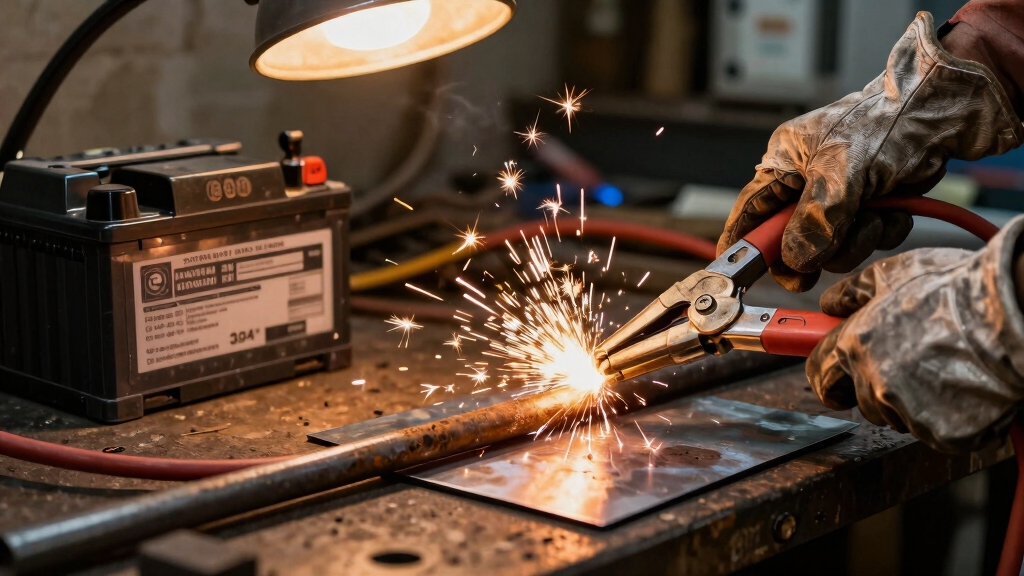
You can weld with a car battery charger by wiring multiple lead-acid batteries in series to reach 24–36 volts. This provides enough voltage and current for short, critical welds.
Use recommended electrodes like 1/8″ 6011 with reverse polarity to maintain arc stability. This method requires strong batteries, secure connections, and safety precautions due to voltage fluctuations and heat buildup.
It’s ideal for emergency repairs when conventional welders aren’t available. Understanding setup details and limitations guarantees effective application.
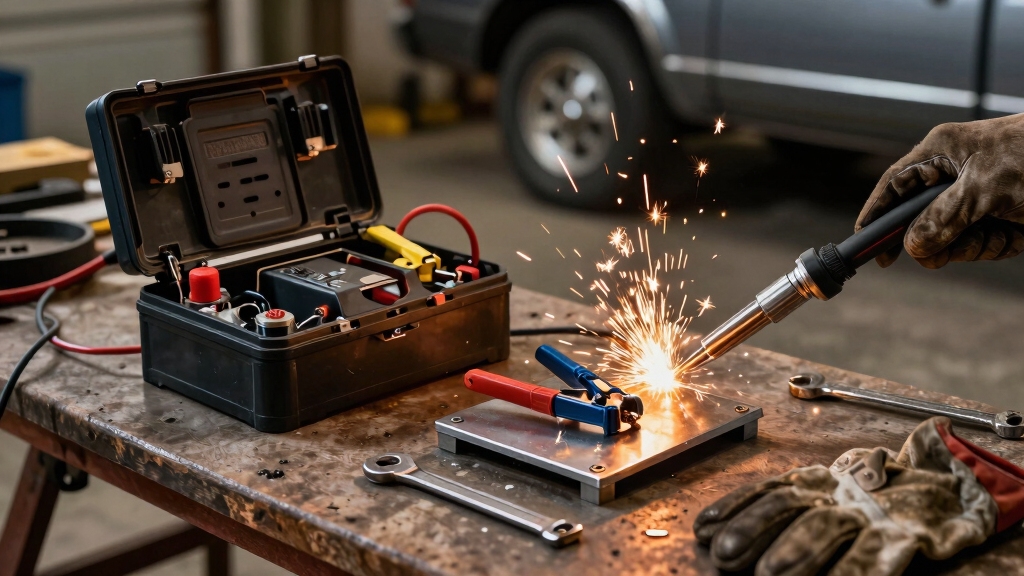
When setting up a welding power source using car battery chargers, selecting the right battery configuration is crucial for consistent arc stability and sufficient amperage.
Choosing the correct battery setup is key for steady arcs and reliable amperage in welding power sources.
You’ll want to connect batteries in series to multiply voltage while maintaining current capacity. For example, three old car batteries in series can provide 36 volts and adequate current for welding.
Golf cart batteries offer an ideal 36-volt, 220 amp-hour capacity, supporting 150 amps for extended periods. Avoid parallel connections, as they increase amperage but keep voltage low, impairing arc initiation.
Make sure batteries are healthy to prevent thermal runaway and voltage drops. Clip into the battery chain to adjust output between 24, 30, or 36 volts depending on your welding requirements.
This precision in battery setup directly influences welding performance with car charger sources. Incorporating a low-voltage high-current transformer can help regulate and stabilize the welding current for better results.
Selecting the right battery setup sets the foundation for effective welding with a car battery charger. Executing the weld requires precise connections and technique.
First, connect jumper cables to batteries in series for 24-36 volts. Guarantee positive clamps to the workpiece (ground) and negative clamps to the electrode holder, establishing reverse polarity.
Secure your electrode, ideally 1/8″ 6011 or 3/32″ 6013 rods, in vice grips. Clean the metal surface thoroughly before striking the arc by tapping the rod on the workpiece.
Maintain a steady arc length to prevent voltage drop and ensure stable puddle formation. Monitor battery temperature to avoid thermal runaway. Keep your connections tight to minimize resistance.
This method enables portable, emergency stick welding without conventional power sources. Proper wire gauge and circuit protection are critical to avoid overheating and voltage drop during welding operations.
Although welding with a car battery charger limits your options compared to industrial welders, choosing the correct electrode and polarity remains critical to achieve a stable arc and proper fusion.
You’ll want to use 1/8″ 6011 or 3/32″ 6013 rods, as their flux coatings accommodate the lower and fluctuating current typical of battery chargers.
Reverse polarity, connecting the positive lead to your ground clamp and negative to the electrode, is essential. It stabilizes the arc and enhances penetration.
Since the charger’s output can’t maintain consistent amperage, these electrodes’ fast arc strike and clean slag removal help compensate.
Secure the electrode firmly with vice grips to maintain contact during the arc. Adhering to these choices maximizes weld quality despite the charger’s inherent electrical limitations.
Proper storage and handling are crucial to prevent moisture absorption and maintain electrode quality for consistent welding performance.
Mastering electrode and polarity choices improves arc stability and weld quality, but welding with car batteries introduces specific hazards that demand rigorous safety measures.
Always wear insulated gloves, a welding helmet with proper shade, and flame-resistant clothing to protect against burns, sparks, and UV radiation.
Make certain batteries are in good condition to prevent thermal runaway or explosion risks.
Maintain good ventilation to avoid inhaling toxic fumes produced during welding.
Connect cables securely and verify polarity to avoid short circuits or equipment damage.
Monitor battery temperature continuously, halting work if overheating occurs.
Never weld near flammable materials or in confined spaces due to explosion hazards.
Finally, use insulated tools and avoid direct skin contact with terminals to prevent electrocution.
Adhering to these protocols minimizes risks inherent in battery-based welding.
It is also critical to ensure proper grounding and insulation to prevent electric shock hazards when working with electrical welding equipment.
Welding with battery chargers can be tricky. One of the main issues you’ll encounter is voltage drop. This can really mess with arc stability, especially when you’re under load or using lower-quality cables.
And let’s not forget about battery health. It’s super important! If your batteries are old or weak, they just won’t be able to provide the current you need for effective welding.
Another thing to keep in mind is that your welding duration will be limited. Thermal stress and voltage sag can cut your time short, so this method is really best for quick, emergency tasks.
Additionally, understanding the running and peak power demands is crucial to avoid voltage instability during welding with unconventional power sources.
When welding with a car battery charger, voltage drop presents a significant challenge that can hinder arc stability and overall weld quality.
The internal resistance of batteries and cables causes voltage to decrease under load, especially during short-circuit conditions inherent in welding arcs. This drop reduces the effective voltage at the electrode, making it difficult to maintain a consistent arc.
Longer cables and thinner gauge wires exacerbate this effect, increasing resistance and power loss. Additionally, the charger’s voltage regulation struggles to compensate during sudden high current draws, further worsening arc fluctuations.
To mitigate voltage drop, you must use thick, short cables and guarantee solid connections. Still, even with peak setup, the inherent limitations of battery charger output mean voltage drop remains a critical constraint in this unconventional welding method.
Selecting the correct cable gauge and minimizing cable length are essential to reduce resistance and maintain effective current flow during welding.
Maintaining battery health is critical to achieving reliable welding performance with a car battery charger. If your batteries suffer from sulfation, low electrolyte levels, or internal corrosion, their ability to supply high current sharply declines. This causes voltage drops and unstable arcs.
You must use lead-acid batteries rated for high discharge to avoid thermal runaway and overheating during welding. Weak or aged batteries struggle to maintain the amperage needed, leading to inconsistent arc strikes and poor weld quality.
Monitoring battery temperature and charge state during welding prevents damage and prolongs service life. Since welding demands brief, intense current surges, ensuring your battery bank remains fully charged and balanced is essential.
Neglecting battery health limits the feasibility and safety of welding with car battery chargers.
Although car battery chargers can supply sufficient current for short welding tasks, their limited capacity restricts welding duration markedly. Extended welding rapidly depletes battery charge and overheats the charger, forcing cool-down periods. This intermittent operation limits productivity and weld quality consistency.
| Factor | Impact |
|---|---|
| Battery Capacity | Limits continuous welding time |
| Charger Output | Drops voltage under sustained load |
| Heat Generation | Requires cooldown, pauses welding |
| Arc Stability | Degrades as voltage fluctuates |
To maximize welding time, monitor battery state and avoid prolonged arcs. The charger’s voltage drop under load reduces arc stability, making sustained welds difficult. Plan short welds or combine multiple batteries to extend welding intervals effectively. In contrast, inverter welding machines provide precise arc control through rapid current adjustments, enabling more stable and consistent welds.
You might want to think about using a car battery charger for emergency welding when you find yourself without conventional power sources but still need enough amperage. It’s pretty handy since it’s portable, allowing you to weld right on-site.
This makes it perfect for those urgent repairs around your property.
Just a quick reminder: safety comes first! Make sure you’re wearing the right protective gear. And keep an eye on the battery conditions to avoid any hazards while you’re working.
Better safe than sorry, right?
Keep in mind that using thick, low-resistance cables like 10-gauge wire is essential to minimize voltage drop and improve welding performance.
When power sources fail or conventional welders aren’t available, you can turn to a car battery charger as an emergency welding power supply.
By leveraging the charger’s high-amp modes, such as 35-amp fast charge or 200-amp engine start, you can generate sufficient current to strike and maintain an arc.
This is particularly effective when combined with batteries wired in series to increase voltage.
This setup suits short, critical repairs on clean metal surfaces using standard rods like 1/8″ 6011.
You need healthy batteries to avoid voltage drops or thermal runaway and must connect clamps correctly for reverse polarity operation.
While this method lacks the consistency of dedicated welders, it provides an effective, portable alternative in power outages or remote locations where immediate welding is essential.
However, it is important to recognize that this emergency method cannot match the precise current control and efficiency of an inverter technology welder.
Setting up a welding station with a car battery charger lets you carry out repairs virtually anywhere on your property without relying on fixed power sources.
This portability proves invaluable during power outages or when working in remote locations lacking electrical infrastructure.
By connecting jumper cables to batteries in series, you can configure a 24-36 volt output sufficient for welding thin metals using 1/8″ 6011 rods.
The compact setup enables quick deployment and flexibility, especially for emergency fixes on farm equipment or structural components.
While it demands healthy lead-acid batteries and careful voltage management, the system’s lightweight nature and independence from mains power allow you to perform critical welds onsite without waiting for professional service or generator availability.
This optimizes downtime and resource efficiency.
Proper voltage adjustment is essential to maintain arc stability and achieve quality welds with this portable setup.
Carrying out emergency welding with a car battery charger demands rigorous attention to safety protocols to prevent injury and equipment damage.
You must wear insulated gloves, a welding helmet with appropriate shading, and flame-resistant clothing to protect against burns, arc eye, and sparks.
Confirm batteries are healthy and well-ventilated to avoid thermal runaway or explosions.
Use clamps securely and verify connections to prevent short circuits.
Keep the work area dry to reduce electrocution risk.
Strike the arc only on clean metal surfaces and never weld near flammable materials or battery acid.
Always monitor battery temperature during welding to prevent overheating.
Use this method strictly in emergencies, as prolonged use risks equipment failure and unsafe conditions.
Safety must remain your priority at all times onsite.
Harnessing a car battery charger for welding involves leveraging its high-amperage output modes, such as the 35-amp fast charge or the 200-amp engine start function, to generate the necessary current and voltage for striking and maintaining an arc.
You connect jumper cables to batteries in series to increase voltage (24-36V) and then use reverse polarity: positive clamp to ground and negative to electrode. The charger’s DC output supports stick welding with rods like 1/8″ 6011.
| Mode | Amperage Output | Voltage Range (V) |
|---|---|---|
| Slow charge | 2 amps | 12 |
| Fast charge | 35 amps | 12-24 |
| Engine start | 200 amps | 12-24 |
This setup creates a stable arc but demands strong batteries and precise connections for consistent welding.
You generally shouldn’t use lithium-ion batteries for welding because they can’t safely deliver the high current spikes welding demands.
Lithium-ion cells lack the robust thermal and current tolerance of lead-acid batteries, risking overheating, damage, or thermal runaway.
Their protection circuits often limit discharge rates, reducing arc stability.
For welding, you need batteries designed for sustained high amperage output, like lead-acid types, to guarantee reliable and safe arc performance.
You can weld continuously for only a few minutes with a typical car battery charger before it overheats. Chargers designed for low amperage, like 35 amps, will quickly reach thermal limits under welding loads.
High-amp engine start modes might sustain welding arcs slightly longer, but overheating remains a risk without forced cooling. To extend run time, monitor temperature closely and allow cooldown periods. Most chargers aren’t built for prolonged welding duty cycles.
After welding, you need to check each car battery’s electrolyte level and top off distilled water if it’s low.
Inspect terminals for corrosion and clean them thoroughly to guarantee good conductivity.
Perform a full charge cycle to restore capacity, avoiding deep discharge states.
Monitor battery temperature during recharge to prevent thermal runaway.
Finally, test voltage and internal resistance to confirm the battery’s health before future welding or automotive use.
Yes, welding with a battery charger can damage your car’s electrical system if not handled properly.
The high current and voltage spikes during welding can backfeed into sensitive electronics, risking component failure.
You must isolate the vehicle’s battery and disconnect electronics before attempting any welding.
Also, avoid using the charger connected to the car’s system directly, as transient surges may cause permanent damage to the alternator, ECU, and wiring harness.
You won’t find many charger brands explicitly designed for welding, but high-amp engine start mode chargers from brands like Schumacher, NOCO, and Battery Tender perform best.
Choose units offering 35-200 amps DC output with stable voltage and robust build quality. Avoid low-amp trickle chargers; they can’t sustain welding arcs.
Focus on models with center tap transformers or specifically rated for deep cycle or high current batteries to guarantee reliable welding performance and safety.
Welding with a car battery charger isn’t your everyday tool. It’s more like a secret weapon in a pinch.
While it won’t replace professional gear, understanding battery setups, electrode choices, and safety protocols lets you tackle emergency welds effectively.
Just remember, the charger’s power is limited, so use it wisely. When the sparks fly, approach methodically, and you’ll weld with precision. You can turn a basic battery into a reliable, if temporary, welding source.