Phone:
(701)814-6992
Physical address:
6296 Donnelly Plaza
Ratkeville, Bahamas.

Phone:
(701)814-6992
Physical address:
6296 Donnelly Plaza
Ratkeville, Bahamas.

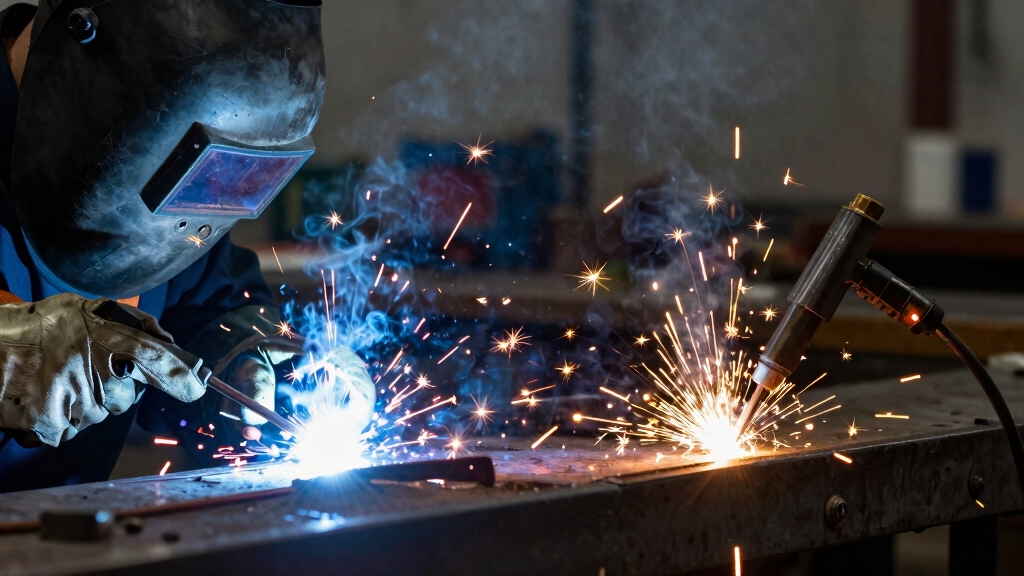
When choosing between arc and MIG welding, consider your material and environment.
MIG welding uses a continuous wire and external gas for cleaner, faster welds on thin metals. However, it struggles in windy or wet conditions.
Arc welding relies on flux-coated electrodes, offering deeper penetration and reliable shielding for thick materials. It is suitable for outdoor or underwater use.
You’ll find arc welding demands more skill yet excels in heavy-duty tasks. MIG boosts productivity in controlled settings.
Explore how each method fits specific welding challenges.

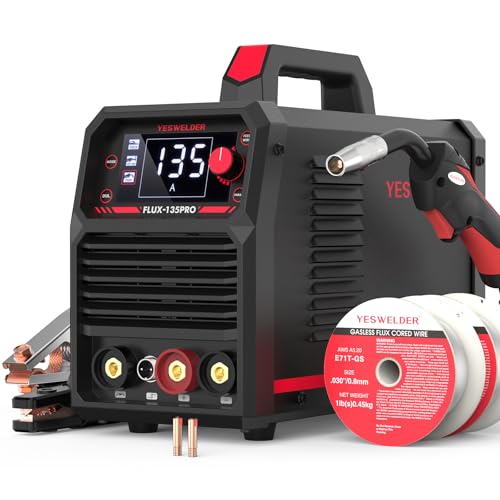
| Feature | Arc Welding (SMAW) | MIG Welding (GMAW) |
|---|---|---|
| Working Principle | Uses flux-coated electrode (self-shielding) | Uses continuous wire + external shielding gas |
| Shielding Method | Flux creates protective gas & slag | External gas (argon + CO₂ mix) |
| Ease of Learning | Harder to master (manual control needed) | Easier for beginners (continuous feed system) |
| Best For Metal Thickness | Thick metals (> ⅜ inch) | Thin to medium metals |
| Penetration Strength | Deep penetration, strong welds | Shallower penetration |
| Weld Cleanliness | More spatter, requires cleanup | Cleaner welds, minimal spatter |
| Speed & Productivity | Moderate (frequent electrode changes) | High (continuous welding, less downtime) |
| Outdoor Performance | Excellent (wind-resistant) | Poor (gas shielding affected by wind) |
| Underwater Use | Suitable | Not suitable |
| Environmental Resistance | Works in wind, rain, rough conditions | Sensitive to wind and moisture |
| Equipment Cost | Lower initial cost | Higher initial + gas cost |
| Operating Cost | Lower (no gas required) | Higher (shielding gas needed) |
| Skill Requirement | High (arc control, electrode handling) | Low to moderate |
| Automation Suitability | Limited | Highly suitable |
| Best Use Cases | Heavy-duty, construction, shipbuilding | Fabrication, automotive, thin sheet work |
| Portability | More portable | Less portable (gas cylinder needed) |
| Surface Tolerance | Works on dirty/rusty surfaces | Requires clean material |
| Spatter Level | High | Low |
| Efficiency | Lower deposition rate | Higher deposition rate |
| Typical Environment | Outdoor, harsh, underwater | Indoor, controlled environments |
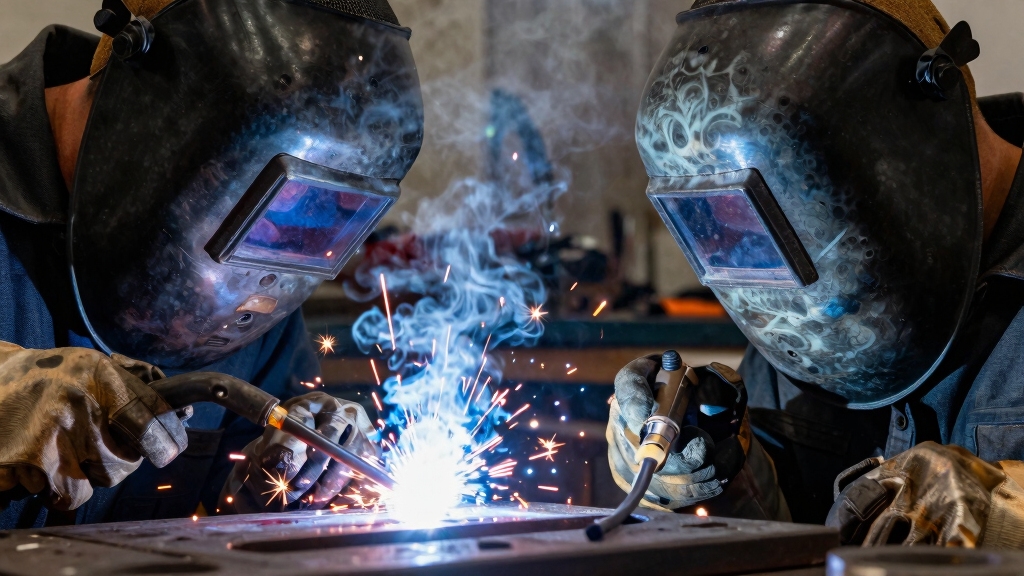
Understanding how arc and MIG welding actually work starts with recognizing their fundamental operational differences.
In arc welding, you use a consumable electrode coated in flux that creates a protective gas shield as it burns. This prevents atmospheric contamination without external gas.
You manually replace electrodes as they deplete.
MIG welding, however, feeds a continuous wire electrode through a welding gun while externally supplying a shielding gas mixture.
This mixture is commonly argon and carbon dioxide to protect the weld pool. This allows uninterrupted operation with a spool-fed wire.
The flux coating in arc welding serves as an integrated shield. MIG’s external gas source guarantees cleaner welds with less spatter.
Your choice between these methods hinges on control, shielding needs, and operational continuity specific to your welding environment.
Proper electrode selection, including understanding flux coating composition, is crucial for achieving optimal weld quality.
How quickly you pick up welding skills largely depends on the method you choose.
MIG welding offers a more straightforward learning curve due to its continuous wire feed and external shielding gas. This setup simplifies torch handling and protects the weld area effectively.
It minimizes the need for frequent electrode changes, allowing you to focus on technique rather than equipment management.
In contrast, arc welding demands higher manual dexterity and timing. You must replace flux-coated electrodes regularly and maintain appropriate arc length to prevent defects.
Although arc welding can be learned relatively quickly, mastering it requires more practice to control spatter and achieve consistent penetration.
Consequently, if you seek a faster, less complex entry point, MIG welding is generally easier to learn and operate effectively.
Additionally, MIG welding’s continuous feed system supports faster deposition and travel speeds, enhancing productivity for beginners.
When you’re dealing with thin metals, MIG welding really shines. It gives you cleaner, more controlled joints and minimizes heat distortion. That’s super important when you want a neat finish.
On the other hand, when you’re working with thicker materials, arc welding is the way to go. It offers deeper penetration and creates stronger welds, which are essential for maintaining structural integrity. So, knowing the strengths of each method can really help you choose the best one based on the thickness of the metal and what your project needs. MIG welding also supports a wide range of material thicknesses through adjustable wire feed and current settings, making it highly versatile for different applications with thin sheet metals to thicker sections.
Choosing the right welding method hinges markedly on the material thickness you’re working with. When dealing with thin metals, MIG welding offers distinct advantages over arc welding.
MIG’s continuous wire feed and stable arc enable precise heat control, reducing the risk of burn-through and warping on thin gauge materials. Its shielding gas protects the weld pool from oxidation, resulting in clean, strong joints with minimal spatter.
Moreover, MIG welding facilitates faster production with less downtime, essential for thin metal fabrication where consistency is critical. In contrast, arc welding’s higher heat input and intermittent electrode replacement increase the likelihood of distortion and less refined welds on thin metals. Using pulse MIG transfer mode can further optimize heat input, allowing intermittent cooling intervals that help prevent burn-through and thermal distortion.
Although MIG welding excels with thin metals, arc welding outperforms it on thick materials exceeding ⅜ inch due to its deeper penetration and stronger welds.
When working with thick metals, you need a welding process that guarantees full fusion and structural integrity.
Arc welding provides this through its flux-coated electrodes.
This flux stabilizes the arc and allows for better control in heavy sections, producing welds with superior mechanical strength.
MIG welding’s continuous wire feed offers efficiency, but its shallower penetration limits effectiveness on thick metals.
Consequently, if your project involves heavy gauge steel or demanding environments like shipyards, arc welding is the more reliable choice.
Conversely, for thinner metals, MIG welding’s cleaner, faster operation remains ideal.
Its ability to weld on rusty, dirty, or wet surfaces while maintaining strong, reliable welds further enhances arc welding’s suitability for heavy-duty applications.
You know, when it comes to welding outdoors or even underwater, arc welding really shines. The flux-coated electrodes do a great job of protecting the weld without needing any external gas. It’s pretty impressive!
On the flip side, MIG welding can have a tough time in windy conditions. The shielding gas can easily get blown away, which can really mess with the quality of the weld. So, it’s essential to keep these environmental factors in mind when choosing the right welding method for different situations. Understanding how the conditions affect each type can make a big difference in your results! Additionally, in adverse weather, it’s important to dry electrodes thoroughly to maintain weld quality and reduce defects.
When welding outdoors, environmental factors like wind and moisture markedly influence the performance of arc and MIG welding.
You’ll find arc welding more resilient under these conditions because its flux-coated electrodes create a protective slag. This shields the weld pool without relying on external gas, making arc welding suitable for variable weather, including damp or windy environments.
In contrast, MIG welding depends on a continuous shielding gas flow, which environmental elements can easily disrupt. This can lead to weld contamination and porosity.
Moisture can also degrade arc stability in both methods, but MIG welds are particularly vulnerable due to gas displacement.
Consequently, when working outdoors, you must consider these performance differences carefully to guarantee weld integrity. Favor arc welding where environmental control is limited.
Additionally, the constant current characteristic of arc welding helps maintain a steady arc despite changes in arc length caused by environmental disturbances.
In windy conditions, shielding integrity plays a critical role in weld quality, especially between arc and MIG welding. MIG welding relies on a shielding gas that wind can easily disperse, causing porosity and weak welds.
Conversely, arc welding’s flux-coated electrodes generate their own protective atmosphere, maintaining weld integrity even in gusty environments. You must account for wind speed and direction to optimize shielding effectiveness.
Using 100% argon gas is essential in TIG welding to maintain a stable arc and prevent oxidation, which would otherwise degrade weld quality in similar environmental conditions due to arc instability.
The table below summarizes the wind impact on these processes:
| Welding Type | Shielding Method | Wind Impact |
|---|---|---|
| MIG | External shielding gas | High risk of gas displacement |
| Arc | Flux-coated electrode | Minimal impact, self-shielding |
| MIG | Requires windbreaks | Often necessary for quality welds |
| Arc | No external gas needed | Reliable outdoors in moderate winds |
| MIG | Sensitive to wind speeds | Decreased weld quality with gusts |
Steering the challenges of underwater welding demands specialized techniques due to the unique environmental conditions.
When welding underwater, arc welding (SMAW) is the preferred method because its flux-coated electrodes create a gas shield independent of external sources, essential in a submerged environment.
MIG welding, relying on external shielding gas, struggles underwater since gas bubbles disperse rapidly, compromising weld integrity.
Arc welding’s deep penetration and robust welds withstand water pressure and contamination effectively.
MIG’s continuous wire feed and cleaner welds are impractical underwater.
Additionally, arc welding equipment is more adaptable to underwater use, despite requiring frequent electrode changes.
In sum, environmental conditions like water pressure and inability to maintain a stable gas shield make arc welding the viable choice for underwater tasks.
MIG welding lacks the necessary adaptability.
Dry hyperbaric welding, however, offers improved weld quality by eliminating water interference and allowing traditional methods like gas tungsten arc welding (GTAW) in a controlled environment with consistent shielding gas.
Although MIG welding machines come with higher upfront costs and ongoing expenses for shielding gas, they often deliver superior productivity compared to arc welding.
You benefit from continuous wire feed in MIG welding, reducing downtime for electrode replacement common in arc welding. This efficiency translates to higher throughput, especially in automated or high-volume environments.
However, arc welding equipment costs less initially and does not require consumable gases, lowering operating expenses.
MIG welding also offers high travel speeds and productivity, enabling faster cycle times and increased throughput in various industrial applications.
| Factor | Arc Welding |
|---|---|
| Initial Equipment Cost | Lower |
| Consumables Cost | Lower (no gas needed) |
| Productivity | Moderate |
| Downtime | Higher (electrode changes) |
| Suitability for Automation | Limited |
MIG welding’s enhanced productivity often justifies its higher overall cost for continuous, large-scale work.
Because arc welding delivers unparalleled penetration and strength, you’ll find it indispensable for demanding tasks involving thick metals.
When working with materials exceeding ⅜ inch, arc welding’s deep fusion guarantees structural integrity that MIG welding often can’t match.
Its flux-coated electrodes provide built-in shielding, enabling reliable performance outdoors or in windy conditions where gas shielding would fail.
This makes arc welding ideal for shipyards, heavy construction, and underwater applications.
Although it requires more skill and frequent electrode changes, the robustness and versatility of arc welding outweigh these challenges for tough jobs.
You’ll appreciate its ability to produce strong, defect-resistant welds on thick sections where precision and durability are critical.
This reinforces why it remains the go-to method for heavy-duty industrial use despite newer alternatives.
Yes, you can effectively join dissimilar metals using MIG welding.
This process allows you to fuse different metal types by selecting appropriate filler wires and adjusting parameters to accommodate varying melting points and thermal conductivities.
MIG’s continuous wire feed and shielding gas create stable welds with minimal contamination, making it suited for such applications.
However, you’ll need to carefully control heat input and pre/post-weld treatments to guarantee joint integrity and prevent defects.
You might be surprised, but yes, arc welding is indeed suitable for underwater repairs. Its unique flux-coated electrodes shield the weld area from water and contaminants, allowing you to maintain arc stability in wet environments.
This capability enables you to perform reliable, deep-penetration welds underwater, vital for ship hulls and offshore structures. Keep in mind, however, that specialized training and equipment are essential to safely execute underwater arc welding tasks.
You’ll notice welding spatter is more prevalent with arc welding due to its flux-coated electrodes and stick process. This generates irregular molten droplets.
In contrast, MIG welding produces markedly less spatter because of its continuous wire feed and shielding gas that stabilizes the arc.
This cleaner operation reduces post-weld cleanup and improves weld quality.
MIG is preferable when minimizing spatter is critical for efficiency and aesthetics in your welding projects.
You use a shielding gas mixture typically composed of 75% argon and 25% carbon dioxide in MIG welding. This blend provides ideal arc stability and weld penetration while minimizing spatter.
Argon offers excellent coverage and smooth arc characteristics, whereas carbon dioxide enhances penetration and reduces costs.
Adjusting this ratio slightly can tailor weld properties for specific metals or thicknesses, but the 75/25 argon-CO2 mix remains the industry standard for most MIG applications.
You’ll find that 80% of veteran welders prefer arc welding because it delivers the strongest welds with the deepest penetration, especially on thick metals over ⅜ inch.
You’ll appreciate its reliability outdoors and in harsh conditions, where shielding gas would fail.
Although harder to master, arc welding offers unmatched control and durability for heavy-duty tasks, making it indispensable despite newer, easier methods like MIG welding.
When choosing between arc and MIG welding, remember that MIG welding can boost your productivity by up to 50% compared to arc welding, especially on thinner metals.
However, arc welding remains indispensable for heavy-duty, thick metal work where precision and durability are essential.
Your choice depends on metal thickness, environment, and skill level. By understanding these factors, you can optimize both efficiency and quality in your welding projects.
Last update on 2026-10-15 / Affiliate links / Images from Amazon Product Advertising API
