Phone:
(701)814-6992
Physical address:
6296 Donnelly Plaza
Ratkeville, Bahamas.

Phone:
(701)814-6992
Physical address:
6296 Donnelly Plaza
Ratkeville, Bahamas.

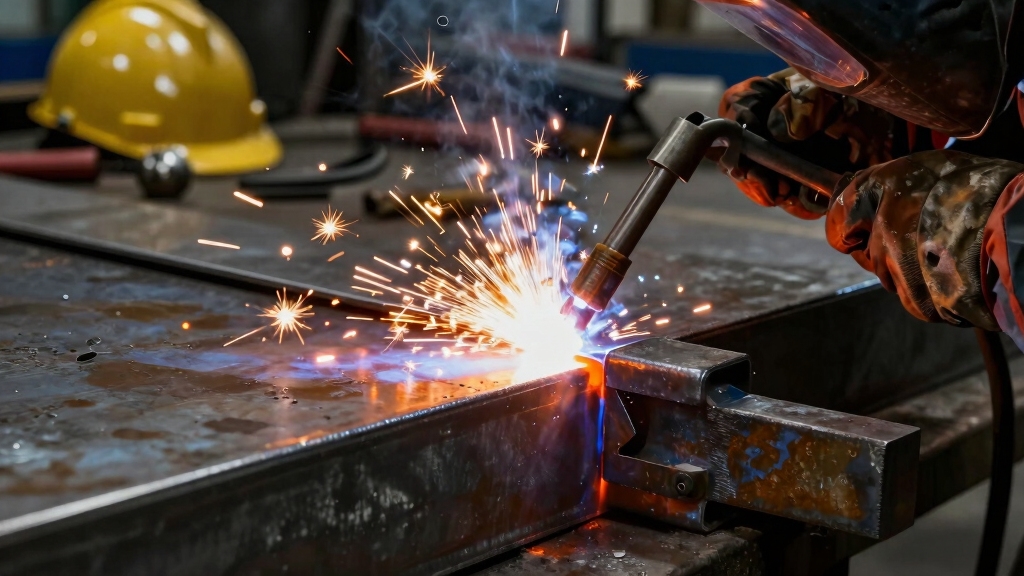
When joining thicker steel plates, you’ll want welding processes that deliver deep penetration and controlled heat input to prevent distortion and cracking.
Methods like MAG suit 10–15 mm plates with multi-layer passes, while Submerged Arc Welding offers high deposition rates for heavier sections.
Stick welding works well with multi-pass techniques, and Flux Cored Arc Welding excels outdoors with heavy deposition.
For very thick plates, Electrogas Welding handles up to 70 mm efficiently.
Combining techniques can also reduce time and boost quality. Discover which process fits your specific needs best.
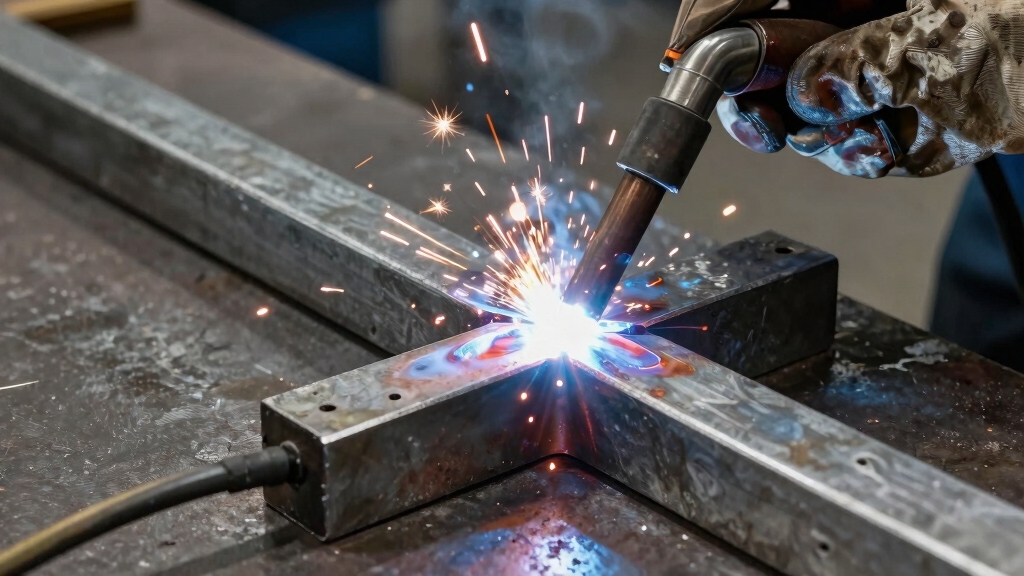
Because thick steel plates require more heat and multiple passes to achieve full penetration, welding them presents unique challenges compared to thinner materials.
Welding thick steel plates demands more heat and multiple passes for full penetration, posing unique challenges.
You must carefully manage heat input to prevent excessive distortion and cracking. The increased thickness demands a multi-layer welding approach, which prolongs the process and necessitates precise control over interpass temperature and bead geometry.
Access to the joint root also becomes more difficult, requiring specialized techniques and equipment. Furthermore, preheating thicker plates is often essential to reduce thermal stress and guarantee weld integrity.
You’ll need to take into account welding parameters that balance penetration depth with deposition rates to optimize efficiency without compromising quality. Selecting a machine with an appropriate duty cycle ensures consistent performance during extended multi-pass welding operations.
When you’re figuring out which welding process to use for thick plates, the first thing you should do is take a good look at the material thickness. This is super important because different methods have varying capabilities when it comes to penetration and layering. You want to make sure that the process you choose can handle the thickness of the material you’re working with.
Now, let’s talk about efficiency and cost. These factors really come into play when you’re trying to find the right balance between deposition rates, labor, and equipment expenses. It’s all about optimizing weld quality while keeping an eye on how much time and resources you’re using.
Additionally, selecting the appropriate welding technique, such as MIG or TIG, is crucial because each offers different advantages depending on the material type and thickness you are working with.
Selecting the appropriate welding process hinges largely on the thickness of the material you’re working with, as different methods offer varying penetration depths, deposition rates, and thermal impacts.
For plates between 10 and 15 mm, MAG welding with multi-layer passes guarantees sufficient penetration, while preheating prevents cracking on thicker steels.
When dealing with very thick plates, submerged arc welding provides high deposition rates and deep penetration, especially for low-carbon steels.
Stick welding suits medium-to-thick sections, enabling strong welds via multiple passes and weaving techniques.
Flux-cored arc welding excels outdoors with heavy deposition, demanding multi-layer approaches for thick joints.
For extreme thicknesses up to 70 mm, electrogas welding offers high heat input and efficiency but necessitates compatible high-heat steel grades.
Your choice must balance adequate fusion depth, thermal control, and weld integrity.
Additionally, controlling the heat input is crucial to avoid distortion or defects when welding thick materials.
Although welding thick plates demands robust techniques, optimizing efficiency and controlling costs remain critical factors in process selection.
You’ll find that processes like Submerged Arc Welding (SAW) and Electrogas Welding (EGW) offer high deposition rates and faster welding speeds, markedly reducing labor time on thick sections.
However, high heat input methods require compatible steel grades to avoid distortion or defects.
Stick Welding (SMAW) is cost-effective for multi-pass welds but slower due to manual operation.
Flux Cored Arc Welding (FCAW) provides stable arcs outdoors but may lower efficiency without hybrid integration.
Combining FCAW with EGW can cut welding time by over 40%, balancing speed and quality.
Choosing your process depends on plate thickness, production volume, and material compatibility to maximize cost-efficiency without compromising weld integrity.
Additionally, maintaining precise positioning during welding is essential to ensure strong seam formation and prevent defects in thick plate joints.
You’ll find that MAG welding suits steel plates between 10 and 15 mm thick by offering a controlled, multi-layer approach that guarantees deep penetration and strong fusion.
MAG welding excels on 10 to 15 mm steel plates with precise multi-layer control for deep, strong fusion.
You use MAG primarily for root and filler layers, taking advantage of its higher melting rate.
Spray transfer mode effectively fills larger gaps, ensuring consistent bead formation and mechanical integrity.
For plates at the upper limit of this range, preheating reduces thermal stress and prevents cracking.
The multi-pass technique, although time-consuming, allows precise control overheat input and weld geometry, enhancing strength and minimizing distortion.
By carefully managing parameters like current and wire feed speed, you maintain optimal arc stability and penetration depth.
MAG is a reliable choice for medium-thickness steel plates where quality and structural performance are critical.
Selecting the proper polarity is essential to control heat input and achieve the desired penetration and bead quality in MAG welding.
Submerged arc welding really shines when it comes to heavy sections, and here’s why. First off, it boasts high deposition rates, which means it can quickly build up filler material on thick plates. That’s pretty handy, right?
Plus, it works great with low-carbon steel and can handle vertical joining like a champ. This makes it ideal for tackling substantial thicknesses, which is often a requirement in heavy-duty applications.
All in all, submerged arc welding streamlines the process of welding large-scale structures. It maximizes productivity while still delivering top-notch weld quality.
So, if you’re dealing with heavy sections, this method is definitely worth considering! In addition, the ability to maintain a stable arc during welding ensures consistent penetration and reduces defects on thicker plates.
Submerged Arc Welding (SAW) achieves high deposition efficiency by delivering a concentrated, stable arc that melts a large volume of filler material rapidly, making it ideal for heavy sections.
You benefit from deposition rates markedly higher than other arc welding methods, allowing you to cover thick plates with fewer passes. This efficiency reduces overall welding time and labor costs.
The continuous wire feed and granular flux enable consistent arc stability and deep penetration, minimizing defects. Additionally, the controlled environment provided by the flux suppresses spatter and oxidation, ensuring high-quality welds.
When you need to weld thick, low-carbon steel plates, SAW’s ability to maintain a high melting rate without compromising weld integrity makes it a superior choice for heavy-duty applications.
Unlike processes such as heliarc welding, which excel in precision for non-ferrous metals, SAW is specifically suited for rapid, high-volume deposition in thicker materials.
The high deposition efficiency described earlier directly supports welding thick plates by enabling rapid, consistent filler metal application that matches the demands of heavy sections.
Submerged Arc Welding (SAW) excels in thick plate compatibility due to its unique attributes:
Additionally, maintaining proper thermal control during welding is essential to avoid thermal distortion and ensure the strength of thick plate joints.
Stick welding excels in handling thick steel plates by delivering deep penetration and strong fusion essential for structural integrity.
When you weld thicker metals, stick welding’s higher penetration capability guarantees thorough joining through multiple passes, especially for plate thicknesses over 3/16 inch.
You can manipulate the electrode in a weaving and pushing manner to fill 3/16″ to 1/2″ V bevels effectively.
Additionally, stick welding proves cost-efficient for multi-pass thick plate welds, reducing equipment complexity and operational expenses.
Its versatility allows you to work in varying environments without stringent shielding gas requirements.
While it demands multiple passes for thicker sections, the process offers reliable mechanical strength and adaptability, making it a practical choice for structural applications where robust, deep welds are critical.
The use of a deep-penetration root pass technique further enhances the weld quality and ensures complete fusion in thick plate welding.
Choose Flux Cored Arc Welding (FCAW) when working with thick plates because it offers a heavy deposition rate and stable arc performance, even in outdoor environments without shielding gas. This makes FCAW highly efficient and reliable for structural applications.
Here’s why you should consider FCAW:
Additionally, maintaining balanced welding parameters such as voltage, wire feed speed, and proper equipment upkeep can further enhance weld quality and reduce spatter during FCAW.
When tackling very thick steel plates, electrogas welding (EGW) steps up as a highly efficient solution capable of handling thicknesses up to 70 mm.
You’ll benefit from EGW’s high heat input, which demands steel plates with suitable high-heat resistance. This process markedly reduces welding time compared to multi-pass FCAW, especially when combining EGW with FCAW for surface layers.
EGW excels in vertical welding, enabling deep penetration and strong joints on heavy sections.
| Feature | EGW | FCAW + EGW Combination |
|---|---|---|
| Max Plate Thickness | Up to 70 mm | Up to 70 mm |
| Welding Speed | High | Moderate, but time-saving |
| Heat Input | Very High | Controlled |
| Penetration Depth | Deep | Deep |
| Application | Non-structural and structural plates | Thick plates needing surface finishing |
By combining welding techniques, you can markedly reduce total welding time while enhancing joint quality in thick plate fabrication.
For example, integrating FCAW with EGW leverages FCAW’s versatility and EGW’s high deposition rate, cutting welding time markedly.
Hybrid methods like GMAW-laser or optimized MAG tandem allow deeper penetration and faster filler application, improving structural integrity.
To optimize outcomes, focus on:
This analytical approach guarantees you achieve faster production without sacrificing weld quality on thick plates.
Although welding thick plates inherently risks distortion and defects due to high heat input and multiple passes, you can mitigate these issues through careful technique and parameter control.
Start by preheating plates thicker than 10 mm to reduce thermal gradients and residual stresses.
Use multi-pass welding with controlled interpass temperature to avoid excessive heat buildup.
Employ skip or staggered welding patterns to distribute heat evenly and minimize warping.
Select appropriate welding processes like FCAW or MAG with spray transfer to guarantee stable arcs and deep penetration, reducing incomplete fusion and porosity.
Additionally, clamp and fixture plates securely to restrict movement during welding.
Monitor welding parameters closely, adjusting voltage and travel speed to balance penetration and heat input.
You must wear proper PPE, including flame-resistant clothing, welding helmet with the correct shade, gloves, and safety boots.
Make sure adequate ventilation to avoid harmful fumes, especially with multi-pass or high-heat processes like EGW.
Use fire-resistant curtains to protect others and keep a fire extinguisher nearby.
Preheat thick plates as needed to prevent cracking.
Always follow lockout/tagout protocols on equipment and inspect your work area to eliminate hazards before starting welding.
When you weld thick plates, you risk altering steel’s mechanical properties due to heat input and cooling rates.
Excessive heat can cause grain growth, reducing toughness and strength. You might encounter residual stresses and distortion, affecting dimensional stability.
Proper preheating and controlled cooling help minimize hardness variations and cracking. Multi-pass techniques distribute heat more evenly, preserving ductility and impact resistance.
You must balance welding parameters to maintain peak mechanical performance.
You’ll often encounter defects like incomplete fusion, porosity, and cracking when welding thick steel plates.
Heat input control is critical; too much leads to distortion and grain coarsening, while too little causes lack of penetration.
Multi-pass welding can cause slag inclusions between layers if not cleaned properly.
Residual stresses from uneven cooling may induce warping or stress corrosion cracking, so you must carefully manage parameters and post-weld treatments.
Preheating helps you control the cooling rate when welding thick steel plates, reducing thermal stresses and minimizing cracking risk.
It guarantees better fusion by raising the base metal temperature, which improves weld quality and reduces hardness in the heat-affected zone.
For plates 3/8 inch or thicker, preheating is essential to prevent cold cracking and distortion, especially during multi-pass welding.
You’ll achieve stronger, more reliable joints by applying proper preheat.
You’ll want to apply post-weld heat treatment (PWHT) to relieve residual stresses and reduce the risk of cracking in thick steel plate welds.
Stress-relief annealing or normalizing is common. Additionally, perform non-destructive testing like ultrasonic or radiographic inspections to guarantee weld integrity.
Mechanical treatments like grinding or peening can improve fatigue resistance. Finally, apply corrosion protection coatings if the environment demands it, securing long-term durability and performance.
When tackling thicker plates, you’ll want to lean on welding methods that offer both strength and efficiency without causing too much thermal enthusiasm. Techniques like Submerged Arc Welding and Electrogas Welding excel in managing heavy sections with minimal fuss.
Combining methods can smartly streamline your workflow. By carefully selecting your approach and tweaking parameters, you’ll keep distortion and defects comfortably in check, ensuring your thicker steel joints stand firm under pressure.