Phone:
(701)814-6992
Physical address:
6296 Donnelly Plaza
Ratkeville, Bahamas.

Phone:
(701)814-6992
Physical address:
6296 Donnelly Plaza
Ratkeville, Bahamas.

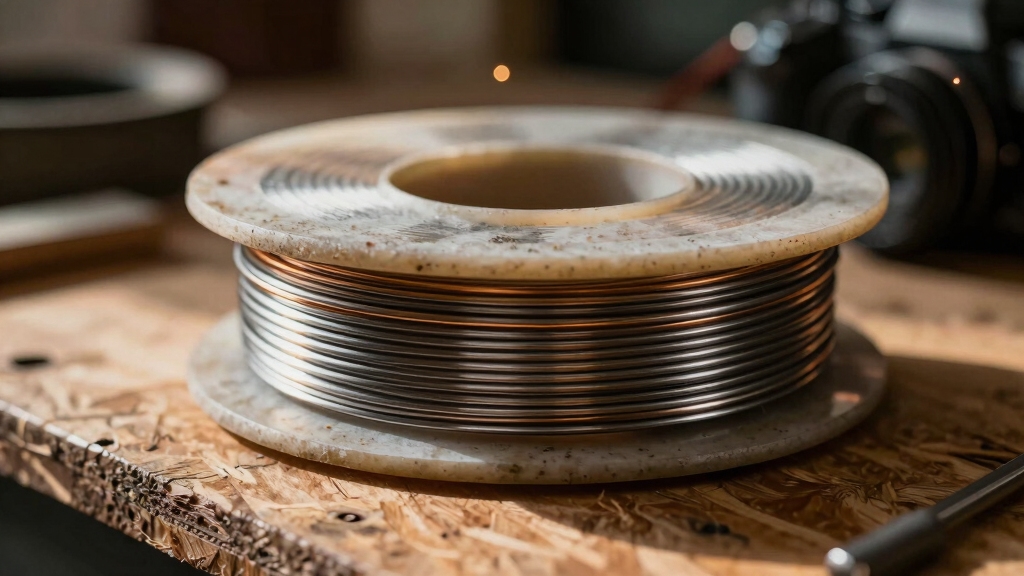
Welding wire acts as the essential filler material that fuses metal pieces into strong, durable joints by forming a metallurgical bond.
Its precise composition controls melting behavior, arc stability, and deposition rates, ensuring high-quality, defect-free welds.
You’ll find solid wires ideal for clean, precise welds under controlled conditions, while flux-cored wires excel outdoors with higher deposition rates.
Matching wire type and classification to your base metal optimizes strength and corrosion resistance.
Explore further to understand how wire choice impacts welding performance and applications.
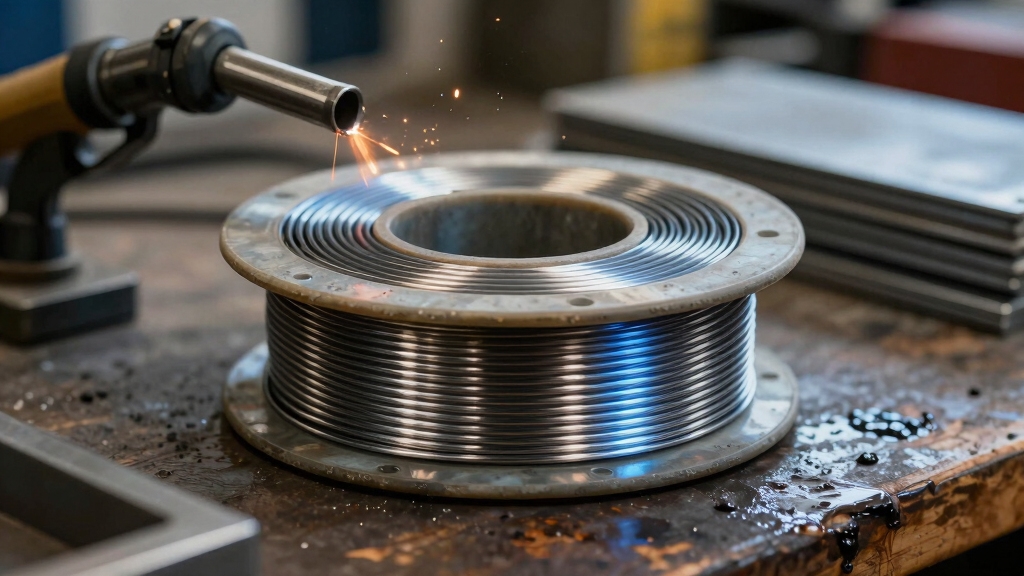
Although welding wire might seem like a simple consumable, it plays a critical role in creating strong, durable metal joints. It acts as the filler material that fuses separate pieces into a unified structure.
Welding wire, though often overlooked, is essential for forming strong, durable, and unified metal joints.
When you activate the MIG gun, the wire feeds through a brass nozzle with exact control. This ensures precise deposition and reduces downtime since one spool can hold approximately one mile of wire, minimizing reload frequency.
The wire’s composition directly affects weld quality and mechanical properties. Selecting the right type is vital for your application.
Its function isn’t just to fill gaps but to form a metallurgical bond that withstands stress, corrosion, and environmental factors. This makes welding wire indispensable for reliable, high-performance fabrication.
Different types of welding wires, such as solid and flux-cored varieties, are chosen based on factors like base metal, welding position, and environmental conditions to optimize welding performance and quality, highlighting the importance of wire selection.
When you use solid welding wire, you really get to enjoy clean and precise welds. It offers excellent control and minimizes contamination, all thanks to the shielding gas that’s required. Pretty neat, right?
This type of wire is perfect for welding carbon and low-alloy steels, as well as stainless steel and aluminum. It shines in applications where good penetration and aesthetic quality are key. So, if you’re working on projects that need those qualities, solid wire is definitely the way to go.
Understanding these strengths can help you make the right choice. It’s great for general fabrication and moderately thick materials, especially when you care about how the welds look and their consistency. The choice of shielding gas significantly influences weld quality and spatter control when using solid wire.
Solid welding wire delivers clean, precise welds by melting uniformly to join metal components with excellent consistency.
When you use solid wire, you benefit from its ability to produce aesthetically pleasing weld beads with minimal spatter.
The uniform composition guarantees stable arc characteristics, which enhances control and accuracy during welding.
Because solid wire requires an external shielding gas, you gain superior protection against atmospheric contamination, resulting in high-quality, defect-free welds.
This wire excels in welding carbon and low-alloy steels, stainless steel, and aluminum, providing good penetration and sound metallurgical properties.
Its versatility and cost-effectiveness make it ideal for controlled environments where you prioritize weld cleanliness and structural integrity.
Solid wire MIG welding typically uses DCEP polarity, which ensures deep penetration and a stable arc for optimal weld quality.
Maximize welding efficiency by selecting solid wire for projects requiring clean, precise welds with minimal spatter.
Solid wire works by feeding a continuous metal electrode through a welding gun, melting to form a consistent filler that bonds base metals.
It requires an external shielding gas, typically argon or CO2, to protect the weld pool from contamination.
You’ll find solid wire ideal for welding carbon steel, stainless steel, and aluminum in controlled environments where aesthetics and weld integrity are critical.
Use it when working on structural fabrication, automotive repairs, or thin to moderately thick materials needing smooth bead appearance and good penetration.
Avoid solid wire in windy or outdoor conditions, where flux-cored wire’s self-shielding properties outperform it.
Understanding these parameters guarantees optimal process control and weld quality.
When welding steel with solid wire, small additions of CO2 or O2 to argon shielding gas improve arc stability and bead profile.
Although flux-cored welding wire resembles solid wire in appearance, its hollow core filled with flux materials fundamentally changes how it performs during welding.
Flux-cored wire looks like solid wire but its flux-filled core transforms welding performance.
The flux generates a protective atmosphere around the weld pool, eliminating the need for external shielding gases in self-shielded variants. This is essential for outdoor or windy conditions.
You benefit from higher deposition rates and deeper penetration, making flux-cored wire ideal for thicker materials and heavy-duty applications.
Additionally, the flux core stabilizes the arc and improves slag formation, enhancing weld quality and reducing contamination.
This wire type offers versatility with gas-shielded and self-shielded options, allowing you to select based on your environment and project requirements.
When used with an inverter welding machine, flux-cored wire benefits from precise arc control and rapid current adjustments, resulting in improved weld quality and stability.
You know, one of the great things about using welding wire is how it really stretches your welding time. Instead of constantly stopping to reload, you can keep the process going smoothly.
This means less downtime and more productivity overall.
Plus, there’s the added benefit of consistent weld quality. With welding wire, you get a steady flow of filler material, which helps maintain control over the weld pool.
It’s a win-win for both efficiency and quality!
Selecting compatible filler materials like ER70S-6 also helps reduce spatter and improve arc stability, further enhancing welding efficiency.
Extending welding time directly enhances your operational efficiency by reducing interruptions during the welding process.
Welding wire spools can contain up to one mile of wire, markedly minimizing downtime associated with frequent reloads.
This continuous feed capability allows you to maintain a steady arc, fostering uninterrupted welding cycles vital for productivity.
The design of welding wires, particularly flux-cored variants, supports high deposition rates, enabling longer weld runs without compromising speed.
By selecting appropriate wire types and diameters for your application, you optimize feed rates and reduce stoppages.
This extended welding duration not only speeds up project completion but also decreases operator fatigue and equipment wear caused by repeated starts and stops.
Ultimately, this boosts overall workflow efficiency in industrial and fabrication settings.
Additionally, maintaining precise wire feed control ensures consistent weld quality throughout extended welding sessions.
Consistently using the right welding wire guarantees you achieve uniform weld quality across every joint, which is critical for structural integrity and efficiency.
Selecting a wire with precise chemical composition and mechanical properties assures predictable melting behavior and optimal fusion. This consistency minimizes defects such as porosity, cracking, or incomplete penetration, which can compromise joint strength.
Additionally, wires designed for specific materials, like ER70S-6 for carbon steel or ER308L for stainless steel, provide tailored alloying elements that stabilize the weld pool and improve bead appearance.
By maintaining stable arc characteristics and controlled deposition rates, welding wire enables you to produce repeatable, high-quality welds rapidly, reducing rework and downtime.
Ultimately, consistent weld quality drives operational efficiency and structural reliability in demanding applications.
Optimizing wire feed speed is essential as it directly influences amperage, thereby controlling penetration and deposition rates for consistent weld quality.
Selecting the appropriate welding wire hinges on understanding the specific metal you’re working with and its unique properties. You must match wire composition and type to the base metal to guarantee weld integrity, corrosion resistance, and mechanical strength.
For example, aluminum demands softer, flexible wires like ER5056 or ER5356, while stainless steel requires chromium-enriched wires in grades 308 or 316 to prevent contamination.
Consider these key factors:
Compatibility: Use carbon steel wires for general welding; stainless steel wires for corrosion resistance.
Environment: Choose flux-cored wires for outdoor or windy conditions due to their self-shielding capabilities.
Application: Opt for dual-shield wires when welding heavy or high-stress materials requiring deep penetration.
These considerations optimize weld quality and longevity for diverse metal types. Additionally, selecting the correct shielding gas is crucial to ensure proper protection and weld quality across different metals.
How do you decode the complex alphanumeric codes on welding wire spools?
Decoding welding wire codes reveals key details about composition, strength, and ideal applications for optimal welds.
The AWS classification system assigns specific designations that convey vital information about wire composition, strength, and application.
For example, ER70S-6 indicates a solid carbon steel wire with 70,000 PSI tensile strength and enhanced silicon-manganese content for welding rusty steel.
Stainless steel wires like ER308L specify low-carbon alloys suitable for corrosion-resistant welds.
Flux-cored wires use designations such as E70C-6, where “E” denotes electrode and “C” indicates flux core.
Understanding these codes lets you match wire types to base metals and welding conditions precisely.
This ensures peak weld quality and mechanical properties.
For dissimilar metal welding, selecting a filler metal like ER309L filler metal is crucial to balance corrosion resistance and thermal expansion differences.
When you face outdoor welding or heavy-duty projects, choosing the right welding wire becomes critical to guarantee durability and weld integrity. In these conditions, flux-cored wires often outperform solid wires due to their self-shielding capabilities that protect the weld pool from wind and contaminants.
You should contemplate wire types offering high deposition rates and deep penetration to handle thicker materials effectively. Key factors to ponder include:
Selecting wires aligned with these parameters guarantees robust, consistent welds suited for harsh, demanding environments.
Welding wire plays a vital role across numerous industries by providing reliable filler material that guarantees strong, durable bonds in metal fabrication.
You’ll find it extensively used in structural fabrication, shipbuilding, and pipeline construction, where weld integrity under stress is critical.
Flux-cored wires offer high deposition rates and deep penetration, making them ideal for outdoor and heavy-duty applications.
Flux-cored wires deliver robust, efficient welding with superior penetration for demanding outdoor and heavy-duty tasks.
Solid wires excel in clean welds on carbon and stainless steels for food processing and chemical plants.
In marine environments, copper-nickel alloy wires resist corrosion effectively, supporting electrical and plumbing work.
Selecting the appropriate wire type and composition secures peak weld quality, minimizes contamination, and enhances productivity.
This allows you to match application demands precisely across diverse industrial settings.
You should store welding wire in a dry, temperature-controlled environment to prevent moisture absorption and rust. These factors degrade weld quality.
Keep spools sealed in airtight packaging until use and avoid exposure to humidity or contaminants.
Use wire dispensers or racks that minimize physical damage and tangling.
For flux-cored wires, controlling moisture is vital, as flux contamination affects shielding properties and weld integrity.
Proper storage guarantees consistent feeding and peak welding performance.
Certainly, you can safely recycle welding wire, saving resources and reducing waste.
Proper processing removes contaminants and segregates metals by type, ensuring purity and performance in reused wire.
However, reusing wire directly without refining risks inconsistent composition and compromised weld quality.
To maintain precision and protect your projects, rely on professional recycling methods or certified suppliers offering recycled wire that meets stringent standards for strength, corrosion resistance, and weld integrity.
You should always wear gloves and safety glasses when handling welding wire to prevent cuts and metal splinters.
Avoid inhaling dust or fumes by working in well-ventilated areas or using exhaust systems.
Store wire spools away from moisture to prevent rust, which can compromise weld quality.
Also, guarantee proper grounding of welding equipment to avoid electrical hazards.
Following these precautions helps you maintain a safe, efficient welding environment.
You’ll find that welding wire diameter greatly influences weld strength and appearance.
Thicker wire provides higher deposition rates and deeper penetration, enhancing strength but potentially creating rougher welds.
Thinner wire allows for finer control and cleaner, more precise welds, ideal for delicate or thin materials.
Selecting the right diameter balances penetration with appearance, ensuring peak fusion without excessive spatter or distortion.
Adjust wire feed speed accordingly to maintain weld quality.
When wire feeding issues pop up like a stubborn knot in a rope, check wire tension first. It shouldn’t be too tight or loose.
Clean the drive rolls and make certain of proper alignment to avoid slipping.
Inspect the liner for blockages or wear. Also, confirm the wire diameter matches your equipment settings.
Don’t forget to check for rust or dirt on the wire spool, as contaminants can disrupt smooth feeding and weaken the weld quality.
Understanding welding wire is essential because it directly impacts your weld quality and efficiency. Did you know that using the correct welding wire can improve deposition rates by up to 30%?
This means faster, stronger welds with less rework. By selecting the right wire type and classification for your specific metal and environment, you optimize performance and durability.
Always prioritize matching welding wire to your project’s demands to achieve precision and reliability in every weld.