Phone:
(701)814-6992
Physical address:
6296 Donnelly Plaza
Ratkeville, Bahamas.

Phone:
(701)814-6992
Physical address:
6296 Donnelly Plaza
Ratkeville, Bahamas.

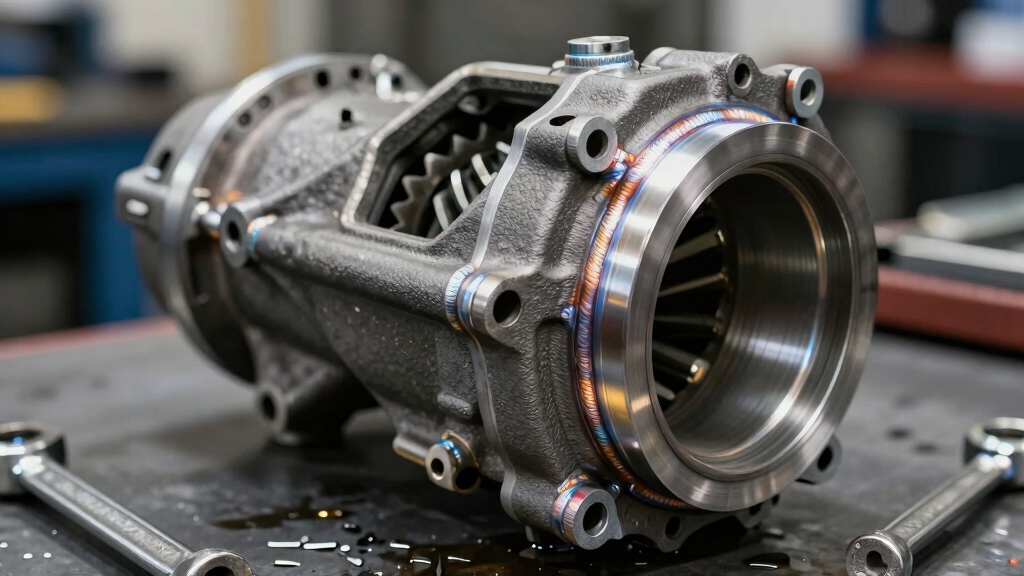
A welded differential permanently locks your vehicle’s spider gears, forcing both axle wheels to rotate at the same speed. This delivers 100% torque equally, regardless of traction differences.
This converts an open differential into a solid axle, improving grip in low-traction conditions. However, it compromises cornering and accelerates drivetrain wear.
It’s cost-effective but non-serviceable compared to LSDs, spools, or lockers. If you want to understand how this impacts performance, durability, and applications, keep exploring these aspects closely.
Although it permanently alters the axle’s function, a welded differential locks the spider gears together to force both wheels on an axle to spin at the same speed.
Welding the differential locks the spider gears, making both wheels spin identically for consistent power delivery.
By welding these gears, you convert an open differential into a solid, locked unit, eliminating independent wheel rotation.
This setup guarantees 100% of engine torque reaches both wheels equally, regardless of traction differences.
Mechanically, you prevent the differential’s normal action, causing the rear axle to behave as a single rigid component.
This modification improves torque delivery and traction in low-grip conditions but compromises cornering dynamics by forcing both wheels to rotate uniformly.
Welding the spider gears is a cost-effective method to enhance performance, especially for drifting or off-road use.
However, it fundamentally changes how the axle handles torque distribution and wheel speed.
Similar to how 5G welding requires precise control and positioning to ensure consistent performance, welding a differential demands accuracy to maintain durability under stress.
When you compare welded differentials to LSDs, spools, and lockers, each offers distinct traction and handling characteristics tailored to specific driving needs.
Welded diffs lock wheels permanently, providing uniform torque but impairing cornering.
LSDs allow variable slip, improving handling smoothness at a higher cost.
Spools behave like welded diffs but are professionally machined and more durable.
Lockers engage and disengage automatically, balancing traction and drivability.
| Differential Type | Traction Control | Handling Impact | Cost Range | Maintenance |
|---|---|---|---|---|
| Welded | 100% locked, no slip | Poor cornering | Low (<$500) | Non-serviceable |
| LSD | Variable slip | Smooth, balanced | Mid ($1,500-$2,000) | Serviceable |
| Spool | 100% locked | Poor cornering | Mid to High | Serviceable |
| Locker | Automatic engagement | Good in off-road | High | Serviceable |
Enhancing traction is the primary benefit you’ll gain from installing a welded differential.
By permanently locking both wheels on an axle to spin at the same speed, it guarantees 100% engine torque is delivered to each wheel regardless of traction conditions.
This eliminates wheel slip on low-grip surfaces, allowing you to maintain momentum in drifting, off-roading, or track driving.
The welded unit acts like a solid axle, providing consistent and predictable power transfer that improves acceleration and reduces understeer during performance driving.
Additionally, welding spider gears is a cost-effective way to upgrade from an open differential, often costing less than $500.
This modification delivers performance advantages by simplifying torque distribution and enhancing wheel engagement without the complexity of mechanical limited-slip differentials.
When fabricating or repairing components like spider gears, proper welding techniques such as controlling heat input and using suitable filler materials are crucial to ensure durability and prevent cracking, especially when working with cast iron parts like differentials’ housings and gears, as outlined in heat input management.
Since welding locks both wheels to spin at the same speed, it compromises your vehicle’s handling during turns. This forces the inside and outside wheels to rotate uniformly.
This uniform rotation increases understeer and skidding because the inside wheel can’t slow down independently. This disruption affects natural cornering dynamics.
You’ll also experience accelerated tire wear and heightened stress on drivetrain components, including axle twist, due to added mechanical strain.
Additionally, once welded, the differential becomes non-serviceable, eliminating your ability to revert to an open or LSD setup without replacing parts.
On slippery surfaces or during daily driving, these drawbacks become pronounced, reducing control and safety.
Welding a differential sacrifices versatility and longevity for traction gains. You need to weigh these trade-offs carefully before committing to this irreversible modification.
Proper welding techniques and adherence to safety protocols are essential to ensure the integrity of any welded component.
You’ll find welded differentials best suited for vehicles and scenarios where maximizing traction outweighs the need for smooth handling.
They excel in drift cars, track vehicles, and off-road rigs, environments demanding consistent torque delivery to both rear wheels despite variable grip.
Welded diffs provide a budget-friendly traction boost, favored in drift academies and grassroots motorsports.
However, they’re less appropriate for daily drivers or front-wheel-drive cars, where smooth cornering and drivability matter more.
Avoid welded diffs on paved commuter vehicles since they induce understeer and accelerate drivetrain wear.
Essentially, if you prioritize traction in low-traction, high-performance contexts and accept compromised handling, a welded differential offers a simple, effective solution.
For street use or mixed conditions, open or LSD units remain superior choices.
Proper maintenance and understanding of wear and tear factors can extend the lifespan of welded differentials and prevent costly repairs.
A welded differential typically lasts anywhere from a few thousand to around 20,000 miles under regular use, depending on driving conditions and maintenance.
You’ll experience accelerated wear on axle components and tires due to constant locked wheel speeds.
If you drive mostly on pavement with frequent turning, expect quicker degradation.
Proper lubrication and avoiding aggressive cornering can extend its life, but it’s not designed for daily driving longevity.
You generally can’t safely reverse or unweld a welded differential without risking damage.
The welding process fuses spider gears permanently, often making disassembly difficult and weakening gear integrity.
Attempting to grind or cut the welds might distort or weaken components, compromising performance and safety.
If you want to restore differential function, it’s more reliable to replace the entire gear set or install a professional locker or LSD instead.
You’ll need a MIG or TIG welder capable of precise, controlled welds to avoid damaging axle components.
Prepare with safety gear: helmet, gloves, and protective clothing. You must disassemble the differential and clean the spider gears thoroughly.
Then tack weld each gear’s contact points to lock them. Welding requires steady hands, understanding of metallurgy, and mechanical aptitude.
This helps avoid warping or misalignment. Post-weld inspection verifies full locking and proper fitment before reassembly.
Welding your differential generally lowers fuel efficiency compared to open or limited-slip differentials.
Since both wheels spin at the same speed constantly, you’ll experience increased drivetrain drag and tire scrub, especially in turns.
This added mechanical resistance demands more engine power, wasting fuel.
While LSDs manage wheel slip better, reducing energy loss, a welded diff locks permanently.
This causes more friction and higher fuel consumption during everyday driving conditions.
Back in the days of steam engines, maintenance was everything, and it still is for welded differentials.
You’ll want to regularly check axle fluid levels and replace gear oil every 20,000 miles to reduce wear.
Monitor for unusual noises or axle stress signs, since welding increases component strain.
Avoid daily street driving to extend lifespan. Because the differential’s non-serviceable post-welding, preemptive inspections are vital to prevent costly failures.
Welding your differential locks the two wheels together, turning your drivetrain into a single, unbreakable chain.
While it’s a cost-effective way to boost traction, it sacrifices smooth handling and can accelerate tire wear. Unlike LSDs or lockers, it’s a blunt instrument, great for specific off-road or racing applications but not everyday driving.
If you need raw grip without finesse, a welded diff might be your straightforward solution, but weigh the trade-offs carefully.