Phone:
(701)814-6992
Physical address:
6296 Donnelly Plaza
Ratkeville, Bahamas.

Phone:
(701)814-6992
Physical address:
6296 Donnelly Plaza
Ratkeville, Bahamas.

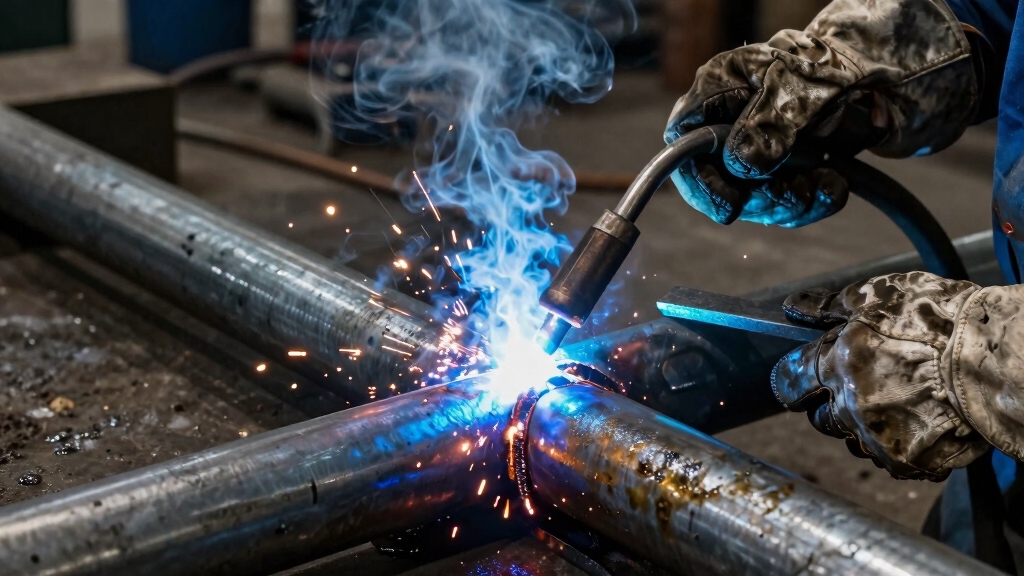
When you perform pipe welding, you create precise, leak-proof joints on curved surfaces that withstand high pressure.
You’ll need strict alignment and multi-pass techniques: root, hot, filler, and cap to guarantee strength and integrity.
Common methods include SMAW, MIG, TIG, and FCAW, each suited for specific materials and positions like 6G.
Proper pipe preparation through cleaning and beveling is essential. To fully master pipe welding, understanding its methods, positions, and applications is key.
While regular welding often involves flat or simple joint surfaces, pipe welding demands precise control over curved surfaces to guarantee leak-proof, high-pressure joints.
Pipe welding requires exact control of curved surfaces to ensure strong, leak-proof, high-pressure joints.
You must manage complex geometries and maintain consistent weld bead profiles around the circumference. Unlike flat plate welding, pipe welding requires strict alignment and fit-up to prevent defects that compromise sealing.
You’ll address challenges like variable wall thickness and limited access, especially in confined spaces. Additionally, pipe welding uses sequential passes: root, hot, filler, and cap to build a robust joint capable of sustaining high volumes of fluids or gases under pressure.
Mastering pipe welding means understanding the nuances of position-specific techniques and ensuring each weld pass meets stringent quality standards to prevent leaks and structural failure in critical piping systems.
Controlling heat input and cooling rates is essential in pipe welding to maintain weld integrity and minimize distortion.
Explore the key welding methods that guarantee strong, reliable pipe joints under demanding conditions.
You’ll often rely on Shielded Metal Arc Welding (SMAW) for its versatility and effectiveness on thick, hard-to-reach pipes, especially in outdoor environments.
Gas Metal Arc Welding (MIG) offers high deposition rates and speed, ideal for mild steel and aluminum pipes.
For precision on thin-walled or stainless steel pipes, Gas Tungsten Arc Welding (TIG) provides clean, controlled welds with excellent quality.
Submerged Arc Welding (SAW) suits high-volume, carbon or alloy steel pipelines, delivering deep penetration and efficiency.
Ultimately, Flux-Cored Arc Welding (FCAW) combines portability with high productivity, perfect for outdoor or field applications.
Selecting the appropriate process depends on pipe material, thickness, and environmental factors to guarantee weld integrity.
MIG welding’s high travel speeds and productivity can significantly reduce cycle times in pipe welding operations.
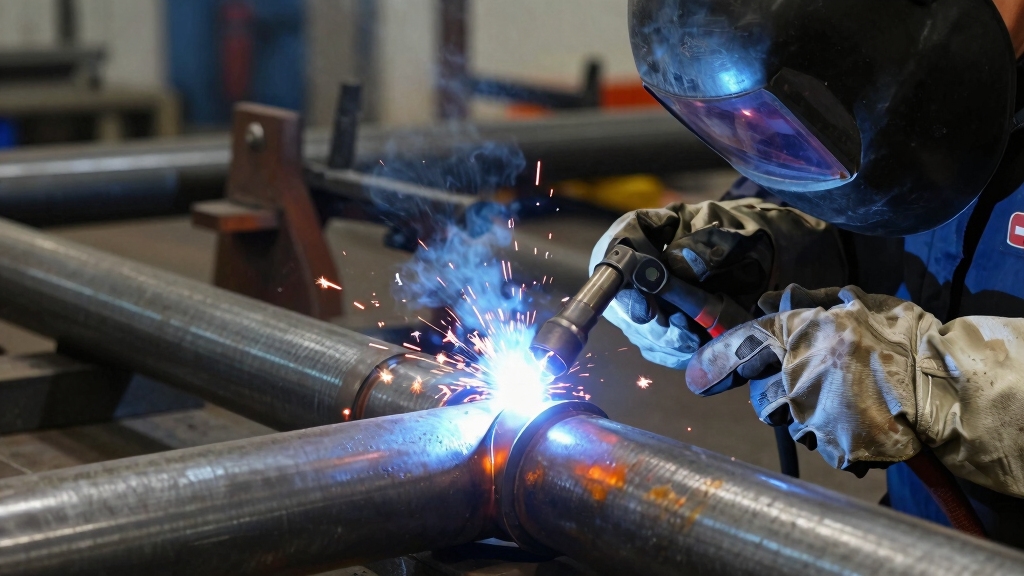
Having selected the appropriate welding method based on pipe material and environment, you must also master the specific positions and techniques required for pipe welding.
These positions make certain strong, precise joints on curved surfaces under various constraints.
Key pipe welding positions and techniques include:
Mastering these positions and techniques guarantees durable, leak-proof joints essential for high-pressure pipelines. Proper selection of welding methods and parameters is critical to minimize distortion and ensure joint integrity.
Before you begin welding, you must thoroughly prepare the pipes to guarantee a strong, defect-free joint.
Start by cleaning pipe surfaces meticulously to remove rust, oil, dirt, and other contaminants that could compromise weld integrity.
Begin with thorough cleaning of pipe surfaces to eliminate rust, oil, dirt, and contaminants that weaken weld quality.
Next, precisely machine or bevel pipe edges to secure proper fit-up and alignment, critical for consistent root penetration.
Position the pipes considering diameter, wall thickness, and material properties to avoid misalignment under heat.
Use tack welds strategically to secure parts temporarily, enabling adjustments before final welding.
Throughout preparation, verify dimensional accuracy and maintain cleanliness to prevent slag inclusion or porosity.
Proper preparation minimizes defects and guarantees optimal fusion during welding passes, ultimately achieving durable, leak-proof joints capable of withstanding operational stresses in demanding pipe systems.
When welding galvanized pipes, it is essential to control zinc fume hazards by removing zinc coating from the weld area to reduce porosity and protect welder health.
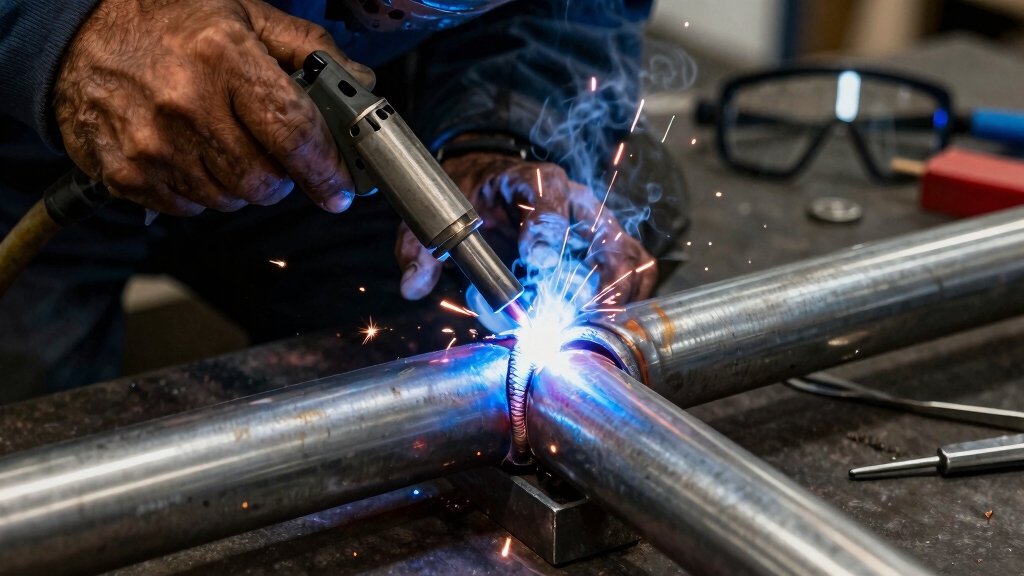
When working with pipe welding, you’ll often encounter a range of materials such as carbon steel, stainless steel, cast iron, and aluminum. Each is selected based on the application’s specific requirements.
Your choice depends on factors like corrosion resistance, strength, and thermal properties.
Typical applications include:
Success in pipe welding also depends on mastering welding techniques such as GTAW and GMAW to ensure strong, reliable joints.
Environmental factors like wind, moisture, and temperature directly affect your pipe welding quality by causing weld contamination, porosity, and cracking.
Wind can blow shielding gas away, leading to oxidation.
Moisture promotes hydrogen-induced cracking and weld defects.
Cold temperatures affect metal flow and cooling rates, increasing brittleness. You must control these conditions.
Use windshields, dry surfaces, and preheat pipes to guarantee consistent, strong, and defect-free welds that meet high-pressure and safety standards.
Wondering how to stay safe during pipe welding? You must wear proper PPE like flame-resistant clothing, welding helmets with correct filter lenses, gloves, and steel-toed boots.
Make certain good ventilation to avoid toxic fumes and gases. Always check equipment for defects and ground it properly.
Keep fire extinguishers nearby and clear flammable materials. Follow strict lockout/tagout procedures to prevent accidental energizing.
These precautions protect you from burns, electric shock, and inhalation hazards.
You inspect pipe welding for defects using visual inspection to spot surface flaws like cracks or porosity.
Then, employ non-destructive testing methods such as radiographic testing (RT) to detect internal discontinuities and ultrasonic testing (UT) for precise thickness and flaw evaluation.
Magnetic particle testing (MT) and dye penetrant testing (PT) help reveal surface and near-surface defects.
Always verify welds meet code standards and perform post-weld inspections meticulously.
You’ll need certifications like the Certified Welder (CW) from the American Welding Society (AWS) or API 1104 for pipeline welding.
Depending on your region and industry, ASME Section IX qualification is essential for pressure vessel and piping welds.
Employers also expect proficiency in specific welding processes, so get endorsements in SMAW, GTAW, or FCAW.
Continuous recertification guarantees your skills meet evolving codes and standards for safety and quality.
You can reduce pipeline maintenance costs by up to 40% with proper pipe welding.
High-quality welds guarantee leak-proof joints that withstand pressure and corrosion, minimizing repairs and downtime.
Precise welding techniques like TIG and SMAW improve joint integrity, extending pipeline lifespan.
When you invest in skilled welding and thorough inspections, you prevent failures, avoid costly emergency fixes, and optimize your maintenance budget effectively.
Now that you’ve navigated the nuances of pipe welding, you understand its distinct demands and dynamic methods.
By mastering meticulous preparation, precise positioning, and proven processes, you’ll produce powerful, professional welds that withstand pressure and time.
Whether working with steel, stainless, or specialty materials, your skills will secure strong seams in critical applications.
Stay sharp, stay steady, and let your craftsmanship carve confident connections in every challenging pipe project.