Phone:
(701)814-6992
Physical address:
6296 Donnelly Plaza
Ratkeville, Bahamas.

Phone:
(701)814-6992
Physical address:
6296 Donnelly Plaza
Ratkeville, Bahamas.

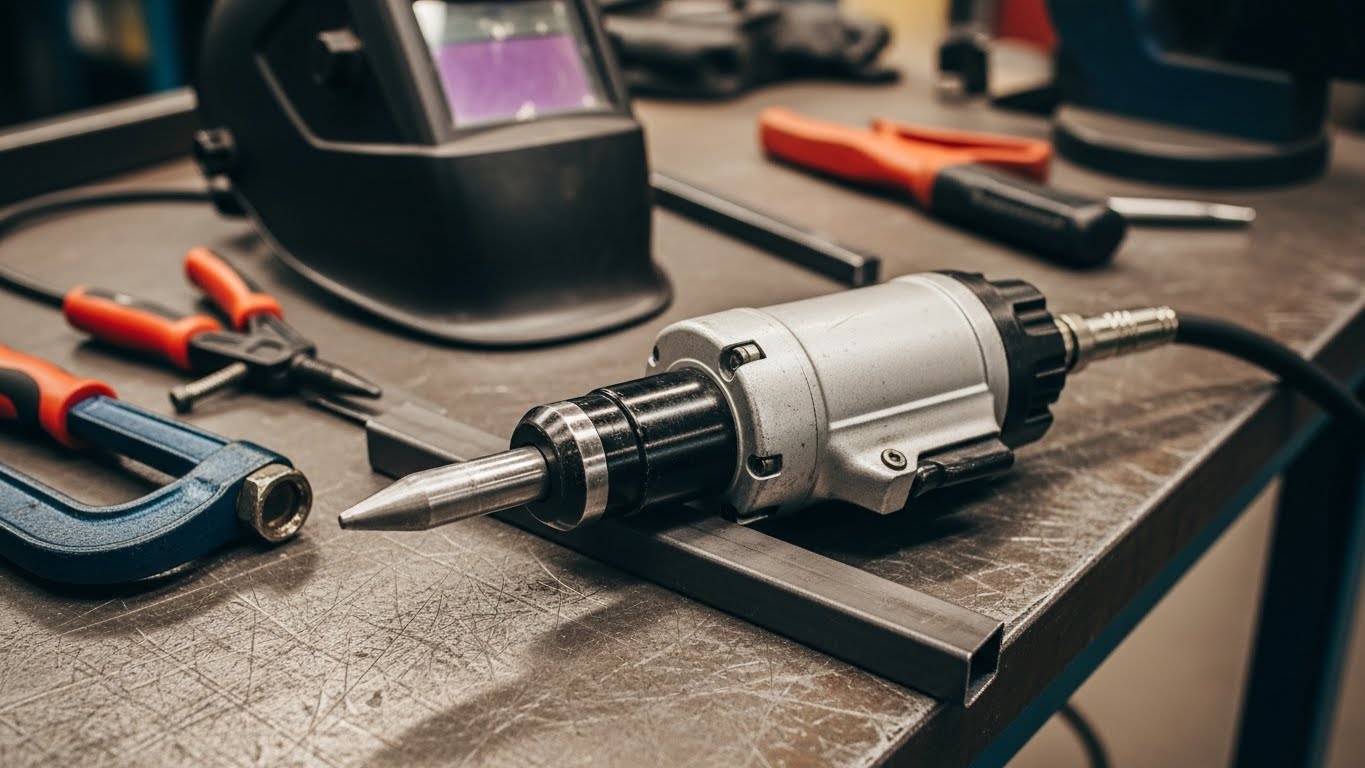
You use air hammers in welding primarily to remove slag and clean up welds efficiently without overheating metal.
They help prepare precise joint bevels and surface finish for strong weld penetration. You can also separate spot welds, remove rivets and fasteners, and shape or peen metal to relieve stress and improve fatigue resistance.
Air hammers speed fabrication and repair while protecting weld integrity. Understanding their full versatility reveals advanced tasks like salvage and metal contour restoration.
When you finish a stick (SMAW) or flux-cored weld pass, you need to remove the flux slag promptly to expose clean weld metal for inspection and subsequent passes.
Using a pneumatic air chipping hammer delivers controlled impacts that fracture and lift slag efficiently without overheating the weld. Wearing heat-resistant gloves during this process protects your hands from sparks and high temperatures.
Pneumatic air chipping hammers efficiently remove slag with controlled impacts, preventing weld overheating.
Timing is critical; you want to chip slag after adequate cooling to prevent distortion but before contaminants set permanently.
After chipping, use a wire brush to scrub away residual slag and check for inclusions requiring grinding. This step is essential because surface contamination can cause porosity and lack of penetration in subsequent weld passes.
Thorough slag removal reduces the risk of inclusions, improving fusion and mechanical integrity of following passes.
Air hammers speed this process notably, especially on large or repetitive welds, ensuring consistent weld quality and reducing cycle time in production environments.
When it comes to edge preparation, you really want to focus on efficiency. Clean and precise bevels are essential because they promote strong weld penetration. Plus, if your spot welds are properly spaced, they’ll help keep everything aligned and prevent any defects during fit-up. Using the right tools and techniques is key here.
It really sets the foundation for reliable, high-quality welds. Proper surface preparation also reduces the risk of porosity and cracking in the final joint. So, take your time with this step—it’s worth it in the long run! Bevel edges for thicker metals to ensure proper weld penetration and fusion, which is critical for joint strength bevel edges.
Efficient edge preparation sets the foundation for consistent weld quality and minimizes rework during joint fit-up. You need to maintain precise bevel angles and root face dimensions to control penetration and fusion. For example, a single V joint with an included angle of 60° and a root face ≤2 mm is commonly used for thicknesses greater than 3 mm to ensure proper weld quality.
Surface cleanliness is critical; removing contaminants prevents porosity and corrosion issues. Dimensional fit-up, including root gap and alignment, ensures proper joint geometry, reducing distortion and residual stress. Using plasma cutting for edge preparation can speed up the beveling process and produce clean edges with minimal thermal distortion.
Using mechanized edge preparation methods like CNC machining or beveling machines boosts time and labor effectiveness, especially in high-volume production.
| Factor | Key Consideration | Effect on Welding |
|---|---|---|
| Bevel Geometry | Consistent angle and root face | Predictable fusion and strength |
| Surface Cleanliness | Remove oils, rust, oxides | Prevents defects and porosity |
| Gap Control | Root gap ≤2–4 mm | Ensures penetration, reduces rework |
| Mechanization | CNC, plasma cutting | Speeds prep, may need finishing |
| Inspection | Visual and dimensional checks | Minimizes fit-up errors |
Breaking apart spot-welded panels requires careful preparation to avoid damaging the metal and guarantee clean joint edges.
You start by drilling a pilot hole with a 1/8-inch bit, then enlarge it to a half-inch, weakening the weld without penetrating the first layer. Proper tool selection and controlled force application are essential to prevent sudden metal shattering during separation.
Next, cut a slot across the weld center for air hammer access. Use a flathead screwdriver to test prying before applying the air hammer.
When separating, insert the chisel attachment between panels and bend them apart, applying force precisely to reveal clean separation lines. The Super SeamBuster attachment simplifies this process, especially in tight spots. Using an air file sander beforehand can help smooth rough edges and remove excess weld material, facilitating easier panel separation with the air hammer industrial and commercial metalworking.
Restoring weld contours can be done quite effectively with air hammers. These tools are great for reshaping distorted metal and smoothing out any irregularities. Plus, they play a significant role in relieving residual stresses by peening welds.
This peening process helps reduce the risks of cracking and distortion, which is always a bonus. After initial welding and grinding, using an air hammer with plastic dies can prevent marking the metal surface during reshaping. Employing proper heat input management during welding also minimizes the extent of distortion that needs correction.
Now, when it comes to precision, controlling the blow force and selecting the right die is crucial. This ensures that the forming process is precise while still keeping the integrity of the material intact. So, whether you’re a seasoned pro or just getting started, understanding how to use these tools effectively can really make a difference in your welding projects.
Mastering weld contour restoration requires precise metal shaping, forming, and peening techniques that adapt weld profiles to their original geometry.
Using an air hammer, you can rapidly contour weld seams by delivering controlled blows to raise or sink metal, matching complex shapes difficult to achieve manually. The planishing hammer is especially useful for working on smaller areas and shaping scoops faster than hand pneumatic hammers. Consistent application of heat and pressure can also help in achieving a better metal fit during shaping, which complements mechanical methods.
You’ll smooth excess weld bead and blend transitions to parent metal with minimal grinding, preserving base material.
Peening lets you cold-work weld crowns, improving hardness and refining micro-contours before finishing. Proper metal shaping techniques ensure that the material maintains its integrity throughout the peening process.
Although welding inherently generates tensile residual stresses that can compromise fatigue resistance, you can effectively relieve these stresses through mechanical means such as hammer peening and controlled metal shaping.
Using pneumatic air hammers, repeated localized impacts plastically deform the weld toe, producing a compressive surface layer that counteracts tensile stresses and improves fatigue life.
By adjusting impact frequency, tool-end shape, and pass count, typically around four passes, you control compressive stress depth and magnitude without damaging the surface.
Additionally, controlled air-hammer shaping corrects post-weld distortions by applying incremental plastic deformation, targeting metal near welds while preserving geometry.
This mechanical approach offers localized residual stress relief without the metallurgical changes of thermal methods, making it practical for medium-gauge components where heat treatment isn’t feasible.
Just avoid over-peening, which can introduce defects and negate benefits. The technique benefits from all-position capability, allowing effective treatment regardless of weld orientation.
Removing rivets, bolts, and fasteners during repair requires precise technique and the right tools to avoid damaging surrounding materials. Air hammers excel here by swiftly shearing off rivet heads and driving out shanks without enlarging holes. Using mechanical removal methods like air hammers helps control surface damage while efficiently removing fasteners.
You’ll need a compressor (3hp, 30gal recommended) and a rivet chisel bit sized for the fastener. Blind rivets, for example, can be particularly suited to removal with access from one side only, making air hammers useful in limited-access areas as well. Follow these steps for effective removal:
This method outperforms drilling or grinding in speed and preserves adjacent material, ideal for frame and chassis repairs. Additionally, wearing safety equipment such as safety glasses and gloves is important to protect against flying debris during the process.
Air hammers frequently play a crucial role in preparing surfaces before welding and coating by efficiently removing contaminants like grease, rust, and old coatings. Their use also helps reduce the generation of hazardous fumes by minimizing grinding and sanding on zinc-plated surfaces, which is crucial for respiratory protection.
You’ll find them invaluable for chipping away slag, oxidation, and persistent debris that hinder weld integrity.
Before welding, air hammers clear back weld roots exposed to oxidation, ensuring clean, defect-free joint preparation.
When stripping paints or galvanized layers, they offer a powered alternative to manual brushing or grinding, reducing risks like zinc inclusion in welds.
Using sprung steel wire attachments, you can achieve a precise SA2.5 surface finish ideal for adhesion without heavy grinding.
Their low vibration and high-impact action accelerate cleaning on large surfaces, enhancing weld quality by preventing cracking and spalling through thorough pre-weld surface conditioning.
Routine inspections and maintenance are essential to detect and address surface contamination early, ensuring optimal welding conditions and preventing corrosion at critical points surface maintenance.
You can gear up your welding shop with a variety of air hammer accessories that expand its functionality beyond basic cleaning.
These tools enable precise metal shaping, efficient automotive repairs, and detailed finishing tasks. Depending on your needs, you can switch bits to optimize performance and improve workflow.
Switching bits lets you maximize precision and efficiency across metal shaping, automotive repairs, and finishing tasks.
With quick-release shanks and varied bit types, you adapt instantly to diverse welding applications.
When tackling salvage and demolition of welded structures, understanding how air hammers deliver focused pneumatic impacts is essential.
You use them to fracture welded joints, shear plates, and break bolt heads by directing chisel impacts that separate joined members efficiently.
Air hammers excel in removing fatigued or heat-weakened weld zones and breaking concrete encasements around embedded steel. Operators must also be aware of thermal hazards caused by residual heat in welded areas during demolition.
For rapid bulk dismantling, high-impact pneumatic breakers provide continuous, powerful blows that outperform manual cutting in speed and throughput.
When selective removal is needed, narrow-bit air hammers let you detach attachments without damaging main members, preserving salvageable components.
Integrating air hammers with other demolition tools maximizes efficiency, but you must manage compressed-air supply and wear proper PPE to mitigate noise, vibration, and debris hazards during welded-structure demolition.
In many cases, pneumatic breakers serve as essential hand tools in piecemeal demolition methods for reinforced concrete and steel components.
You won’t find a real difference between air hammers and pneumatic hammers in welding since both use compressed air to deliver rapid, piston-driven blows.
You’ll notice they share functions like chipping welds, removing slag, and cutting spot welds. The terms are interchangeable, so whether you call it an air hammer or pneumatic hammer, you’re using the same tool types with similar attachments tailored for tasks like weld smoothing and spatter removal.
You need face protection that’s more than a shield; wear an auto-darkening welding helmet with safety goggles underneath for flying debris.
Don’t forget heat-resistant and anti-vibration gloves to protect your hands and reduce fatigue.
Use flame-resistant clothing with close-fitting cuffs to prevent snagging.
Respirators guard against dust and fumes, while hearing protection is essential against loud noise.
Finally, wear a hard hat in overhead work to guard from falling debris.
You shouldn’t use air hammers on non-metal materials during welding prep because they’re designed specifically for metal tasks.
The pneumatic force can easily crack or shatter brittle plastics or composites.
Their tooling and custom bits suit ferrous and non-ferrous metals, not delicate non-metal surfaces.
To work safely and effectively, stick to metals when using air hammers and avoid applying them to non-metal materials in any welding preparation.
Don’t cut corners when maintaining your air hammer. You need to keep the air supply clean and lubricated, using an inline lubricator and draining moisture traps daily.
Regularly inspect and replace worn chisels, retainers, and internal parts per manufacturer guidelines. Schedule periodic disassembly for thorough cleaning and component checks.
Also, avoid overloading the tool and use proper bits and retention methods to extend its service life and maintain peak performance.
Air pressure directly impacts your air hammer’s impact energy and cycle rate. Higher pressure boosts piston force, improving cutting speed and material removal, but excessive PSI risks tool damage and over-driving.
Low pressure causes stalling and weak strikes, slowing work. To maximize performance and tool life, maintain recommended PSI (typically around 90 psi), use pressure regulators for control, and guarantee proper lubrication to prevent wear and inconsistent operation.
When you wield an air hammer in welding, you’re not just handling a tool. You’re commanding precision and power to shape, clean, and restore metal with surgical accuracy.
It’s your versatile ally, breaking through welds, preparing surfaces, and reshaping metal like a sculptor’s chisel. In the hands of a skilled welder, the air hammer is the heartbeat of efficiency. It transforms tough tasks into seamless craftsmanship, ensuring every weld stands strong and true.