Phone:
(701)814-6992
Physical address:
6296 Donnelly Plaza
Ratkeville, Bahamas.

Phone:
(701)814-6992
Physical address:
6296 Donnelly Plaza
Ratkeville, Bahamas.

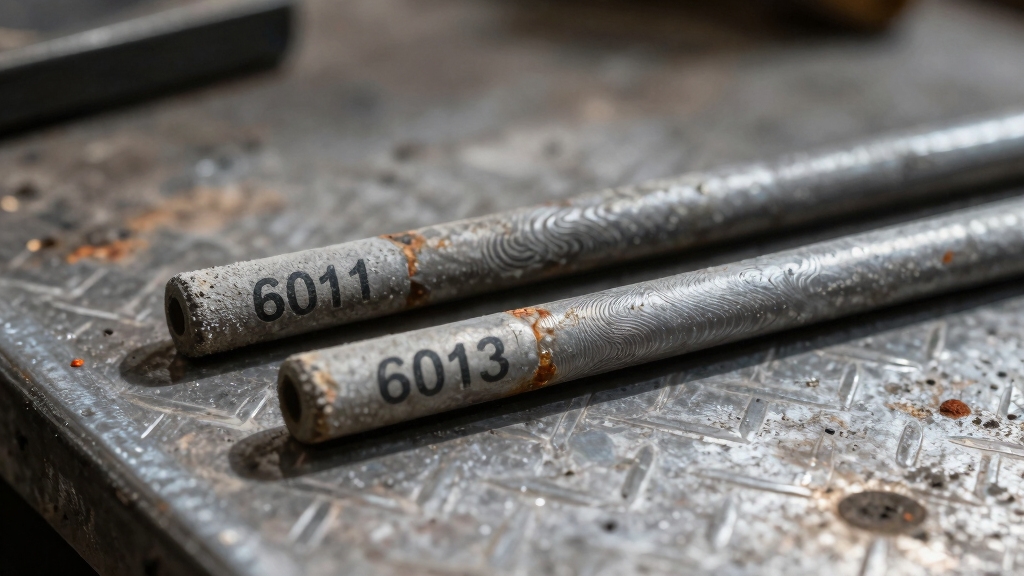
You’ll choose 6011 rods for deep penetration and strong welds on thicker or rusted materials. They are ideal for structural and pipe applications.
They require skill, produce an aggressive arc, and work best on AC power. In contrast, 6013 rods offer easier arc control and smoother beads. They are better suited for thinner steel or beginners.
6013 rods create moderate strength welds with cleaner slag and stable arcs on AC or DC. Understanding these differences boosts your welding precision and project outcomes.
When choosing between 6011 and 6013 welding rods, understanding their penetration capabilities is essential.
You’ll find that 6011 rods deliver markedly deeper penetration into the base metal, melting more of the plate during welding. This characteristic makes 6011 ideal when you need to join thicker or rusted materials.
In contrast, 6013 rods provide mild, shallow penetration, which leaves much of the base metal’s edge intact. Testing on a 3/8″ plate demonstrated that 6011 melted most of the plate edge, while 6013 maintained the original edge with minimal melt-through.
This difference impacts joint integrity and weld strength potential. Consequently, if your project demands aggressive penetration, 6011 rods outperform 6013, which are better suited for applications requiring controlled, less invasive welds.
Additionally, 6011 electrodes feature a cellulose-based flux that produces a forceful spray-type arc and chemical cleaning action, enhancing their ability to weld through rust and contaminants.
The deeper penetration achieved by 6011 welding rods directly contributes to their superior weld strength compared to 6013.
When you use 6011 rods, the weld fuses deeply into the base metal, anchoring it firmly and increasing mechanical durability.
This deeper fusion results in welds that require more force to break, making 6011 ideal for structural applications.
| Attribute | 6011 Welding Rod | 6013 Welding Rod |
|---|---|---|
| Penetration Depth | Deep, cuts through rust | Shallow, mild |
| Mechanical Strength | High, strong welds | Moderate, more ductile |
| Weld Appearance | Lumpy, uneven beads | Smooth, aesthetic |
Using 6011 rods guarantees welds that withstand higher stresses due to their aggressive arc and deeper metal melting. However, it is important to consider proper electrode storage to maintain rod integrity and prevent moisture-related weld defects.
When it comes to welding, 6013 rods are often recommended for beginners, and it’s easy to see why. First off, they make it pretty straightforward to strike an arc. This means you can get started without too much fuss, which is always a plus when you’re just learning the ropes.
Once you’ve got that arc going, you’ll notice that the weld pool is more stable. This really helps with control, making it easier for you to focus on getting those steady welds down. It’s all about building your confidence, right?
Now, let’s talk about the slag. With 6013 rods, the slag forms a nice, consistent coating. What’s great is that it’s manageable and can be removed without too much hassle, so you won’t have to worry about disturbing the bead you just laid down. This simplicity really cuts down on the complexity of the process, making it a lot less intimidating for those just starting out.
Also, using the right filler materials like 6013 rods ensures better arc stability and reduces spatter, which is helpful for beginners to achieve cleaner welds.
Mastering arc striking can pose challenges, but 6013 welding rods simplify this crucial step for beginners.
You’ll find 6013 rods require less amperage precision and produce a stable arc initiation. This reduces the risk of sticking or erratic strikes. Their fast-freeze coating facilitates immediate solidification of the weld puddle, allowing you to maintain steady control right from the start.
In contrast, 6011 rods demand greater skill to initiate and sustain the arc due to their aggressive, deep-penetrating characteristics. This can cause frequent arc outages or rod sticking if mishandled.
Beginners should also be mindful of heat input management to avoid defects and distortion during welding.
Building on easier arc striking, 6013 welding rods offer a remarkably stable weld pool that simplifies control during welding.
You’ll find the molten metal behaves predictably, allowing you to maintain a consistent bead without sudden fluid shifts typical of more aggressive rods like 6011.
This stability results from the rod’s fast-freeze characteristics, which solidify the weld pool swiftly and reduce spatter.
Because the pool is larger and more manageable, you can better regulate heat input and travel speed, preventing common beginner errors such as burn-through or uneven bead formation.
The improved control fosters smoother, more aesthetically pleasing welds, making 6013 ideal for novices developing steady hand coordination and arc manipulation skills.
In contrast, rods with deeper penetration demand advanced technique to handle their less stable pools effectively.
Additionally, using the correct polarity and heat input is crucial for optimizing weld pool stability and bead quality with 6013 rods.
Frequently, the ease of slag removal markedly influences welding efficiency and weld quality, especially for beginners.
6013 welding rods generate a larger weld pool with more controllable, iron-pound slag that peels away cleanly and predictably.
When you use 6013 rods, you’ll find slag detachment straightforward, minimizing post-weld cleanup time and reducing the risk of slag inclusions.
In contrast, 6011 rods produce less slag that can adhere unevenly, complicating removal and increasing the likelihood of defects.
This predictable slag behavior with 6013 enhances visual inspection and supports consistent bead quality.
For novices, manageable slag removal not only improves workflow but also reinforces proper technique by allowing focus on weld pool control rather than slag interference.
This makes 6013 rods distinctly more user-friendly in practical welding scenarios.
Additionally, understanding the role of welding quality control helps ensure that slag removal contributes to durable, defect-free joints.
When you use 6013 welding rods, you’ll notice something pretty cool: they give you excellent arc control. This means you can keep a stable welding arc while you’re working, which is super helpful. With that kind of control, it’s way easier to create smoother beads. You’ll see consistent scalloping and much better fusion between passes.
Because of this, the welds turn out looking really clean. They actually blend into the base metal surface in a way that just makes everything look more polished and professional. It’s definitely a noticeable difference! Additionally, 6013 rods typically use DCEN polarity, which helps reduce heat input and minimizes warping on thinner materials.
Although 6011 rods offer deeper penetration, 6013 welding rods give you superior arc control, making it easier to maintain a stable arc throughout the weld.
This enhanced control comes from the 6013’s fast-freeze characteristic and iron powder coating, which moderates the arc’s aggressiveness.
You’ll find it simpler to strike and sustain the arc consistently, reducing spatter and minimizing bead irregularities.
Compared to 6011’s aggressive arc requiring higher skill, 6013’s smooth arc response enables more precise manipulation and steadier travel speed.
This stability helps you avoid common issues like arc wandering or burn-through, especially on thinner materials.
Consequently, 6013 rods provide a more manageable welding experience, allowing you to focus on bead placement and quality without constantly adjusting for arc fluctuations.
Additionally, the ease of use associated with 6013 rods makes them ideal for welders seeking consistent quality with less technical complexity.
When you lay down a bead with 6013 welding rods, you’ll notice a consistently smoother and more visually appealing finish compared to 6011. This improvement stems from 6013’s controlled arc and slag characteristics, allowing better fusion and blending across passes.
The bead exhibits superior scalloping and a larger weld pool, which enhances overall aesthetics. In contrast, 6011 beads tend to appear segmented with uneven contours.
Key reasons for 6013’s bead appearance benefits include:
These factors make 6013 rods ideal for applications where bead appearance and surface quality matter. Proper surface preparation and cleaning also contribute significantly to achieving this consistent bead quality.
Since 6011 welding rods deliver deeper penetration and considerably greater mechanical strength, they’re ideal for structural and pipe welding where weld integrity is critical.
You’ll use 6011 rods when working on thicker materials or joints requiring robust root penetration, such as grooved pipe welds or heavy structural steel frames.
Their aggressive arc effectively melts through surface contaminants and rust, guaranteeing a sound fusion with the base metal.
While 6011 demands more skill to control due to its forceful arc and produces less visually smooth beads, its superior mechanical strength and weld durability outweigh aesthetic concerns in these applications.
Choosing 6011 rods guarantees welds can withstand significant mechanical stress, making them indispensable for load-bearing structures and pressure-retaining pipe systems where failure isn’t an option.
Additionally, using an inverter welding machine can enhance arc stability and current control when welding with 6011 rods, improving the overall weld quality.
You’ll find that 6013 welding rods reduce the risk of burn-through on thin steel compared to 6011 electrodes.
This safety advantage arises because 6013 rods deliver mild penetration, preventing excessive melting of the base metal.
When working with thin materials, controlling heat input is vital, and 6013 rods excel in this aspect.
Here’s why 6013 rods are safer for thin steel:
Balancing the strengths of 6011 and 6013 welding rods can maximize weld quality and efficiency across varying material thicknesses.
Start by using 6011 rods for root passes on thicker or rusted metal to assure deep penetration and strong weld anchoring.
Then switch to 6013 rods for fill and cap passes to achieve smoother, visually appealing beads with controlled slag and less burn-through risk on thinner sections.
| Welding Stage | Recommended Rod | Purpose |
|---|---|---|
| Root Pass | 6011 | Deep penetration, strong hold |
| Fill Pass | 6013 | Smooth bead, controlled slag |
| Cap Pass | 6013 | Aesthetic finish, less spatter |
| Thin Material | 6013 | Minimize burn-through risk |
| Thick Material | 6011 | Structural strength |
This combination leverages 6011’s mechanical strength and 6013’s arc control for peak results.
Anyone selecting welding rods must consider power source compatibility to guarantee peak performance.
For 6011 rods, you’ll want an AC power source, although they also operate on DC. The alternating current enhances the aggressive arc, promoting deep penetration and strong welds on thicker materials.
Meanwhile, 6013 rods perform well on both AC and DC power sources, offering versatility and easier arc control for general fabrication.
Here’s what to keep in mind:
Choosing the right power source guarantees you maximize each rod’s performance efficiently.
Understanding the power source compatibility helps set the stage for selecting the appropriate welding rod for your project.
You’ll want to evaluate material thickness, desired weld appearance, and penetration needs carefully. Use 6011 for thick, rusted, or painted metals requiring deep penetration and structural strength.
Opt for 6013 when welding thinner materials or seeking smoother, visually appealing welds with easier arc control.
| Factor | 6011 | 6013 |
|---|---|---|
| Penetration | Deep, aggressive | Mild, shallow |
| Material Suitability | Thick, structural | Thin, general fabrication |
| Weld Appearance | Rough, multi-pass visible | Smooth, consistent bead |
You’ll find that 6013 rods produce a larger welding pool with more controllable slag, making slag removal smoother and more manageable.
In contrast, 6011 rods create less slag overall, which simplifies cleanup but can be tougher to chip off due to its smaller, denser deposits.
You need to store both 6011 and 6013 rods in dry, moisture-free environments to prevent rust and hydrogen-induced cracking.
You should keep them sealed in airtight containers or rod ovens with temperatures around 250°F to maintain low moisture levels.
You must handle them carefully to avoid chipping the flux coating.
Consistent storage conditions guarantee peak arc stability and weld quality, no matter which rod you choose to work with.
You can use 6011 rods underwater and in harsh environments, as their deep penetration and aggressive arc handle damp conditions effectively.
However, 6013 rods aren’t ideal underwater due to their mild penetration and slag characteristics.
For harsh environments, 6011’s strength and durability outperform 6013, especially on thicker materials.
Keep in mind, 6011 requires skill to maintain weld quality under these conditions, while 6013 suits controlled, less demanding settings better.
You’ll find 6011 rods excel on rusty or dirty metal surfaces because they deliver deeper penetration, effectively melting through contaminants and providing strong welds.
In contrast, 6013 rods offer mild penetration, struggling to cut through rust or scale.
So, if you need reliable performance on imperfect surfaces, 6011 is your best choice.
However, 6013 is better suited for cleaner metals where smoother welds and easier control matter more.
You should always wear a welding helmet with a shade of 10-14 to protect your eyes from intense UV and infrared rays.
Especially since 6011 rods produce a more aggressive arc. Use flame-resistant gloves, heavy-duty long sleeves, and a respirator rated for fumes.
This is important because 6011 generates more smoke and spatter. For 6013, the arc is milder, but you still need the same protective gear.
Focus on comfort during longer welds and minimizing inhalation of iron oxide fumes.
So, if you want a weld that digs deep like a determined mole, grab the 6011. But if you prefer your beads smoother than a jazz sax solo and your welding journey less “trial by fire,” 6013’s your buddy.
Just don’t confuse the two unless you enjoy welding adventures that test both your patience and your PPE. Choose wisely, or prepare for a metal symphony of sparks and sweat.