Phone:
(701)814-6992
Physical address:
6296 Donnelly Plaza
Ratkeville, Bahamas.

Phone:
(701)814-6992
Physical address:
6296 Donnelly Plaza
Ratkeville, Bahamas.

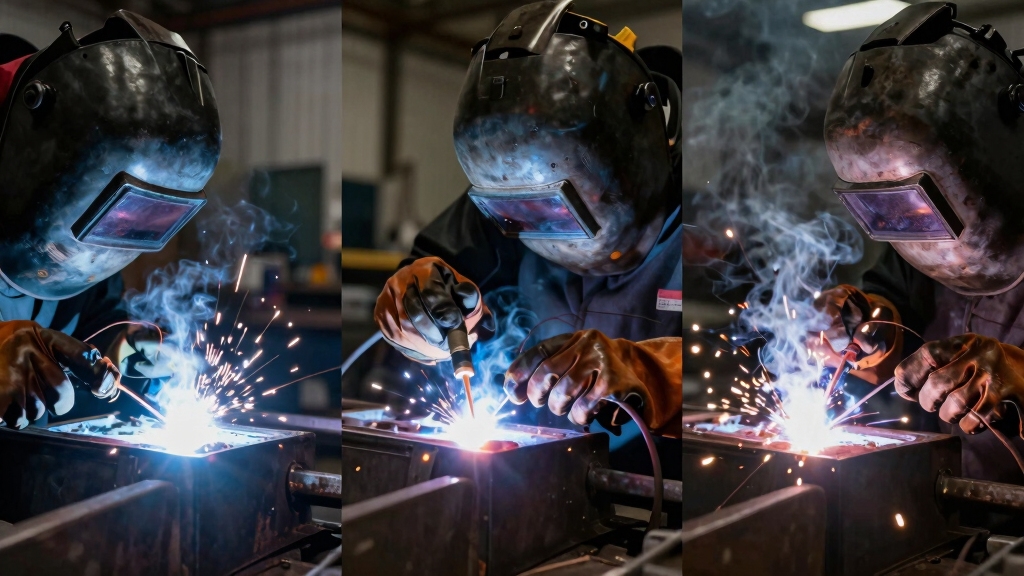
You’ll find MIG welding offers fast, clean welds using a continuously fed wire and external gas, ideal for moderate to thick metals in controlled settings.
TIG delivers the highest precision with a non-consumable tungsten electrode and clean gas shielding, perfect for thin metals and critical finishes though it demands more skill and slower speed.
Stick welding uses flux-coated electrodes for tough, outdoor conditions but leaves slag to clean. Understanding these trade-offs can help you select the best method for your needs.
| Feature | MIG Welding (GMAW) | TIG Welding (GTAW) | Stick Welding (SMAW) |
|---|---|---|---|
| Electrode Type | Consumable continuous wire | Non-consumable tungsten electrode | Consumable flux-coated rod |
| Filler Material | Automatically fed wire | Manually fed filler rod | Electrode acts as filler |
| Shielding Method | External inert gas (argon / argon-CO₂ mix) | External inert gas (argon) | Flux coating creates shielding gas + slag |
| Ease of Learning | Easiest (point-and-shoot) | Most difficult (high precision required) | Moderate (arc control needed) |
| Speed & Deposition Rate | Fastest | Slowest | Moderate |
| Weld Appearance | Clean, smooth, minimal spatter | Highest precision, smoothest finish | Rougher bead, slag residue |
| Slag Production | None | None | Yes (requires cleanup) |
| Outdoor Performance | Poor (wind affects shielding gas) | Very poor (gas sensitive) | Excellent (flux resists wind) |
| Material Suitability | Steel, stainless, aluminum | Thin metals, stainless, aluminum | Mild steel, cast iron, rusty metals |
| Surface Cleanliness Required | Moderately clean | Immaculately clean | Can tolerate dirty/rusted surfaces |
| Equipment Cost | Moderate to high | Highest | Lowest |
| Setup Complexity | Moderate | Complex | Simple |
| Best For | High-volume production work | Precision, thin materials, critical finish | Outdoor, heavy-duty, fieldwork |
| Skill Development Time | 1–2 weeks basic proficiency | 30–100+ hours practice | Moderate training required |
| Strength & Durability | Strong, consistent welds | Highest strength & precision | Strong but may contain inclusions |
When you break down the differences among MIG, TIG, and Stick welding, the key distinctions lie in their electrodes, shielding methods, and operational complexities.
MIG welding uses a continuously fed consumable wire electrode, allowing for faster deposition and smoother operation.
MIG welding features a continuous consumable wire electrode for quicker, more efficient, and smoother welding performance.
TIG employs a non-consumable tungsten electrode, requiring you to manually feed a filler rod, demanding greater precision and control.
Stick welding utilizes a consumable flux-coated electrode that simultaneously provides filler and shielding through its flux, simplifying setup but producing slag requiring cleanup.
MIG and TIG generate cleaner welds without slag, while Stick leaves slag residue.
Each process shields the weld pool from atmospheric contamination, but you’ll notice operational complexity varies.
MIG is straightforward, TIG requires advanced skill, and Stick offers moderate difficulty due to arc maintenance and slag removal.
Additionally, MIG welding is favored for its high travel speeds and productivity, which can significantly increase throughput compared to other processes.
Several distinct shielding methods define how MIG, TIG, and Stick welding protect the weld pool from atmospheric contamination.
MIG and TIG use external inert gases like argon to prevent oxidation and nitrogen intrusion, enabling clean, continuous welds.
Stick welding relies on a flux coating that decomposes, releasing shielding gases and forming protective slag.
This flux tolerates dirtier surfaces and windy conditions better than gas shielding.
You must consider these differences when selecting a method for your environment and material.
Choosing the appropriate shielding gas, such as pure argon for aluminum or argon-CO2 blends for carbon steel, greatly influences weld quality and penetration control through gas mixtures.
| Welding Type | Shielding Method |
|---|---|
| MIG | External inert gas (argon) |
| TIG | External inert gas (argon) |
| Stick | Flux-coated electrode (slag) |
| Flux-Cored MIG | Flux within wire (slag + gas) |
Each method’s shielding directly impacts weld quality and suitability.
Diving into the cost and equipment requirements of MIG, TIG, and Stick welding reveals significant differences that influence your choice of method.
MIG welding demands a wire feeder, gas supply system, and a welding power source, elevating initial setup costs.
MIG welding requires a wire feeder, gas system, and power source, increasing initial setup expenses.
TIG welding involves a more sophisticated power source, high-quality gas regulators, and additional accessories like foot pedals, making it the priciest upfront.
Stick welding requires the simplest and most affordable equipment: a basic power source and consumable electrodes, making it cost-effective for entry-level or fieldwork.
While MIG and TIG depend on consistent shielding gas flow, increasing operational expenses, Stick welding’s flux-coated rods eliminate gas needs but add slag cleanup time.
Your selection hinges on balancing initial investment, operational costs, and application demands for efficiency and quality.
Additionally, understanding the differences between welding and fabrication can help optimize your metalworking projects by selecting appropriate processes and equipment.
Maximizing welding speed and deposition rates directly impacts your project efficiency and productivity.
When comparing MIG, TIG, and Stick welding, speed and deposition vary appreciably:
Choosing the fastest method depends on your material, environment, and production goals. MIG generally leads in speed and deposition. Properly optimizing voltage and wire speed can further enhance MIG welding efficiency by reducing spatter and improving weld consistency.
Speed and deposition rates matter, but mastering the welding process itself is just as important for consistent results.
MIG welding is the easiest to learn; once you set the parameters, you can mostly point and shoot.
You’ll typically grasp basic MIG techniques within one to two weeks, thanks to its automatic wire feed and stable arc.
Stick welding requires moderate skill. Its simpler setup than TIG helps, but you’ll need to maintain the arc manually and manage slag cleanup.
TIG welding demands the highest skill level. You must control the tungsten electrode, manually feed filler, and maintain precise arc stability.
TIG requires patience and fine motor skills, making it the most challenging for newcomers.
Your choice depends on how quickly you need proficiency versus your willingness to invest time in skill development.
Extensive training and practice, often exceeding 30 to 100 hours, are essential to develop proficiency and produce defect-free welds.
When it comes to welding, you’ll find that TIG welding truly stands out. It delivers a top-notch appearance with smooth, precise beads, making it perfect for those thin materials that need excellent penetration. If you’re working on something delicate, TIG is definitely the way to go.
Now, let’s talk about MIG welding. It strikes a nice balance, offering clean and strong welds with minimal spatter. This makes it a great choice for a variety of metals, including thin steel and aluminum. So, if you need versatility, MIG might just fit the bill!
On the other hand, we’ve stick welding. It’s quite robust, producing durable joints even when working with dirty or outdoor metals.
However, you should keep in mind that it does leave behind slag and spatter. This might affect the finish, and you’ll probably need to spend some time on cleanup afterward. So, while stick welding has its advantages, the finish might require a little extra effort.
Inverter welding machines enable precise current control that enhances weld quality across TIG, MIG, and stick processes.
The appearance and finish of a weld vary noticeably between MIG, TIG, and Stick welding due to their distinct processes and materials.
When you inspect these welds, consider these factors:
You’ll notice TIG excels in aesthetics, MIG balances speed and finish, and Stick favors versatility over appearance. Additionally, TIG welding uses a non-consumable tungsten electrode and inert gas shielding, which contributes to its clean and precise welds.
Although all three welding processes can produce structurally sound joints when executed correctly, TIG welding consistently delivers the highest quality welds characterized by precise, smooth beads and exceptional penetration, especially on thin materials.
You’ll find TIG welds exhibit superior fusion and minimal defects, resulting in enhanced durability and fatigue resistance. MIG welding also produces strong, reliable joints with good penetration, though slightly less precise, making it suitable for thicker materials where speed is essential.
Stick welding creates robust welds capable of withstanding harsh conditions but often has more inclusions and slag entrapment, slightly reducing long-term durability.
Ultimately, your choice affects weld integrity: TIG maximizes strength and longevity, MIG balances quality with productivity, and Stick prioritizes toughness under challenging environments.
TIG welding primarily uses DCEN polarity to concentrate heat on the workpiece, which supports deeper penetration and prolongs electrode life.
Understanding the strengths of each welding method naturally leads to evaluating their suitability for different materials and applications. You’ll find that:
Choosing the right process depends on your material type, condition, and positional requirements to optimize weld quality and efficiency.
For MIG welding on steel, using argon/CO2 mixtures significantly improves arc stability and penetration compared to pure argon, ensuring better weld quality.
MIG welding really shines when working with materials like steel, stainless steel, and aluminum, especially if you’re dealing with thin gauges.
Just remember, it’s important to keep those surfaces clean and free from any contaminants for the best results.
On the other hand, when it comes to TIG welding, it requires a bit more finesse.
You’ll want to use immaculate, rust-free metals like aluminum and stainless steel to achieve peak precision and top-notch weld quality.
Now, if you’re working in less controlled environments, stick welding might be your best bet.
It’s quite forgiving and can handle rougher, dirtier surfaces like mild steel and cast iron, making it perfect for outdoor jobs.
For stainless steel MIG welding, choosing the correct filler wire and maintaining proper shielding gas coverage are crucial for preventing contamination and ensuring corrosion resistance.
When selecting the ideal welding process for your project, the choice of metal greatly influences performance and weld quality. Each welding method suits specific metals based on compatibility and conditions.
MIG welding excels on mild steel, stainless steel, and aluminum (with spool gun), handling thicknesses down to 26 gauge efficiently.
TIG welding is best for thin, clean metals like aluminum and stainless steel, delivering precise, high-quality welds across all positions.
Stick welding is preferred for mild steel and cast iron, especially when metals are dirty or in outdoor environments due to flux shielding.
For harsh or windy conditions, Stick welding offers superior reliability compared to gas-shielded MIG and TIG processes.
Choose your welding technique with these metal-specific strengths in mind to guarantee excellent results.
Surface cleanliness plays a critical role in determining which welding process you should use. TIG welding demands the cleanest surface, free from rust, oil, or contaminants, to guarantee arc stability and quality. MIG requires a relatively clean surface but tolerates minor oxidation. Stick welding can handle dirtier, rusted, or painted metals due to its flux shielding.
| Welding Process | Surface Condition Requirement | Reason |
|---|---|---|
| TIG | Immaculately clean | Precise arc control, no contamination |
| MIG | Moderately clean | Shielding gas effectiveness |
| Stick | Tolerant of dirt/rust | Flux shields and slag protect weld pool |
Choose your welding method based on surface prep to optimize weld integrity and minimize defects.
Although welding positions directly influence technique and outcome, understanding how each process adapts to various orientations is essential for peak performance.
You’ll find that:
Select the method aligning with your positional requirements to optimize weld quality and efficiency.
Shielding effectiveness plays a critical role in selecting a welding method for outdoor and windy environments.
Stick welding outperforms MIG and TIG outdoors because its flux coating produces its own shielding gas and slag, resisting wind displacement.
MIG and TIG rely on external shielding gas, which wind can easily disperse, causing weld defects.
If you weld outdoors frequently, Stick is more reliable despite slag cleanup.
| Welding Method | Shielding Type | Wind Resistance | Setup Complexity | Cleanup |
|---|---|---|---|---|
| MIG | External gas | Low | Easy | Minimal |
| TIG | External gas | Very low | Difficult | None |
| Stick | Flux coating & slag | High | Moderate | Requires slag removal |
| Flux-Cored MIG | Flux + gas (optional) | Moderate | Moderate | Some slag |
When choosing the right welding process for your project, it’s essential to match it with the material type and thickness. This way, you can ensure proper penetration and weld strength. Have you thought about the environment in which you’ll be working?
For instance, gas-shielded methods like MIG and TIG really need stable conditions. On the other hand, Stick welding is more forgiving and can handle dirt and wind better.
Another thing to consider is your skill level. If you’re just starting out, MIG might be the way to go since it allows for quicker mastery. But if you’re feeling confident and ready to tackle a challenge, TIG requires more precision and practice. It all comes down to what you’re comfortable with and the specific demands of your project!
Selecting the right welding process often hinges on the material type and thickness you’re working with. Each process offers strengths tailored to specific scenarios:
1. Thin Materials (e.g., 26 gauge aluminum or steel): TIG excels due to precise heat control and minimal distortion.
2. Medium Thickness (mild steel, stainless, aluminum): MIG delivers high-speed, clean welds with good penetration.
3. Thick or Dirty Metals: Stick welding tolerates surface contaminants and thicker sections, providing robust joints.
4. Alloy Sensitivity: TIG suits reactive metals requiring clean, oxide-free surfaces. MIG and Stick accommodate less stringent cleanliness.
When working in challenging environments, the choice of welding process markedly impacts weld quality and efficiency.
MIG and TIG welding require external shielding gases, making them less suitable for windy or outdoor conditions where gas dispersal compromises weld integrity.
In contrast, Stick welding relies on a flux-coated electrode that generates its own shielding gas and slag. This allows it to tolerate dirtier metals and outdoor settings with wind exposure.
Additionally, flux-cored MIG welding offers a gasless alternative, combining some benefits of Stick in adverse environments.
If your project involves clean, controlled indoor settings, MIG or TIG will yield cleaner, higher-quality welds.
For rugged, variable conditions, Stick welding provides robustness and consistent performance despite surface contaminants and environmental instability.
Your environment directly dictates the most suitable welding method for efficiency and weld longevity.
Environmental conditions influence not only the choice of welding method but also the skill level required for effective execution.
When selecting between MIG, TIG, and Stick welding, consider your proficiency:
Choosing the right process aligned with your expertise guarantees quality welds and efficient project completion.
You need to handle MIG’s shielding gas tanks carefully to prevent leaks and make sure proper ventilation, avoiding asphyxiation risks.
For TIG, protect your eyes from intense UV light and manage tungsten electrode contamination by avoiding contact with the weld pool.
With Stick welding, be cautious of slag spatter, which can cause burns, and manage fumes from flux decomposition by working in well-ventilated areas.
Each method demands specific PPE and workspace controls tailored to these hazards.
Think of your welding machine as a finely tuned orchestra: MIG machines require frequent wire feed checks and gas flow monitoring to keep the rhythm smooth.
TIG machines demand meticulous tungsten cleaning and gas line inspections for a flawless solo.
Stick welders need regular electrode holder and cable maintenance to handle rugged conditions.
Each demands tailored upkeep to prevent downtime and make certain consistent weld quality under varying operational stresses.
Yes, you can automate MIG and TIG welding for industrial use due to their consistent arc and shielding gas control. This makes them ideal for robotic systems.
MIG’s continuous wire feed suits high-speed automation, while TIG’s precision fits specialized applications.
Stick welding is less common in automation because of its flux-coated electrode and slag removal needs. This complicates robotic handling and post-weld cleaning, reducing efficiency in automated setups.
When your welds look like stormy seas, start by checking your settings.
For MIG, make sure wire feed speed matches voltage; too fast or slow causes spatter or weak beads.
TIG needs precise torch angle and clean tungsten to avoid porosity.
Stick demands correct electrode angle and arc length; too long invites slag and poor fusion.
Always clean surfaces, control heat input, and adjust shielding to prevent defects like cracks, undercuts, or inclusions.
You’ll find humidity impacts TIG and MIG more severely since their shielding gases can’t fully protect the weld pool if moisture contaminates the area, causing porosity and weak welds.
Stick welding handles humidity better due to its flux coating, which shields the arc even in damp conditions.
However, excessive moisture can still cause hydrogen-induced cracking across all methods, so you should always preheat or dry electrodes and materials in high humidity environments.
Choosing between MIG, TIG, and Stick welding is like selecting the right tool from a craftsman’s chest.
Picture MIG’s swift, steady sparks for speed and ease, TIG’s precise, clean arcs sculpting delicate joints, and Stick’s rugged resilience shining through outdoor challenges.
By analyzing your project’s material, environment, and skill level, you can pinpoint the method that welds efficiency with quality.
This ensures every bead fuses perfectly, no matter the conditions or demands you face.