Phone:
(701)814-6992
Physical address:
6296 Donnelly Plaza
Ratkeville, Bahamas.

Phone:
(701)814-6992
Physical address:
6296 Donnelly Plaza
Ratkeville, Bahamas.

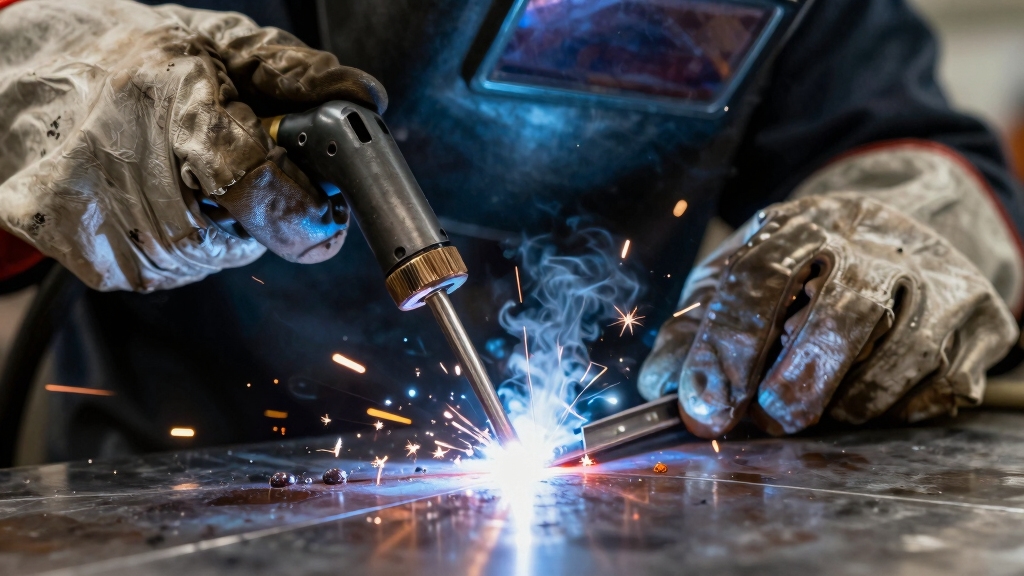
To walk the cup in TIG welding, hold your torch at a 70°–80° angle with tungsten stickout near 1/4 inch for a stable arc.
Use a tight, rhythmic side-to-side wiggle, applying light, consistent cup pressure to control the puddle without distortion.
Coordinate your motion with forward travel and add filler metal by dabbing the rod into the puddle’s center.
Mastering these steps enhances bead uniformity and penetration precision. Explore further to optimize technique for various weld types and passes.
Before you begin walking the cup in TIG welding, you need to prepare your tungsten and torch meticulously to guarantee peak arc stability and weld quality.
Start by grinding your 2% lanthanated tungsten on a dedicated 200-grit wheel to achieve a sharp point, avoiding contamination.
Begin by sharpening your 2% lanthanated tungsten on a dedicated 200-grit wheel to ensure a clean, precise point.
Limit tungsten exposure to between 1/8 and 1/4 inch, ensuring it doesn’t exceed your nozzle diameter.
Install a 3/32-inch diameter tungsten firmly into the collet after correctly assembling the nozzle and collet pieces.
Set your amperage around 175 amps for a 2.4 mm wire and electrode to optimize arc characteristics.
This precise setup enhances arc focus and stability, which is critical for effective cup walking.
Neglecting these steps risks arc wandering and inconsistent weld penetration.
Always ensure the ceramic cup is properly fitted over the collet body to provide adequate gas shielding.
When walking the cup in TIG welding, maintaining the correct torch angle and tungsten stickout is essential for stability and weld consistency.
You want to hold the torch at a 70- to 80-degree angle relative to the workpiece to guarantee peak arc focus and control.
Tungsten stickout should be set between 1/8 to 1/4 inch, ideally around a quarter inch, to prevent contamination and maintain a stable arc.
Applying light pressure with the cup on the metal enhances stability without distorting the weld pool.
Key points to remember:
This technique helps ensure proper gas coverage to protect the weld pool from atmospheric contamination during the process.
Although maintaining steady forward movement is critical, mastering the subtle wiggle technique is what guarantees even heat distribution and consistent puddle progression when walking the cup.
You’ll want to apply light pressure with the cup, initiating a controlled, slight side-to-side motion that breaks surface tension without disrupting puddle stability.
This wiggle should be tight and rhythmic, allowing the molten pool to expand evenly while preventing excessive heat concentration.
Maintain a consistent travel speed, coordinating your torch’s subtle rocking with incremental forward steps.
On flat surfaces, a figure-eight motion refines puddle width and penetration uniformity.
Avoid abrupt or wide oscillations, as they can cause uneven bead width and inconsistent fusion.
Precise control in this wiggle directly influences weld integrity and appearance, making it a crucial skill in effective cup walking.
Remember that maintaining the proper torch angle is essential to ensure arc stability and consistent heat distribution during the wiggle.
Mastering the subtle wiggle sets the stage for effective filler metal application while walking the cup.
You’ll want to hold the filler rod horizontally at about a 15-degree angle, dabbing it quickly into the molten puddle without creating large deposits.
Maintaining consistent contact with the puddle center guarantees uniform fusion as you advance.
Focus on timing your dips with the torch’s figure-eight motion to avoid excessive buildup.
Key considerations include:
Keep filler rod tip in the puddle’s middle, burning from corner to corner.
Use ER70S-6 1/8-inch filler for general passes; adjust size for subsequent layers.
Control filler feed rate to match travel speed and puddle size.
Avoid lingering filler in one spot to prevent overheating or contamination.
These steps enhance weld integrity during cup walking.
Ensure to maintain the proper torch angle and a stable arc for consistent gas coverage and penetration during the process, as outlined in torch technique.
As you adapt the walk the cup technique for different passes and joint types, you’ll need to modify your torch angle, cup pressure, and wiggle pattern to match the weld’s specific requirements.
Root passes require a tighter wiggle and lighter cup pressure to maintain penetration and avoid burn-through.
Hot and fill passes benefit from a wider, faster wiggle and slightly increased cup pressure to control puddle size.
Tee joints and pipe welds demand precise torch angles and consistent cup contact to guarantee even bead width and fusion.
Proper shielding gas selection and flow help stabilize the arc and prevent contamination during these varied techniques, ensuring weld integrity through arc stability and protection.
| Pass Type | Torch Angle | Cup Pressure | Wiggle Pattern | Emotional Impact |
|---|---|---|---|---|
| Root | 70° | Light | Tight | Focused, controlled |
| Hot | 75° | Moderate | Wider | Confident, steady |
| Fill | 80° | Firm | Fast | Assertive, precise |
| Tee Joint | 70-80° | Moderate | Consistent | Balanced, attentive |
| Pipe Weld | 70° | Light-moderate | Smooth | Careful, deliberate |
You choose the right cup size based on the weld pass type and access.
Use smaller cups for root and hot passes to maintain precise control and access tight spaces.
For fill and cap passes, switch to larger cups to accommodate wider puddles and increase shielding gas coverage.
Adjust cup size depending on joint geometry and position: smaller for narrow, confined areas and larger for open, flat surfaces.
This ensures consistent weld quality and gas protection.
You need essential safety gear when walking the cup TIG welding because over 60% of welding injuries involve eye or skin damage.
Always wear a properly rated welding helmet with a shade 10-13 lens to protect your eyes from UV radiation.
Use flame-resistant gloves and long-sleeve jackets to shield your skin.
Respirators are vital in poorly ventilated areas to avoid inhaling harmful fumes.
Don’t forget safety boots and ear protection for full coverage.
To prevent tungsten contamination during long welding sessions, limit tungsten exposure to 1/8 to 1/4 inch. Ensure it never exceeds the nozzle diameter.
Grind tungsten exclusively with a 200-grit wheel designed for tungsten to avoid contamination. Keep your tungsten sharp, especially if using 2% lanthanated rods.
Maintain proper torch angle and distance of 1/16 to 1/8 inch off the workpiece to avoid contact and contamination buildup.
Replace contaminated tungsten promptly.
Over 60% of beginners struggle with inconsistent torch angles when walking the cup, leading to poor weld quality.
You often make mistakes like applying too much pressure, causing tungsten contamination or uneven puddles.
You might hold the tungsten too close or too far from the workpiece, disrupting arc stability.
Failing to maintain a steady, subtle wiggle and inconsistent travel speed can result in weak, irregular welds.
Focus on precision and control to improve.
Environmental factors like wind, humidity, and temperature directly impact your walking the cup TIG weld quality.
Wind can blow shielding gas away, causing oxidation and contamination.
High humidity increases moisture, leading to porosity in the weld.
Cold temperatures affect puddle fluidity, making consistent cup movement harder.
To maintain quality, you must shield your work area, control ambient conditions, and adjust amperage or travel speed to compensate for these environmental changes.
Mastering walking the cup in TIG welding is like conducting a precise dance between torch and metal.
By preparing your tungsten and torch meticulously, maintaining the correct angle and stickout, and wiggling smoothly, you guarantee a clean, consistent weld.
Adding filler metal at the right moment sharpens your technique, while adjusting for passes and joints fine-tunes your control.
With practice, you’ll command the arc’s rhythm, forging flawless welds every time.