Phone:
(701)814-6992
Physical address:
6296 Donnelly Plaza
Ratkeville, Bahamas.

Phone:
(701)814-6992
Physical address:
6296 Donnelly Plaza
Ratkeville, Bahamas.

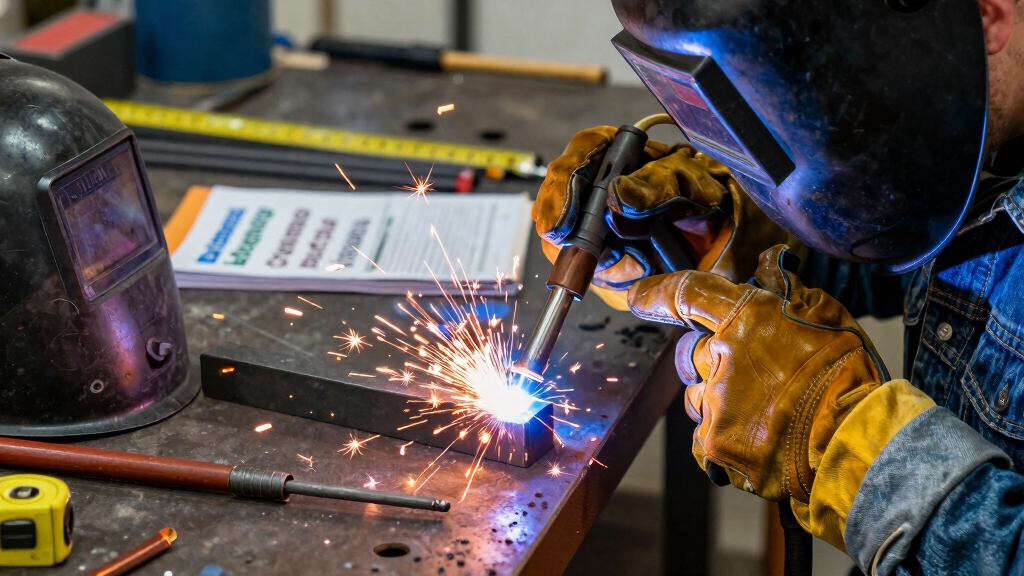
To start welding with no experience, gear up with an auto-darkening helmet, heat-resistant gloves, and flame-retardant clothing to stay safe.
Begin with MIG welding. It’s beginner-friendly, offers easy setup, and suits many metals.
Choose a straightforward welder with simple controls. Invest in quality clamps and gases.
Learn through formal courses or hands-on apprenticeships.
Practice bead control on scrap metal in a ventilated space to build skills and confidence.
Explore more tips to master welding efficiently and safely.
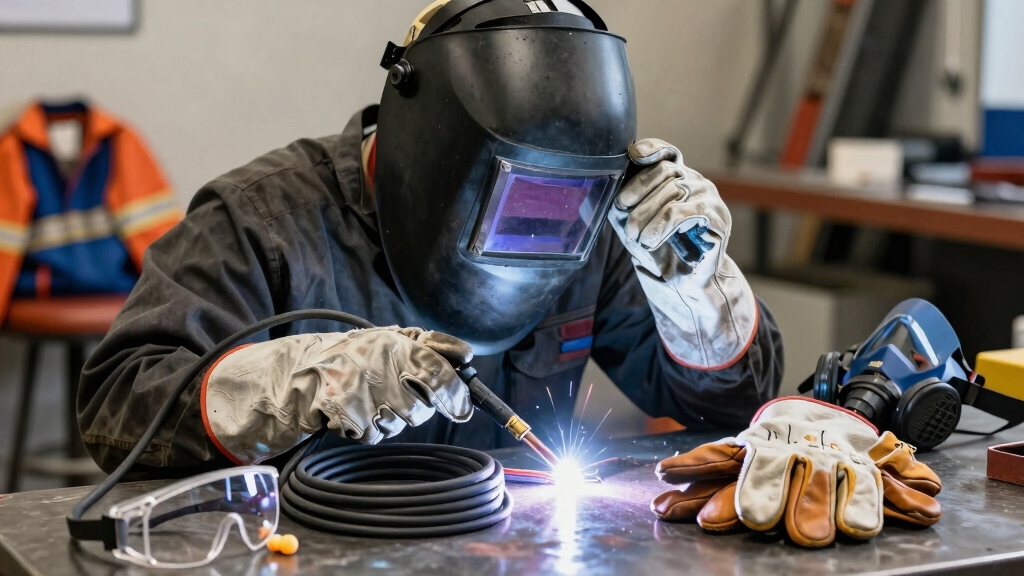
Before you strike your first arc, you need to equip yourself with essential safety gear that shields you from intense heat, harmful UV radiation, and flying sparks.
Start with a welding helmet featuring an auto-darkening filter to protect your eyes and face from ultraviolet and infrared radiation.
Wear heat-resistant clothing, ideally flame-retardant and covering all exposed skin to prevent burns.
Leather gloves are critical for hand protection against sparks and heat.
Keep a fire extinguisher nearby in case of emergencies.
Use clamps to secure materials, reducing movement and risk.
Avoid shortcuts; quality gear guarantees consistent protection and safety.
Proper preparation minimizes hazards, so never weld without these basics fully in place.
Your safety is the foundation of every successful weld you make.
Always wear properly fitted, certified personal protective equipment to significantly reduce the risk of injury.
If you’re just starting out with welding, it’s a good idea to choose a method that’s easy to control.
MIG welding is a great option for beginners because it works well on thin to medium-thickness metals.
Now, keep in mind that the type of metal and its thickness matter.
Some welding processes are better suited for steel, while others work best with aluminum or stainless steel.
Also, think about where you’ll be doing your welding.
Are you planning to work indoors or outside?
Certain techniques are better at handling wind and weather than others, so it’s worth considering that, too.
MIG welding’s ease of use and suitability for automation make it ideal for beginners learning the craft.
When starting out in welding, choosing a method that balances ease of use with effective results can set you up for success.
MIG welding (GMAW) is widely recommended for beginners due to its straightforward setup, continuous wire feed, and cleaner welds with minimal slag.
It allows you to focus on torch control and bead consistency without juggling complex parameters.
Stick welding (SMAW) is versatile and excellent for outdoor or thicker materials but demands more skill managing the electrode.
TIG welding (GTAW) offers precision but requires advanced coordination and control, making it less beginner-friendly.
For your first welding projects, MIG machines provide an ideal learning curve, combining user-friendliness with quality welds.
Investing in a reliable MIG welder guarantees you develop core skills efficiently and safely.
Proper machine setup and metal preparation are key to achieving strong, clean welds and avoiding common defects.
Although welding techniques vary, selecting the right method hinges largely on the metal type and thickness you’re working with.
For beginners, MIG welding suits thin to medium-thickness steels and aluminum due to its ease and consistent wire feed.
Stick welding handles thicker, rusted, or dirty metals better, offering versatility but demanding more skill to control slag.
TIG welding excels with thin stainless steel and non-ferrous metals, providing precise, clean welds but requires steady hands and experience.
When working with thin metals below 1/8 inch, avoid high heat to prevent burn-through; MIG or TIG with controlled settings work best.
For metals thicker than 1/4 inch, stick or flux-cored arc welding delivers deeper penetration.
Match your welding type to metal characteristics to guarantee strong, defect-free joints as you build skills.
For thin metals and out-of-position welding, selecting short circuit or pulsed MIG transfer modes can help reduce heat input and improve weld quality.
Selecting the right welding type goes beyond metal thickness and composition. The environment where you weld plays a significant role in method effectiveness and safety.
Indoor welding offers controlled conditions, minimizing wind interference and allowing consistent shielding gas coverage. This is essential for MIG and TIG welding.
As a beginner, you’ll find indoor setups more forgiving, promoting cleaner, higher-quality welds.
Outdoor welding exposes you to variables like wind, moisture, and uneven surfaces. These can disrupt gas shields and increase porosity risk, making stick welding or flux-cored arc welding preferable due to their flux shielding.
While outdoor welding demands extra safety precautions and equipment durability, indoor welding provides a stable learning environment.
Start indoors to master technique before progressing to outdoor conditions where adaptation and environmental control become critical.
Using the correct shielding gas mixtures indoors can further enhance weld quality and consistency.
When you’re choosing your first welder, the type really matters. For beginners, MIG welders are often the go-to choice because they’re super user-friendly. They make the learning curve a lot less steep!
Now, let’s talk about safety gear. You definitely want to invest in some essential protective equipment. An auto-darkening helmet is a must—it makes it so much easier to see what you’re doing without constantly adjusting. And don’t forget about heat-resistant gloves and fire-resistant clothing. Safety first, right?
Lastly, think about the accessories you’ll need. Clamps are great for keeping your workpieces steady, and good quality welding gases can really enhance your projects. Picking the right accessories can give you better control and make your welding experience even smoother!
Also, consider a welder with synergic MIG mode for easier setup and better control as you learn.
When starting welding, choosing the right type of welder and accessories can make a significant difference in your learning curve and results.
For beginners, a MIG welder is often the best choice due to its simplicity and versatility. It uses a wire feed system and inert gas, allowing smoother, cleaner welds on thin to medium metals.
If you want more flexibility, consider a multi-function welder supporting MIG, TIG, and stick welding. This lets you adapt to different metals and thicknesses.
Accessories like quality welding clamps, proper gas supplies, and a reliable auto-darkening helmet complement your setup.
Avoid cheap machines; investing in dependable equipment guarantees consistent performance and skill growth. Match your welder type to your projects, metal types, and working environment for peak results. Entry-level models with simple two-knob controls are ideal for beginners to reduce setup complexity and welding errors.
Always prioritize protective gear as the foundation of safe welding practice. Start with a welding helmet featuring an auto-darkening filter to shield your eyes from intense UV and infrared radiation instantly.
Wear heat-resistant, flame-retardant clothing, preferably leather or specialized fabrics, to protect your skin from sparks and molten metal. Invest in high-quality leather gloves that offer dexterity and insulation.
Don’t neglect ear protection to prevent noise-induced damage. Keep a fire extinguisher nearby for emergencies. Use welding clamps to secure workpieces, minimizing movement and reducing accident risk.
Avoid cheap, substandard gear; your safety depends on reliable, certified equipment. Proper protective gear not only safeguards your health but also enhances your confidence. This lets you focus on mastering welding techniques without compromise. Be sure to choose helmets with adjustable shade settings to customize protection for different welding tasks and lighting conditions.
Reliable protective gear sets the foundation, but selecting the right welder and accessories shapes your welding capabilities.
For beginners, a MIG welder offers user-friendly operation and versatility, making it ideal for various metals and thicknesses. Choose a multi-function welder only if you’re ready to handle complexity.
Prioritize quality over price to avoid frequent repairs and inconsistent performance.
Essential accessories include an auto-darkening helmet for dynamic light adjustment and heat-resistant gloves for protection and dexterity.
Clamps ensure stable workpieces, improving weld accuracy. Also, invest in appropriate welding gases and wire suited to your chosen welding process.
Avoid cheap knockoffs; reliable equipment guarantees consistent arc stability and better skill development. This ultimately accelerates your welding proficiency and safety.
Be sure to inspect and maintain PPE regularly to ensure proper fit and protection during welding tasks.
Exploring formal welding courses offers the most structured path for beginners without experience. Community colleges and technical schools provide thorough training on MIG, TIG, and stick welding, including safety protocols and equipment handling.
These programs combine theoretical instruction with hands-on practice, ensuring you develop essential skills like bead control and proper torch angle. Additionally, accredited welding academies specialize in skill certification, preparing you for industry standards and welding codes.
If attending a course isn’t feasible, consider apprenticeships with experienced welders or local fabrication shops. These opportunities immerse you in real-world environments, accelerating your learning curve through practical exposure.
Prioritize programs that emphasize safety essentials, welder maintenance, and multi-position welding techniques. These foundations are pivotal for your welding competency and career advancement. Understanding shielding gas setup and its role in TIG welding can significantly improve weld quality and consistency.
When practicing welding skills at home, start by setting up a safe, well-ventilated workspace equipped with essential protective gear like an auto-darkening helmet, heat-resistant gloves, and flame-resistant clothing.
Use a quality MIG welder for ease and consistency. Begin with bead control exercises on scrap metal, maintaining steady torch angle and speed. Track your settings and results to refine technique.
| Task | Equipment Needed | Key Focus |
|---|---|---|
| Bead Control | MIG welder, scrap metal | Torch angle, speed |
| Tack Welding | Clamps, welder | Joint alignment |
| Voltage Settings | Welder controls | Arc stability |
| Wire Feed Speed | Welder controls | Consistent weld bead |
| Cooling Techniques | Safety gloves | Avoid warping, cracks |
Maintain safety and precision to build skills effectively.
Although welding demands patience and practice, you can accelerate your mastery by focusing on consistent bead control, maintaining ideal torch angle, and adjusting settings like voltage and wire feed speed based on material and position.
Master welding faster by perfecting bead control, torch angle, and fine-tuning voltage and wire feed settings.
Start by practicing on scrap metal, guaranteeing your torch angle remains steady, usually between 10° and 15° from vertical. Pay close attention to the melt puddle edge to avoid undercut or overlap.
Experiment systematically with voltage and wire feed speed to find the best combination for each metal thickness and welding position. Use tack welds to stabilize joints before layering final beads.
Always monitor your travel speed to guarantee uniform penetration and bead appearance. Document settings and results for each trial to refine your technique efficiently.
This disciplined approach sharpens your skills faster and builds a solid technical foundation.
Build your welding confidence by mastering fundamental skills through deliberate, focused practice. Start by refining hand-eye coordination and bead control on scrap metal to guarantee consistency.
As you progress, track your improvements to identify strengths and areas needing adjustment.
To build confidence effectively:
You often make common mistakes like poor bead control, which leads to uneven welds.
You might hold the torch at the wrong angle or move too fast, causing weak joints.
Neglecting proper preheating or using incorrect settings for voltage and wire feed can create porosity or burn-through.
Skipping safety gear or rushing without consistent practice also increases errors.
Focus on steady hand-eye coordination, material prep, and adjusting parameters to improve quality.
Think of welding outdoors like painting on a canvas that constantly changes. Rain, wind, and cold can blur your strokes.
Weather conditions affect your weld by disrupting shielding gas coverage, causing porosity and weak joints. Wind blows gas away, rain cools metal too fast, and cold leads to brittle welds.
You need to adjust gas flow, preheat metal, or use windshields to maintain weld quality despite nature’s interference.
Yes, welding can be a profitable long-term career if you develop strong technical skills and specialize in high-demand areas like pipeline, aerospace, or underwater welding.
You’ll need continuous training and quality equipment to maintain precision and efficiency.
Diversifying your expertise across MIG, TIG, and stick welding increases job opportunities.
Investing in certifications and safety knowledge boosts your market value, enabling you to command higher wages and secure steady, well-paying contracts.
Like the heartbeat of a machine, regular maintenance keeps your welding equipment alive and efficient.
You’ll clean and inspect your MIG or multi-function welder’s cables, connections, and torch for wear and damage.
Replace consumables like tips and nozzles promptly.
Keep your auto-darkening helmet’s sensors and lens spotless.
Check gas hoses for leaks and make certain regulators function properly.
Lubricate moving parts and store equipment in a dry, dust-free environment to extend its lifespan.
Yes, welding exposes you to health risks beyond eye and skin protection.
You’ll inhale hazardous fumes and gases like manganese and ozone, which can cause respiratory issues and long-term lung damage.
Prolonged exposure to intense UV radiation can also harm your immune system.
Always use proper ventilation, respirators, and monitor air quality to minimize these risks.
Regular health check-ups and strict adherence to safety protocols are essential for your well-being.
Getting into welding without experience is entirely achievable when you start with the right safety gear, beginner-friendly welding types, and suitable equipment.
Contrary to the myth that welding skills come only from formal training, consistent practice—even at home—accelerates mastery.
By combining hands-on learning with safety and technique awareness, you build both skill and confidence faster than expected.
Remember, welding proficiency grows through deliberate, precise practice and continual skill refinement.