Phone:
(701)814-6992
Physical address:
6296 Donnelly Plaza
Ratkeville, Bahamas.

Phone:
(701)814-6992
Physical address:
6296 Donnelly Plaza
Ratkeville, Bahamas.

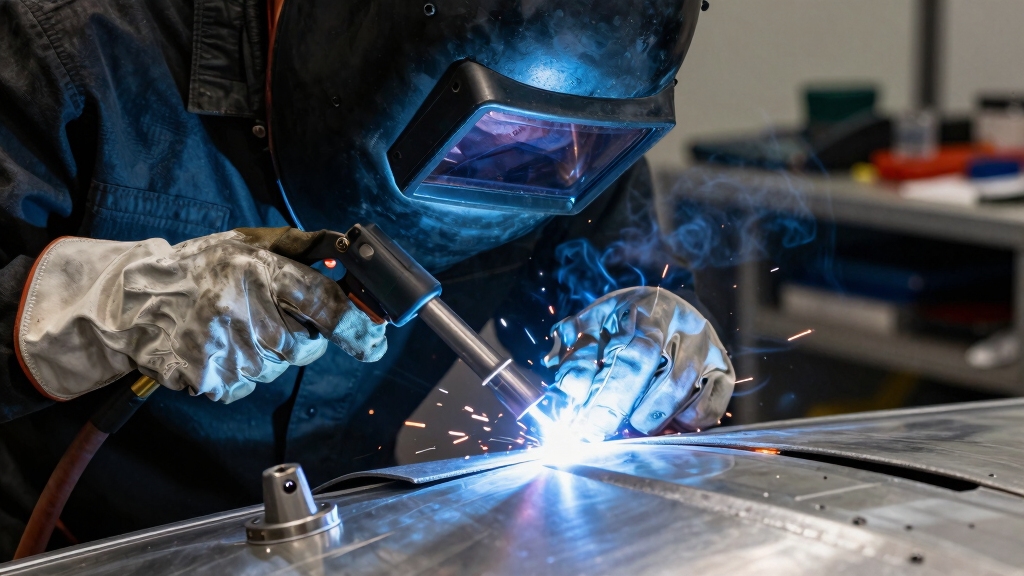
To become an aerospace welder, you’ll start by earning a high school diploma. Then complete specialized training in TIG, MIG, and advanced welding techniques focused on aerospace alloys like titanium and aluminum.
You must master blueprint reading and precision welding processes. Additionally, passing AWS D17.1 certification exams is essential. Gaining hands-on experience through apprenticeships or specialized programs is crucial.
Maintaining certifications and learning nondestructive testing remain ongoing requirements. Explore further to uncover detailed steps, standards, and career paths in aerospace welding.
Although you can’t start aerospace welding training without a high school diploma or GED, obtaining this foundational credential confirms your readiness for technical education.
A high school diploma or GED is essential to begin aerospace welding training and demonstrate readiness.
This credential demonstrates your commitment and meets the standard entrance requirements at technical institutes offering aerospace welding programs.
Typically, you’ll need reading and math skills at a 10th-grade level to succeed. Aerospace welding requires a deep understanding of heat control and metallurgy to work effectively with materials like titanium and nickel-based alloys. Maintaining welding certification continuity is essential for staying qualified in this specialized field.
With this credential, you gain access to certificate and degree programs that provide specialized training.
Certificate programs usually last six months to one year, focusing on hands-on welding techniques, safety protocols, and industry standards.
Completing these programs qualifies you for entry-level positions in aerospace fabrication.
Alternatively, associate degree programs combine general education with advanced welding courses, preparing you for roles involving complex aerospace components and meeting local employer demands.
In mastering aerospace welding, you’ll need to develop expertise in specific welding processes, material characteristics, and precision techniques that guarantee structural integrity and compliance with rigorous industry standards.
You’ll focus on TIG welding for thin, high-strength alloys, MIG welding for aluminum fabrication, and advanced methods like electron beam welding. Aerospace welders often work in varied environments including clean rooms, maintenance hangars, and field locations, adapting their skills accordingly. Mastery of AC polarity in TIG welding is crucial when working with aluminum to balance penetration and oxide cleaning.
Understanding thermal management and metallurgical effects on materials such as titanium, stainless steel, and nickel-based alloys is vital. Selecting the correct polarity, such as DCEN for deep penetration or AC for cleaning action, directly influences weld quality and cooling rates.
You must skillfully interpret blueprints, confirm precise fit-up, and control thermal distortion to maintain tight tolerances.
Proficiency in non-destructive testing methods like X-ray and ultrasonic inspection is essential for verifying weld quality.
Finally, you’ll develop fine motor skills and meticulous documentation practices to meet traceability and audit requirements in aerospace manufacturing.
Pursuing formal and on-the-job training equips you with the specialized skills required for aerospace welding. This training combines theoretical knowledge with hands-on practice. Cochise College’s Aerospace Welding Technology program, for instance, is an IHE Certificate offering that prepares students with entry-level welding skills specifically tailored to the aerospace industry. Argon gas is often used as a shielding gas in aerospace welding to protect welds from contamination and ensure high-quality joints.
Programs like Cochise College’s 36-week Aerospace Welding Technology Certificate and Tulsa Welding School’s 7-month Professional Welder course provide thorough instruction in GTAW, blueprint reading, and welding safety.
Hands-on components simulate real-world welding positions and materials, preparing you for entry-level aerospace roles.
| Institution | Duration | Key Focus Areas |
|---|---|---|
| Cochise College | 36 weeks | GTAW, blueprint interpretation |
| Tulsa Welding School | 7 months | Structural, flux core, pipe welding |
| UTI | 9-10 months | GMAW, SMAW, FCAW, GTAW processes |
| Southern California | Variable | AWS D17.1, ASME Section IX |
| VA School of Metal | Advanced courses | Complex joints, aerospace materials |
When you aim to excel as an aerospace welder, obtaining the right certifications is crucial for validating your skills and meeting industry standards.
Start with foundational AWS certifications like D1.1 for structural steel and D1.2 for aluminum welding, which build core competencies in materials and processes typical in aerospace. Mastery of proper welding parameters is essential to ensure weld quality and minimize defects across different metals.
The pivotal certification is AWS D17.1, focusing on fusion welding of aerospace components; it demands passing both a written exam and a rigorous hands-on weld test evaluated by radiographic or destructive inspection. For those seeking specialization, the AWS offers a D17.1 Endorsement exam, which is open-book and requires a 72% passing score.
Additionally, FAA requirements mandate working under approved repair stations to guarantee compliance with aviation safety regulations.
Facility-level Nadcap accreditation enforces strict procedural adherence and quality control, often influencing your daily workflow.
For advanced roles, consider AWS D17.1 endorsements or Certified Welding Inspector (CWI) credentials to expand your professional scope. The D17.1 Endorsement exam fees vary for members and non-members.
To effectively interpret aerospace blueprints, it’s crucial to decode the welding symbols. These symbols provide vital information about joint type, weld size, and specific process details. By grasping the significance of the reference line, arrow placement, and tail information, you can ensure that you apply the correct welding procedure.
These symbols are part of a standardized language governed by organizations like the American Welding Society, which enables clear communication of welding requirements. It’s really important to master these symbols, especially considering the stringent quality and safety standards in the aerospace industry.
Understanding them not only helps in executing the tasks accurately but also in maintaining the high standards expected in aerospace welding. Additionally, mastering welding symbols aids in managing precise welding parameters, which is essential to produce defect-free welds that meet aerospace specifications.
How do aerospace welders accurately interpret complex blueprints to make certain flawless welds?
You rely on the ANSI/AWS A2.4 standard, which codifies welding symbols as precise shorthand for weld type, size, and processing. This standard is divided into parts covering welding, brazing, and nondestructive examination, providing comprehensive symbol guidance for various fabrication needs. Understanding these symbols also aids in planning the appropriate inspection & testing methods to ensure weld quality.
Each symbol integrates a reference line, arrow, and tail, guiding you to the exact joint and welding method.
Recognizing fillet weld triangles, weld-all-around circles, and groove weld annotations guarantees you meet stringent aerospace standards.
Supplementary symbols indicate finish contours or intermittent weld patterns, critical for part integrity.
You’re tasked with understanding notes on fusion welding, radiographic inspections, and surface treatments, all embedded within the symbols to comply with aerospace quality demands.
Mastering these symbols reduces errors and safeguards structural performance.
Mastering blueprint interpretation is essential for aerospace welders to execute precise welds that meet stringent industry standards.
Begin by orienting the reference line, the horizontal base for all weld symbols, noting arrow placement to determine arrow-side or other-side welds.
Identify weld types via symbol shapes and analyze size, length, and spacing numbers adjacent to symbols. The reference line serves as a crucial guide for indicating exactly where welding should be performed. Additionally, understanding the correct welding shade to use during execution helps ensure safety and weld quality.
Review the blueprint’s title block and notes for component details, beam sizes, and revision history to guarantee current specifications.
Pay attention to breaks in the reference line indicating joint preparation types.
Understand joint types, T-joints, lap joints, corner joints, and their specified welds.
Finally, check the tail for welding process instructions like MIG or TIG.
Aerospace welders rely on a specialized set of tools and materials designed to meet the stringent demands of the industry’s high-precision standards.
You’ll work with TIG welding torches for delicate aluminum and stainless steel joints and electron beam welding chambers for ultra-precise assemblies. Understanding the importance of shielding gas composition helps maintain weld quality in these sensitive applications.
Selecting the right electrodes and filler metals is vital to guarantee alloy compatibility and weld integrity. Proper electrode selection depends on factors like base metal type and required mechanical properties, ensuring a stable arc and strong weld.
Precision cutting tools like plasma cutters and angle grinders prepare surfaces accurately. Consistent gas flow rates and purity are critical to avoid contamination and ensure optimal welds.
You’ll also use clamps and welding magnets to secure components firmly during welding, maintaining dimensional accuracy.
You fabricate and assemble intricate parts for aircraft and spacecraft, working from detailed blueprints and specifications to guarantee exact fit-up and alignment. Applying weld-through primer can be critical in aerospace fabrication to ensure corrosion resistance in joints where post-weld treatment is impractical.
You weld sub-assemblies, such as fuselages and engine components, using TIG, plasma arc, and GMAW/MIG techniques on aluminum, titanium, and nickel-based alloys. Precision heat control prevents distortion during welding thin metals.
You repair mission-critical parts, addressing cracks or warps in engine mounts and hydraulic lines, restoring them to flight-ready condition. It is essential to detect surface abnormalities early to ensure repairs target all defects effectively.
Your responsibilities include inspecting welds visually and with NDT methods like X-ray and ultrasonic testing, verifying compliance with AWS D17.1 and aerospace standards. Maintaining a clean surface and proper primer application helps prevent corrosion that could compromise weld integrity.
You interpret complex technical drawings and maintain strict documentation for quality control and regulatory traceability, ensuring every weld meets stringent aerospace industry requirements.
Building expertise in welding intricate aerospace components requires practical experience combined with progressive skill development. You’ll start in entry-level roles, honing steady hands and precision under supervision. This is often supported by on-the-job training and mentorship, including learning about heat management critical to high-strength alloys.
Master aerospace welding by starting with hands-on training and guided skill-building in entry-level roles.
As you gain 3-5 years of experience, you’ll tackle complex assemblies involving titanium and aluminum. You’ll master TIG and MIG techniques while understanding metallurgy and thermal distortion control. Precise documentation and certifications like AWS D17.1 become essential. Aerospace welding demands a high level of precision and adherence to stringent safety standards to ensure component integrity.
This structured progression guarantees you build a solid foundation indispensable for aerospace welding success.
Elevate your welding expertise by obtaining certifications like AWS D17.1, which validate your ability to meet strict aerospace standards through written exams and hands-on weld testing. Employers in this field often include aircraft manufacturers. Maintain these credentials with regular renewals to stay competitive in high-demand regions such as Philadelphia.
Advance your career by mastering precision welding on titanium and aluminum, and gain proficiency in MIG, TIG, and robotic welding systems. Pursue continuous education in robotics and CAD to remain current with evolving aerospace technologies.
With experience, you can progress from apprentice to master welder, then shift into supervisory or inspection roles. Additional credentials may be necessary for positions with aircraft manufacturers and defense contractors.
This specialized path offers above-average wages and career stability amid growing aerospace sector demand.
You can expect an average annual salary of about $46,302 to $57,537 as an aerospace welder.
Notably, in California, you’ll earn around $63,463, roughly $10,000 more than the national average.
Entry-level positions start near $39,000, while senior welders with specialized skills can exceed $73,000.
Your pay will vary by experience, location, and certifications. Gaining advanced qualifications boosts your earning potential markedly.
Yes, you face specific health risks in aerospace welding due to exposure to welding fumes containing hexavalent chromium, nickel, and cobalt.
These can trigger occupational asthma and increase cancer risk. You may also inhale ultrafine particles and gases like ozone and nitrous oxides, causing respiratory irritation, metal fume fever, and long-term lung damage.
Prolonged exposure can lead to chronic conditions such as COPD, neurological issues, and increased susceptibility to infections.
You’ll find aerospace welding demands far greater precision and consistency than automotive welding.
You work with exotic alloys like titanium and nickel-based metals, requiring advanced metallurgy knowledge and specialized processes like TIG, electron beam, and friction stir welding.
Unlike automotive welding’s basic MIG or stick methods, aerospace welding enforces stricter cleanliness, rigorous non-destructive testing, and exact adherence to blueprints.
Weld failures can compromise critical flight components under extreme conditions.
You generally can’t perform hands-on aerospace welding remotely since it requires cleanroom environments and strict safety protocols.
However, you can find remote roles in related fields like quality assurance, engineering, or welding modeling.
Most actual welding jobs demand you be on-site at facilities like SpaceX or Gulfstream.
Geographic locations like Portland, OR, or Cape Canaveral, FL, are common hubs.
Certification and training also require physical presence for practical assessments.
You’ll often find yourself welding under bright overhead lights or the early dawn, working shifts like 6am-2pm or 2pm-10pm to keep aerospace manufacturing humming smoothly.
Typical shifts run 8 to 14 hours, sometimes stretching overnight from 10pm-6am.
Expect rotating schedules with two or three shifts daily, ensuring 24/7 production.
You’ll often work full-time, exceeding 40 hours weekly, in tightly controlled environments requiring precision and endurance.
Becoming an aerospace welder demands precise skills, thorough training, and essential certifications to meet industry standards.
You’ll need to master blueprint interpretation, welding symbols, and specialized tools to guarantee structural integrity in critical aerospace components.
With hands-on experience and continuous learning, you can advance your career markedly.
So, are you ready to weld the future of aerospace technology with accuracy and expertise? Your dedication will shape the skies ahead.