Phone:
(701)814-6992
Physical address:
6296 Donnelly Plaza
Ratkeville, Bahamas.

Phone:
(701)814-6992
Physical address:
6296 Donnelly Plaza
Ratkeville, Bahamas.

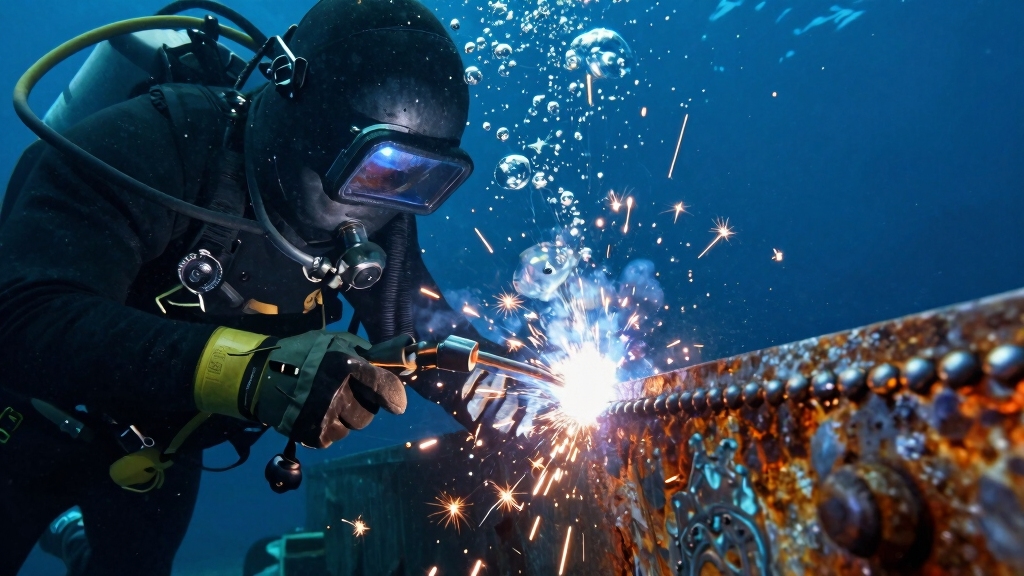
When you weld underwater, you control electric arcs carefully to join metals despite water’s challenges. You use wet welding with waterproof electrodes or dry welding inside pressurized chambers filled with inert gas for better quality.
You’ll maintain specific angles and use DC power to reduce risks like electrical shock and hydrogen cracking. Safety gear and strict protocols protect you from hazards like decompression sickness.
Understanding these key techniques and precautions guarantees efficient, secure welds in demanding conditions.
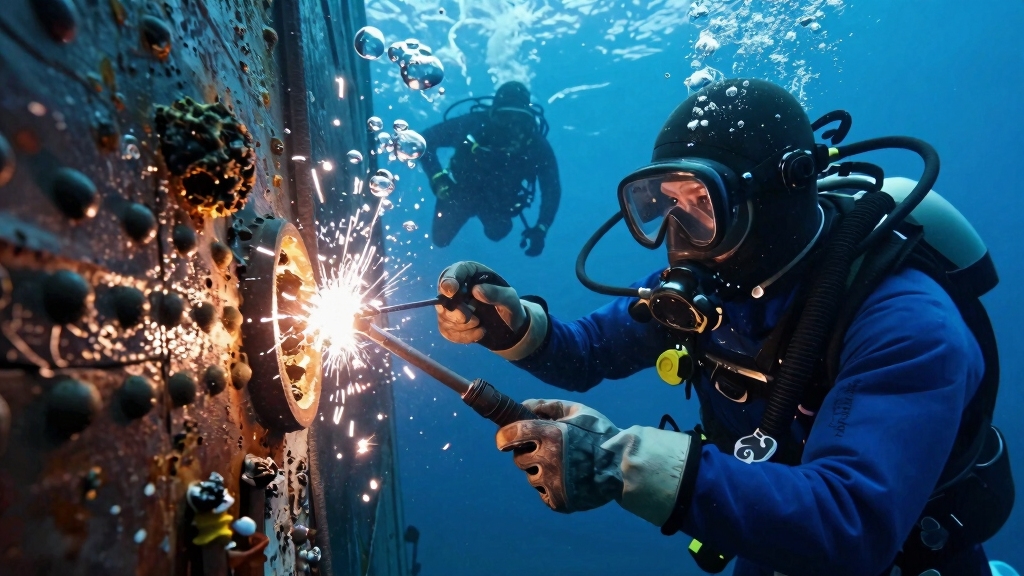
Although underwater welding involves joining metals beneath the surface, the methods vary substantially based on environment and pressure conditions.
Underwater welding methods differ greatly depending on environmental and pressure factors.
You’ll encounter wet welding, where you work directly in water using waterproof electrodes and direct current, typically on low carbon steels to reduce hydrogen cracking.
Dry welding confines you inside a sealed hyperbaric chamber, filled with inert gas and pressurized to depth, allowing traditional welding techniques and preheating to minimize cracking risks.
Hyperbaric welding includes both wet and dry types but focuses on elevated pressures.
Saturation welding, rare and highly hazardous, uses underwater habitats for extended projects at depth.
Understanding these differences is vital for selecting safe, effective methods tailored to project requirements and environmental constraints, ensuring weld integrity and diver safety.
Proper equipment maintenance and rigorous safety protocols are essential to mitigate the high risks associated with underwater welding operations.
Selecting the appropriate equipment and mastering specific techniques directly impact the quality and safety of underwater welds.
You’ll use waterproof electrodes powered by 300–400 amps DC for wet welding, typically employing shielded metal arc welding (SMAW).
Maintaining a lead angle between 35º and 45º helps bubbles escape, preserving weld integrity.
For dry welding, you’ll work inside a hyperbaric chamber filled with inert gas, allowing precise methods like gas tungsten arc welding (GTAW) with preheated metals to reduce cracking.
Techniques such as drag, oscillation, and step-back control bead formation are essential underwater.
You must avoid AC power due to electrocution risk and carefully select low carbon equivalent steels to minimize hydrogen cracking.
Mastery of these tools and techniques guarantees effective, reliable underwater welds under challenging conditions.
Regular medical clearance and fitness assessments are crucial to maintaining diver safety standards during underwater welding operations.
When you dive to perform underwater welding, limited visibility and safety hazards like electrical shock and drowning present constant challenges that demand strict attention and adherence to protocols.
You must manage poor lighting and bubbles that obscure your view, while ensuring your electrical equipment stays insulated to prevent electrocution. Understanding these risks helps you stay safe and maintain weld quality.
Welding underwater also requires careful heat control and process selection to minimize defects and maintain weld integrity despite the challenging environment.
| Challenge | Cause | Safety Measure |
|---|---|---|
| Limited visibility | Bubbles, murky water | Use bright lighting, clear water |
| Electrical shock | Wet environment, power source | Insulated cables, DC power only |
| Drowning risk | Equipment failure, entanglement | Reliable gear, emergency training |
| Decompression sickness | Pressure changes | Controlled ascent, monitoring |
You must focus on these factors to weld safely and effectively underwater.
Managing visibility and electrical safety challenges in wet welding often limits weld quality due to environmental unpredictability.
Wet welding’s unpredictable environment hampers weld quality through visibility and electrical safety challenges.
When you perform dry underwater welding, you work inside a sealed hyperbaric chamber filled with inert gas, which eliminates water interference.
This controlled environment allows you to use traditional welding techniques like GTAW, ensuring precise heat control and superior weld bead formation.
You can preheat the metal, reducing hydrogen-induced cracking risks common in wet welding.
The dry chamber also minimizes electrical hazards, improving safety and weld consistency.
Additionally, you avoid the visibility issues caused by bubbles and water currents, enhancing your ability to maintain weld integrity.
Maintaining consistent shielding gas composition and purity inside the chamber is crucial to avoid contamination and ensure optimal weld quality.
Across marine industries, underwater welding plays a critical role in maintaining and repairing essential structures like offshore pipelines, oil rigs, ships, and nuclear plants.
You rely on underwater welding to guarantee these assets remain structurally sound, preventing costly failures and environmental hazards.
Whether performing wet or dry welding, you must prioritize safety protocols to avoid risks like electrocution and decompression sickness.
Underwater welding allows timely repairs without removing equipment from service, minimizing downtime and operational disruptions.
Its importance extends to emergency interventions, where rapid, reliable welds safeguard infrastructure integrity.
By mastering specialized techniques and understanding environmental challenges, you contribute to extending the lifespan of marine installations, supporting energy production, transportation, and national security.
Your expertise in underwater welding is indispensable for these critical industrial applications.
Proper preparation, precise control of heat input, and sequential welding passes ensure high-pressure joints that withstand harsh underwater conditions.
You should know that Konstantin Khrenov invented underwater welding in 1932. This breakthrough allowed you to perform welding directly underwater, enhancing marine repair capabilities.
When working in this field, you must prioritize safety against drowning and electrocution, given the inherent risks. Understanding the invention’s origin helps you appreciate the evolution of techniques and equipment that now guarantee precision and protection during underwater welding operations.
Think of amperage as the heartbeat of wet welding. It drives the process.
You’ll typically use 300 to 400 amps of direct current with waterproof electrodes. This power level guarantees a stable arc underwater despite the challenging environment.
Staying within this range is vital; too low and the weld weakens, too high risks cracking and safety hazards.
Always prioritize precise control and protective gear to navigate the wet welding’s electric and physical dangers safely.
You avoid AC power in underwater welding because it poses severe electrical hazards, including a higher risk of electrocution.
AC current alternates direction, increasing the chances of dangerous electric shock in a wet environment.
Instead, you use direct current (DC), which offers safer, more stable arcs and better control.
Prioritizing safety, you stick with DC to minimize risks and protect yourself against the unpredictable and lethal nature of AC underwater.
You can safely operate dry welding chambers at depths up to around 400 meters.
Beyond this, diver physiology and chamber construction impose limits.
The chamber must be pressurized to match the external water pressure to prevent decompression sickness while maintaining a dry, inert gas environment.
Though research aims to extend this limit to 1000 meters or more, current practical and safety constraints keep operations below 400 meters for reliable and secure welding.
You’ll often use the drag technique, where you pull the electrode steadily across the workpiece with slight downward pressure, ensuring consistent weld beads.
Oscillation involves moving the electrode side-to-side for better penetration but requires experience to control.
The step-back method lets you form beads gradually, improving quality.
Keep your lead angle between 35–45º to help bubbles escape and prevent weld defects.
Always maintain flux coverage beyond the core wire to avoid sticking.
When you plunge into underwater welding, you’re not just joining metals. You’re battling the ocean’s fiercest elements with precision gear and techniques.
One wrong move could turn a simple weld into a catastrophic failure. Dry welding’s controlled environment gives you the upper hand, ensuring premium quality.
Remember, mastering equipment, understanding safety protocols, and steering visibility challenges aren’t optional. They’re lifesaving essentials in this high-stakes, high-pressure craft.