Phone:
(701)814-6992
Physical address:
6296 Donnelly Plaza
Ratkeville, Bahamas.

Phone:
(701)814-6992
Physical address:
6296 Donnelly Plaza
Ratkeville, Bahamas.

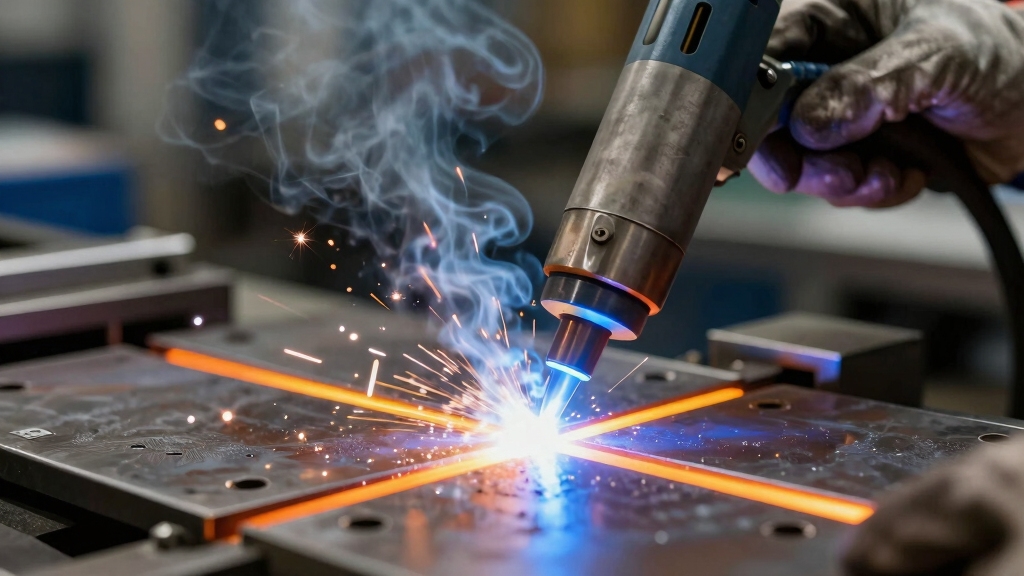
You control a coherent laser beam generated by stimulated emission, shaping its mode to optimize energy distribution.
Precisely focusing this beam concentrates power density above one million watts per square centimeter. This enables deep, stable melting in either conduction or keyhole welding modes.
When the beam hits metal, it rapidly heats and fuses material while minimizing distortion and heat-affected zones.
Managing plasma through shielding gases preserves beam efficiency and weld consistency.
Understanding these principles helps unleash advanced laser welding performance and quality.
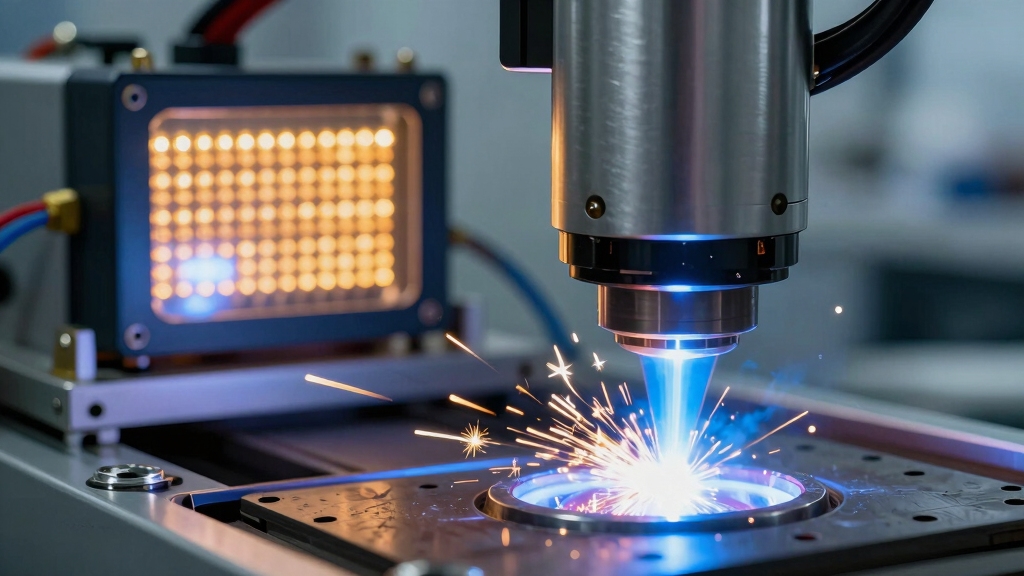
Although the raw laser beam initially carries insufficient energy to melt metals, the laser source generates coherent light by stimulating excited electrons to return to their ground state. This process produces photons in a highly ordered wave.
You rely on this stimulated emission process to create a beam with consistent phase and wavelength, ensuring high coherence. The photons emitted form a beam with minimal divergence, essential for precise focusing later.
The initial power density is low, so the raw beam alone can’t melt the workpiece. You’ll find that laser modes, such as single Gauss, multi, or ring, affect penetration depth and energy distribution.
Understanding this photon generation mechanism is fundamental before you manipulate the beam for welding applications requiring intense, localized heating and material fusion.
In welding applications, selecting the appropriate power source is crucial to achieving stable and effective material fusion.
After generating a coherent laser beam with controlled modes, the next step involves focusing this beam to dramatically increase its power density on the workpiece.
By converging photons into a tiny spot, you amplify the energy concentration to over 10^6 watts/cm², enabling rapid heating and melting of metals.
This focused intensity determines whether you achieve conduction or keyhole welding modes, directly impacting penetration depth and weld quality.
Adjusting the focal spot size allows precise control over the thermal profile, influencing melt pool stability and minimizing heat-affected zones.
Additionally, tailored beam shapes, like ring modes, distribute energy to preheat surrounding areas, reducing spatter and distortion.
Without precise focusing, the laser’s raw energy dissipates, making effective welding impossible.
Therefore, beam focusing is critical for converting laser energy into controlled, localized thermal effects essential for high-quality welds.
Similar to plasma cutting, controlling the thermal energy concentration in the focal spot optimizes heat input and prevents material distortion.
When the focused laser beam strikes metal, its concentrated photons rapidly convert into thermal energy through photon absorption within the material’s lattice structure. This energy excites electrons, generating phonons that propagate heat waves, raising the temperature swiftly to the melting point.
The metal then forms a localized molten pool, initiating fusion upon solidification. You witness energy density reaching over 10^6 watts/cm², enabling precise, deep melting without excessive heat spread.
| Effect | Sensation | Result |
|---|---|---|
| Intense heat | Metal glows bright | Rapid melting |
| Photon absorption | Vibrating lattice | Thermal energy |
| Molten pool forms | Fluid, glowing mass | Fusion on cooling |
| Vaporization begins | Thin plasma plume | Keyhole formation |
This process transforms light into controlled metal bonding with minimal distortion. Similar to plasma welding, controlling the heat input is crucial for maintaining weld quality and minimizing distortion in the keyhole welding process.
Understanding how welding modes influence penetration depth is essential for selecting the right parameters in laser welding.
When you operate in conduction mode, the power density remains around 0.5 MW/cm². This produces shallow, wide welds due to heat diffusion primarily at the surface.
Increasing power density beyond 1 MW/cm² shifts the process to keyhole mode. Here, vaporization creates a deep cavity that channels laser energy deeper into the material.
This keyhole acts as a conduit, markedly increasing penetration depth and enabling narrow, uniform welds suited for thick parts.
The exact mode you choose directly affects weld geometry and strength by controlling how energy distributes within the metal.
Therefore, understanding the threshold between conduction and keyhole modes helps you optimize weld quality and efficiency precisely.
Proper shielding gas use during welding stabilizes the arc and controls heat input, which is critical for achieving consistent penetration depth and weld integrity.
Selecting the appropriate welding mode sets the stage for how the melting process shapes the weld’s strength. When the laser beam heats the joint to its melting point, you create a localized molten pool where fusion occurs upon solidification. This forms a strong metallurgical bond without filler material. The melt pool dynamics directly influence weld quality.
Key factors to take into account include:
Additionally, controlling the heat input precisely is crucial to ensure optimal penetration and avoid defects such as burn-through or incomplete fusion.
Although welding performance largely depends on physical phenomena like melting and plasma behavior, you must precisely adjust control parameters to achieve the best results.
Begin by calibrating laser power to balance penetration depth and avoid excessive vaporization. Set pulse frequency to control heat input and minimize distortion.
Adjust feed speed carefully; too fast reduces fusion, too slow causes overheating. Optimize focal length for a tightly focused beam, maximizing power density at the joint.
Employ beam oscillation patterns to manage heat-affected zone size and weld bead consistency. Select appropriate shielding gas and flow rate to prevent oxidation without disrupting the molten pool.
Use sensor feedback to monitor real-time conditions, enabling dynamic parameter adjustments. This analytical approach guarantees stable keyhole formation and consistent weld quality.
Additionally, understanding the difference between constant current and constant voltage welding can help in selecting power supply settings that enhance arc stability and process control in laser welding.
To get the best results in welding, it’s crucial to control plasma formation. You see, when metal vaporizes, it creates a plasma plume. This plume can absorb and scatter the laser beam, which means that the energy delivery isn’t as effective.
One great way to tackle this issue is by using inert gases to suppress the plasma. This helps keep the beam intensity up and improves penetration depth. So, by managing plasma effectively, you not only boost beam efficiency but also reduce defects in the weld. It’s all about fine-tuning the process for better outcomes! Proper shielding gas control is essential to minimize atmospheric exposure and reduce oxidation and nitriding that can compromise weld quality.
When vaporized metal forms plasma during laser welding, it can markedly reduce beam efficiency by absorbing and scattering laser energy.
To suppress plasma effectively, you must control its generation and interaction with the laser beam.
Here are three key suppression techniques:
Using inert shielding gases like argon and helium also helps prevent contamination and stabilizes the arc for better weld quality.
Effective plasma suppression directly enhances beam efficiency by minimizing energy loss caused by plasma absorption and scattering.
When plasma forms above the weld zone, it absorbs and disperses laser photons, reducing the energy that reaches the workpiece.
By managing plasma through inert gas shielding and optimized beam parameters, you maintain a clearer optical path, enabling deeper penetration and consistent energy delivery.
This control decreases weld defects caused by unstable plasma plumes, such as spatter and inconsistent keyhole formation.
Additionally, plasma suppression prevents excessive ionization that disrupts beam focus.
As a result, you achieve higher thermal efficiency, precise melting, and improved weld quality.
Fundamentally, controlling plasma isn’t just about preventing interference; it fundamentally boosts the laser’s effectiveness, ensuring stable, repeatable welding performance.
Moreover, laser welding’s ability to focus heat precisely results in a minimal heat-affected zone, preserving base material properties and reducing distortion.
You must always wear appropriate laser safety goggles rated for the laser’s wavelength to protect your eyes from intense radiation.
Make sure the welding area is enclosed or shielded to prevent stray beam exposure.
Use proper ventilation to avoid inhaling harmful fumes or plasma byproducts.
Follow lockout/tagout procedures during maintenance and keep flammable materials away.
Regularly inspect safety interlocks and warning signs to maintain a secure operating environment.
You’ll find laser welding generally costs more upfront due to expensive equipment and maintenance. However, it reduces labor and post-processing time thanks to faster, precise welds with minimal heat-affected zones.
Over time, you save on filler materials and rework, especially for high-volume or complex parts. So, while initial investment is higher, laser welding often offers better cost-efficiency in production runs demanding accuracy and speed compared to traditional methods.
You’ll find metals with high reflectivity, like copper and aluminum alloys, challenging for laser welding. They reflect much of the laser energy, reducing efficiency.
Also, metals with low thermal conductivity or highly porous structures can cause inconsistent melting and defects.
Reactive metals such as titanium require strict shielding to avoid oxidation.
Imagine you’re conducting an orchestra where every note aligns perfectly; that’s how you automate laser welding for mass production.
You can integrate laser welders with robotic arms and conveyor systems, controlling laser power, speed, and focus with real-time sensor feedback.
This precise control guarantees consistent weld quality at high speeds, minimizing defects and heat distortion.
Automation optimizes throughput, making laser welding ideal for large-scale manufacturing environments demanding repeatability and efficiency.
You can expect laser welding machines to last around 10 to 15 years with regular maintenance.
Proper upkeep involves cleaning optics, calibrating beam focus, and replacing worn parts like lenses or fiber cables.
Monitoring system parameters and ensuring stable power supply minimize wear.
Neglecting maintenance accelerates degradation of laser sources and optics, reducing lifespan.
Consistent servicing optimizes performance, prevents unplanned downtime, and extends operational reliability over the machine’s lifecycle.
Understanding how a laser welder works reveals its precision and efficiency. Laser welding can achieve penetration depths up to 10 mm with minimal distortion.
By generating a focused beam, controlling welding modes, and managing plasma, you guarantee the strongest welds. Optimizing these factors improves quality and boosts productivity.
Mastering these technical details empowers you to leverage laser welding’s full potential in demanding industrial applications.