Phone:
(701)814-6992
Physical address:
6296 Donnelly Plaza
Ratkeville, Bahamas.

Phone:
(701)814-6992
Physical address:
6296 Donnelly Plaza
Ratkeville, Bahamas.

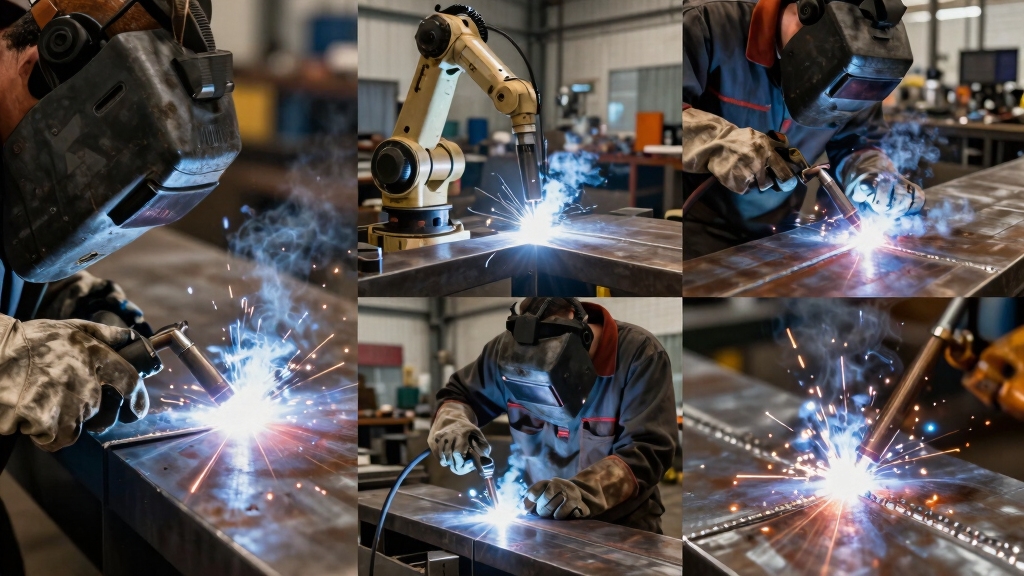
You’ll find four main MIG welding transfer types, each tailored to different tasks.
Short circuit transfer suits thin metals and tight spaces, offering low heat and minimal spatter for out-of-position work.
Globular transfer produces large droplets and high spatter, best for flat, thick applications where speed matters over finish.
Spray arc excels with thick materials in flat positions, delivering deep penetration and high deposition.
Pulsed MIG balances control and spatter reduction for thin to medium sections.
Understanding these modes sharpens your welding choices and improves results.
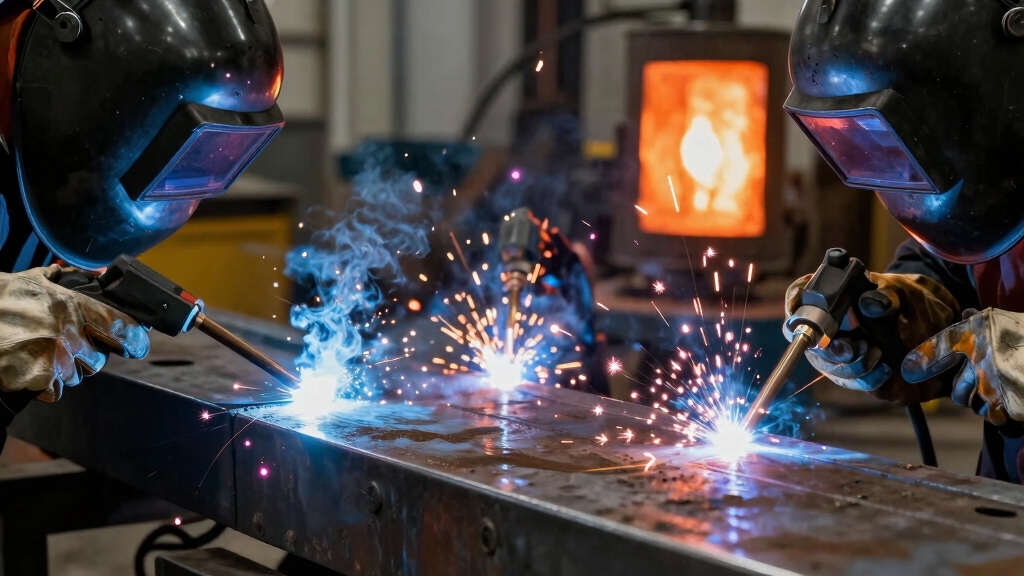
When you engage in MIG welding, also known as Gas Metal Arc Welding (GMAW), you use a continuous solid wire electrode fed through a welding gun to create an arc between the wire and the base metal.
MIG welding uses a continuous wire electrode to form an arc with the base metal.
This arc generates the heat necessary to melt both the wire and the workpiece, forming a strong fusion. You rely on a shielding gas, typically an argon-based mix, to protect the molten weld pool from atmospheric contamination, ensuring weld integrity.
The process demands a constant voltage direct-current power supply, which stabilizes the arc and controls heat input. MIG welding suits a wide range of metal thicknesses and offers high deposition rates.
Its relative ease of use makes it popular among beginners and professionals, balancing speed, precision, and versatility for various fabrication tasks.
For maintaining high-quality welds and preventing defects, proper surface preparation of the base metal is essential before welding.
Short circuit transfer is a pretty neat process that works at low voltage. Basically, the wire electrode keeps making contact with the base metal, which results in a quick-freezing weld puddle. This technique really shines when you’re working with thin materials or when you’re in tight spots or awkward positions. Why? Because it allows for better control over heat input.
Another cool thing about this method is that it reduces spatter and sparks compared to other welding techniques. However, it’s worth noting that it’s not the best choice for thicker metals. When you try to use it on those, you might end up with cold lapping, which isn’t ideal. So, while it has its perks, just keep in mind where it works best! Proper voltage and wire speed adjustments are essential to minimize spatter during short circuit transfer welding.
Mastering short circuit transfer can markedly enhance your welding performance on thin materials and in tight or complex positions. This mode uses low voltage, causing the wire to short circuit repeatedly, which forms a fast-freezing weld puddle.
You benefit from minimal spatter and excellent control, allowing precise weld bead placement in narrow spaces. However, it carries a slightly higher spatter risk compared to other MIG modes.
| Characteristic | Description | Benefit |
|---|---|---|
| Low Heat Input | Repeated short circuits | Protects thin metals from burn-through |
| Fast-Freezing Puddle | Rapid solidification | Enables welding in multiple positions |
| Minimal Spatter | Controlled metal transfer | Reduces cleanup and rework |
This transfer mode is your go-to for delicate, positional welding with high precision. Careful control of heat input is essential to avoid distortion and maintain weld quality, especially on heat-sensitive materials.
Building on the control and precision offered by short circuit transfer, its ideal applications primarily involve welding thin-gauge metals and projects requiring intricate positional work.
You’ll find it effective for welding sheet metal, automotive panels, and light structural components where minimal heat input prevents warping or burn-through.
Its ability to operate in all positions, including vertical and overhead, makes it suitable for confined spaces and complex geometries.
However, be cautious with thicker materials, as the low heat input can cause cold lapping and insufficient fusion.
While short circuit transfer generates some spatter, it remains manageable compared to globular transfer modes.
Using the correct argon and CO2 gas mix can help optimize arc stability and spatter control during short circuit welding.
When choosing a welding transfer mode, globular transfer tends to come into play for flat and horizontal fillet welds where high heat input is acceptable.
You’ll use it when welding thicker materials that tolerate significant spatter and heat without warping. However, it’s less ideal for thin metals or out-of-position work due to droplet size and weld puddle disruption.
Careful control of welding parameters is essential to minimize the excessive spatter typical of globular transfer.
| Parameter | Globular Transfer |
|---|---|
| Welding Position | Flat, Horizontal Fillet |
| Heat Input | High |
| Droplet Size | Large, irregular |
| Spatter Level | Significant |
| Fusion Quality | Moderate, risk of underfusion |
Use globular transfer when speed and penetration outweigh spatter control. This is particularly true on heavy gauge metals in controlled settings.
Spray arc transfer frequently delivers a consistent, high-quality weld by propelling fine droplets of molten metal across the arc in a stable and controlled manner.
You benefit from a constant stream of weld metal, enhancing deposition rates and guaranteeing deep penetration, especially on thicker materials.
This mode reduces the risk of cold laps and fusion defects common in other transfer types, supporting robust root fusion.
However, spray arc transfer is best suited for flat and horizontal positions, as its high heat input can cause burn-through on thin metals.
You’ll find it ideal for applications involving thick aluminum or steel where speed and quality are critical.
This transfer mode is commonly paired with DCEP polarity to ensure stable arc characteristics and optimal heat distribution.
Pulsed MIG transfer enhances your welding control by alternating between high and low current pulses. This stabilizes the weld puddle and reduces excessive heat input.
This modulation minimizes spatter and allows you to weld thinner materials with precision while maintaining penetration. You gain better control over bead shape and can weld out-of-position with higher travel speeds.
This increases productivity without sacrificing quality.
Careful adjustment of welding parameters is essential when using pulsed MIG transfer to maintain arc stability and optimize weld quality.
| Feature | Benefit |
|---|---|
| High current pulse | Guarantees consistent metal transfer |
| Low current pulse | Controls heat input and cooling |
| Reduced spatter | Minimizes cleanup and defects |
| Stable weld puddle | Improves bead uniformity |
Selecting the appropriate MIG welding type depends heavily on the material thickness and welding position you’re working with.
Choosing the right MIG welding method hinges on material thickness and welding position.
For thin materials and out-of-position welding, short circuit transfer excels due to its low heat input and fast-freezing puddle. This minimizes burn-through risks.
Spray arc transfer suits thicker metals but restricts you to flat or horizontal positions because of its high heat input and continuous molten metal stream.
Pulsed MIG transfer offers versatility across mild steel, aluminum, and stainless steel up to 3/16-inch thick. It allows controlled puddle and reduced spatter even in out-of-position welds.
Globular transfer generates large droplets and excessive spatter, limiting you to flat and horizontal fillet welds on thicker materials.
Matching transfer modes to material and position guarantees peak weld quality and efficiency.
Proper wire feed mechanism ensures consistent wire delivery and stable arc conditions across different transfer modes.
Choosing the right MIG welding type can feel a bit overwhelming, but it really comes down to a few key factors.
First off, you’ll want to consider the thickness of the material you’re working with. This is super important because matching the welding type to the material thickness ensures proper penetration. You definitely want to avoid issues like burn-through or lack of fusion—nobody wants to deal with that!
Next, think about the welding position. Some transfer modes shine in flat or horizontal setups, while others are better suited for out-of-position work. It’s all about knowing where you’ll be welding and what’s going to work best in that scenario.
Lastly, don’t forget about the quality of the weld itself. This includes things like spatter control and the overall appearance of the bead. Take a moment to weigh these factors against your project’s performance standards. By keeping all this in mind, you’ll be well on your way to selecting the perfect MIG welding process for your needs! Choosing the correct wire composition is also crucial to ensure weld integrity and mechanical strength.
Material thickness plays a crucial role in determining the appropriate MIG welding type for your project.
For thin materials, short circuit transfer is best due to its low heat input, minimizing burn-through and distortion. This method allows welding in various positions.
Avoid globular transfer here, as its high spatter and heat can damage thin sections.
For thicker materials, spray arc transfer excels by delivering a steady, high-heat weld pool. This guarantees deep penetration and high deposition rates but restricts you to flat and horizontal positions.
Pulsed MIG offers a versatile middle ground, controlling heat to weld thin to medium thickness (up to 3/16-inch) with reduced spatter and out-of-position capability.
Selecting the MIG mode aligned with material thickness secures weld integrity, efficiency, and peak appearance. Using the correct shielding gas blend also significantly influences weld quality, arc stability, and penetration.
When welding position dictates your approach, choosing the right MIG welding type becomes critical to guarantee weld quality and efficiency.
For out-of-position welding, short circuit and pulsed MIG transfers offer superior control due to their low heat input and stable puddle. This minimizes sagging and spatter.
Short circuit transfer excels in tight spaces and thin materials, while pulsed MIG provides versatility with reduced spatter on aluminum and mild steel up to 3/16-inch thick.
Conversely, spray arc and globular transfers are best limited to flat and horizontal positions. Their high heat input and molten droplet behavior hinder positional welding and risk burn-through on thin sections.
Consequently, assess the weld orientation carefully. Select short circuit or pulsed modes for vertical or overhead work. Reserve spray arc for flat, thick material applications to optimize weld integrity and productivity.
Achieving ideal weld quality hinges on selecting the appropriate MIG welding transfer mode tailored to your project’s specific requirements.
You need to balance heat input, spatter control, and positional flexibility to meet your weld’s structural and aesthetic demands.
For instance, short circuit transfer suits thin metals with minimal spatter, while spray arc excels on thick materials but is limited to flat positions.
| Transfer Mode | Key Quality Attributes |
|---|---|
| Short Circuit | Low heat, minimal spatter |
| Globular | High heat, increased spatter |
| Spray Arc | High deposition, flat position |
| Pulsed MIG | Controlled heat, low spatter |
Choose pulsed MIG for out-of-position welds and better control. This ensures consistent fusion and reduced defects.
You need to clean the contact tip regularly to guarantee consistent wire feeding and electrical conductivity.
Inspect and replace worn liners to prevent wire jams.
Check the nozzle for spatter buildup and clean or replace it to maintain proper gas shielding.
Also, examine the trigger and cable connections for damage or wear.
Regularly lubricate moving parts and verify gas flow rates to avoid contamination and guarantee peak welding performance.
You might think shielding gas is just a background player, but it actually controls your weld’s destiny.
Choosing the wrong gas can turn your weld into a porosity-riddled mess or cause weak fusion.
Argon mixes stabilize the arc and prevent contamination, ensuring clean, strong joints.
Too much CO2 sparks spatter and rough beads.
So, picking the right shielding gas directly affects your weld’s quality, strength, and appearance.
Don’t underestimate its power.
Yes, you can automate MIG welding for production to boost consistency and speed.
Automated systems maintain precise wire feed, voltage, and gas flow, reducing human error.
They’re ideal for high-volume manufacturing, especially on thick metals or repetitive tasks.
Automation enhances weld quality by controlling parameters tightly, minimizing spatter and defects.
You’ll see improved productivity and less rework, making it a preferred choice in industrial applications like pipe and plate welding.
You need a welding helmet with an auto-darkening filter to protect your eyes from intense UV and infrared rays.
Wear flame-resistant gloves and a long-sleeve jacket to shield your skin from sparks and spatter.
Use safety glasses underneath for added eye protection.
Respiratory protection is essential, especially in confined spaces, to avoid inhaling fumes.
Don’t forget ear protection and sturdy boots to safeguard against noise and hot debris.
Oh, you just love when your weld beads look like a lumpy road, right?
To troubleshoot, first check your shielding gas flow. Too low invites contamination, while too high causes turbulence.
Inspect wire feed speed for consistency; uneven feed leads to spatter or weak fusion. Adjust voltage and polarity to match material thickness.
Also, make sure your contact tip is clean and properly seated. Fix these, and your weld defects will shrink like bad jokes.
Now that you understand the different types of MIG welding, you can navigate the options like a skilled pilot through turbulent skies.
Each transfer method offers unique advantages depending on your material and position, ensuring precision and control.
By choosing the right MIG welding type, you’ll optimize your weld quality and efficiency.
Remember, mastering these techniques isn’t just a task; it’s your gateway to professional, reliable results every time you weld.