Phone:
(701)814-6992
Physical address:
6296 Donnelly Plaza
Ratkeville, Bahamas.

Phone:
(701)814-6992
Physical address:
6296 Donnelly Plaza
Ratkeville, Bahamas.

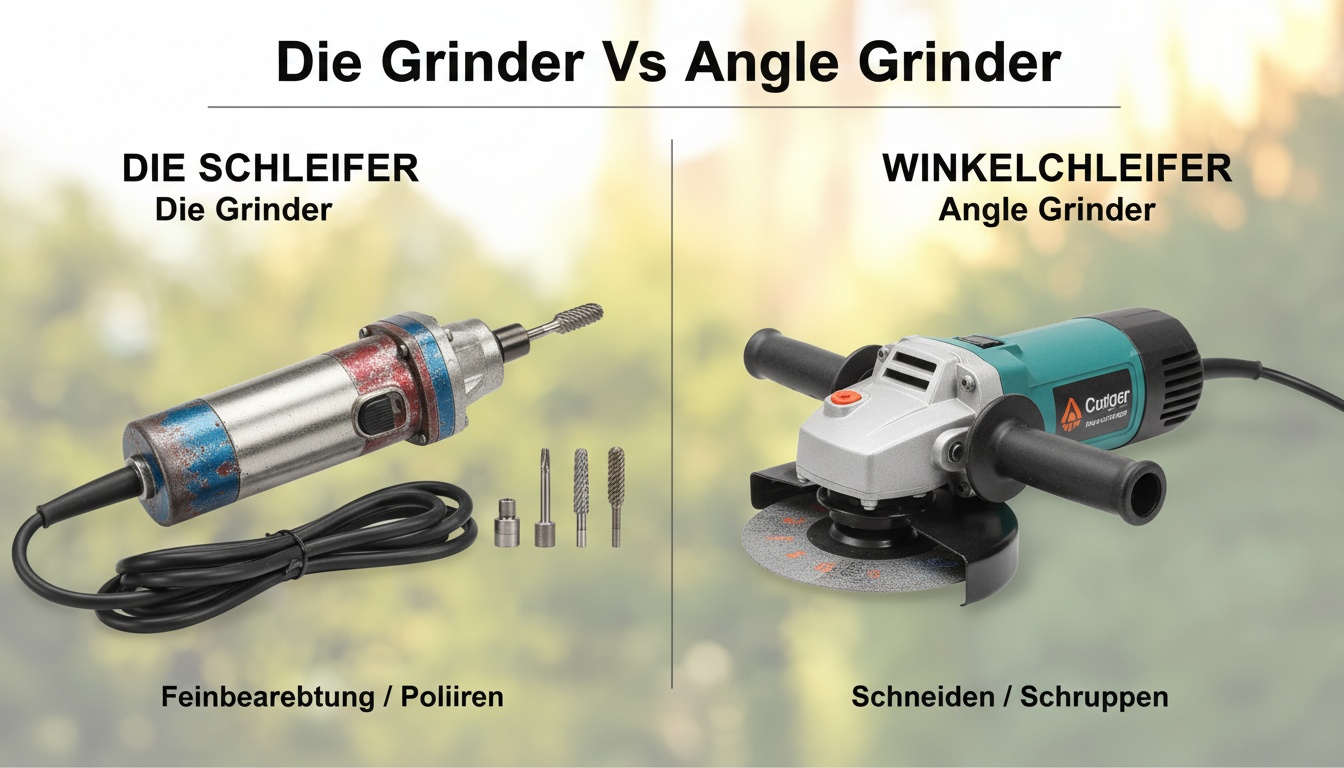
You’d choose a die grinder when you need high-speed precision for detailed tasks like deburring or intricate shaping, thanks to its direct-drive, high-RPM design with small collet attachments.
An angle grinder, with its right-angle gearbox and larger discs, delivers greater torque for heavy-duty grinding, cutting, and broad surface work.
Both tools offer corded and cordless options balancing power and mobility. Understanding these differences helps you match the right grinder to your project needs.
| Feature | Die Grinder | Angle Grinder |
|---|---|---|
| Primary Strength | High-speed precision and control | High torque and heavy-duty power |
| Best For | Deburring, edge cleanup, intricate shaping, tight spaces | Grinding, cutting, sanding, bulk material removal |
| Power Transmission | Direct drive (motor to spindle) | Right-angle gearbox (90° gear system) |
| RPM Range | 8,000 – 28,000 RPM (very high speed) | Lower RPM, optimized for torque |
| Torque Output | Low torque | High torque |
| Attachment System | Collet (small bits like carbide burs) | Disc system (larger grinding & cutting discs) |
| Disc/Bit Size | Small precision accessories | Large grinding/cutting discs |
| Surface Coverage | Small, detailed areas | Broad surface areas |
| Material Removal Rate | Light to moderate | Heavy and aggressive |
| Design Focus | Compact, lightweight, slim body | Robust, durable, power-focused |
| Gear Mechanism | No gearbox (except right-angle die grinder variants) | Built-in right-angle gearbox |
| Corded Option | Consistent speed, ideal for shop work | Continuous high torque for heavy tasks |
| Cordless Option | Lightweight, quieter, finesse-focused | Portable with sustained torque |
| Control & Finesse | Excellent precision and maneuverability | Moderate precision, more power-driven |
| Vibration Level | Lower vibration (especially brushless models) | Higher vibration under load |
| Ideal User Goal | Detailed finishing and shaping | Cutting, grinding, and surface prep at scale |
When you need to tackle detailed, precision tasks, a die grinder stands out as the ideal tool.
Unlike angle grinders, it transfers power directly from the motor to the spindle without a gearbox. This enables higher speeds, up to 28,000 RPM.
This direct drive, combined with high-speed bearings, guarantees smooth, efficient operation tailored for fine work like deburring, edge cleanup, and intricate shaping.
You’ll use collet attachments to secure small bits such as carbide burs, which are perfect for tight spaces and delicate surfaces.
Cordless die grinders offer quieter, vibration-reduced performance with brushless motors that extend tool life and reduce maintenance.
While they lack the torque for heavy material removal, their precision and speed make them indispensable for detailed applications where control and finesse outweigh brute force.
For optimal results and tool longevity, it is important to monitor operating speed and pressure during use to avoid overheating and premature wear.
An angle grinder is a powerful tool that uses a right-angle gearbox to position the disc in a way that gives you the best leverage for those heavy-duty tasks.
Pretty handy, right?
With its higher torque and compatibility with larger discs, it really shines when it comes to broad surface grinding, sanding, and material removal.
So, if you’re tackling a big project that requires sustained power, you’ll find that an angle grinder outperforms die grinders in both design and function.
It’s like having a reliable workhorse in your toolkit!
However, just like with MIG welding where heat input control is crucial to prevent damage, managing the tool’s power and speed ensures optimal results without overheating or material distortion.
Although angle grinders incorporate a gearbox that redirects rotation by 90 degrees, their design prioritizes torque over speed. This makes them ideal for heavy material removal and broad surface grinding.
The gearbox enables the disc to operate at a right angle to the motor shaft, allowing better access to awkward positions. Unlike die grinders, which transfer power directly to the spindle for high-speed precision, angle grinders sacrifice RPM for increased torque.
They use a disc attachment system that accommodates larger accessories, enhancing their suitability for sanding, grinding, and polishing wide surfaces. The right-angle configuration and robust motor design guarantee sustained power delivery.
Cordless models reduce vibration and weight, improving handling during extended use. This design fundamentally sets angle grinders apart for more demanding, large-scale tasks.
When comparing fuel sources for powering tools, propane’s higher energy density means it can deliver more power in a compact form, which can be advantageous in portable tool applications.
Since angle grinders deliver high torque through their right-angle gearbox design, they excel at heavy material removal and broad surface grinding tasks.
You’ll find them ideal for cutting, grinding, and polishing large metal, plastic, or wood surfaces where power and sustained torque matter.
Their disc attachment system supports bigger accessories, making them perfect for aggressive sanding or removing mill scale.
In contrast, die grinders suit precision work on smaller areas, like deburring or intricate edge cleanup, thanks to their direct-drive high-speed spindle.
However, they lack the torque for bulk material removal and aren’t suited for large sanding discs.
Angle grinders can also be used with metal shaping attachments for cutting, shaping, and forming metals in various applications.
Harness the robust power and torque of an angle grinder to tackle heavy-duty grinding and cutting tasks that demand sustained force. Unlike die grinders, which prioritize high RPM for precision, angle grinders leverage a gearbox to deliver increased torque at lower speeds. This makes them ideal for removing thick mill scale or grinding large surfaces.
You’ll find angle grinders excel with larger discs, sustaining power for extended periods and handling tougher materials without bogging down. While die grinders spin faster, up to 28,000 RPM, they lack the torque to manage heavy bulk removal efficiently.
If your project requires consistent, powerful grinding or cutting on broad areas, the angle grinder’s torque advantage guarantees better performance and durability under load compared to the speed-focused die grinder. Modern angle grinders often incorporate advanced electronic components for improved power control and efficiency during operation.
Did you know that die grinders and angle grinders have some pretty significant design differences? For starters, die grinders transfer power directly from the motor to the spindle. This means they don’t need a gearbox, which makes them a bit more straightforward in their mechanics. On the other hand, angle grinders use a right-angle gearbox to position the disc, giving them a different setup altogether.
Now, let’s talk about attachments. Die grinders typically use a collet system, which is perfect for precision attachments. This makes them ideal for detailed work. In contrast, angle grinders rely on a disc attachment system that’s more suited for broader surface tasks. So, if you’re looking for versatility in precision, die grinders have you covered.
Oh, and here’s something interesting: right-angle die grinders come with a bevel gear assembly. This design choice increases the head size compared to standard die grinders, which can influence how you use them. So, depending on the job at hand, one may be more suitable than the other!
For welding applications, choosing the right tool and technique, such as torch angle control, is crucial for achieving the desired precision and finish.
Understanding the power transmission mechanisms reveals the core design distinctions between die grinders and angle grinders.
Die grinders feature a direct power transfer from the motor to the spindle, eliminating the need for a gearbox. This direct drive enables higher rotational speeds, typically between 8,000 and 28,000 RPM, ideal for precision work.
In contrast, angle grinders incorporate a gearbox that redirects the motor’s rotation by 90 degrees, positioning the disc at a right angle to the handle. This gearbox reduces speed but increases torque, supporting heavy-duty grinding.
The angle grinder’s transmission design accommodates larger discs and more robust applications, whereas the die grinder’s direct drive favors compactness and high-speed precision.
You’ll notice this fundamental difference affects the tools’ performance, noise, and vibration levels during operation.
For heavy-duty tasks such as welding thick steel, selecting equipment with an appropriate amperage capacity is critical to ensure consistent performance and avoid overheating issues.
When you look closely at their attachment and gear configurations, die grinders and angle grinders reveal distinct design approaches tailored to their functions.
Die grinders transmit power directly from the motor to the spindle without a gearbox, allowing high-speed rotation up to 28,000 RPM. They use a collet system for holding small, precise attachments like carbide burs.
Conversely, angle grinders incorporate a right-angle gearbox that changes rotation by 90 degrees, positioning the disc for broad surface work. Their attachment system supports larger discs designed for heavy grinding and cutting.
Right-angle die grinders exist but feature a bevel gear assembly that increases head size, compromising compactness. Understanding these mechanical differences helps you choose the right tool based on precision needs versus torque and surface coverage demands.
Similar to how proper polarity selection in MIG welding controls heat and performance, choosing the right tool design optimizes power delivery and application effectiveness.
Although both die grinders and angle grinders serve material removal purposes, their speed and power characteristics differ markedly to suit distinct tasks.
Die grinders reach exceptionally high speeds, ranging from 8,000 up to 28,000 RPM, with minimal torque. This makes them ideal for precision work like deburring and fine detailing.
For instance, Milwaukee’s M18 die grinder hits 20,000 RPM, emphasizing speed over brute force.
In contrast, angle grinders operate at lower RPM but deliver markedly greater torque, optimized for heavy material removal and broad surface grinding.
Their right-angle gearboxes reduce speed but multiply torque, enabling sustained power for demanding applications.
When choosing between them, consider whether your task demands the die grinder’s rapid, precise spinning or the angle grinder’s robust torque for larger-scale grinding.
Using the correct blades and maintaining proper workpiece handling ensures safety and efficiency with both tools.
Since your choice between corded and cordless die and angle grinders hinges on mobility and power needs, it’s essential to weigh their performance trade-offs.
Corded grinders offer consistent power and longer operation without battery constraints, ideal for extended or heavy-duty tasks.
Conversely, cordless models provide enhanced portability and reduced noise, perfect for job sites lacking power access or quick maneuvering.
Cordless die grinders typically reach up to 18,700–20,000 RPM with brushless motors, balancing speed and runtime.
Cordless angle grinders deliver 12–19.5 minutes under a 200W load, favoring lighter, less intense applications.
Corded tools maintain peak torque without battery drain but sacrifice convenience.
Ultimately, your choice depends on task duration, access to power, and whether you prioritize continuous output or flexible mobility.
Proper maintenance and operating conditions can significantly extend the service life of your power tools and compressors.
For tasks demanding fine detail and intricate shaping, you’ll find die grinders deliver unmatched precision with their high-speed, direct-drive spindles and collet attachments. Operating at speeds up to 28,000 RPM, they excel in edge cleanup and deburring where control is critical.
In contrast, angle grinders provide greater torque at lower RPMs, suited for broad surface grinding, sanding, and heavy material removal. Their right-angle gearbox positions larger discs effectively for aggressive cutting and polishing.
When matching tools to tasks, rely on die grinders for delicate, small-area work requiring finesse, while angle grinders handle large-scale, high-torque applications with sustained power.
Understanding these mechanical distinctions helps you select the most suitable grinder—precision-focused die grinders for intricate shaping and torque-oriented angle grinders for robust surface preparation.
When you zero in on detailed and fine work, die grinders stand out by delivering superior precision through their high-speed, direct-drive spindles and collet attachment system.
This design eliminates gearbox-related play, ensuring smooth, consistent rotation up to 28,000 RPM, far exceeding typical angle grinder speeds.
The collet mechanism firmly secures small-diameter accessories like carbide burs, enabling intricate edge cleanup and deburring tasks.
Compared to angle grinders, which focus on torque and use larger discs for surface grinding, die grinders excel on tight spots and delicate contours.
Their brushless motors also extend tool life and reduce vibration, enhancing control for fine operations.
When precision matters, especially on small areas, die grinders provide unmatched accuracy and responsiveness that angle grinders can’t replicate.
Although angle grinders operate at lower speeds than die grinders, their gearbox design delivers higher torque, making them ideal for heavy-duty grinding tasks.
You benefit from the right-angle disc positioning, which grants better access to awkward spots and larger surface areas. This design supports broader discs, enabling you to remove heavy mill scale or bulk material efficiently.
Cordless angle grinders also offer reduced vibration and lighter weight compared to corded models, enhancing user comfort during extended use. Their sustained power output guarantees consistent performance in large-scale applications.
While die grinders excel in precision, you’ll find angle grinders more capable when you need to tackle tough grinding jobs that demand torque and durability over speed and finesse.
Deciding between a die grinder and an angle grinder hinges on your project’s specific demands for speed, torque, and precision.
If you require high RPMs for detailed tasks like edge cleanup or deburring, a die grinder’s direct motor-to-spindle design delivering up to 28,000 RPM suits you best.
Conversely, if you need torque for bulk material removal or broad surface grinding, the angle grinder’s gearbox and right-angle disc positioning offer superior power and access.
Consider attachment size and type: die grinders use collets for small, precise bits, while angle grinders handle larger discs ideal for sanding or polishing.
Also, evaluate runtime and tool weight—cordless die grinders offer quieter, lighter operation, whereas cordless angle grinders provide sustained torque for heavy-duty applications.
Match tool capabilities to task specifics for optimal outcomes.
You can use some overlapping accessories on die grinders and angle grinders, especially 2-inch attachments for material removal and surface prep.
However, die grinders typically use collets designed for smaller, precision tools like carbide burs. Angle grinders employ disc attachment systems suited for broader surface work.
Think of maintenance like tuning an instrument: die grinders demand careful collet cleaning and bearing checks due to high RPMs and direct motor-spindle drive, ensuring precision stays sharp.
Angle grinders require more gearbox lubrication and disc guard inspections since their right-angle design faces heavier torque and debris.
You’ll also want to monitor brushes in both, but angle grinders may need more frequent replacement given their rugged, torque-heavy use and larger accessory wear.
You should recognize die grinders pose risks from their high speeds, increasing potential for bit breakage and flying debris, demanding tighter control and eye protection.
Angle grinders, with higher torque and larger discs, carry greater kickback hazards and require guarding against disc shattering and sparks.
Both need secure attachments, but angle grinders’ right-angle design necessitates caution in awkward positions to avoid injury.
Proper PPE and steady handling are essential for both.
In an age when even musketeers prized precision, you’ll find die grinder replacement parts generally cost more due to specialized collets and high-speed bearings.
Expect $10-$40 per component.
Angle grinder parts, like discs and gearboxes, typically run $15-$50, reflecting their robust design for torque-heavy tasks.
You’ll pay a premium for durability in both, but angle grinder parts tend to be slightly pricier given their gearbox complexity and larger accessory sizes.
Angle grinders aren’t ideal for precision tasks because their right-angle gearbox and larger discs limit fine control.
You’ll struggle with detailed work since they deliver higher torque and focus on broad surface grinding rather than accuracy.
Instead, die grinders excel at precision due to their direct motor-to-spindle power transfer and smaller collet-held attachments.
If you need exact edge cleanup or deburring, choose a die grinder over an angle grinder for better results.
Choosing between a die grinder and an angle grinder is like picking the right tool for a craftsman’s masterpiece: precision or power.
When your project demands detailed finesse, the die grinder’s agility shines. For heavy-duty tasks, the angle grinder’s muscle dominates.
Understanding their design, speed, and capabilities lets you wield each with confidence, ensuring your work is both efficient and exact.
Trust your judgment, and let the right grinder be your reliable partner in every project.