Phone:
(701)814-6992
Physical address:
6296 Donnelly Plaza
Ratkeville, Bahamas.

Phone:
(701)814-6992
Physical address:
6296 Donnelly Plaza
Ratkeville, Bahamas.

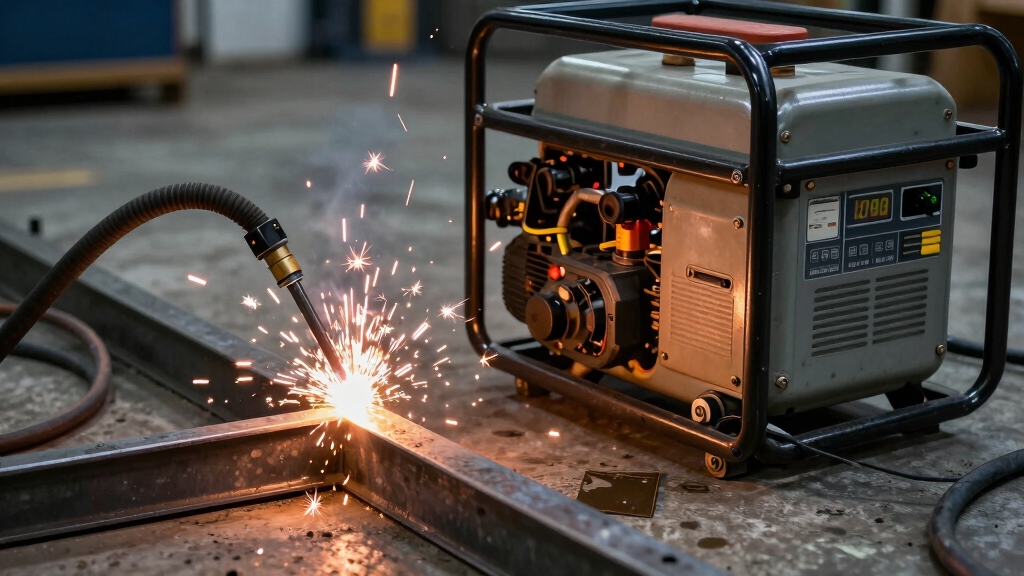
You can run a welder on a generator if you correctly size it based on the welder’s voltage, current, and efficiency.
Account for both running watts and startup surge, which can spike 2–3 times higher. Match generator capacity above continuous power by 25–30% to guarantee stable voltage and avoid arc interruptions.
Inverter welders require smaller generators due to higher efficiency. Fuel type and power quality also affect performance and reliability.
Understanding these details optimizes your welding setup and equipment longevity.
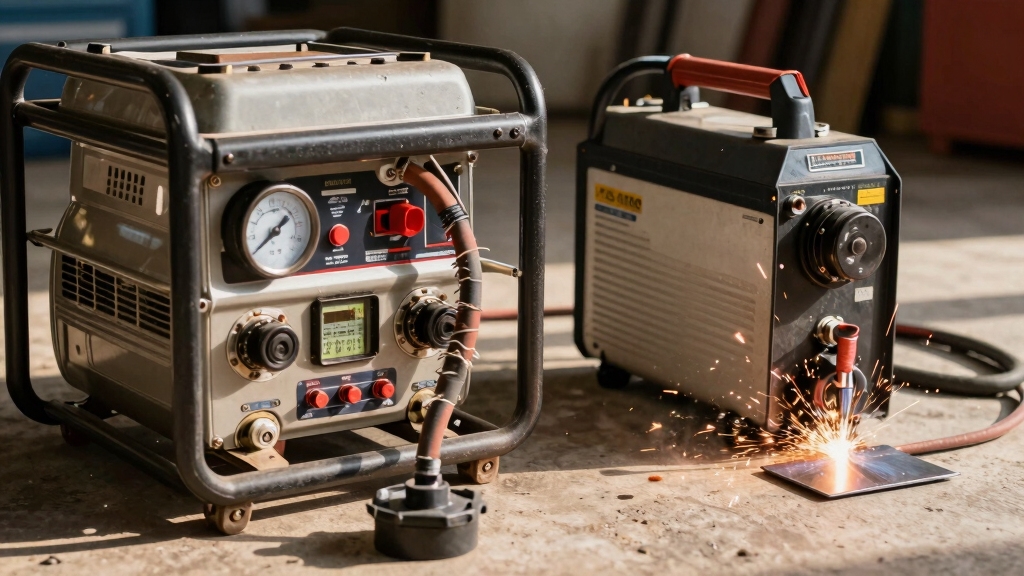
To accurately calculate power needs for welders and generators, you must first determine the welder’s voltage and current requirements.
Start by identifying the welder’s voltage and current to calculate accurate power requirements.
Then convert these values into watts using the formula Volts × Amps = Watts. Locate the welder’s input power rating on its nameplate or manual for precise figures.
Account for a 15% safety margin on voltage to maintain supply stability. Recognize that running watts differ from peak watts due to efficiency variations, typically ranging between 50% and 90%.
This affects the actual power draw and generator sizing. By calculating baseline wattage and incorporating efficiency factors, you establish the minimum continuous power needed.
This foundational step guarantees your generator selection meets the welder’s operational demands without risking underperformance or damage to equipment.
Keep in mind that welding power sources deliver controllable current and voltage crucial for stable arc conditions and optimal performance.
Although you might’ve calculated the running wattage for your welder, you can’t overlook starting watts and surge capacity since welders demand markedly higher power during startup.
This surge can be 2-3 times the running watts, causing peak wattage to spike about 30% above continuous power. Ignoring these surges risks overloading your generator, tripping breakers, or causing voltage instability.
You must size the generator’s capacity to handle these transient peaks by factoring in both real and reactive power components reflected back during startup.
Properly accounting for starting watts guarantees stable arc quality and prevents equipment damage. Without this, even a generator with adequate running watts may fail under surge loads, undermining welding performance and safety.
Inverter welding machines feature built-in control circuits that help stabilize output despite fluctuations, making generator compatibility especially critical for these advanced units.
Understanding the power surges during welder startup highlights the importance of matching your generator size to the specific welder type and amperage. For instance, if you’re using a 140A welder, a generator with at least 5,000 watts is essential to handle running and surge loads.
MIG and flux-cored welders at lower amps can function on 3,000-watt units. However, heavy-duty stick welders operating near 160A at 220 volts demand generators rated around 50,000 watts to maintain stable voltage and prevent breaker trips.
For 200A welders, aim for generators of 12,000 watts or more. Always include a 25-30% safety margin above running watts to accommodate startup surges and avoid voltage drops that compromise weld quality. This guarantees your generator efficiently supports your specific welding amperage and type.
Welding 1/2″ steel typically demands stable 220–240 V supply to ensure arc stability and proper penetration, which should be considered when selecting a generator.
When it comes to choosing the right generator for your welder, efficiency plays a big role. You see, less efficient transformers tend to pull more input power compared to high-efficiency inverters. So, what does that mean for you? Well, transformer-based welders usually operate around 50-70% efficiency. This means you’ll need a larger generator to keep up with their power demands.
On the other hand, inverter welders are a different story. They typically run at 80-90% efficiency, which means you can get away with a smaller generator. So, if you want to avoid oversizing your generator or risking those pesky voltage drops, it’s crucial to adjust your generator size based on the efficiency of your welder. By doing this, you ensure reliable power delivery that meets your welding needs without any extra hassle. Additionally, ambient temperature changes can affect transformer resistance and efficiency, influencing the power requirements of your generator for stable welding performance and longer equipment lifespan through proper temperature management.
Since welder efficiency directly affects the amount of input power required, it plays a critical role in determining the appropriate generator size.
When a welder operates at lower efficiency, say 50-70%, it demands significantly more input watts than its output rating. This forces you to select a generator with higher capacity.
Conversely, high-efficiency inverter welders running at 80-90% reduce input power needs. This allows for smaller, more economical generators.
You must also consider the power factor. Welders with poor power factor reflect reactive current, increasing total amperage load on your generator.
Ignoring efficiency and power factor inflates generator sizing or risks underperformance. Thus, accurately evaluating welder efficiency and factoring in reactive power guarantees you choose a generator that delivers stable voltage and reliable welding performance without oversizing or overloading.
Additionally, balancing amperage and voltage is essential to maintain stable arc conditions and optimize power usage during welding.
Efficiency differences between transformer-based and inverter welders directly influence the generator capacity you need.
Transformer welders typically operate at 50-70% efficiency, demanding larger generators to accommodate higher power losses. In contrast, inverter welders reach 80-90% efficiency, reducing load on your generator and enabling smaller units.
Consider these factors when choosing between the two:
Transformer welders require generators with higher wattage due to lower efficiency and power factor.
Inverter welders produce cleaner power with less harmonic distortion, easing generator strain.
Generator sizing for transformers must include a larger safety margin to handle inefficiencies.
Inverters’ compact design and efficiency reduce total amperage draw, optimizing generator use.
Understanding these differences helps you select the right generator size for efficient, stable welding performance.
Proper setup and maintenance of the welding system, including power source connections, are essential to maximize efficiency and reduce generator load.
Adjusting your generator capacity depends heavily on the welder’s efficiency rating, as this directly impacts the power demand and overall load.
Transformer-based welders operate at 50-70% efficiency, meaning you’ll need a larger generator to compensate for energy losses.
In contrast, inverter welders achieve 80-90% efficiency, reducing required generator wattage.
To size your generator properly, calculate running watts using volts × amps.
Then apply a 15-30% safety margin to account for efficiency and starting surges.
Don’t forget to consider power factor and reflected reactive currents, which add to total amperage load.
Neglecting these factors can cause voltage drops or tripped breakers.
Ultimately, matching generator capacity to your welder’s efficiency guarantees stable voltage, consistent arc quality, and protects your equipment from overload.
Using inverter machines can also improve duty cycle management and overall welding performance when powered by a generator.
When setting up your welding equipment, it’s super important to include a safety margin of about 25-30% over your welder’s running watts. This extra buffer helps ensure that you maintain stable voltage, which is crucial for preventing any equipment failures down the line.
You see, those power surges and reactive loads can really mess with your voltage during operation. If you don’t have that safety margin in place, you might notice a drop in the quality of your welding arc and even have issues with generator reliability. So, taking that little extra step can make a big difference in your welding experience! It’s also essential to assess power demands to avoid voltage drops during high-amperage welding tasks.
Although your generator might meet the basic power requirements of your welder, incorporating safety margins is essential to protect your welding setup from voltage drops, equipment damage, and inconsistent arc performance.
Safety margins provide a buffer against electrical fluctuations and startup surges, ensuring stable operation.
Without them, you risk tripped breakers, reduced arc quality, and accelerated wear.
To safeguard your setup, consider these key factors:
Add 25-30% extra wattage beyond running power for consistent performance.
Include a 30% margin for starting wattage to handle surge demands.
Factor in reactive power and inefficiencies from transformer-based welders.
Choose a generator capacity exceeding calculated loads to maintain voltage stability.
Prioritizing safety margins optimizes reliability and extends the lifespan of both your generator and welder.
Regular maintenance and matching equipment duty cycles further enhance operational reliability and lifespan.
When your generator operates close to its maximum capacity without adequate safety margins, voltage instability is likely to occur. This can disrupt the consistent power delivery required for quality welding.
You need to maintain a 25-30% wattage buffer above running power to avoid voltage dips that can cause arc interruptions and poor weld penetration.
| Welding Setup | Running Watts | Recommended Generator Capacity |
|---|---|---|
| Low amperage MIG | 3,000 W | 3,900 – 4,000 W |
| Stick welder 140A | 5,000 W | 6,500 – 6,800 W |
| Heavy-duty 200A | 12,000 W | 15,600 – 16,000 W |
| Inverter welder | 4,000 W | 5,200 – 5,300 W |
| Flux-cored welder | 3,500 W | 4,550 – 4,700 W |
This margin guarantees stable voltage and prevents generator overload. It also protects your welding equipment from power surges.
Since fuel type directly influences generator efficiency and durability, selecting the right fuel source is critical for welding applications. Your choice affects runtime, power consistency, and maintenance demands, impacting welding quality and operational costs.
Consider these factors when evaluating fuel types:
Diesel: High efficiency and durability. Ideal for heavy-duty welding with longer runtime and better fuel economy.
Gasoline: Offers portability and easier refueling. However, it has lower efficiency and shorter engine life under continuous load.
Propane: Cleaner burning with reduced maintenance needs. Fuel availability and energy density may limit runtime.
Solar: Suitable for low-amperage welders. Zero fuel cost but limited output and dependence on environmental conditions.
Matching fuel type to welding demands optimizes generator performance. This ensures stable voltage and consistent arc quality. For example, using a generator with dual voltage input capability can enhance flexibility across various welding equipment requirements.
Yes, you can use a portable generator for welding outdoors, but you need to make certain it meets your welder’s power demands.
Check the welder’s running and starting wattage, then select a generator with at least a 25-30% safety margin above that.
For low-amperage MIG or flux-cored welders, a 3,000W generator might suffice.
Remember to account for surge capacity and maintain voltage stability to avoid arc disruptions and equipment damage.
Think of your generator as the heart pumping power to your welder. If you skip maintenance, it weakens, causing voltage drops and unstable current that ruin weld quality.
Regular oil changes, air filter cleaning, and checking spark plugs keep output steady. This prevents arc fluctuations and breaker trips.
Proper upkeep guarantees your generator maintains surge capacity and efficiency. This delivers consistent, reliable power essential for precise, high-quality welds every time you work.
Yes, inverter generators are quieter during welding because they use advanced electronics to regulate engine speed.
They run only as fast as needed, which reduces noise compared to conventional generators that operate at constant high RPM.
Additionally, inverter technology produces cleaner power with lower total harmonic distortion, improving welding quality.
Don’t underestimate safety gear; it’s your lifeline when linking generators with welders.
You must wear insulated gloves to prevent electric shocks and flame-resistant clothing to shield from sparks and heat.
Eye protection via welding helmets with proper shading is essential to avoid arc flash injuries.
Ear protection helps counter generator noise, while proper footwear guards against grounding hazards.
Always include respiratory protection if fumes accumulate, ensuring a safe, controlled welding environment.
Yes, you can run multiple welders on one generator, but only if its capacity exceeds the combined starting and running wattage of all welders plus a safety margin of at least 30%.
Calculate total amperage, including reactive power, to avoid overloads.
Undersized generators cause voltage drops, tripping breakers and reducing arc quality.
Always select a generator with sufficient surge capacity and continuous output to maintain stable voltage and protect your equipment.
You might think any generator can run your welder, but it’s precisely matching their power needs that matters. Coincidentally, overlooking starting watts or surge capacity often leads to underperformance or damage.
By carefully calculating your welder’s amps and factoring in efficiency, you make certain your generator size aligns perfectly. Don’t forget safety margins; they’re essential.
Fuel type also subtly shifts performance. So, get these details right, and your welding setup will run smoothly every time.