Phone:
(701)814-6992
Physical address:
6296 Donnelly Plaza
Ratkeville, Bahamas.

Phone:
(701)814-6992
Physical address:
6296 Donnelly Plaza
Ratkeville, Bahamas.

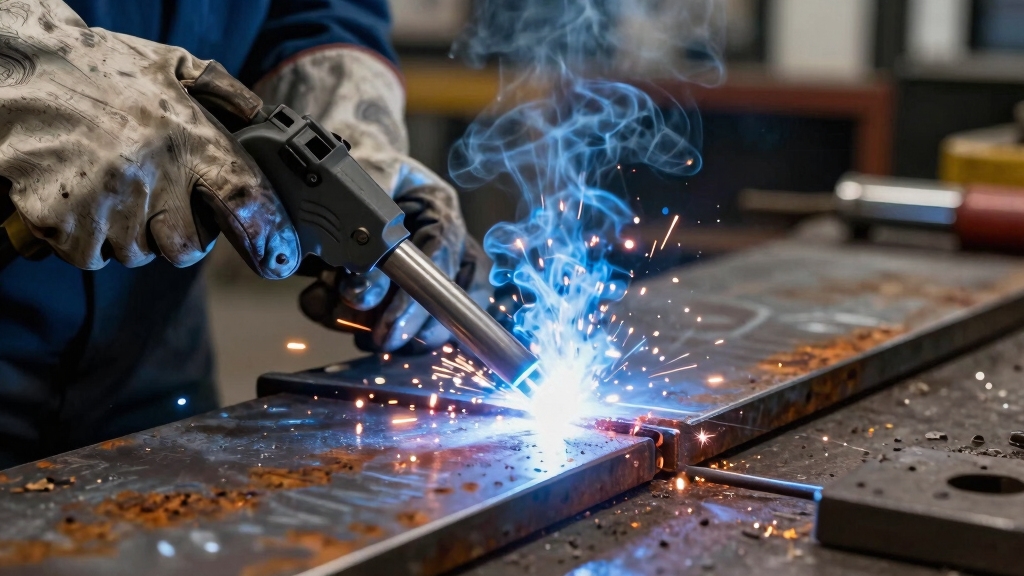
A flux core welder uses a continuously fed tubular electrode filled with flux that self-shields the weld pool, eliminating the need for external gas.
You’ll benefit from high deposition rates and slag protection, making it ideal for thick steel and outdoor jobs where gas cylinders are impractical.
Its constant-voltage system guarantees steady arc stability and penetration on dirty or rusted surfaces.
Understanding its operation, types, and maintenance can markedly improve your welding performance and efficiency.
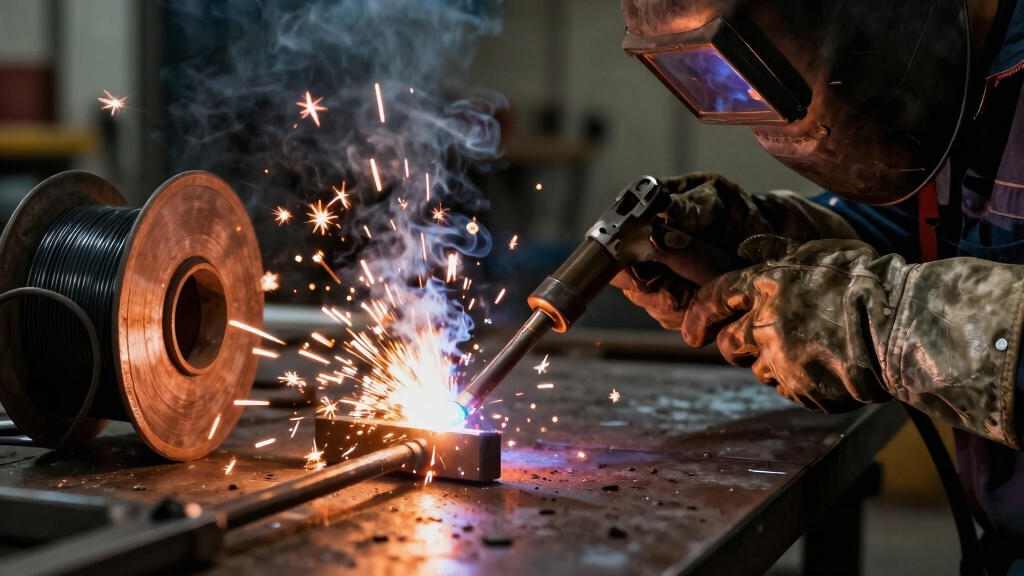
How does a flux core welder function to create strong, reliable welds? It uses a continuously fed tubular electrode filled with flux, combining MIG and stick welding features.
When you initiate the arc between the wire electrode and base metal, the flux inside the electrode melts. This generates shielding gas and slag that protect the weld pool.
Initiating the arc melts flux, producing shielding gas and slag that safeguard the weld pool.
Your wire feeder guarantees a steady supply of filler metal, which melts and fuses with the base material. The slag layer solidifies on top, trapping impurities and preventing oxidation during cooling.
This semi-automatic process employs a constant-voltage power source and delivers high deposition rates, even on contaminated surfaces. By understanding this mechanism, you achieve efficient, durable welds suitable for demanding construction or repair tasks.
Flux core welding benefits from semi-automatic operation that provides consistent welds with minimal spatter, reducing cleanup time.
When it comes to choosing the right flux core welder for your projects, it’s really important to match it to the specific demands you’re facing. Think about things like the thickness of the materials you’ll be working with, the position of your welds, and the environment where you’ll be welding. These factors can make a big difference!
Next, take a close look at some key features of the welder. You’ll want to consider the wire feed speed, power output, and the type of shielding it uses. These details are crucial for making sure everything is compatible and works efficiently.
Flux-cored wires are especially advantageous in outdoor or windy conditions because their self-shielding capabilities eliminate the need for external shielding gas.
Selecting the right flux core welder hinges on understanding your specific welding project requirements, including material type, thickness, and environmental conditions.
For example, if you’re working with thicker steel sections, you’ll need a welder with higher amperage capacity to guarantee adequate penetration and strong welds.
Consider whether your project demands portability for outdoor use, where self-shielded flux core welding excels due to its slag and gas protection without external shielding gas.
Analyze environmental factors such as wind or contaminants; these influence your choice between self-shielded and dual-shield flux core welders.
Also, factor in the material surface condition. Rust or dirt may require flux core welding’s inherent tolerance.
Accurately matching these parameters secures peak weld quality, efficiency, and project success.
Additionally, understanding the heat input control is crucial to prevent distortion and defects, especially when working with heat-sensitive materials.
Compare key features such as amperage range, duty cycle, and wire feed speed to match your flux core welder to project demands.
The amperage range dictates the thickness of materials you can weld; higher amperage accommodates thicker metals.
Duty cycle, expressed as a percentage, indicates how long the welder can operate continuously without overheating. Choose a higher duty cycle for extended use.
Wire feed speed controls deposition rate and weld bead consistency. Adjustable speeds allow precise control for different welding tasks.
Additionally, consider portability, power source compatibility (AC/DC), and spool size, as these affect efficiency and convenience.
Evaluating these technical specifications guarantees you select a flux core welder optimized for your specific projects, balancing performance, durability, and operational ease.
Keep in mind that amperage settings also influence consumable lifespan, so precise tuning can extend the life of wire tips and nozzles.
When preparing for flux core welding, understanding the essential equipment and consumables is vital for peak performance and weld quality.
Grasping key equipment and consumables is crucial for optimal flux core welding results.
You’ll need a reliable power source, typically a constant-voltage DC unit, to maintain a stable arc.
The wire feeder is critical; it delivers the flux-cored tubular electrode steadily into the weld joint, ensuring consistent deposition.
Your welding gun must precisely direct both the wire and the arc to the joint, while the ground clamp completes the electrical circuit.
Consumables primarily include spools of flux-cored wire, which vary by diameter and flux composition depending on the application.
Selecting the correct wire guarantees adequate shielding gas generation and slag formation.
Proper equipment calibration and matching consumables directly influence weld integrity, penetration, and slag removal efficiency.
Additionally, maintaining a secure and low-resistance connection with the ground clamp is essential for optimal arc stability and operator safety.
Although both self-shielded and dual-shield flux core welding share the core principle of using a flux-cored electrode, they differ fundamentally in their shielding methods.
Self-shielded welding relies exclusively on the flux inside the electrode to protect the weld pool. This makes it ideal for outdoor or windy environments where gas shielding might fail.
Dual-shield welding supplements the flux’s protection with an external shielding gas. This enhances weld quality, reduces slag, and improves arc stability.
| Feature | Self-Shielded | Dual-Shield |
|---|---|---|
| Shielding Method | Flux-generated gas only | Flux + external shielding gas |
| Application | Outdoor, windy conditions | Controlled indoor environments |
| Weld Quality | Moderate with slag formation | Superior with minimal slag |
Choosing the correct shielding gas mixture in dual-shield welding can significantly sharpen weld precision and reduce spatter.
Since both flux core and MIG welding utilize continuously fed wire electrodes and similar equipment setups, you might assume they function identically; however, the fundamental difference lies in their shielding methods and wire composition.
Flux core welding employs a tubular wire filled with flux that generates shielding gas and slag upon melting. This protects the weld pool without requiring an external gas supply in self-shielded variants.
Conversely, MIG welding uses a solid wire electrode and depends exclusively on an external inert gas for shielding.
This distinction affects performance: flux core welders excel on dirty or rusted surfaces and outdoor environments due to slag formation and self-generated gas.
MIG welders require cleaner conditions and consistent external gas flow. Additionally, flux core wires provide stronger welds with deoxidizing flux, while MIG offers cleaner welds without slag removal.
Furthermore, selecting the appropriate transfer mode in MIG welding, such as short circuit or pulsed MIG for thin materials, is critical for optimal weld quality and spatter control.
Flux core welding really shines when it comes to outdoor projects. Why? Well, it has this awesome self-shielding flux that protects the weld pool from wind and other contaminants. This means you don’t have to fuss with external gas, making it super convenient.
Think about construction sites, shipyards, and pipeline projects—places where the weather can change at the drop of a hat. With flux core welding, you can get the job done without worrying about those unpredictable conditions. Additionally, understanding how to adjust voltage and wire feed is key to achieving consistent weld quality even in challenging environments.
Handling outdoor welding projects demands equipment that can perform reliably under variable weather conditions. Flux core welding excels here due to its self-shielded flux, which produces protective slag and shielding gas. This eliminates the need for external gas cylinders vulnerable to wind.
This makes it highly resistant to rain, wind, and dust. It ensures consistent weld quality and reduces the risk of porosity.
| Weather Factor | Flux Core Welding Benefit |
|---|---|
| Wind | Self-shielding flux prevents contamination |
| Rain | Slag protects molten weld pool |
| Dust | Flux barrier minimizes inclusions |
| Temperature | Stable arc performance in cold/hot |
| Mobility | Portable setup adapts to conditions |
Additionally, proper electrode selection and cooling are critical to maintaining weld quality under varying outdoor conditions, ensuring consistent heat generation during the welding process.
This durability allows you to maintain productivity and weld integrity in challenging environments. You can do this without extensive protective measures.
Explore how flux core welding’s design inherently suits demanding outdoor environments, making it a preferred choice for various field applications.
Its self-shielding capability eliminates the need for external gas, allowing you to weld efficiently even in windy or dusty conditions where traditional MIG processes struggle.
You’ll find flux core welding indispensable in construction, shipbuilding, pipeline installation, and repair work, where portability and high deposition rates are critical.
Additionally, the process tolerates dirty or rusty surfaces, reducing preparation time on-site.
This versatility enables you to achieve strong, consistent welds on thick structural steel and heavy equipment outdoors.
Its ability to operate without external shielding gas makes it especially valuable for outdoor use where gas protection is difficult to maintain.
Consistently achieving strong, clean flux core welds requires precise control over parameters such as wire feed speed, voltage, and travel angle.
You should adjust wire feed speed to match the voltage setting. A mismatch can lead to undercut or excessive spatter.
Maintain a travel angle between 10 to 15 degrees from vertical to guarantee proper penetration and slag coverage.
Control your travel speed; too fast results in weak fusion, while too slow causes excessive buildup and slag inclusions.
Keep the nozzle clean and free from spatter to maintain prime gas and slag shielding.
Position the gun about ¾ inch from the workpiece to stabilize the arc.
Finally, use appropriate electrode diameter and polarity settings tailored to your material thickness to maximize weld integrity and minimize defects.
Mastering the correct settings and techniques for flux core welding is only part of the equation. Making certain your equipment operates reliably requires regular maintenance and prompt troubleshooting.
You need to inspect the wire feed system frequently to prevent jams and ensure consistent wire delivery. Clean the welding gun nozzle regularly to avoid spatter buildup that can disrupt the arc. Check connections and cables for wear or damage to maintain stable electrical flow.
Key maintenance and troubleshooting steps include:
Wire Feed Inspection: Clear debris and verify tension to prevent wire slipping.
Nozzle Cleaning: Remove spatter to maintain arc stability and weld quality.
Electrical Checks: Tighten connections and replace frayed cables to avoid intermittent faults.
These practices help maintain peak performance and extend your welder’s service life.
Flux core welding excels when working with a range of ferrous metals, particularly mild and low alloy steels. You’ll find it highly effective on carbon steel, which is the most common base metal in construction and manufacturing due to its weldability and strength.
Additionally, low alloy steels benefit from flux core welding’s deep penetration and slag coverage. These features enhance weld integrity in structural applications. While stainless steel can be welded using specialized flux-cored wires, you must select the correct electrode to prevent contamination and maintain corrosion resistance.
Flux core welding is less suited for non-ferrous metals like aluminum unless using dedicated wires and equipment. Overall, your material choice should align with the electrode type to optimize weld quality, strength, and durability in demanding environments.
You need a welding helmet with a proper shade lens to protect your eyes from intense UV and infrared radiation.
Wear flame-resistant gloves and a long-sleeve jacket to shield your skin from sparks and heat.
Use safety boots and pants made from non-flammable materials.
Respiratory protection is vital because flux-cored welding emits fumes. Use a respirator or ensure adequate ventilation.
Don’t forget ear protection in noisy environments to safeguard your hearing.
Think of your flux core welding wire spool as a river that flows steadily but will eventually run dry.
Typically, a standard 10-pound spool lasts about 20 to 25 hours of continuous welding, depending on your wire feed speed and welding current.
High feed rates or thicker welds consume wire faster.
Monitoring your usage closely helps you anticipate spool changes, ensuring uninterrupted work and consistent weld quality throughout your project.
Yes, you can automate flux core welding for large-scale production. The continuous wire feed and semi-automatic nature make it ideal for mechanization.
You’ll integrate wire feeders, programmable power sources, and robotic arms to maintain consistent weld quality and high deposition rates. Automation enhances efficiency, especially in shipbuilding or pipeline manufacturing, where repetitive, thick welds are common.
You’ll also reduce operator fatigue and guarantee precise control over welding parameters throughout the process.
Imagine inspecting a weld revealing tiny pinholes or a brittle surface. Those are porosity and cracking, common flux core defects.
You’ll also encounter slag entrapment, where slag remains trapped inside the weld, weakening it.
Incomplete fusion or lack of penetration occurs if you don’t control heat or wire feed properly.
These unique flaws arise because flux core welding’s molten slag and gas shielding must be precisely managed to guarantee strong, defect-free welds.
Temperature markedly impacts flux core welding performance by influencing arc stability and weld penetration.
If the ambient or base metal temperature is too low, you’ll experience poor fusion and increased spatter due to slower flux activation.
Conversely, high temperatures can cause excessive melt-off, weakening the weld pool.
Maintaining ideal temperature guarantees consistent slag formation and proper gas shielding.
This is essential for defect-free, strong welds with reliable mechanical properties.
Now that you know what a flux core welder brings to the table, you’re equipped to tackle projects with precision and confidence.
Like a reliable compass in the welding world, it guides you through challenging outdoor conditions and varied materials.
By choosing the right type, maintaining your gear, and mastering techniques, you’ll guarantee strong, clean welds every time. Remember, the right flux core welder isn’t just a tool; it’s your partner in craftsmanship.