Phone:
(701)814-6992
Physical address:
6296 Donnelly Plaza
Ratkeville, Bahamas.

Phone:
(701)814-6992
Physical address:
6296 Donnelly Plaza
Ratkeville, Bahamas.

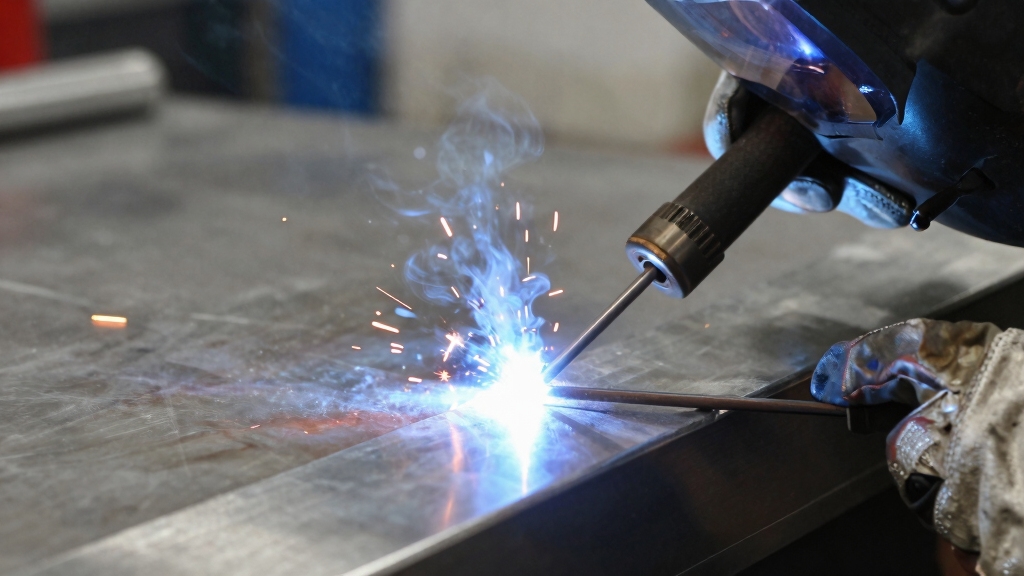
To weld stainless steel effectively, choose TIG welding for thin, precise jobs and MIG for thicker, faster applications.
Prepare by thoroughly cleaning and beveling edges, matching filler metals to the stainless grade.
Calibrate equipment precisely, setting amperage around 1 amp per 0.001″ thickness for TIG.
Control heat input and travel speed carefully to avoid distortion and defects.
Maintaining proper torch angles and shielding gas guarantees corrosion resistance.
Mastering these steps sets the foundation for optimizing your weld quality and durability.
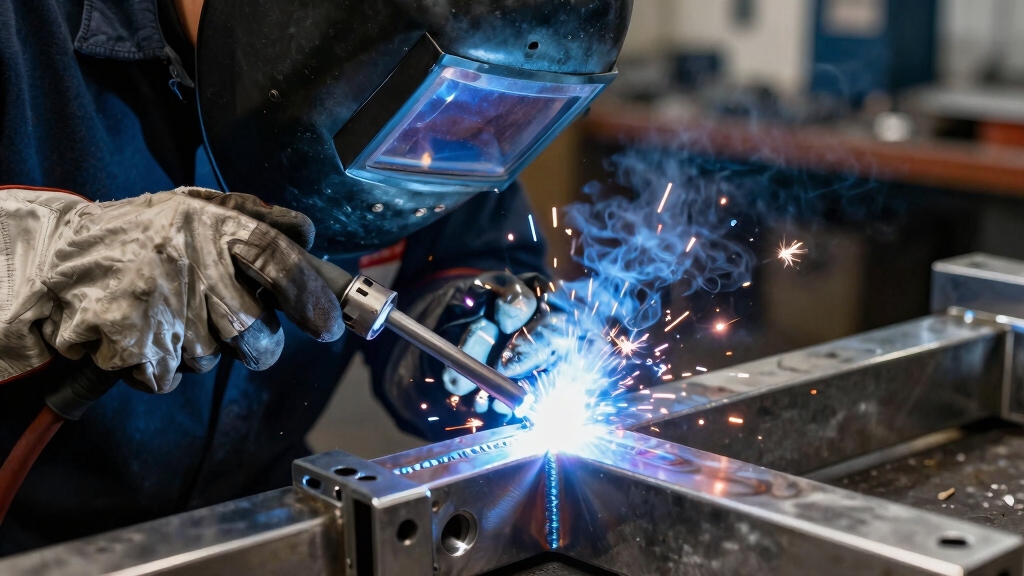
Selecting the best welding process for stainless steel hinges on analyzing your project’s specific requirements, including material thickness, desired weld quality, and production speed.
Choosing the right welding process depends on material thickness, weld quality, and production speed.
If you’re working with thin materials needing precision and aesthetics, TIG welding is your ideal choice due to its fine control and clean results.
For thicker sections where speed and cost efficiency matter, MIG welding offers a faster, more economical solution without compromising strength.
Stick welding suits home or low-budget projects involving thick pieces but lacks finesse on thin materials.
Additionally, consider your skill level; TIG demands more expertise, whereas MIG and Stick provide more straightforward operation.
Balancing these factors guarantees you select a process that maximizes weld integrity, minimizes distortion, and aligns with your production goals for stainless steel fabrication.
Proper shielding gas and gas delivery is essential to prevent oxidation and maintain corrosion resistance during stainless steel welding.
Before welding stainless steel, you must prepare the material meticulously to guarantee strong, clean welds and prevent contamination.
Start by thoroughly cleaning the surface to remove oils, dirt, and oxides. Use a stainless steel wire brush or a chemical cleaner dedicated to stainless.
For thick sections, bevel edges at a 60-degree angle and create a root opening to secure proper penetration.
Secure the pieces firmly using clamps or tack welds to prevent movement during welding.
Match the filler or electrode to the stainless grade, such as 308 or 316, to maintain corrosion resistance.
Make certain your workspace is well-ventilated to avoid contaminant buildup.
Avoid introducing carbon steel brushes or contaminants that can cause weld discoloration or corrosion.
Proper preparation minimizes defects and ensures structural integrity.
Ensure a uniform root gap of about 1/8 in. to promote consistent root penetration and prevent oxidation during welding.
Evaluate your welding project’s specific needs carefully to determine the most suitable equipment. Analyze material thickness, desired weld quality, and your skill level.
For precision and thin stainless steel, choose TIG welding with pulse capability between 0.5 and 50 Hz to minimize distortion.
Make certain your tungsten electrode is clean and sharp. Set DCEN amperage at 1 amp per 0.001 inch thickness.
If working with thicker stainless, MIG welding offers speed and cost benefits. Use the push technique for better visibility and bead control.
For low-cost or home projects involving thick pieces, Stick welding with Arc Force Control can be effective. Avoid it on sheets thinner than 2 mm due to poor control.
Match electrodes or filler metals precisely to the stainless grade, like 308 or 316, to ensure weld integrity.
Also, selecting the correct shielding gas mixture is crucial to protect the chromium oxide layer and achieve a stable arc during MIG welding.
To get clean and strong stainless steel welds, it’s super important to keep your welding angles just right—usually around 90 degrees, with a few slight adjustments as you travel. This helps ensure you get proper penetration and a good bead shape.
Now, let’s talk about heat input. You really want to manage that carefully. Too much heat can cause distortion and mess with the corrosion resistance of the stainless steel, which is definitely not what you want.
Also, don’t forget about your welding speed! Keeping it consistent is key. If you go too fast or too slow, you might end up with defects, and nobody wants a wobbly weld profile. So, take your time, and make sure everything flows smoothly!
Using low heat input welding methods like TIG or pulsed MIG can help minimize distortion and preserve corrosion resistance in your stainless welds.
When welding stainless steel, maintaining the correct gun or electrode angle is essential for producing clean, strong welds with proper penetration and minimal distortion.
For MIG welding, hold the gun at 90 degrees perpendicular to the joint, with a 5 to 15-degree travel angle to optimize bead shape and control metal transfer.
With TIG, position the tungsten electrode at about 15 degrees from vertical, directing the arc precisely to establish a stable puddle.
Stick welding demands a 90-degree electrode angle with a slight drag and minor weaving on vertical joints to guarantee uniform penetration.
Deviating from these angles risks incomplete fusion, excess spatter, or distortion.
Consistently maintaining ideal angles improves heat distribution, weld bead appearance, and mechanical properties, essential for stainless steel’s corrosion resistance and structural integrity.
For MIG welding stainless steel, it is important to use DCEP polarity to ensure deep penetration and stable arc characteristics.
Controlling heat input is critical for welding stainless steel. Excessive heat can cause warping, reduced corrosion resistance, and weakened mechanical properties.
You should balance amperage, travel speed, and pulse settings to minimize heat-affected zones. Using pulse TIG welding at 0.5–50 Hz helps reduce distortion on thin materials.
MIG’s push technique improves bead control with moderate heat input. Always match your settings to stainless thickness and joint design.
| Parameter | Effect on Heat Input | Recommended Adjustment |
|---|---|---|
| Amperage | Directly increases heat | Use 1 amp per 0.001-inch thickness |
| Travel Speed | Inversely affects heat input | Increase speed to reduce heat |
| Pulse Frequency | Controls heat cycles | Use higher frequencies for thin materials |
Managing heat input also helps limit carbide precipitation that compromises corrosion resistance in stainless steel welds.
Manage heat precisely to ensure clean, strong welds.
Consistently maintaining welding speed plays a crucial role in achieving clean and strong stainless steel welds.
When you control your travel speed precisely, you prevent excessive heat buildup that causes warping or discoloration.
For TIG welding, matching amperage to your speed guarantees an ideal puddle size, minimizing undercut or burn-through.
In MIG, a steady speed combined with the correct gun angle maintains a stable arc and uniform bead profile.
Variations in speed can lead to uneven penetration, slag inclusion, or weak fusion zones.
You should practice maintaining a rhythm that balances speed with control, especially on thin stainless where heat sensitivity is critical.
Employing pulse TIG or short stringer beads helps you regulate speed effectively, resulting in welds that are structurally sound and visually consistent.
For stainless steel, using pulsed MIG transfer can provide controlled heat input and reduced spatter, which is beneficial for thin to medium thickness materials.
When working with stainless steel, it’s super important to set your amperage just right. A good rule of thumb is about 1 amp for every 0.001 inch of material thickness when using TIG. If you don’t get this right, you might end up with too much heat, which can lead to distortion.
Now, let’s talk about travel speed. This one is crucial too! If you go too fast, you could end up with weak fusion, and nobody wants that. On the flip side, moving too slowly can cause burn-through and warping.
Using DCEN polarity is generally preferred for stainless steel TIG welding because it concentrates heat on the workpiece, producing deeper penetration and reducing electrode wear.
Although ideal amperage varies with material thickness and welding method, setting the correct current is essential to achieving strong, clean stainless steel welds.
For TIG welding, use approximately 1 amp per 0.001 inch of thickness, allowing precise control and minimizing heat input to prevent warping.
MIG amperage depends on wire diameter and thickness; increase amperage for thicker materials but avoid excessive heat that causes burn-through.
Stick welding requires higher amperage to maintain arc stability, especially on thick stainless steel, but be cautious to prevent slag inclusion.
Adjust amperage incrementally, observing weld bead formation and penetration, guaranteeing consistent fusion without distortion.
Remember, precise amperage settings optimize weld quality, reduce defects, and maintain stainless steel’s corrosion resistance and mechanical properties.
Always calibrate your machine before welding to assure amperage accuracy.
Using inverter technology can further improve arc control and reduce heat distortion during welding.
Adjusting amperage sets the foundation, but controlling travel speed directly influences bead shape, penetration, and heat distribution in stainless steel welding.
If you move too slowly, excess heat causes warping and excessive penetration, risking burn-through and distortion. Conversely, too fast travel speed results in inadequate fusion, weak joints, and a narrow, convex bead profile.
You need to match your travel speed to the selected amperage and material thickness precisely. For TIG welding thin stainless, a steady, moderate pace with pulse settings minimizes heat input, preserving base metal integrity.
When MIG welding thicker sections, maintain a consistent, slightly faster travel speed to optimize deposition without overheating.
Monitor your weld puddle carefully, adjusting speed dynamically to maintain uniform bead width, prevent undercut, and guarantee peak mechanical properties in your stainless steel welds.
Using argon-nitrogen blends in TIG welding helps stabilize the arc and improve bead appearance when working with stainless steel.
When welding stainless steel, preventing common defects requires strict control over heat input, cleanliness, and technique. You must maintain proper amperage to avoid warping and distortion. Clean the base metal and filler materials thoroughly to prevent contamination and porosity.
Consistent travel speed and correct electrode angle reduce undercut and incomplete fusion.
| Defect | Cause | Prevention Method |
|---|---|---|
| Porosity | Contamination, moisture | Clean surfaces, dry materials |
| Cracking | Excess heat, rapid cooling | Control heat, preheat if needed |
| Undercut | Incorrect travel speed, angle | Maintain steady speed, angle |
| Lack of fusion | Low amperage, poor technique | Adjust settings, proper technique |
| Warping | Excessive heat input | Use pulse TIG, control heat |
Controlling these factors guarantees durable, defect-free welds.
Preventing defects like porosity, cracking, and undercut lays the groundwork for achieving a professional stainless steel weld finish.
You must maintain consistent travel speed and torch angle, typically 90 degrees for TIG and 5-15 degrees travel angle for MIG, to ensure uniform bead shape and penetration.
Use pulse TIG to control heat input and minimize distortion on thin sections.
Clean each pass thoroughly to avoid slag inclusion and maintain tungsten cleanliness for sharp arc control.
Employ stringer beads on thin material and J-weave on thick sections to optimize fusion without excessive heat.
Adequate shielding gas flow is critical to prevent oxidation and discoloration.
Finally, practice steady hand movement and appropriate filler metal selection matched to the base stainless grade to secure a defect-free, aesthetically smooth weld finish.
You need a welding helmet with a proper shade to protect your eyes from intense UV and infrared light.
Wear flame-resistant gloves and a long-sleeve jacket to shield your skin from sparks and molten metal.
Use respiratory protection, like a respirator or adequate ventilation, to avoid inhaling hazardous fumes.
Don’t forget ear protection in noisy environments.
Always make sure your clothing fits snugly to prevent accidental ignition during stainless steel welding.
Weather conditions can markedly impact your stainless steel welding. Wind can disturb shielding gas coverage, causing oxidation and weld defects.
Cold temperatures may increase metal brittleness and slow cooling rates, affecting weld quality. High humidity can introduce moisture, leading to porosity and hydrogen embrittlement.
To guarantee consistent results, weld in controlled environments or use windshields. Preheat as needed and maintain proper gas flow to protect your weld pool effectively.
You generally can’t weld stainless steel without shielding gas if you want quality results.
Shielding gas protects the weld pool from atmospheric contamination, preventing oxidation and carbide precipitation. Without it, your weld risks porosity, brittleness, and corrosion.
However, stick welding with specialized electrodes can work without external gas but is limited to thick sections and less aesthetic applications.
For precision or thin stainless, shielding gas is essential to maintain weld integrity.
You improve stainless steel corrosion resistance after welding by performing passivation with nitric or citric acid to remove free iron and enhance the chromium oxide layer.
Electrochemical polishing smooths the surface, reducing corrosion sites.
Additionally, cleaning welds to eliminate slag and spatter prevents crevice corrosion.
Stress-relief heat treatments can also reduce susceptibility to intergranular attack.
These steps collectively restore stainless steel’s protective qualities post-weld.
Picture the shiny surface reflecting light differently; this subtle clue helps you identify stainless steel grades. Use a magnet: austenitic grades like 304 or 316 are non-magnetic, while ferritic or martensitic types attract it.
Check mill test reports or stamping for grade numbers. You can also perform a spark test; different grades produce distinct spark patterns.
Combining these methods guarantees you precisely match filler materials and welding parameters to the specific stainless grade.
When welding stainless steel, remember: precision isn’t just a goal; it’s your shield against defects.
By carefully preparing your material, selecting the right equipment, and fine-tuning welding parameters, you guarantee clean, durable welds.
Each step is a calculated move in a complex dance, where technique and control dictate success.
Master these elements, and your stainless steel welds won’t just hold; they’ll stand the test of time with professional strength and flawless finish.