Phone:
(701)814-6992
Physical address:
6296 Donnelly Plaza
Ratkeville, Bahamas.

Phone:
(701)814-6992
Physical address:
6296 Donnelly Plaza
Ratkeville, Bahamas.

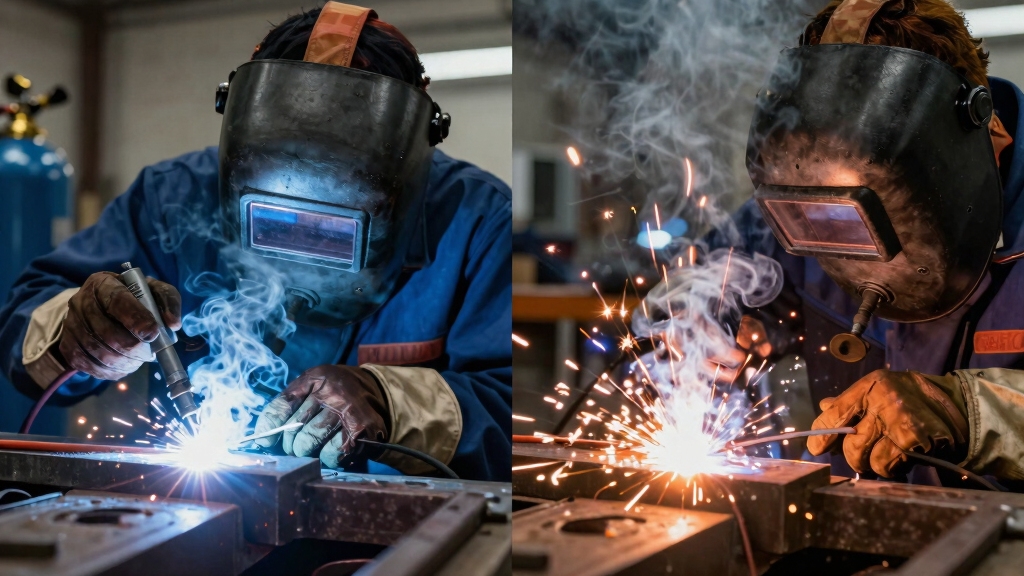
You’ll find gas MIG welding offers stable arcs, cleaner welds, and minimal spatter, thanks to external shielding gas. This makes it ideal for controlled indoor settings and quality-critical projects.
Gasless MIG eliminates gas cylinders, boosting portability and suitability for outdoor or windy conditions. However, it produces more spatter and slag, requiring added cleanup.
Equipment setup and cost also differ markedly between methods. Understanding these trade-offs guarantees you pick the best process for your application’s demands and environment.
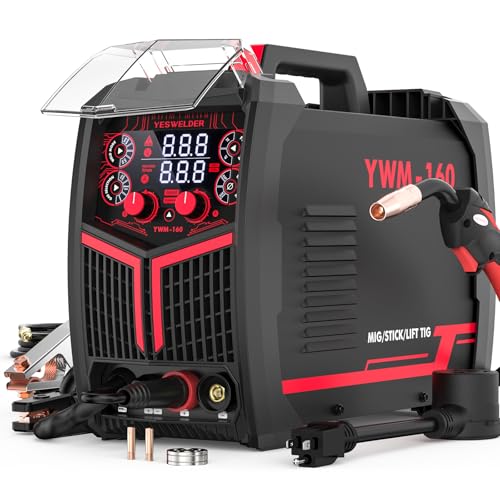

| Feature | Gas MIG Welding | Gasless MIG Welding |
|---|---|---|
| Shielding Method | Uses external shielding gas | Uses flux-cored wire that creates shielding gas |
| Weld Quality | Cleaner welds with less spatter | More spatter and slag formation |
| Arc Stability | More stable and consistent arc | Slightly less stable arc |
| Outdoor Use | Less effective in windy conditions | Excellent for outdoor welding |
| Portability | Less portable due to gas cylinder | Highly portable and easy to move |
| Setup Complexity | Requires regulator, hose, and gas cylinder | Simple setup without gas equipment |
| Cleanup Required | Minimal cleanup needed | Extra slag removal required |
| Initial Cost | Higher setup cost | Lower initial setup cost |
| Operating Cost | Ongoing gas refill expense | Higher flux wire cost |
| Best For | Indoor precision welding | Outdoor repair and field work |
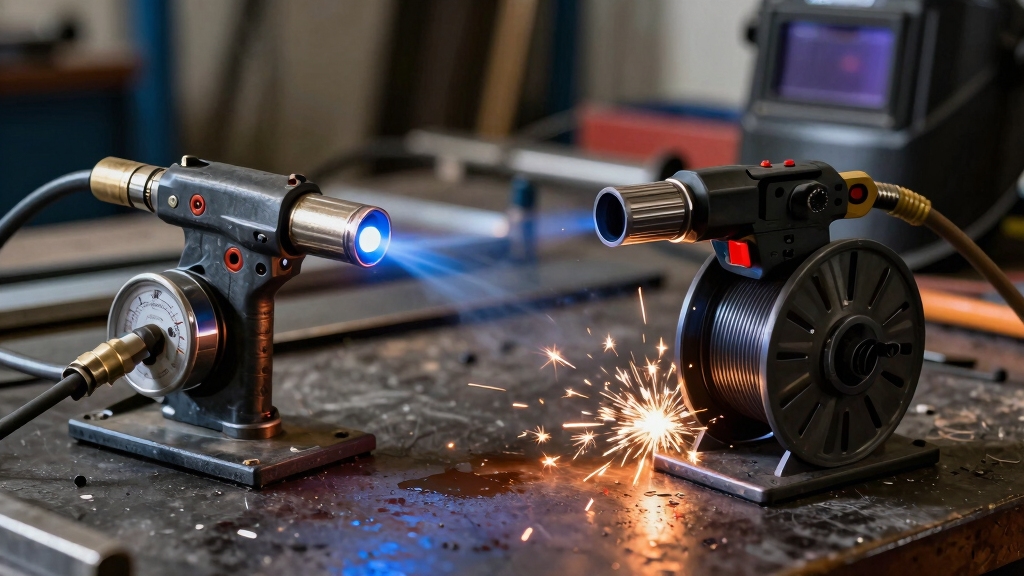
Although both gas and gasless MIG welding share the basic principle of using a continuously fed wire electrode, they differ markedly in shielding methods and operational environments.
Gas and gasless MIG welding both use continuous wire feed but differ in shielding and usage environments.
With gas MIG, you rely on an external shielding gas that protects the molten weld pool from atmospheric contamination. This results in stable arcs, cleaner welds, and reduced spatter.
This method is ideal for thin materials and indoor use due to its superior weld quality and lower fumes.
In contrast, gasless MIG employs flux-cored wire, which generates protective gas through flux decomposition. This eliminates the need for external gas cylinders.
However, this creates slag that requires manual removal and produces more fumes and spatter, compromising weld aesthetics.
As a result, gasless MIG is primarily suited for outdoor or rugged conditions. Understanding these functional distinctions helps you select the appropriate process for your welding task.
In addition, gas MIG provides precise control and repeatability that are crucial for complex geometries and diverse material thicknesses.
When you’re getting ready for gas MIG welding, there’s a bit more to think about. You’ll need extra gear, like gas cylinders and regulators. This can make your setup bulkier and limit how easily you can move around.
On the flip side, gasless MIG welding simplifies things quite a bit. You won’t have to worry about any external gas, so your setup is more compact and much easier to transport.
This difference might seem small, but it really affects your convenience and efficiency, especially when you’re working in remote spots or outdoors. So, if flexibility is your priority, gasless might just be the way to go!
However, it’s important to note that gas MIG welding typically requires a reliable flowmeter and proper gas flow settings to prevent porosity and ensure weld quality.
Setting up gas MIG welding requires you to manage additional equipment like gas cylinders, regulators, and hoses. This adds complexity and weight to your rig.
You must guarantee proper connections and pressure settings for consistent shielding gas flow. This demands meticulous attention to hardware integrity and safety protocols.
Conversely, gasless MIG welding eliminates the need for an external gas supply. It relies on flux-cored wire that self-shields through flux decomposition.
This simplification reduces your equipment footprint and minimizes setup time. However, it requires a machine capable of polarity reversal and feeding flux wire.
While gas MIG setups prioritize stable shielding and weld quality, gasless setups favor equipment simplicity and reduced gear.
Your choice influences not only initial assembly but also maintenance demands and operational readiness.
Choosing the correct shielding gas, such as argon and CO2 blends, is essential for optimizing weld quality in gas MIG welding.
You’ll find that gasless MIG welding markedly cuts down on setup complexity and boosts portability by eliminating the need for external gas cylinders and related accessories.
Without bulky gas tanks, you can easily transport and deploy the welder in remote or windy environments where gas shielding proves problematic.
In contrast, gas MIG welding requires you to manage compressed gas cylinders, regulators, and hoses, which increase setup time and reduce mobility.
This added equipment demands careful handling and limits your operational range, particularly outdoors.
While gas MIG offers cleaner welds, its setup constraints hinder convenience.
Gasless MIG’s self-shielding flux-cored wire streamlines your workflow, especially on job sites lacking infrastructure.
Consequently, if mobility and rapid deployment are priorities, gasless MIG welding provides a distinct advantage over gas-shielded systems.
However, achieving optimal weld quality with gas MIG requires careful adjustment of voltage and wire feed to ensure arc stability and bead consistency.
Although gas MIG welding requires additional equipment and setup, it excels in applications demanding high-quality, clean welds with minimal post-weld cleanup.
You should opt for gas MIG when working indoors or in controlled environments where shielding gas remains stable. This guarantees arc consistency and weld integrity.
Choose gas MIG welding indoors to ensure stable shielding gas, consistent arcs, and high weld integrity.
It’s especially advantageous on thin or fine materials where precision and appearance matter.
Use gas MIG welding when you need superior weld bead aesthetics without slag or spatter.
You’ll benefit from reduced fumes and cleaner work conditions.
Enhanced arc stability is crucial for delicate or critical welds.
Choosing gas MIG welding guarantees you achieve strong, visually appealing joints with less post-weld finishing.
Its controlled shielding gas environment optimizes weld quality, making it the preferred choice for industrial and professional workshop settings.
Additionally, proper shielding gas selection plays a critical role in minimizing spatter and ensuring arc stability.
While gas MIG welding offers superior control and clean results indoors, it struggles in outdoor environments where wind can disperse the shielding gas. This compromises weld quality.
You’ll find gasless MIG welding, which uses flux-cored wire, excels outdoors because it doesn’t rely on external shielding gas. The flux coating decomposes during welding, generating protective gases that shield the molten pool effectively even in gusty conditions.
This eliminates concerns about gas cylinder management and wind interference. Although gasless MIG produces more slag and fumes, its self-shielding capability guarantees consistent arc stability and weld penetration outdoors.
If you work in remote or exposed sites, gasless MIG’s portability and resilience to environmental factors make it the practical choice. It minimizes setup complexity and guarantees reliable welds despite unpredictable weather. Flux-cored wires are preferred for outdoor use due to their self-shielded capabilities, which provide protection without external gas.
When evaluating weld quality between gas and gasless MIG welding, you need to take into account factors like arc stability, weld cleanliness, and visual finish.
Gas MIG welding offers a stable arc and a shielding gas that protects the weld pool from contamination. This results in cleaner, spatter-free welds with superior aesthetics.
Gas MIG welding ensures a stable arc and clean, spatter-free welds with excellent visual quality.
In contrast, gasless MIG welding relies on flux-cored wire, which produces slag and more spatter. This compromises the weld’s cleanliness and visual appeal.
Key quality differences include:
Arc stability: gas MIG provides consistent, stable arcs; gasless is more erratic.
Weld cleanliness: gas MIG yields slag-free welds; gasless generates slag needing removal.
Visual finish: gas MIG produces smoother, more refined weld beads; gasless appears rougher and less uniform.
You’ll find gas MIG preferable for quality-critical applications. For optimal results, choosing the appropriate transfer mode based on material thickness and welding position is essential to balance heat input and spatter control.
Understanding weld quality differences between gas and gasless MIG welding naturally leads to examining their cleanup and post-weld finishing requirements.
With gas MIG welding, you’ll find minimal spatter and no slag, so cleanup is straightforward. Usually, just a quick wire brush is needed to remove minor oxidation. This results in a smoother surface and reduces finishing time.
Conversely, gasless MIG welding generates significant slag that adheres tightly to the weld bead. This demands manual removal with a chipping hammer or wire brush. The slag must be thoroughly cleared to inspect weld integrity and prepare for subsequent passes or coating.
Additionally, gasless welding produces more spatter, requiring extra grinding or cleanup to achieve acceptable aesthetics. Understanding these differences helps you allocate appropriate post-weld labor and select the right method for your project’s finish quality.
Regular equipment maintenance and fine-tuning of voltage and wire speed settings can help reduce spatter and improve overall weld quality in both methods.
Evaluating cost factors plays a crucial role in choosing between gas and gasless MIG welding for your project.
Gas MIG welding demands an initial investment in gas cylinders, regulators, and hoses, increasing setup costs. You’ll also face recurring expenses for gas refills and potential rental fees.
Conversely, gasless MIG welding eliminates gas cylinder costs, making it more affordable upfront and portable. However, you must account for increased consumable wire prices and post-weld cleaning labor.
Consider these cost aspects carefully:
Additionally, ongoing consumable replacement such as contact tips and nozzles can significantly impact long-term operating costs.
Your choice hinges on balancing these cost dynamics with weld quality and application demands.
You need to prioritize ventilation during gasless MIG welding, as flux-cored wires emit more toxic fumes and smoke.
Wear a high-quality respirator to protect your lungs. Be prepared to manage slag removal safely using a chipping hammer and wire brush, wearing gloves and eye protection to avoid flying debris.
Also, make certain your welding machine supports flux wire polarity to prevent equipment damage and maintain consistent weld quality.
You can use gas MIG welding on many metals, but not all.
It works best on steel, stainless steel, and aluminum when paired with the right shielding gas and wire.
However, it’s less effective on certain exotic alloys or highly reactive metals without specialized gases or equipment.
Always match your gas type and wire to the metal to ensure proper arc stability, penetration, and weld quality for your specific application.
Humidity above 60% can increase weld porosity by up to 30%, seriously impacting weld integrity.
You’ll find gas welding more sensitive to humidity, as moisture disrupts the shielding gas coverage. This causes contamination and weaker welds.
Gasless welding’s flux core handles humidity better but produces more fumes and slag when damp.
To maintain weld quality, you must control moisture levels, dry consumables, and adjust parameters based on ambient humidity conditions.
Flux-cored wire fumes release higher levels of particulate matter and toxic gases like manganese and iron oxides.
You’ll inhale more harmful smoke, increasing respiratory risks and environmental pollution. These emissions contribute to poor air quality, especially indoors, demanding effective ventilation and protective gear.
Compared to other welding methods, flux-cored wire fumes pose greater health hazards. You must manage exposure carefully to minimize environmental and occupational impacts.
You should clean the contact tip and nozzle after every 5 hours of welding to maintain peak arc stability. Studies show over 30% of weld defects stem from poor maintenance.
Regularly inspect the gas supply and hoses for leaks. Replace liners every 20-30 pounds of wire usage.
Keeping the drive rolls clean and properly tensioned prevents wire feed issues. This ensures consistent weld quality and equipment longevity.
When choosing between gas and gasless MIG welding, consider that gas MIG welding offers up to 30% cleaner welds. This makes it ideal for precision work indoors.
However, gasless MIG excels outdoors, eliminating wind-related issues. Your setup and portability needs also matter; gasless setups are more compact.
By understanding these differences, you can optimize weld quality, minimize cleanup, and control costs effectively. This informed choice guarantees you get the best results for your specific welding environment and project demands.
Last update on 2026-10-01 / Affiliate links / Images from Amazon Product Advertising API