Phone:
(701)814-6992
Physical address:
6296 Donnelly Plaza
Ratkeville, Bahamas.

Phone:
(701)814-6992
Physical address:
6296 Donnelly Plaza
Ratkeville, Bahamas.

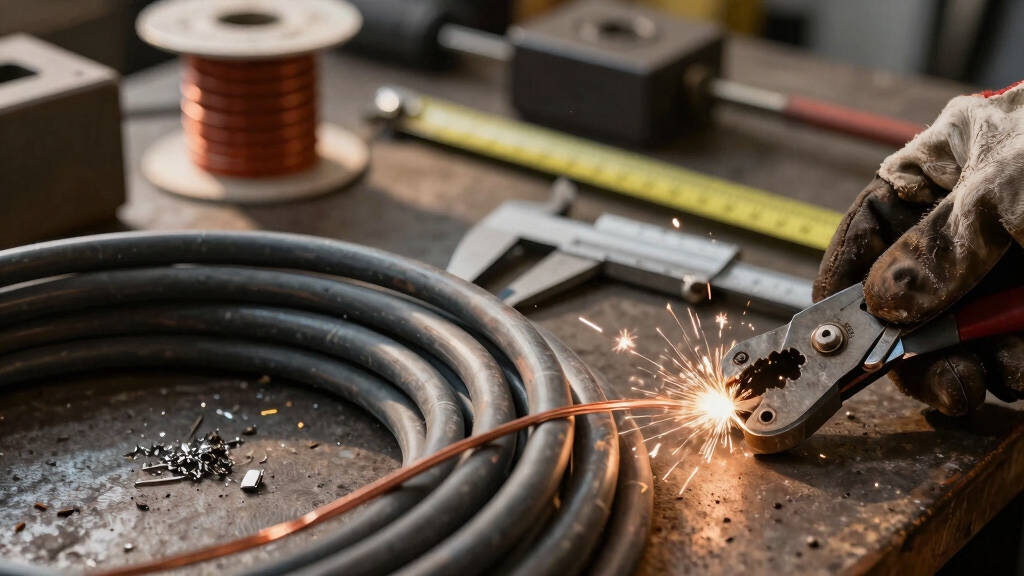
You determine welding cable size primarily by the total cable length, which affects voltage drop and resistance.
You also need to match cable gauge to your welder’s ampacity to prevent overheating.
Your duty cycle plays a key role, as higher duty cycles demand thicker cables for sustained current.
Ambient temperature and insulation type impact ampacity, requiring upsizing in hotter conditions.
Properly balancing these factors guarantees peak performance and safety. Exploring these intricacies reveals how to tailor cable selection precisely to your needs.
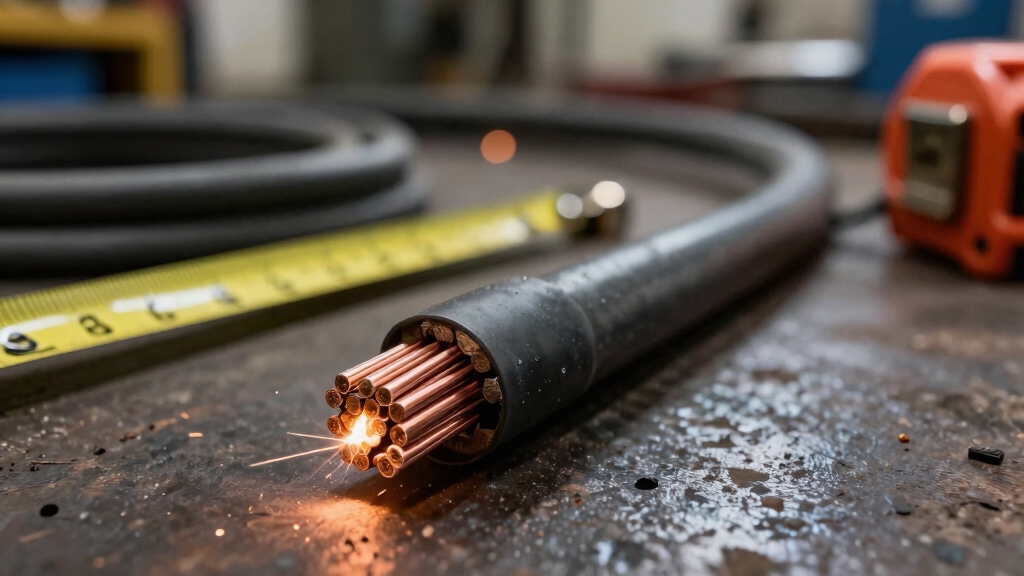
Because longer welding cables increase electrical resistance, you’ll need to size them larger to maintain ampacity and minimize voltage drop.
As cable length increases, resistance rises proportionally, causing greater voltage drop and reducing effective current at the arc.
To compensate, you should increase the cable gauge by one step roughly every 50 feet of total circuit length, which includes both the electrode and work lead.
For instance, a 4/0 AWG cable supports runs up to 50-75 feet at 405 amps; beyond that, a thicker cable is necessary.
Accurately measuring the total cable run guarantees you select a cable size that maintains peak welding performance and prevents overheating or power loss.
Ignoring length effects risks inadequate current delivery and potential equipment damage.
For runs longer than 50 feet, upgrading to a larger cable gauge helps reduce voltage drop and maintain welder performance.
Choosing the right cable gauge is crucial for handling the ampacity your welder needs without running the risk of overheating.
If you think about it, thicker cables actually have lower resistance. This is great because it helps improve heat dissipation and keeps the current flowing steadily.
So, when you pick the correct gauge, you’re not just making a choice—you’re directly impacting your welding performance and the longevity of your cables.
It really does make a difference!
Additionally, using cables that match the welder’s current stability requirements ensures optimal arc control and consistent weld quality.
When welding amperage increases, selecting the correct cable gauge becomes critical to managing heat buildup effectively. A thicker gauge reduces resistance, minimizing heat generation and preventing insulation damage.
Undersized cables overheat, risking cable failure and safety hazards. You must match the cable ampacity to your welder’s output and duty cycle to guarantee reliable performance.
Here’s a clear comparison of common gauges and their ampacity limits:
| Cable Gauge (AWG) | Max Ampacity (A) | Typical Voltage Drop (V/100ft) |
|---|---|---|
| 4/0 | 405 | 0.5 |
| 3/0 | 350 | 0.7 |
| 2/0 | 300 | 1.1 |
| 1 | 210 | 1.5 |
| 2 | 130 | 2.3 |
Choosing the right gauge manages heat and maintains safe, efficient welding. Ensuring proper cable sizing is also essential to support the duty cycle of your welding equipment and prevent overheating.
Selecting the appropriate cable gauge directly influences welding performance by controlling electrical resistance and heat generation.
When you choose a thicker gauge (lower AWG number), you reduce resistance, allowing higher ampacity without excessive voltage drop or overheating.
For instance, a 2/0 AWG cable with a cross-sectional area of about 67.4mm² supports up to 300A safely, while thinner cables risk insulation damage and power loss.
You must also consider cable length; longer runs increase resistance, requiring a gauge upgrade to maintain current capacity.
Additionally, higher duty cycles and ambient temperatures demand thicker gauges to dissipate heat effectively.
By selecting the correct gauge, you ensure efficient energy transfer, minimize thermal stress, and protect both the cable and welder.
This optimization enhances overall welding performance and safety.
It is also important to match cable gauge with the welder’s duty cycle rating to prevent overheating and equipment damage.
When it comes to matching your welding cable’s ampacity to your welder, it’s super important to get it right. You definitely want to avoid issues like overheating or voltage drops.
So, the first step is to check out your welder’s rated amperage.
Once you have that number, keep in mind that if your duty cycle requires you to run high currents for a longer time, you should consider bumping up the cable size a bit. It’s all about ensuring that your setup performs reliably.
Trust me, taking the time to size your cables properly won’t only protect your equipment but also keep you safe while you work.
Proper cable sizing also helps maintain consistent amperage for stable welding performance.
Because welding cables must safely handle the current output of your welder, matching cable ampacity to your equipment’s amperage rating is critical.
Start by identifying your welder’s maximum output current. Then select a cable gauge with an ampacity rating equal to or exceeding that value.
For example, a welder rated at 200A requires at least 2/0 AWG cable, rated around 300A, to prevent overheating and voltage drop.
Remember, cable length affects ampacity. Longer cables increase resistance, so you may need to increase gauge size accordingly.
Accurately measuring the total circuit length ensures you choose a cable that maintains performance without excessive voltage loss.
Undersizing cables risks insulation damage and equipment failure. Precise ampacity matching guarantees both safety and efficiency during welding operations.
Always ensure your power supply and wiring infrastructure support the current draw to prevent voltage drop and instability.
Accounting for duty cycle plays a crucial role in matching welding cable ampacity to your welder’s demands. The duty cycle defines how long your welder operates at a given current within a 10-minute window, dictating heat buildup in the cable.
If your welder runs at a high duty cycle, you’ll need to increase cable size beyond the base ampacity to prevent overheating and insulation damage.
To optimize cable selection, consider:
Additionally, maintaining a 25–30% safety margin in power delivery helps prevent voltage drops that can increase cable heating during extended welding operations.
When a welder operates at a high duty cycle, the cable must handle sustained current without excessive heat buildup. This demands a thicker gauge.
The duty cycle, expressed as a percentage of a 10-minute period during which welding occurs, directly affects how much continuous current your cable must carry.
For instance, a 60% duty cycle at 200A can push you to upgrade from 2 AWG to 1 AWG cable to prevent overheating.
This increase in cable size reduces resistance and improves heat dissipation, ensuring reliable performance under prolonged loads.
Ignoring duty cycle can lead to insulation damage or cable failure due to thermal stress.
Consequently, accurately matching cable gauge to the expected duty cycle is essential for maintaining safety and equipment longevity.
Choosing the appropriate cable size also complements the constant current welding process by helping maintain steady amperage and arc stability during manual welding operations.
Ambient temperature markedly affects welding cable performance by limiting the cable’s ability to dissipate heat. As ambient heat rises, the cable’s ampacity decreases because the insulation and conductor temperature approach critical limits faster.
Ambient temperature directly reduces welding cable ampacity by limiting heat dissipation and raising conductor temperatures.
You must consider insulation ratings—75°C, 90°C, or 105°C—to avoid damage or melting. In hot environments, cables may require upsizing to maintain safe current levels and prevent premature failure. Combined with duty cycle, ambient temperature shapes your cable choice critically.
Imagine the frustration when overheating cables halt your project unexpectedly. Consider the risk of insulation failure causing costly downtime or hazards.
Think about the confidence a properly rated cable gives you, even under extreme heat. Recognizing ambient temperature’s influence helps you select cables that endure conditions without compromising performance. Proper ventilation and cooling are essential to maintain stable output and extend cable lifespan in high-temperature settings.
Although cable gauge, length, ampacity, duty cycle, and temperature are primary sizing factors, several additional considerations critically influence your welding cable selection.
First, the conductor’s strand count affects resistance and flexibility. Finely stranded cables reduce resistance while enhancing maneuverability.
Next, insulation type matters. Materials resistant to abrasion, oils, and heat improve durability in demanding environments.
You also need to account for the welding process and cable routing. Complex paths increase voltage drop and thermal stress, necessitating thicker cables.
Frequent movement or coiling demands flexible cables to prevent internal damage.
Finally, cost influences your choice. Larger copper content and thicker cables raise expenses, so you must balance performance with budget constraints.
Considering these factors guarantees peak cable performance and longevity.
Proper equipment inspection before use ensures cable integrity and safe operation.
Yes, welding cable size directly affects welding quality and bead appearance. If you use an undersized cable, voltage drops increase, causing inconsistent arc stability and poor bead formation.
This leads to spatter, uneven penetration, and weak welds. Choosing the correct gauge guarantees proper current delivery, maintaining a stable arc and producing clean, uniform beads.
Cable insulation type directly impacts welding cable lifespan by protecting against heat, abrasion, oils, and environmental factors.
If you choose insulation rated for higher temperatures (90°C or 105°C), your cable resists melting and degradation better during intense welding sessions.
Durable insulation also prevents physical damage from frequent coiling or rough handling, reducing failure risk.
Selecting the right insulation guarantees consistent performance and extends your cable’s operational life under demanding conditions.
Think of welding cable sizing as the lifeline of your setup, where safety standards act as its guardian.
Yes, specific standards like NEC (National Electrical Code) and AWS (American Welding Society) set clear ampacity and insulation requirements.
They guarantee cables handle current without overheating or voltage drops, preventing hazards.
You must follow these to match cable gauge, length, and duty cycle precisely, safeguarding both equipment and your safety during welding operations.
You extend welding cable durability by regularly inspecting for cuts, abrasions, and exposed conductors.
Keep cables clean and dry to prevent corrosion and insulation breakdown.
Avoid sharp bends and excessive coiling to reduce internal wire fatigue.
Store cables properly, off the floor and away from chemicals or heat sources.
Periodically test continuity and insulation resistance to catch early faults.
These practices minimize damage, maintain conductivity, and guarantee safe, reliable welding performance.
Different welding processes demand varying cable flexibility.
For instance, TIG welding requires highly flexible cables because you maneuver the torch intricately.
In contrast, stick welding often uses stiffer cables since the movement is less dynamic.
MIG welding falls in between, needing flexibility for continuous wire feeding but still some rigidity for durability.
You’ll want finely stranded conductors for enhanced flexibility without compromising conductivity, especially in processes involving frequent motion.
When choosing welding cable size, you must consider length, ampacity, duty cycle, and ambient temperature.
For instance, if you’re welding outdoors in hot weather with a long cable, you’ll need a larger gauge to prevent voltage drop and overheating.
Ignoring these factors risks equipment damage and poor weld quality.
By analyzing your specific conditions, you can select the best cable size, ensuring safety, efficiency, and consistent welding performance every time.
[…] the conductor strand count directly impacts both electrical resistance and flexibility, which are critical factors in cable […]