Phone:
(701)814-6992
Physical address:
6296 Donnelly Plaza
Ratkeville, Bahamas.

Phone:
(701)814-6992
Physical address:
6296 Donnelly Plaza
Ratkeville, Bahamas.

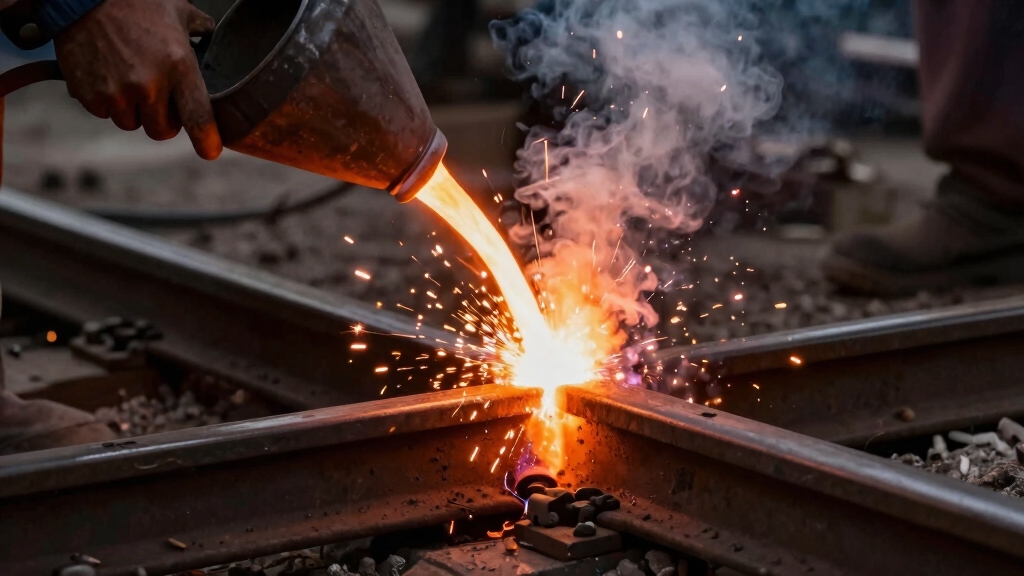
Thermite welding uses a highly exothermic reaction between aluminum powder and iron oxide to produce molten iron at around 4500°F.
This process fuses thick steel parts without external heat or filler metals. You’ll rely on a refractory mold to shape the weld as molten metal flows into the joint, creating a strong, homogeneous bond ideal for heavy-load applications.
This portable process excels in on-site repairs where electricity isn’t available. Explore further to understand the detailed chemistry, equipment, and safety involved.
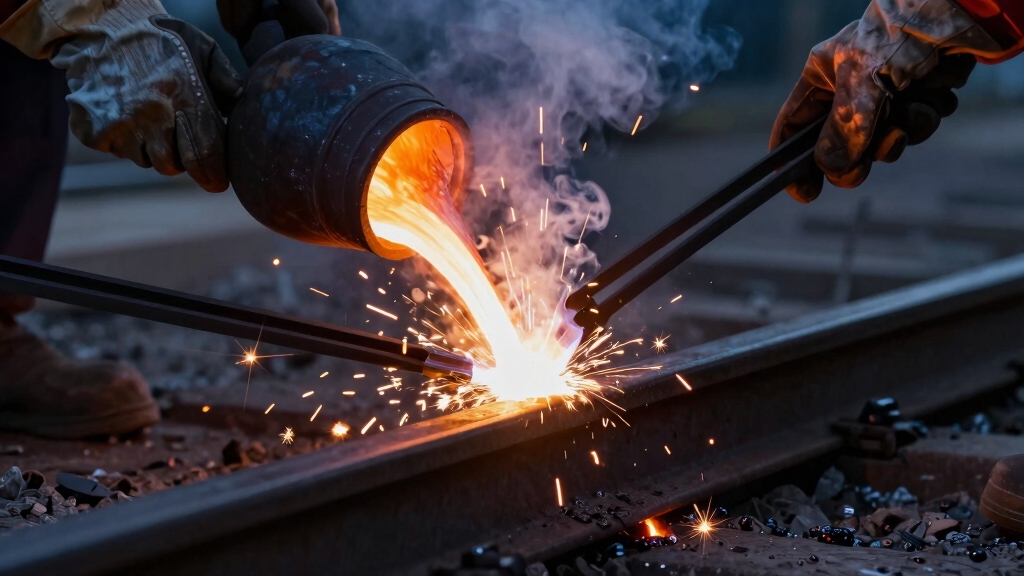
Thermite welding harnesses the intense heat generated by an exothermic chemical reaction to fuse metal components without relying on external heat sources or electrical current.
You initiate this process by mixing aluminum powder with a metal oxide, typically iron oxide, in a precise ratio.
Once ignited, the reaction produces molten iron at temperatures reaching 4500°F (3000°C), which fills a mold surrounding the joint.
As the molten metal solidifies, it forms a robust bond between the workpieces.
You don’t need filler materials or external energy inputs, as the chemical reaction itself provides sufficient heat and molten metal.
This method, developed by Hans Goldschmidt in the 1890s, is especially useful for joining thick steel parts.
It offers a self-contained, high-temperature fusion process that guarantees deep penetration and a strong metallurgical bond.
Precise control of heat input is critical in welding processes to ensure strong fusion and minimize defects, similar to techniques like pulse current control.
Compared to traditional welding methods, this process offers unique advantages that address common challenges in metal joining.
Thermite welding generates intense heat from an exothermic reaction, eliminating the need for external power or filler metals.
This self-sustaining heat source guarantees deep fusion and a strong, homogeneous joint without applying external pressure.
You benefit from a process that’s highly portable, ideal for field applications like rail welding where electricity isn’t accessible.
Additionally, the molten metal produced alloying elements during the reaction, enabling you to tailor steel properties in-situ, enhancing joint integrity.
Because the reaction produces molten metal and slag separately, the weld cleans itself automatically, reducing impurities.
However, unlike traditional welding, thermite welding requires careful workspace setup to ensure safety and effective results.
The intense heat and self-sustaining nature of this welding method stem from a carefully balanced chemical reaction involving specific substances.
You’ll primarily use aluminum powder and a metal oxide, usually iron oxide, combined in a weight ratio of approximately 3:5 (aluminum to iron oxide).
When ignited, aluminum reduces the iron oxide, producing molten iron and aluminum oxide slag.
This exothermic reaction can reach temperatures near 4500°F (3000°C), sufficient to melt the iron, which then fills the joint.
The aluminum oxide slag, being less dense, floats on the molten iron, allowing easy separation.
This precise stoichiometric balance guarantees maximum energy release and efficient conversion to molten metal, making thermite welding both powerful and self-sustaining without external heat or filler materials.
To perform thermite welding, you’ll need some specialized equipment that helps facilitate the exothermic reaction and metal fusion. First off, a crucible is essential. This is where you’ll contain the thermite mixture, so it’s a key piece of the puzzle.
Next, you’ll want to have a mold that’s precisely shaped around the joint you’re working on. It’s important to get this right to ensure a solid weld.
Now, let’s talk about ignition. Reliable ignition devices are a must. You can use materials like magnesium or barium oxide to get that reaction started.
And don’t forget about preheating tools! Gas torches are really handy for preparing the metal surfaces. They help create the ideal conditions for fusion, making your welding process much smoother.
Additionally, maintaining a stable arc length is crucial for consistent heat input and effective fusion during welding.
Gathering the right equipment is essential for successful thermite welding, as each tool plays a specific role in controlling the intense heat and molten metal produced during the process.
You’ll need a crucible to hold the thermite mixture, an igniter to initiate the reaction, and a gas torch to preheat the workpieces.
Additionally, a mold shapes the molten metal as it solidifies, while safety gear protects you from extreme temperatures and sparks.
| Tool | Function | Key Feature |
|---|---|---|
| Crucible | Contains thermite reaction | Heat-resistant alloy |
| Mold | Shapes molten metal | Precise joint fit |
| Igniter | Starts exothermic reaction | Reliable ignition |
Selecting durable, heat-resistant tools guarantees process control and weld integrity. It is also crucial to wear personal protective equipment to prevent injuries from sparks and extreme heat during thermite welding.
Once you have the basic tools like the crucible and mold in place, focus shifts to their proper setup to guarantee controlled containment and shaping of the molten metal.
Position the crucible securely above the mold to assure accurate pouring without spillage.
The mold must be tightly clamped around the joint with precise alignment to maintain the weld gap and prevent leakage.
Use refractory materials to line the mold cavity, enhancing thermal resistance and preserving mold integrity during the exothermic reaction.
Secure the crucible’s nozzle or thimble fits flawlessly within the mold’s pouring channel for smooth metal flow.
Any misalignment or gap can cause defects or incomplete fusion.
A meticulously set crucible and mold are essential to achieve uniform, high-quality welds with consistent mechanical properties.
Preheating the mold and joint area is often necessary to reduce thermal stress and ensure proper fusion during the welding process.
When you set up for thermite welding, choosing the right ignition and preheating devices is critical to guarantee a controlled, reliable reaction.
You’ll typically use a gas torch to preheat the metal parts until they reach an orange glow, assuring proper fusion and preventing thermal shock.
For ignition, you rely on an igniter made of barium peroxide or magnesium, which initiates the thermite reaction by producing sufficient heat to start the exothermic process.
The igniter must be placed precisely on the thermite composition in the crucible to assure consistent ignition.
Proper preheating and ignition device selection minimize incomplete reactions and slag inclusion, leading to a homogeneous weld.
Accurate control here directly impacts weld integrity, strength, and overall process safety.
Using a torch with precise flame control ensures the metal reaches the correct temperature without damage or burn-through.
Alright, let’s dive into how to prepare and align parts for thermite welding. First off, you really want to make sure the parts are squeaky clean. This means getting rid of any rust, oil, or debris that might be lurking around. A clean surface is key for a solid metal fusion.
Now, once everything’s clean, it’s time to align and clamp those components. You’ll want to get them just right to maintain the correct weld gap. This step is super important because if anything shifts during the reaction, it could mess up your weld.
So, remember: proper prep and secure positioning are your best friends here. They make all the difference in achieving a strong, defect-free joint. Additionally, removing contaminants like oils and coatings before welding is crucial to reduce porosity and defects.
Happy welding!
Properly preparing and aligning parts for thermite welding is critical to guarantee a strong, defect-free joint. First, remove all contaminants: rust, scale, oil, paint, and dirt using abrasive brushing or grinding.
Any residual impurities can hinder fusion and cause porosity or inclusions. Next, check the joint surfaces for flatness and ensure they fit tightly with minimal gaps. Excessive gaps lead to incomplete filling or cold shuts.
Clean the surfaces immediately before preheating to prevent oxidation. Use solvents or degreasers if necessary, then dry completely. Avoid handling cleaned surfaces directly with bare hands to prevent recontamination.
This meticulous cleaning and surface prep secures peak chemical bonding during the thermite reaction, maximizing molten metal flow and solidification quality for a durable weld. Maintaining a clean welding area also helps reduce spatter and improve the overall weld quality.
After thoroughly cleaning and preparing the joint surfaces, focus on aligning and clamping the parts to assure exact fit-up.
Precise alignment guarantees the molten metal flows uniformly, producing a defect-free weld. Use appropriate clamps to maintain position throughout the process, preventing movement during preheating and pouring.
Follow these steps:
Proper clamping maintains dimensional stability, critical for achieving the joint’s structural integrity and seamless fusion in thermite welding. Maintaining proper welding parameters during the process is essential to ensure weld quality and strength.
Begin thermite welding by thoroughly cleaning, aligning, and securely clamping the workpieces to guarantee precise joint geometry and consistent weld quality.
Next, fit a refractory mold snugly around the joint, assuring no gaps for molten metal to escape.
Preheat the workpiece ends with a gas torch until they reach an orange glow, improving fusion.
Load the thermite mixture into the crucible and ignite it using an appropriate igniter.
The exothermic reaction generates molten metal, which you’ll direct through a thimble into the mold cavity.
Allow the molten metal to solidify completely, forming a strong, homogeneous joint.
Finally, remove the mold and clean the weld area to inspect the joint integrity and assure slag separation.
Always ensure proper grounding and use of personal protective equipment to minimize the risk of electric shock during welding operations.
When you need to join thick steel components without access to electricity, thermite welding offers a reliable solution.
Its exothermic reaction produces molten metal capable of fusing heavy parts with exceptional strength.
You’ll find thermite welding indispensable in these key applications:
These applications benefit from thermite welding’s high-temperature fusion and portability.
This allows you to perform robust, on-site repairs or installations without relying on external power or filler materials.
Thermite welding’s ability to produce intense heat and molten metal on-site brings inherent risks that require strict safety protocols.
You must wear heat-resistant gloves, a welding helmet with appropriate shading, and flame-retardant clothing to protect against molten metal splatter and radiant heat.
Always make certain the work area is clear of flammable materials and maintain proper ventilation to avoid inhaling fumes.
Use insulated tools and maintain a safe distance during ignition and pouring phases.
Preheat parts carefully to prevent thermal shock and cracking.
Secure molds firmly to avoid leaks of molten metal.
Keep a fire extinguisher and first aid kit nearby for emergencies.
Adhering to these measures minimizes hazards and guarantees precise, controlled thermite welds.
A typical thermite weld takes about 30 to 60 minutes to cool and set sufficiently for handling.
However, achieving full mechanical strength requires several hours to cool completely to ambient temperature.
You should monitor cooling carefully to avoid thermal stresses or cracking.
Cooling time varies with weld size, ambient conditions, and mold design, so you’ll want to adjust your process accordingly to guarantee peak joint integrity and performance.
Sure, you can try thermite welding on non-ferrous metals if you enjoy watching molten aluminum and iron oxide have a party that doesn’t invite your metal of choice.
Thermite welding primarily fuses ferrous metals like steel, producing molten iron. Non-ferrous metals often lack compatible oxides for this reaction, making thermite ineffective.
You’ll need specialized processes for copper or aluminum. So, don’t force it; thermite’s party favors are strictly ferrous-only.
You need to control moisture, temperature, and wind during thermite welding to guarantee quality.
Moisture can cause steam pockets or weaken the weld, so dry conditions are essential.
Low temperatures slow preheating and solidification, risking defects.
Excessive heat may affect mold integrity.
Strong wind can cool the molten metal too quickly or disperse sparks, compromising fusion.
Maintaining stable, dry, and moderate environmental conditions optimizes weld strength and consistency.
You control molten metal temperature in thermite welding primarily through the precise ratio of aluminum powder to metal oxide. This ensures an ideal exothermic reaction.
Preheating the workpieces with a torch stabilizes temperature and prevents heat loss. Additionally, using quality thermit materials and proper crucible design helps maintain consistent heat generation.
Since the reaction is self-sustaining, careful preparation and controlled ignition are vital for achieving the desired molten metal temperature.
About 10% of thermite welds face defects unique to the process, like incomplete fusion or slag entrapment.
You’ll often see porosity caused by trapped gases or unmelted aluminum oxide slag remaining in the joint, weakening it.
Misalignment during mold setup can create cold shuts or cracks.
To avoid these, you must guarantee precise preheating, correct thermite mixture, and proper mold sealing.
This ensures weld integrity and strength consistently.
Thermite welding offers you a robust alternative to traditional methods, delivering strong, seamless joints with minimal equipment.
By harnessing the controlled chemical symphony of aluminum and metal oxides, you can achieve precision and efficiency in challenging environments.
While the process demands respect for safety protocols, its unique advantages make it a valuable skill.
Embracing thermite welding means stepping into a world where chemical reactions quietly but powerfully forge lasting connections.