Phone:
(701)814-6992
Physical address:
6296 Donnelly Plaza
Ratkeville, Bahamas.

Phone:
(701)814-6992
Physical address:
6296 Donnelly Plaza
Ratkeville, Bahamas.

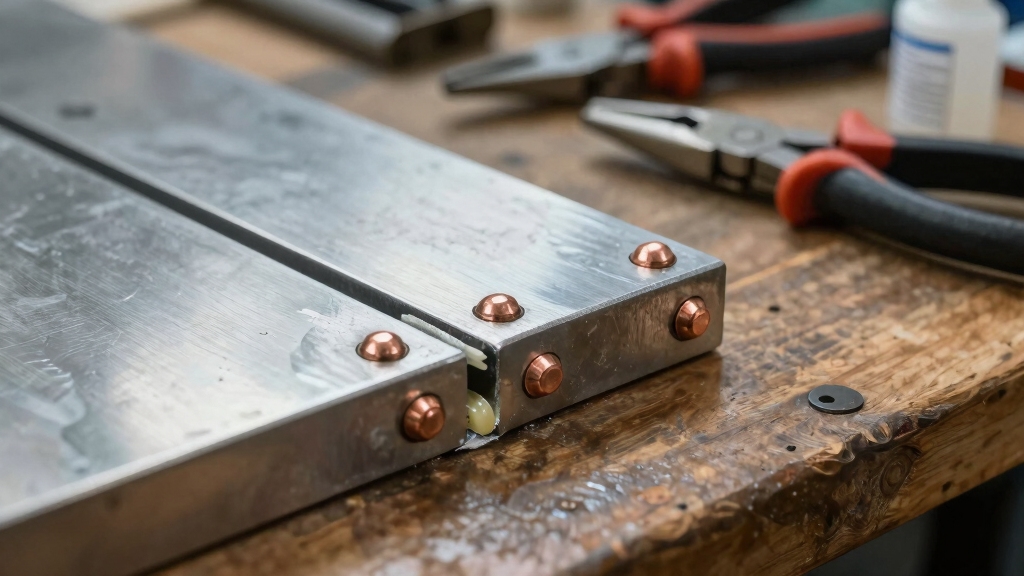
You can bond metal to metal without welding by choosing methods based on your strength, permanence, and temperature needs.
Epoxy adhesives offer strong bonds for lightweight parts but often degrade in high heat.
Mechanical fasteners like rivets, bolts, or self-clinching fasteners provide immediate, load-bearing joints with easy disassembly.
For heavy loads or heat exposure, brazing forms durable, corrosion-resistant joints without melting base metals.
Proper surface prep is key to lasting bonds. Explore these options further to match your application requirements precisely.
When selecting a metal bonding method without welding, you need to take into account the application’s mechanical stress, environmental conditions, and permanence requirements.
Choosing a metal bonding method requires considering mechanical stress, environment, and how permanent the joint must be.
For lightweight, non-structural parts exposed to minimal heat, adhesives like epoxy offer a quick, cost-effective solution.
If you need mechanical strength and occasional disassembly, bolting or riveting provides robust, reliable connections.
For heat-resistant, permanent joints without welding equipment, brazing is suitable, especially in pipe or dissimilar metal applications.
Self-clinching fasteners deliver fast installation with minimal prep and reversibility, ideal for sheet metal assemblies.
When high retention on shafts is required, retaining compounds like anaerobic adhesives replace welds efficiently.
For applications requiring high-pressure and leak-proof connections that are also reusable, flanged joints offer an effective non-welded alternative.
Sure thing! Here’s a more conversational version of your text:
First off, you’ll want to mix the two epoxy components really well. This step is super important because it ensures that the epoxy cures and adheres properly.
Now, keep in mind that epoxy is best suited for lightweight, non-structural metal applications. But don’t worry—there are specific formulations out there that can handle higher heat if you need them.
Also, make sure you apply the right epoxy for your project. And don’t skip on prepping those metal surfaces! Taking the time to do this right will really boost the bond strength and durability of your work.
For the best results, clean and roughen the metal surface thoroughly before applying epoxy to create a strong mechanical bond.
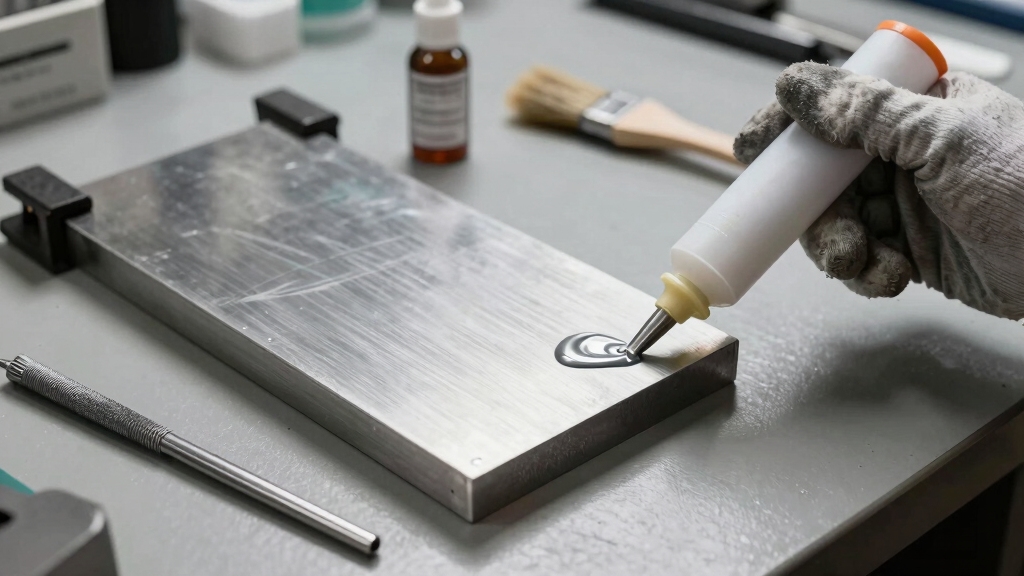
Begin by thoroughly cleaning and degreasing the metal surfaces to guarantee peak adhesion. Mix the two epoxy components in exact ratios specified by the manufacturer, usually 1:1 by volume or weight.
Use a disposable surface to blend components evenly until you achieve a uniform color and consistency. Apply the epoxy promptly to avoid premature curing, spreading it thinly and evenly across both surfaces to maximize contact.
Clamp or secure the pieces together during curing to prevent movement and assure consistent bond strength. It is important to roughen surfaces before applying epoxy to improve mechanical interlocking and enhance bond durability.
| Step | Action | Tip |
|---|---|---|
| Surface prep | Clean & degrease | Use isopropyl alcohol |
| Mixing ratio | Combine parts accurately | Use scale or syringe |
| Application | Spread thinly | Avoid air bubbles |
| Curing | Clamp pieces | Follow temperature/time specs |
After preparing and applying epoxy adhesives correctly, selecting the appropriate metal type markedly impacts bond performance.
Epoxy works best on clean, smooth surfaces like aluminum, stainless steel, and mild steel, where it can form strong chemical bonds.
Avoid using epoxy on metals exposed to continuous high heat, as most formulations degrade under such conditions.
For lightweight, non-structural parts, epoxy provides sufficient shear and tensile strength, particularly in automotive panel applications where thin metals are involved.
You’ll find epoxy ideal for bonding sheet metals, small brackets, and decorative components that don’t carry heavy loads.
Make certain surfaces are free of oils, rust, and contaminants to maximize adhesion.
For critical or load-bearing joints, consider alternatives, but epoxy remains a cost-effective, accessible solution for many metal bonding tasks.
Proper surface preparation is essential as oxide films on metals like aluminum can affect adhesive bonding and must be preserved or managed carefully.
Selecting epoxy adhesives with specific heat resistance capabilities is essential when bonding metals exposed to elevated temperatures. Standard epoxies suffice for lightweight, non-structural applications but degrade quickly under heat stress.
You should opt for high-temperature epoxies formulated to withstand continuous exposure above 150°C (300°F) without losing adhesion or mechanical strength. When applying, make certain surfaces are clean and properly prepared to maximize bond integrity.
Consider the thermal expansion coefficients of both metals and adhesive to prevent stress-induced failure during temperature cycling. Although epoxy adhesives offer convenience and quick curing, their heat resistance limits their use in heavy-load or prolonged high-temperature environments.
In such cases, alternative bonding methods like brazing might be more appropriate. Always check manufacturer specifications for maximum operating temperatures before selecting your epoxy. Note that some epoxies, like JB Weld, can withstand temperatures up to 500°F (260°C) but may degrade under prolonged extreme heat, making understanding heat resistance properties critical for long-term performance.
Riveting and bolting create strong metal joints by mechanically fastening components together. This distributes load evenly across the connection.
When you use rivets or bolts, you guarantee the joint withstands shear and tensile stresses better than adhesives.
Riveting requires precise hole alignment and drilling. However, pop rivets simplify installation with minimal tools.
Bolting offers the advantage of disassembly, allowing maintenance or part replacement without damage.
Key benefits include:
Proper flange support during installation is essential to prevent common failures like spin-out and to maintain joint strength.
While riveting and bolting rely on mechanical fastening to create durable joints, brazing offers a metallurgical approach that forms a strong, permanent bond between metals without melting the base materials.
Brazing creates strong, permanent metal bonds without melting the base materials, unlike mechanical fastening methods.
You’ll use a flame torch to heat the joint area while applying a filler metal with a lower melting point than the base metals.
Flux is essential to prevent oxidation and guarantee proper flow of the filler metal into the joint.
Brazing achieves a solid, corrosion-resistant connection ideal for pipe fittings and heat-resistant applications where adhesives fall short.
Unlike welding, brazing requires less specialized equipment and avoids base metal distortion, making it cost-effective and efficient.
Proper temperature control and joint cleanliness are critical to guarantee maximum joint strength and longevity.
For applications requiring corrosion resistance in welded joints, weld-through primer can be used to protect metal surfaces prior to welding.
You’ll really appreciate how self-clinching fasteners save time. They install at speeds that can rival welding, but the best part? They need minimal surface prep.
And here’s another cool feature: their reversible design lets you disassemble joints without causing any damage. That kind of flexibility is something traditional welding just can’t offer.
Plus, these fasteners boost product performance too. They create consistent, strong connections that ultimately improve overall quality. It’s a win-win!
Additionally, unlike welding, self-clinching fasteners do not require electrical circuit completion or complex setup, making them more accessible for various applications.
When installing metal joints, self-clinching fasteners offer a significant advantage by eliminating surface preparation and cure time. This enables you to achieve strong, reliable connections almost as quickly as welding.
This efficiency is critical in high-volume production or repair settings where time constraints and consistency matter. You’ll find that these fasteners embed securely into sheet metal, creating permanent, load-bearing joints without the need for heat or adhesives.
Key fast installation benefits include:
Additionally, using proper protective gear such as heat-resistant gloves when handling metal components ensures safety without sacrificing efficiency.
Because self-clinching fasteners can be removed and reinstalled without damaging the metal components, they provide a reversible joining method that enhances both the strength and serviceability of metal joints.
You’ll find these fasteners require minimal surface preparation and no cure time, allowing installation speeds comparable to welding.
Their design embeds securely into sheet metal, offering load-bearing capacity superior to typical weld nuts in spot or tack weld scenarios.
By enabling easy disassembly, self-clinching fasteners facilitate maintenance, repair, and part replacement without compromising joint integrity.
This reversibility also reduces lifecycle costs and downtime.
When you need a robust yet serviceable metal joint, self-clinching fasteners deliver a precise, efficient alternative to permanent welding, balancing mechanical strength with operational flexibility.
Unlike welding, which provides permanent metal bonds through heat or pressure, self-clinching fasteners offer mechanical assembly options that do not require fusion.
Self-clinching fasteners enhance metal joints by embedding securely into sheet metal. This increases load-bearing capacity and resists loosening under stress.
You’ll find these fasteners improve product durability and assembly efficiency without welding’s complexity.
They require minimal surface prep and no cure time, speeding up production while maintaining strength.
Key benefits include:
Installation speed comparable to welding, reducing labor costs.
Strong mechanical interlock that withstands vibration and torque.
Easy reversibility, allowing disassembly without damage.
Although super glue mixtures aren’t designed for heavy-duty metal bonding, they offer a practical solution for quick repairs when you lack welding equipment.
By mixing metal electrodes with super glue, you create a compound that adheres rapidly and reliably to metal surfaces.
This method suits non-structural parts where load-bearing is minimal. The mixture cures quickly, providing immediate adhesion without complex preparation or heat application.
You’ll find this technique efficient for temporary fixes or small component attachments. However, its bond strength remains limited compared to mechanical fasteners or welding.
It’s critical to make certain surfaces are clean and aligned precisely, as the quick cure leaves little room for repositioning.
While super glue mixtures offer quick fixes for lightweight parts, they fall short when it comes to securing components subjected to rotational forces or heavy loads.
Retaining compounds, such as LOCTITE 648, provide a robust alternative by chemically bonding metal shafts and gears without welding. Their anaerobic formula cures only in the absence of air, guaranteeing a strong, uniform bond inside press-fit assemblies.
You benefit from:
Using retaining compounds guarantees durable, reliable shaft bonding where mechanical loads and rotational forces exceed the capabilities of simple adhesives. This offers an industrial-grade solution without heat or welding equipment.
When deciding between mechanical fastening and adhesive bonding for metal joining, you need to evaluate the load requirements and environmental conditions of your application.
Mechanical fasteners like rivets, bolts, and self-clinching nuts provide superior strength, especially under shear and tensile loads. They tolerate vibration and impact better than most adhesives.
They also allow disassembly and maintenance, which adhesives do not. Adhesive bonding, such as with epoxy or retaining compounds, offers uniform stress distribution and can bond complex shapes without holes, preserving material integrity.
However, adhesives typically perform well under static or lightweight loads. They may degrade under high heat or harsh environments unless specialized formulations are used.
Ultimately, mechanical fastening is stronger and more reliable for heavy-duty or dynamic applications. Adhesives suit lighter, precise, or sealed joints where mechanical fasteners are impractical.
Achieving a strong bond between metal surfaces starts with meticulous preparation to eliminate contaminants, oxidation, and surface irregularities that compromise adhesion or mechanical fastening.
First, thoroughly clean the surfaces using solvents like acetone or isopropyl alcohol to remove oils and dirt. Next, mechanically abrade the metal with fine-grit sandpaper or a wire brush to increase surface roughness, enhancing adhesive grip or fastener hold.
Finally, degrease and dry the surfaces completely before bonding.
Avoid these common mistakes:
Skipping surface abrasion leads to weak adhesive contact.
Using contaminated tools or hands reintroduces oils.
Bonding in humid or dusty environments impairs curing.
Following these steps guarantees peak bonding strength and durability without welding.
Yes, many metal bonding methods can withstand outdoor weather conditions if you choose the right one.
Epoxy adhesives designed for high temperatures resist moisture and UV exposure.
Brazing offers excellent corrosion resistance due to its flux protection.
Mechanical fasteners like riveting and bolting handle environmental stresses well, especially with corrosion-resistant coatings.
Retaining compounds like LOCTITE 648 also maintain strong bonds outdoors by curing anaerobically and resisting air and moisture intrusion.
You should always wear heat-resistant gloves and eye protection when brazing, since temperatures can exceed 1,000°F, posing serious burn and eye injury risks.
Make certain proper ventilation to avoid inhaling toxic fumes from flux and molten metal.
When using adhesives, avoid skin contact by wearing gloves and work in a well-ventilated area to prevent inhaling harmful vapors.
Follow manufacturer guidelines strictly and keep fire extinguishers nearby during brazing operations.
Temperature changes cause metal joints to expand and contract, stressing bonded interfaces.
You’ll find adhesives may lose strength or degrade if exposed to heat beyond their limits, leading to joint failure.
Mechanical bonds like riveting handle thermal cycling better but can loosen over time.
Brazed or retaining compound joints generally tolerate temperature fluctuations well but require proper flux or anaerobic conditions to prevent corrosion and maintain bond integrity under thermal stress.
You’ll find that metals like certain aluminum alloys and stainless steel can be challenging to bond without welding due to their oxide layers and low surface energy.
These surfaces often require specialized preparation or adhesives formulated for their chemistry.
Additionally, metals exposed to extreme heat or stress, such as titanium, may not bond reliably without welding.
You’ll need to choose bonding methods carefully, considering metal type, surface treatment, and application requirements for effective adhesion.
You’ll need a drill for riveting and bolting, along with rivets or bolts and nuts.
A flame torch and flux are necessary for brazing.
For adhesive bonding, use epoxy or super glue with mixing tools.
Self-clinching fasteners require a press or hammer.
Retaining compounds like LOCTITE 648 are essential for press-fit assemblies.
Each tool matches its method’s demands, ensuring precise alignment, secure attachment, and proper curing or setting to create strong, reliable metal bonds without welding.
You’ve learned that bonding metal without welding offers versatile options like epoxy adhesives, riveting, brazing, and self-clinching fasteners.
Particularly, adhesive bonding can achieve up to 90% of the metal’s base strength when properly applied, underscoring its effectiveness.
By preparing surfaces meticulously and choosing the right method, you’ll guarantee durable, high-strength joints.
Remember, understanding each technique’s strengths helps you optimize metal bonding for your specific project requirements.