Phone:
(701)814-6992
Physical address:
6296 Donnelly Plaza
Ratkeville, Bahamas.

Phone:
(701)814-6992
Physical address:
6296 Donnelly Plaza
Ratkeville, Bahamas.

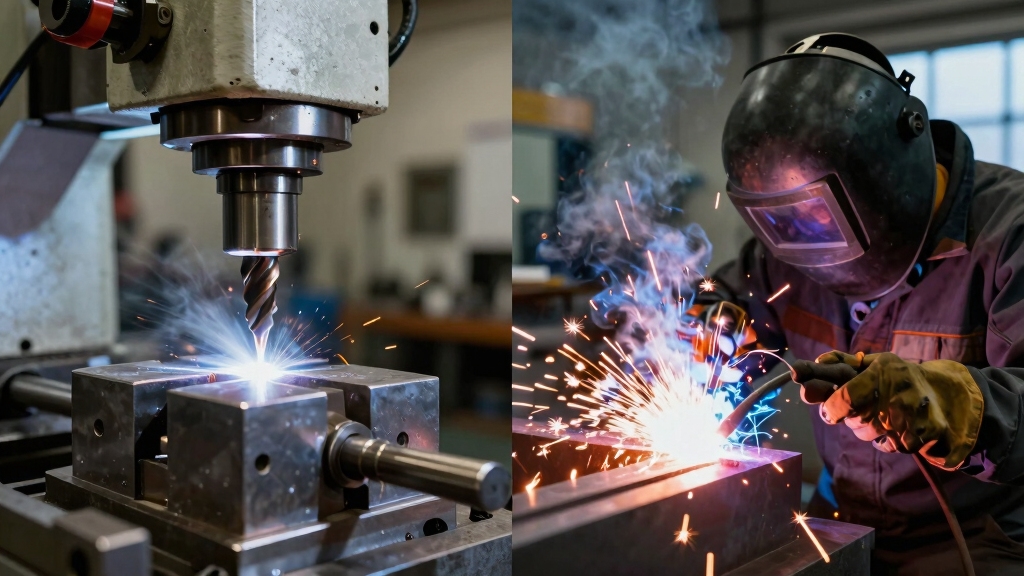
You’ll find milling shapes metal by precisely removing material with tools like face and slot mills. This process delivers tight tolerances and minimal heat impact.
Welding, on the other hand, joins metals by adding material to form strong, permanent bonds. This method is ideal for structural integrity but is prone to heat distortion and localized stress.
Your choice hinges on prioritizing dimensional precision or durable connections. Explore further to understand how these methods differ in technique, cost, and application.
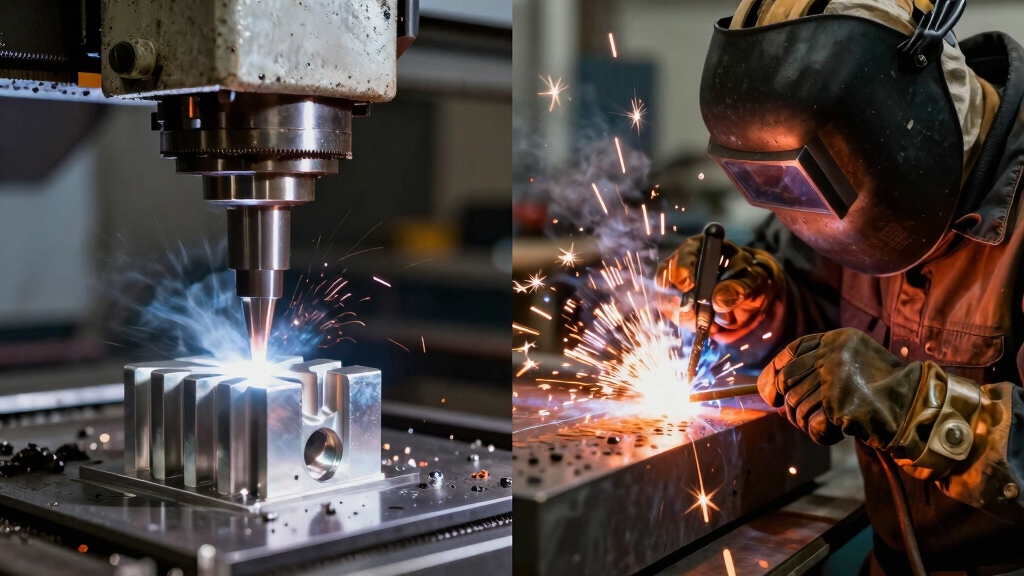
Although both milling and welding are fundamental metalworking processes, they serve distinctly different purposes: milling shapes components by removing material subtractively, while welding joins metals by adding material to create permanent bonds.
When you mill, you precisely cut, contour, or groove metal surfaces using tools like face, peripheral, or slot mills. This subtractive approach lets you achieve intricate shapes and tight tolerances without heat distortion.
Welding, on the other hand, uses methods such as MIG, TIG, or friction welding to fuse metals, focusing on structural integrity rather than shaping. You’ll notice milling excels in detailed form generation, whereas welding excels in creating permanent joints.
Both processes often integrate into fabrication workflows, complementing each other by addressing shaping and assembly needs separately but effectively.
Welding acts as the crucial connection within fabrication that brings components together into one solid structure by forming permanent, load-bearing joints through melting base metals with precise heat and pressure application, making it indispensable in metal assembly fabrication workflow.
When you compare milling and welding in terms of precision, milling clearly stands out for its ability to achieve high accuracy and intricate detail. Milling removes material subtractively, allowing you to control dimensions within tight tolerances using advanced software and CNC machines.
Welding, by contrast, adds material and is prone to distortions from heat, making fine precision more challenging. While welding guarantees strong structural bonds, achieving exact dimensions demands more setup and skilled technique.
| Aspect | Milling |
|---|---|
| Accuracy | High, with tight tolerances |
| Detail | Intricate shapes and contours |
| Heat Impact | Minimal, no warping |
| Setup Complexity | Automated, less operator-dependent |
Milling offers superior dimensional control compared to welding’s heat-affected zone variability.
When it comes to milling, there are several techniques to consider. Face, peripheral, slot, and profile milling are all excellent at shaping components with precise contours and grooves.
Each method has its own strengths, making it easier to achieve the exact specifications you need for your project.
On the welding side, methods like MIG, TIG, gas, and friction welding really shine when it comes to creating strong, permanent joints. These techniques cater to different types of metals and varying thicknesses, so you can find the right fit for whatever you’re working on.
Butt welds, known for their full penetration and strength, are often preferred in applications requiring durable, leak-proof joints.
Mastering key milling techniques lets you achieve precise material removal and complex shapes essential in fabrication.
You’ll rely on face milling to efficiently remove material from broad surfaces, optimizing flatness and finish.
Peripheral milling enables you to cut edges with accuracy, crafting precise contours critical for component fit.
Slot milling lets you create grooves essential for assembly or mechanical interlocks, while profile milling handles intricate designs requiring complex tool paths.
Additionally, milling uniquely prepares J-grooves, which are indispensable for certain welding joints.
These techniques leverage controlled tool movements and speeds to maintain tight tolerances, minimize tool wear, and reduce material waste.
While milling focuses on shaping components through precise material removal, welding secures parts by adding material to form permanent bonds.
You’ll encounter several common welding methods, each suited for specific applications.
Gas welding utilizes a controlled flame, ideal for thin metals but slower and less precise.
MIG welding feeds wire continuously, providing fast, strong bonds on steel and aluminum, perfect for production environments.
TIG welding offers superior precision and control, especially with thin or stainless steel, though it demands skill and time.
Friction welding joins metals through vibration and rotation without heat, producing clean, strong welds without filler.
Understanding these methods helps you select the best approach based on material type, joint complexity, and production speed, distinguishing welding’s additive nature from milling’s subtractive accuracy.
Among these, MIG welding is noted for its ease of learning and high productivity in controlled environments.
Because milling and welding serve fundamentally different purposes, their technique-specific applications vary widely depending on project requirements.
When you mill, you remove material subtractively to create precise shapes, contours, or slots. Face milling is ideal for broad surface removal, while profile milling handles intricate designs.
Slot milling guarantees accurate groove cuts essential for assembly.
Conversely, welding adds material to form permanent joints. MIG welding suits fast bonding on steel and aluminum. TIG welding provides high accuracy on thin metals, and friction welding joins without heat distortion.
Your choice depends on whether you prioritize dimensional precision or structural integrity. Often, you’ll combine milling’s exact shaping with welding’s bonding strength in fabrication workflows to assure performance, efficiency, and material use. The weld bead plays a critical role in ensuring joint strength and durability in welded structures.
Milling offers unparalleled versatility in metal fabrication by enabling precise shaping, drilling, and tapping across a wide range of component sizes.
You can efficiently execute face, peripheral, slot, and profile milling, achieving complex geometries and tight tolerances unachievable by manual methods.
Milling reduces material waste by subtractive removal with controlled depth and tool paths, maximizing component durability.
It supports mass production with automated software, minimizing human variability and speeding minor beveling tasks when milling equipment is already in use.
Unlike welding, milling avoids heat distortion, preserving dimensional accuracy and surface finish integrity.
Additionally, milling facilitates specialized preparations like J-grooves, enhancing assembly precision.
For applications requiring joining, inverter welding machines offer precise arc control that complements milling by providing stable and high-quality welds.
Milling can be a great way to save on costs, thanks to its focus on material conservation and automation.
On the other hand, welding really shines when it comes to creating strong, permanent joints, plus it usually requires less setup time on-site.
Now, think about portability for a moment. Welding equipment is generally more mobile, which can really help with your workflow.
In contrast, milling machines often need a fixed setup, which can limit where you can work.
Additionally, ensuring proper ground clamp connection during welding is essential for stable current flow and operator safety.
When evaluating cost efficiency, you must consider both the upfront expenses and long-term benefits each process offers.
Milling involves higher initial costs due to sophisticated machinery and software requirements. However, its precision reduces material waste and rework, making it cost-effective for complex or high-volume production.
Welding, by contrast, demands less capital investment in equipment and offers portability, lowering setup costs for onsite tasks. Yet, it incurs ongoing expenses from consumables, energy, and health safety measures.
Welding’s permanent bonds minimize future repairs, saving time, especially with narrow J-groove designs that reduce filler material.
Ultimately, you’ll find milling excels when precision and repeatability dominate. Welding provides cost advantages in flexible, onsite, or structural applications where setup speed and joint permanence matter most.
Proper welding settings can also enhance efficiency by reducing defects and rework costs.
Although both milling and welding contribute to component durability, their impacts on longevity differ markedly based on application and environmental conditions.
Milling enhances longevity by producing precisely shaped components with minimal residual stress and no heat-induced warping, which reduces fatigue risk over time.
Its subtractive nature ensures uniform material properties, essential in high-wear scenarios.
Welding, on the other hand, forms permanent joints that maintain structural integrity under dynamic loads but may introduce localized stress concentrations and heat-affected zones prone to corrosion or cracking if improperly executed.
You’ll find welding ideal for assemblies requiring robust bonding, especially when combined with protective treatments.
Ultimately, selecting between milling and welding for durability hinges on balancing precise material preservation against joint strength needs, considering factors like load type, exposure, and maintenance capabilities.
Applying post-weld heat treatments can significantly improve the toughness and durability of welded joints, mitigating risks associated with the heat-affected zone.
In evaluating portability and setup, welding equipment offers significant advantages for on-site applications due to its compact, transportable nature. This allows you to perform permanent joins directly at the fabrication location.
Milling machines, often larger and requiring stable setups, are less suited for field operations and typically remain in workshops. When considering setup and portability, keep these points in mind:
Therefore, if your project requires mobility and rapid assembly, welding offers cost-effective, practical benefits. Milling excels in controlled environments where precision outweighs portability. Modern welding rigs often incorporate inverter technology for enhanced energy efficiency and precise arc control, further improving their suitability for varied job sites.
Since your project demands specific structural features and tolerances, choosing between milling and welding hinges on the desired outcome and functional requirements.
If you need precise shapes, tight tolerances, and complex contours, milling is the best choice due to its subtractive accuracy and advanced automation.
Conversely, if your priority is permanent metal joining with strong structural integrity, welding offers superior additive bonding, especially for assembly and repair tasks.
Consider material thickness and geometry: welding excels in thick, load-bearing joints, while milling handles intricate surface details and narrow J-groove preparations.
Also, factor in setup time and portability. Welding suits onsite work with portable equipment, whereas milling often requires fixed setups.
Ultimately, your decision should align with project specifications, balancing precision, strength, and operational constraints.
For thicker plates, selecting the appropriate welding process is essential to ensure full penetration and minimize distortion.
Yes, you can safely automate milling and welding together in one workflow by integrating precise CNC milling with robotic welding systems.
You’ll need synchronized controls to handle material removal and additive joining without collision. Proper fixture design and real-time monitoring guarantee alignment and quality.
Automation reduces human error, improves repeatability, and optimizes cycle times. However, you must address distinct safety protocols for milling’s moving parts and welding’s heat and fumes.
You’ll find milling generates metal chips and consumes significant energy, contributing to waste and carbon emissions.
However, it avoids harmful fumes since it’s a subtractive process.
Welding, on the other hand, emits fumes, gases, and radiation, impacting air quality and worker safety.
It also consumes high energy and requires ventilation.
Managing waste and emissions in both processes is vital to minimize environmental footprints, especially in continuous or large-scale operations.
You’ll find milling mainly influences alloys by inducing work hardening and residual stresses due to mechanical cutting.
It preserves the original microstructure since it’s subtractive.
Welding, however, alters metallurgical properties markedly.
Heat input causes grain growth, phase transformations, and potential sensitization or embrittlement in heat-affected zones.
You must consider these changes carefully in design.
Welding modifies hardness and ductility, while milling maintains baseline alloy characteristics with minimal thermal impact.
You’ll need distinct safety gear for each.
Milling demands sturdy gloves, safety goggles, and hearing protection against flying chips and loud noise.
A dust mask or respirator guards against metal dust.
Welding requires a welding helmet with a proper filter lens to protect your eyes from intense UV radiation and sparks.
You’ll also need flame-resistant gloves and protective clothing to prevent burns.
Both processes require ventilated workspaces, but welding’s fume hazards necessitate specialized respirators.
Your skill level directly impacts milling and welding quality.
In milling, precise tool control and programming knowledge guarantee accurate cuts and tight tolerances. This reduces material waste.
In welding, expertise affects joint strength and defect prevention. You must control heat input and filler application carefully.
Skilled operators optimize setup and adapt to material variations, improving efficiency and structural integrity.
Without adequate skill, both processes risk errors, rework, and compromised component performance.
When deciding between milling and welding, you’ll weigh precision against fusion, shaping against joining, and cost against durability.
Milling offers controlled material removal with high accuracy, while welding provides strong, permanent bonds. You’ll choose milling for intricate, precise fabrication and welding for robust assembly and repair.
By understanding their distinct techniques and applications, you’ll make informed decisions that optimize your metalworking process, balancing efficiency, quality, and cost effectively.